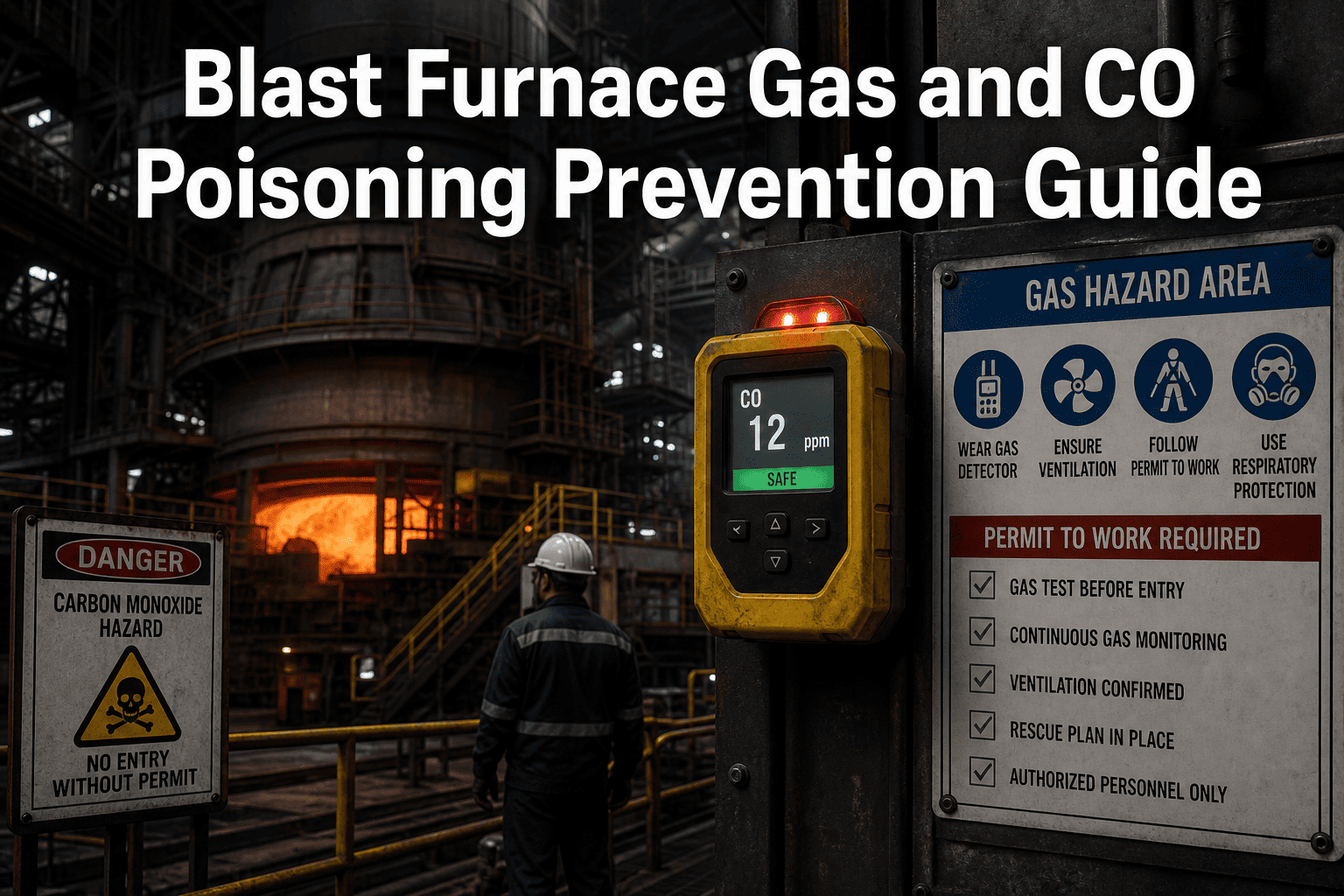
Blast furnace gas (BF gas) contains 20–28% carbon monoxide by volume — a concentration that causes rapid incapacitation and death with minimal exposure. CO is colorless and odorless, offering no sensory warning before neurological symptoms begin. At concentrations above 1,200 ppm, loss of consciousness can occur within minutes. In integrated steel plants, BF gas is present not just around the blast furnace itself but throughout the gas cleaning, distribution, and stove firing systems — covering hundreds of meters of pipework, valves, and equipment where leaks are difficult to detect without continuous monitoring. This checklist covers gas detection infrastructure, permit-to-work controls, emergency response protocols, and the CMMS inspection schedules that keep CO exposure events from becoming fatalities. Track gas safety inspections in Oxmaint or book a walkthrough with our compliance team.
Exposure Limits Reference
25 ppm
ACGIH TLV-TWA
8-hour time-weighted average limit. Continuous work permitted. Enhanced monitoring required.
50 ppm
OSHA PEL (8-hr TWA)
Work may continue only with gas mask equipped. No entry without respiratory protection above this level.
200 ppm
NIOSH STEL (Ceiling)
Short-term exposure limit. Immediate area evacuation. Work suspended. Source investigation mandatory.
1,200 ppm
IDLH — Immediately Dangerous
Immediately dangerous to life and health. Emergency response only with SCBA. No entry without full breathing apparatus.
Gas Hazard Zones
Blast Furnace Cast House
Highest Risk
BF gas escapes during tapping, tuyere failures, and inadequate sealing. CO concentrations can spike rapidly. Continuous fixed detector network mandatory. Minimum 4 detectors per cast house.
Gas Cleaning Plant (GCP)
Highest Risk
Dustcatcher, venturi scrubber, and electrostatic precipitator areas handle full-concentration BF gas. All access requires gas permit and personal CO monitor. Confined space rules apply inside vessels.
Hot Blast Stoves
High Risk
BF gas burned in stoves for air heating. Combustion control failures or valve leaks can introduce unburned gas into working areas. Detector placement required at stove valve levels and control floors.
BF Gas Distribution Pipework
High Risk
Flanges, valve packings, and expansion joints are chronic leak points. Any maintenance on charged pipework requires gas permit. Detectors at all valve stations and branching points.
Top Gas Recovery Area
Medium-High Risk
Furnace top pressure and gas recovery systems. CO escapes during pressure relief and sampling operations. Personal monitors mandatory for all workers on the furnace top.
BOF / EAF Off-Gas Systems
Medium-High Risk
EAF decarburization generates CO that can overwhelm ventilation. BOF converter hoods and off-gas ducting require monitoring. CO explosion risk during EAF operations specifically documented by OSHA.
Prevention Checklist
1
Fixed Gas Detection Infrastructure
Fixed CO detectors installed at all BF gas hazard zones — sensor height accounts for gas density (CO is slightly lighter than air)
Detectors connected to central alarm panel — audible and visual alarms at alarm thresholds (50 ppm warning, 200 ppm evacuation)
Alarm panel tested monthly — response time and threshold accuracy verified and logged in CMMS as recurring inspection work order
Online monitoring system performance checked once per month per BF gas area — records maintained per industry standard
Hydrogen-resistant CO sensors specified where Flash Ironmaking Technology or H2 co-injection is in use — standard electrochemical sensors cross-react with H2
2
Personal Gas Monitor Program
Personal CO monitors issued and worn by every worker entering BF gas hazard zones — no exceptions
Monitors bump-tested daily before use — failed bump test removes monitor from service immediately
Full calibration of personal monitors every 6 months — calibration records stored in CMMS linked to individual device asset records
Monitors set to alarm at 35 ppm (warning) and 50 ppm (evacuate) — factory-default settings verified and locked
Workers trained to respond immediately to alarm — no assumption of false alarm without source investigation
3
Work Permit Controls for Gas Areas
Gas entry permit required for all work in areas where BF gas may be present — no walk-in access for any task
Pre-entry atmospheric test mandatory — CO reading below 50 ppm before entry authorized; result logged on permit
Non-sparking tools or grease-coated tools used exclusively on charged BF gas pipelines — steel-on-steel spark ignition documented as explosion cause
Minimum two-person entry rule enforced in gas permit areas — no single worker entry under any circumstance
Gas mask and SCBA availability confirmed at work area before permit activated — equipment location recorded on permit form
Permit duration set conservatively — re-entry after atmospheric change requires re-test and new permit authorization
4
Gas Pipework and Equipment Inspection
BF gas pipework flanges, valve packings, and expansion joints inspected for leaks quarterly using portable CO detector — findings trigger corrective work order same day
Valve seals and isolation blanks inspected before any gas system maintenance — no reliance on upstream isolation alone
BF gas seal pots water level checked daily — seal failure allows uncontrolled gas escape into atmosphere
Hot blast stove burner management system tested at each stove regeneration cycle — combustion control failures are the primary stove-area CO source
All gas system maintenance documented in CMMS with pre-work atmospheric test result, findings, and corrective actions — full audit trail per inspection
5
Emergency Response Readiness
Escape routes posted and lit in all BF gas areas — routes verified clear and unobstructed monthly
SCBA sets stored at gas area entry points — cylinder pressure and mask seal tested monthly; record in CMMS
CO poisoning first aid (pure oxygen administration) equipment available within 2 minutes of any gas hazard zone
Emergency response drill for CO event conducted annually — drill debrief findings documented and corrective actions tracked in CMMS
Medical protocol for CO-exposed worker clearly posted — symptoms (headache, dizziness, nausea) constitute medical emergency; immediate oxygen administration; no return to work same shift
Schedule Every Gas Safety Inspection Automatically
Oxmaint's Compliance Tracking module schedules fixed detector monthly tests, personal monitor calibrations, and pipework leak inspections automatically — generating immutable audit records for every BF gas area safety check linked to asset records.
Expert Review
"The most dangerous BF gas incidents I have investigated did not involve a broken pipe or catastrophic failure. They involved a flange that had been weeping slightly for weeks, a worker who felt slightly unwell and attributed it to the heat, and a gas area where the fixed detector had been in alarm so frequently it was being ignored. False alarm fatigue is as dangerous as no alarm at all — detector reliability must be maintained religiously."
Industrial Hygienist
Steel Industry Gas Safety Consultant — 15 years BF gas hazard management
"Monthly detector function checks sound like a basic requirement. In practice, we found that 30% of fixed detectors in our plant had drifted outside calibration tolerance and would not have alarmed at the correct concentration. The CMMS inspection schedule with mandatory sensor response verification caught these before they became an incident — it is not optional overhead, it is the program."
Safety Engineer
Integrated Blast Furnace Plant — post gas-safety audit findings, 2024
Frequently Asked Questions
Blast furnace gas contains 20–28% carbon monoxide by volume — far higher than the CO concentration in combustion exhaust or EAF off-gas under normal operation. BF gas is also distributed across large areas of the plant through high-pressure pipework, creating a large potential leak surface. Because BF gas has slight positive pressure in the distribution system, even small flange or packing failures result in continuous leakage. The colorless, odorless nature of CO means workers in a slowly accumulating leak zone may have no sensory warning until neurological symptoms — headache, dizziness, nausea — begin, at which point they may already be impaired enough that self-evacuation is difficult. Talk to our compliance team about gas area permit controls in Oxmaint.
Industry standards and OSHA requirements specify that online CO monitoring systems in BF gas areas must be checked monthly for proper operation, with records maintained. Personal CO monitors require daily bump testing before use and full calibration every 6 months. Fixed detector calibration frequency depends on the manufacturer specification and the sensor technology — electrochemical sensors typically require calibration every 3–6 months. In Oxmaint, each detector is an asset with its own PM schedule: monthly function check (work order auto-generated), 6-monthly calibration, and annual full system audit. Any detector that fails a monthly check triggers a corrective work order and a backup monitoring protocol for that zone until repair is complete. Set up detector calibration schedules in Oxmaint from day one.
Work in areas where CO is confirmed or suspected above 50 ppm requires a gas mask at minimum — typically an air-purifying respirator (APR) with a CO cartridge. At concentrations above 200 ppm (NIOSH STEL/ceiling), air-purifying respirators are inadequate because they depend on ambient oxygen for the wearer. Above 200 ppm, SCBA (self-contained breathing apparatus) or supplied-air respirator (SAR) is mandatory. At IDLH levels (1,200 ppm), only SCBA with a positive-pressure full-face mask provides adequate protection. Routine maintenance work on BF gas pipework in areas with confirmed gas presence uses SCBA as a standard — never air-purifying. OSHA 29 CFR 1910.134 governs respiratory protection program requirements. Book a demo to see how Oxmaint tracks respiratory equipment inspections.
Never Miss a Gas Safety Inspection Again
Oxmaint automatically schedules CO detector function tests, personal monitor calibrations, pipework inspections, and emergency equipment checks — with digital audit trails that prove compliance to OSHA and plant safety auditors. Built for blast furnace, BOF, and EAF operations.