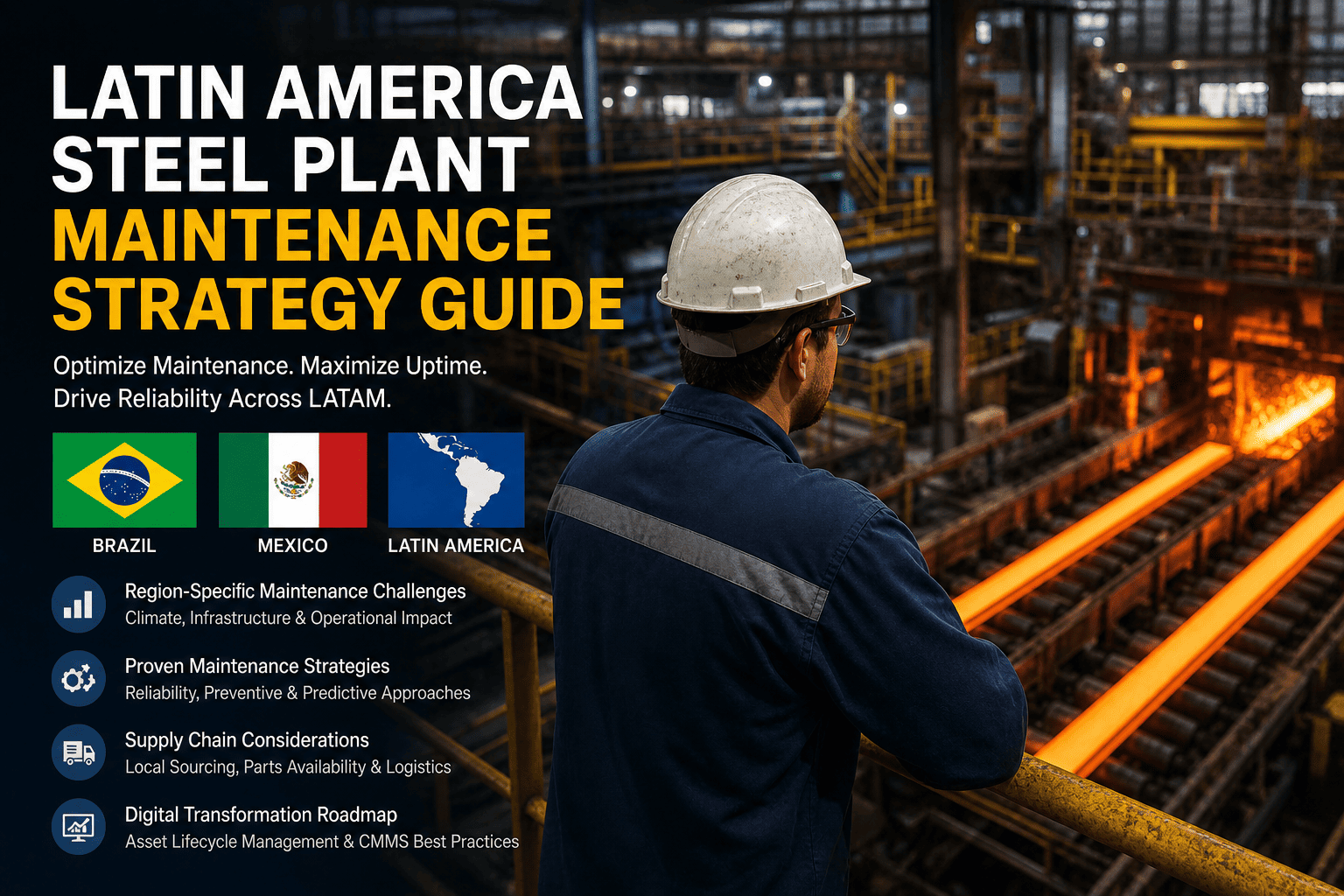
Latin America produces over 60 million tonnes of crude steel annually — with Brazil, Mexico, and Argentina operating plants that face a unique combination of high ambient temperatures, import-dependent spare parts supply chains, and a structural shortage of certified reliability engineers. Steel producers from Ternium and CSN to Usiminas and Gerdau have spent the last decade recognising that maintenance strategy in LATAM cannot simply replicate European or North American frameworks — it must account for 90-day lead times on critical imported spares, tropical corrosion rates in coastal plants, and maintenance teams that are highly skilled operationally but rarely supported by digital asset management systems.
Regional Steel Industry · Asset Lifecycle Management
Latin America Steel Plant Maintenance Strategy Guide
Brazil · Mexico · Argentina — Climate Challenges · Supply Chain Strategy · CMMS-Driven Reliability
LATAM Steel Production Context
BR
Brazil
34M t/yr · Coastal + tropical inland plants · 60–90 day import lead times
MX
Mexico
20M t/yr · High dust / semi-arid zones · US border supply advantage
AR
Argentina
5M t/yr · Currency volatility impacts spare parts budgeting acutely
CO
Colombia / Chile
Growing EAF sector · High-humidity coastal environments · Expanding flat steel capacity
The 4 Maintenance Challenges Unique to LATAM Steel Operations
01
Tropical Corrosion and Heat Degradation
Companhia Siderúrgica Nacional (CSN) · Usiminas Ipatinga · Coastal Brazilian plants
Ambient temperatures of 35–42°C in Brazilian and Colombian steel corridors accelerate bearing grease degradation, insulation ageing, and hydraulic fluid oxidation at rates 40–60% faster than temperate climate plants. Coastal locations add chloride-induced corrosion on structural steel and instrumentation. PM intervals designed for European plants require systematic recalibration — OxMaint's asset-specific PM frequency adjustment tracks actual condition data to determine when tropical-adjusted intervals are needed.
40–60% faster bearing wear
Corrosion doubles in coastal zones
02
Import-Dependent Spare Parts Supply
Mexico · Argentina · Andean region plants
Critical components — high-precision bearings, PLC modules, specialised refractory shapes, and drive inverters — carry 60–120 day lead times from European or Asian suppliers. Argentine plants face the additional challenge of import licence delays and currency restrictions that can extend effective lead times to 6+ months. This makes MTBF prediction critical: the failure must be predicted far enough in advance that the part can be ordered and arrive before breakdown, not after. Without CMMS-linked prediction, plants default to holding excess insurance stock that ties up capital.
60–120 day import lead times
Argentina: up to 6 months effective
03
Reliability Engineering Talent Scarcity
Regional challenge across Brazil, Mexico, Colombia
LATAM steel plants consistently report difficulty retaining vibration analysts, lubrication specialists, and CMMS programme managers. The supply of CMRP-certified reliability engineers in the region is a fraction of demand. This means maintenance improvement programmes must be designed to function with generalist technicians supported by systematic digital tools — not with specialist roles that cannot be filled. OxMaint's guided work order system provides task-level instructions and checklists that allow skilled but non-specialist technicians to execute complex maintenance reliably.
CMRP scarcity across region
High technician turnover rates
04
Paper-Based Maintenance Systems Still Prevalent
Mid-size producers across LATAM · Sponge iron · Long products mills
A significant portion of LATAM steel capacity outside the tier-1 producers still operates on paper work orders, physical inspection registers, and Excel-based PM tracking. This makes MTBF calculation impossible, PM compliance invisible, and repeat failure patterns undetectable. The transition to CMMS in LATAM must account for mixed-literacy workforce contexts — OxMaint's mobile interface with offline capability and Portuguese and Spanish language support is designed for operational adoption in field conditions without reliable connectivity.
60%+ mid-size plants still paper-based
MTBF invisible without CMMS
OxMaint Works Offline, in Portuguese and Spanish, on Mobile — Built for LATAM Field Conditions
Work orders sync when connectivity returns. Technicians complete tasks in their language. Managers see plant-wide KPIs regardless of connectivity — designed for how LATAM steel plants actually operate.
Maintenance KPI Benchmarks — LATAM Steel vs Global Standards
| KPI | LATAM Average (2024) | Global Top Quartile | Gap | Primary Cause of Gap in LATAM |
|---|---|---|---|---|
| OEE (Overall Equipment Effectiveness) | 62–67% | 82–86% | 15–20pts | Reactive maintenance cycle, no CBM programme |
| PM Compliance Rate | 54–63% | 88–94% | 25–35pts | Paper scheduling, no digital compliance tracking |
| Planned Maintenance % | 48–58% | 75–85% | 20–30pts | Reactive spiral from deferred PM backlog |
| Spare Parts Availability | 71–78% | 93–97% | 15–22pts | No CMMS-linked reorder; import dependency |
| MTTR (Mean Time To Repair) | 6.2–9.8 hrs | 2.4–4.1 hrs | 3–6 hrs | Parts unavailable at time of failure; no pre-staging |
LATAM-Specific Maintenance Optimisation Strategies
Regional Spare Parts Pooling
Multi-plant groups in Brazil and Mexico increasingly pool insurance spares across plants — a single critical transformer or caster segment shared between plants within 500km reduces per-plant holding cost while maintaining cover. OxMaint's multi-site inventory visibility makes this visible — plants see shared stock levels and request transfer rather than ordering new units.
Tropical PM Interval Adjustment
European OEM PM intervals assume 20–25°C ambient conditions. LATAM plants that apply these intervals unchanged over-maintain some items (conservative OEM intervals) and critically under-maintain bearing lubrication cycles, which degrade 2–3× faster at 40°C ambient. OxMaint tracks actual failure frequency per asset per climate zone and uses this to propose interval adjustments backed by failure data, not estimation.
Local Manufacturing Development for Non-Critical Spares
Brazilian and Mexican steel plants increasingly qualify local manufacturers for C-category spares — wear plates, simple castings, standard fasteners, and fabricated components — to eliminate import dependency for items that do not require OEM specification. OxMaint's vendor management module tracks qualified local suppliers per part category and region, enabling procurement teams to route non-critical orders to the fastest available local source.
"
The fundamental tension in Brazilian steel maintenance is the combination of aggressive tropical degradation rates and extended import lead times for the components most affected by that degradation. Bearing replacement intervals that work in Germany fail in Ipatinga or Vitória at high ambient temperatures — and when the bearing fails before the European-designed PM interval, the replacement part is eight weeks away in Rotterdam. The plants that have solved this are the ones that have enough CMMS history to predict failure at their actual degradation rate, calculate the reorder point against their actual lead time, and have the part on the shelf before the failure happens. Without a functioning CMMS tracking real failure data in your specific climate, you are flying blind on both sides of the equation — prediction and procurement.
Rodrigo Figueiredo Alves, Eng. Mecânico (UFMG), MBA Gestão Industrial, CMRP (SMRP)
Gerente de Confiabilidade — Usiminas (Ipatinga, MG) · 20 Anos Manutenção Industrial Siderúrgica · Especialista em gestão de ativos, estratégia de manutenção em climas tropicais, e implementação de CMMS para operações integradas de aço
Frequently Asked Questions
How should LATAM steel plants adjust PM intervals for tropical climate conditions?
The starting point is building 18–24 months of actual failure history per asset class in OxMaint before adjusting any OEM-specified intervals. Once failure frequency data is available at your plant's actual ambient temperature and humidity conditions, OxMaint's MTBF trend analysis identifies which asset classes are failing ahead of OEM PM intervals — these are candidates for interval reduction. Bearing lubrication cycles consistently need 30–50% frequency increases in plants above 35°C average ambient. Hydraulic fluid change intervals and insulation inspection cycles also require tropical adjustment. OxMaint makes the failure data visible so interval changes are evidence-based, not guesswork. Start your free trial to see OxMaint's MTBF analysis for climate-adjusted PM intervals.
How do LATAM steel plants manage spare parts given long import lead times and currency risk?
OxMaint's inventory management module allows reorder points to be set based on both consumption rate and supplier lead time — so a bearing with a 90-day import lead time has its reorder point set to trigger an order 100+ days before projected stock-out, not at the standard minimum stock level. For Argentine plants managing currency risk, OxMaint's procurement reporting helps identify which items should be pre-purchased in advance of devaluation events and which can safely be ordered on demand. The combination of CMMS-predicted failure timing and lead-time-adjusted reorder points is the most practical solution available to LATAM plants without on-site manufacturing capability. Book a demo to see OxMaint's lead-time-adjusted inventory management for LATAM operations.
Does OxMaint support Portuguese and Spanish for field technician mobile use?
Yes. OxMaint's mobile application supports Portuguese (Brazilian) and Spanish as primary interface languages — work order instructions, checklists, failure codes, and asset descriptions are all presented in the technician's configured language. The offline sync capability is specifically important for LATAM field operations where connectivity in plant interiors — particularly in large integrated plants in interior Brazilian states — is intermittent. Technicians complete tasks offline and the data synchronises to the central CMMS when connectivity is restored, with no data loss and no duplicate entry. Start your free trial to experience OxMaint in Portuguese or Spanish on mobile.
What is a realistic improvement timeline for a LATAM steel plant transitioning from paper to CMMS?
Plants transitioning from paper or Excel-based maintenance management to OxMaint typically see measurable PM compliance improvement within 60–90 days of go-live — the act of digital scheduling and mobile work order assignment alone closes the most significant compliance gap. MTBF visibility (requiring 6+ months of data) and spare parts optimisation benefits (requiring 12+ months of consumption data) follow in the second and third phases. LATAM plants with 20–50 maintenance technicians typically complete full operational adoption within 90 days of implementation, with KPI dashboard visibility from week one of go-live. Book a demo to see an implementation plan for your LATAM plant size and profile.
OxMaint · Asset Lifecycle Management
LATAM Steel Maintenance Deserves a System Built for LATAM Conditions — Not a European Template Forced Onto Tropical Operations.
Offline mobile, Portuguese and Spanish interface, climate-adjusted PM intervals, and lead-time-aware inventory — OxMaint is designed for how Brazilian, Mexican, and LATAM steel plants actually operate.