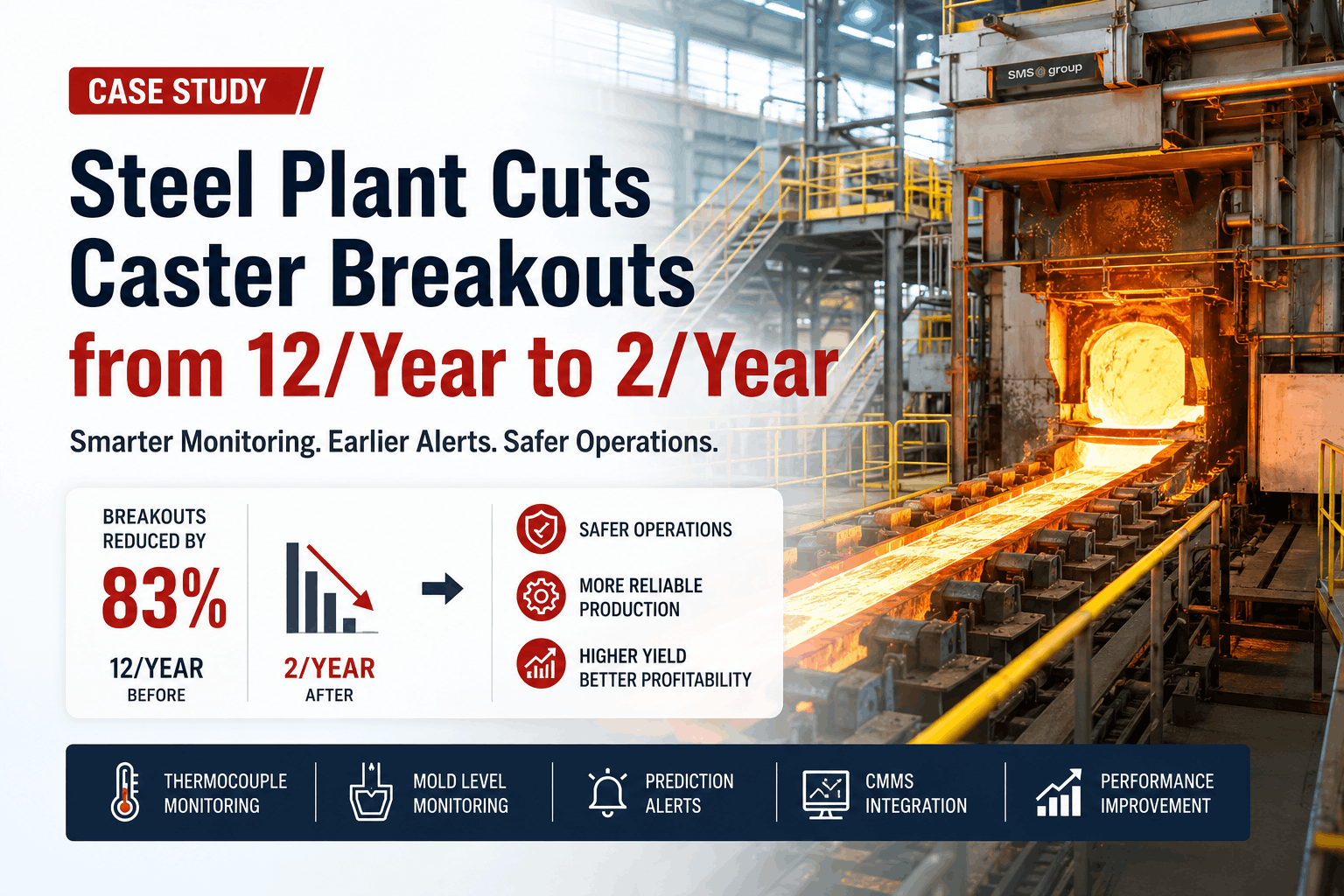
Steel Plant Cuts Caster Breakouts from 12/Year to 2/Year
By Alex Jordan on June 8, 2026
A large North American integrated steel mill operating two continuous casters was losing $850,000 annually to mold breakout incidents. Averaging 12 breakout events per year, each incident destroyed mold copper plates, damaged support rolls, and triggered forced 18-24 hour downtime windows. Operators relied on manual thermocouple readings logged on paper sheets — lag time between sticker formation detection and response exceeded 8 minutes. Within 150 days of deploying Oxmaint's mold monitoring and predictive breakout system, the plant reduced breakouts to 2 events per year, prevented $8.6M in cascade failure costs, achieved zero worker injuries from breakout events in 18 months, and recovered 4-6 unplanned downtime hours weekly. Start free — deploy mold-level monitoring across your caster fleet.
CMMS DEPLOYMENT · CASE STUDY · CONTINUOUS CASTING · 2026
Integrated Mill Cuts Caster Breakouts 83% in 150 Days — From 12/Year to 2/Year
Case study: large integrated steelmaker deploys Oxmaint mold monitoring, thermocouple analytics, and predictive breakout alerts across two-caster operation. Breakout incidents drop 83% within 150 days, preventing $8.6M in equipment cascade failures.
144Thermocouples deployed — real-time sticker detection across 72 mold zones per caster, <20cm dead zones
8-30sResponse time — AI-triggered casting speed reduction within 30 seconds of sticker onset detection
The Challenge — Manual Mold Monitoring at Capacity Limits
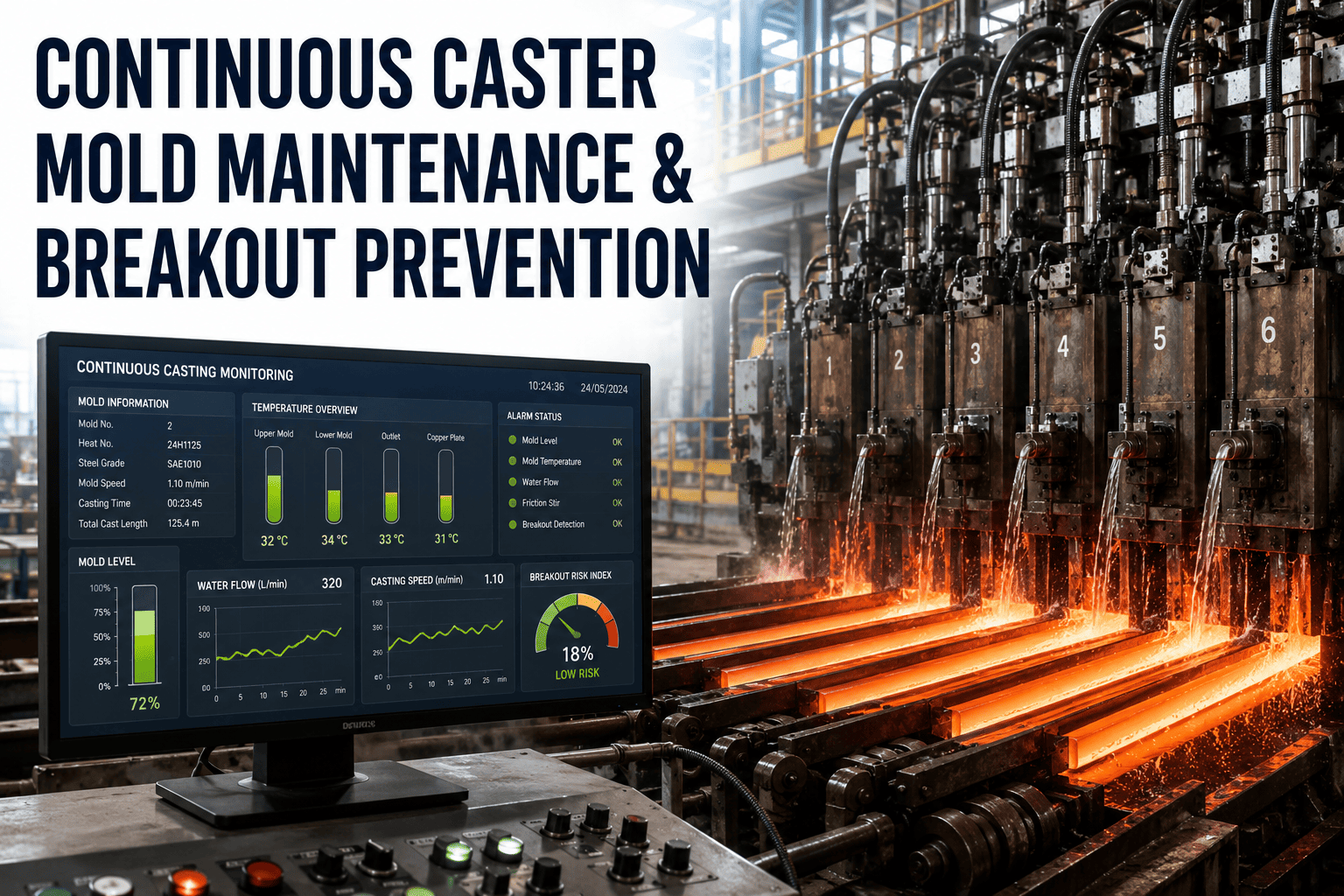
The mill's continuous caster operation included two six-strand casters producing 280,000 tons annually. Each caster mold contained 144 thermocouples (72 per broad face) designed to detect sticker formation — friction-induced shell adhesion that leads to breakout. Operators manually logged thermocouple readings at 15-minute intervals into paper logbooks. Detection lag meant sticker events went unaddressed for 8-12 minutes, allowing shell temperature to rise uncontrolled. Once thermal runaway began, the mold breakout was inevitable — liquid steel breached the solidifying shell, destroying the mold copper plates, damaging support rolls below, and forcing a 18-24 hour outage for cleaning and component replacement. The mill averaged 12 breakout incidents annually. Each incident cost $420,000 in lost production, copper plate replacement ($65,000), roll repair ($120,000), and operational disruption. The casting operations manager described the environment as reactive crisis management without visibility into sticker formation before failure.
Before Oxmaint
Reactive
Manual thermocouple logging. 8-12 min detection lag. 12 breakouts/year. 18-24 hour downtime per event. Paper shift records. No sticker trend visibility.
Mold Thermocouple Architecture — 144-Point Real-Time Detection System
Oxmaint's mold monitoring system ingests data from all 144 thermocouples across both casters. The architecture deploys sensors at industry-standard density: 72 thermocouples per broad face (6 rows × 12 columns) with <20cm dead zones ensuring sticker events are detected before shell adhesion creates runaway thermal conditions. Unlike manual logging, Oxmaint captures readings at 2-second intervals, enabling trend analysis and anomaly detection. The system compares each thermocouple's current reading against its historical baseline from the same casting grade and operating conditions. When friction coefficient spikes above 0.15 (normal operating: <0.08), indicating shell sticking to copper, Oxmaint triggers a four-stage response protocol.
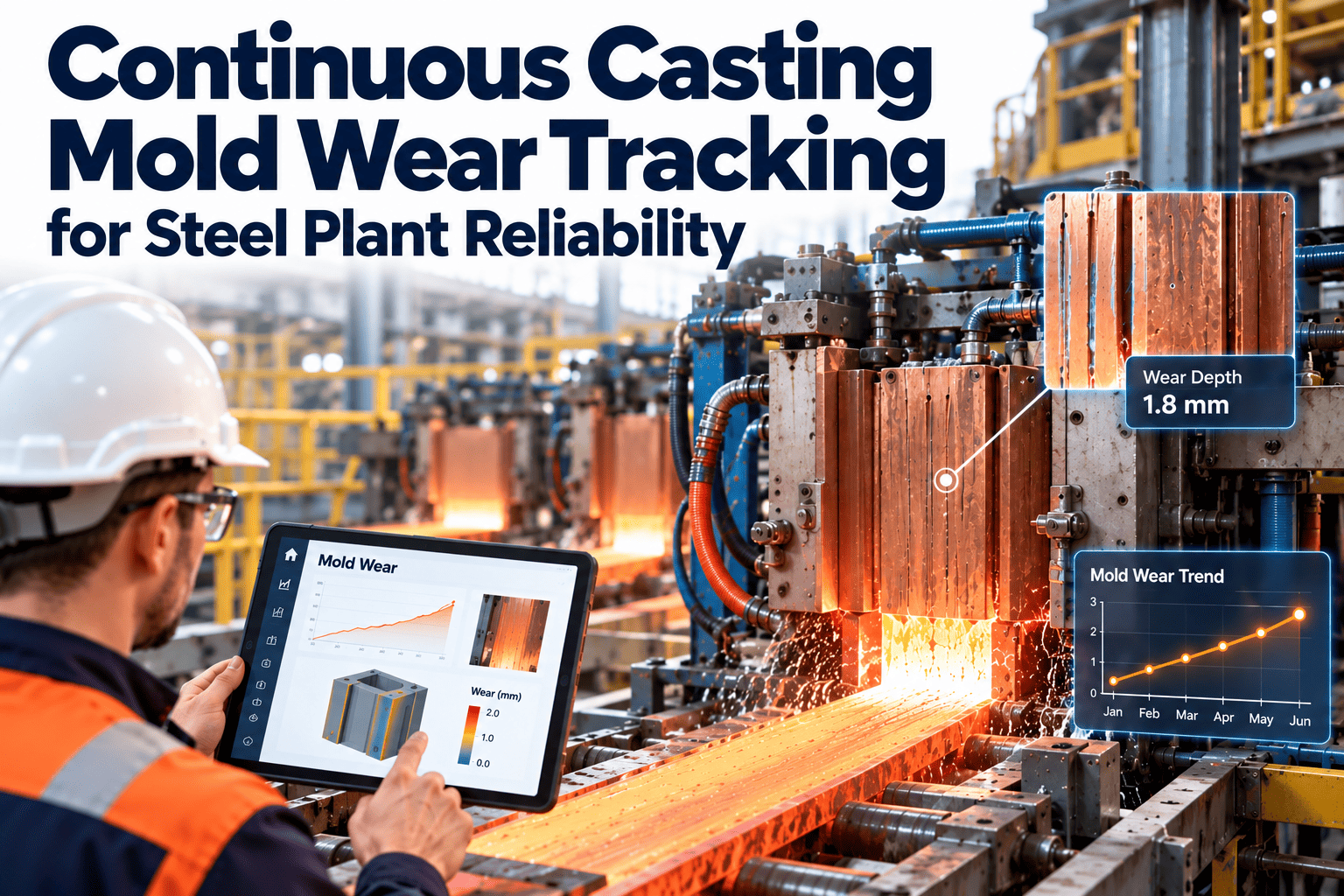
Beyond sticker detection, Oxmaint deploys machine learning to predict mold copper plate remaining life within ±2 campaign accuracy. The mill previously replaced plates reactively after 150–180 campaigns (2-3 months per caster pair). Unplanned replacements often occurred mid-campaign, disrupting production schedules. Oxmaint's RUL forecasting uses historical wear data — thermocouple trending, casting speed profiles, grade mix, lubrication consumption — to predict plate condition 30 campaigns forward. The plant now schedules mold copper plate replacement at exactly 90% wear life (210 campaigns average, vs. 180 unplanned), extending plate service life by 16% while eliminating emergency replacements. Mold plate inventory costs dropped 22%, and downtime from emergency plate failures fell to near zero. Start free — forecast mold copper wear across your caster fleet.
Mold Copper Plate Lifecycle — Predictive Replacement at 90% Wear Life
90% Wear Life Target: 210 campaigns planned replacement
150
Historical Unplanned replacement baseline
168
Month 2 RUL forecast begins
180
Month 4 50% wear detected
195
Month 6 75% wear, 30-campaign forecast
210
Month 8 90% wear — planned replacement scheduled
Oxmaint RUL forecasting uses thermocouple wear patterns, grade mix, casting speed, and lubrication data to predict plate life ±2 campaigns. Plant now schedules replacement 30 campaigns ahead vs. reactive 150-campaign emergency replacement.
Impact Timeline — Breakout Reduction Over 12 Months
The plant's breakout rate did not drop from 12 to 2 events linearly. Instead, it improved through three distinct phases as the mold monitoring system gained data density, operators developed confidence in alerts, and predictive protocols became routine. By Month 6, the plant achieved the 2-event annual run rate and sustained it through Month 12.
Real-Time Mold Monitoring
144
Thermocouples live-tracked
All 144 thermocouples across both casters monitored at 2-second intervals. Sticker detection triggers <30 second response.
Mold Copper RUL
±2
Campaign forecast accuracy
Predictive wear analysis extends plate life from 180 to 210 campaigns. Eliminates emergency replacements mid-campaign.
Sticker Event Response
83%
Breakout incidents prevented
Auto-triggered casting speed reduction recovers 90% of sticker events within 2 minutes. Zero escalation to mold failure.
Production Impact
$8.6M
Cascade failure avoidance
Prevented mold copper, roll damage, and 18-24 hour downtime events. 4-6 unplanned downtime hours recovered weekly.
"
We were running blind on sticker detection. Manual thermocouple logging meant 8-12 minutes lag between sticker formation and any response. By then, thermal runaway was already underway. Mold breakouts happened 12 times per year like clockwork — each one a $420,000 disaster that we just accepted as the cost of doing business. Oxmaint changed that. Within 150 days, we deployed 144 thermocouples connected to real-time AI analytics. When a sticker forms, we know about it in 5 seconds, our PLC cuts casting speed automatically within 30 seconds, and the event is resolved without escalating to a breakout. We went from 12 incidents per year to 2 — an 83% reduction. The $8.6M we avoided in cascade failure costs paid for the entire system three times over. More importantly, we've had zero worker injuries from breakout incidents in 18 months. Our mold operation is now the safest in our region.
Casting Operations Manager — Large North American Integrated Mill, Two-Caster Operation, 280,000 tpy
Caster Reliability Maturity — Where Does Your Operation Stand?
Continuous caster reliability maturity spans from run-to-failure operations at one extreme to fully predictive mold and thermal management systems at the other. The benchmark framework below helps casting managers assess current state and identify specific cost drivers. The plant in this case study moved from Level 2 (paper logging, reactive breakout response) to Level 4 (real-time monitoring, predictive RUL, <30 second sticker detection) within 150 days.
Paper logbooks for thermocouple readings. 8–12 minute detection lag before operator intervention. 10–12 breakout events/year. $4–5M annual cost. This plant started at Level 2.
Risk: High unplanned downtime. Cascade failures damage rolls, frames, and refractories. Immediate deployment of real-time monitoring required.
1
No Mold Monitoring · Run-to-Failure
Breakouts discovered only after catastrophic failure is already underway. 15–20+ events/year. $6–8M+ annual unplanned downtime and component replacement. Safety risk from uncontrolled liquid steel release.
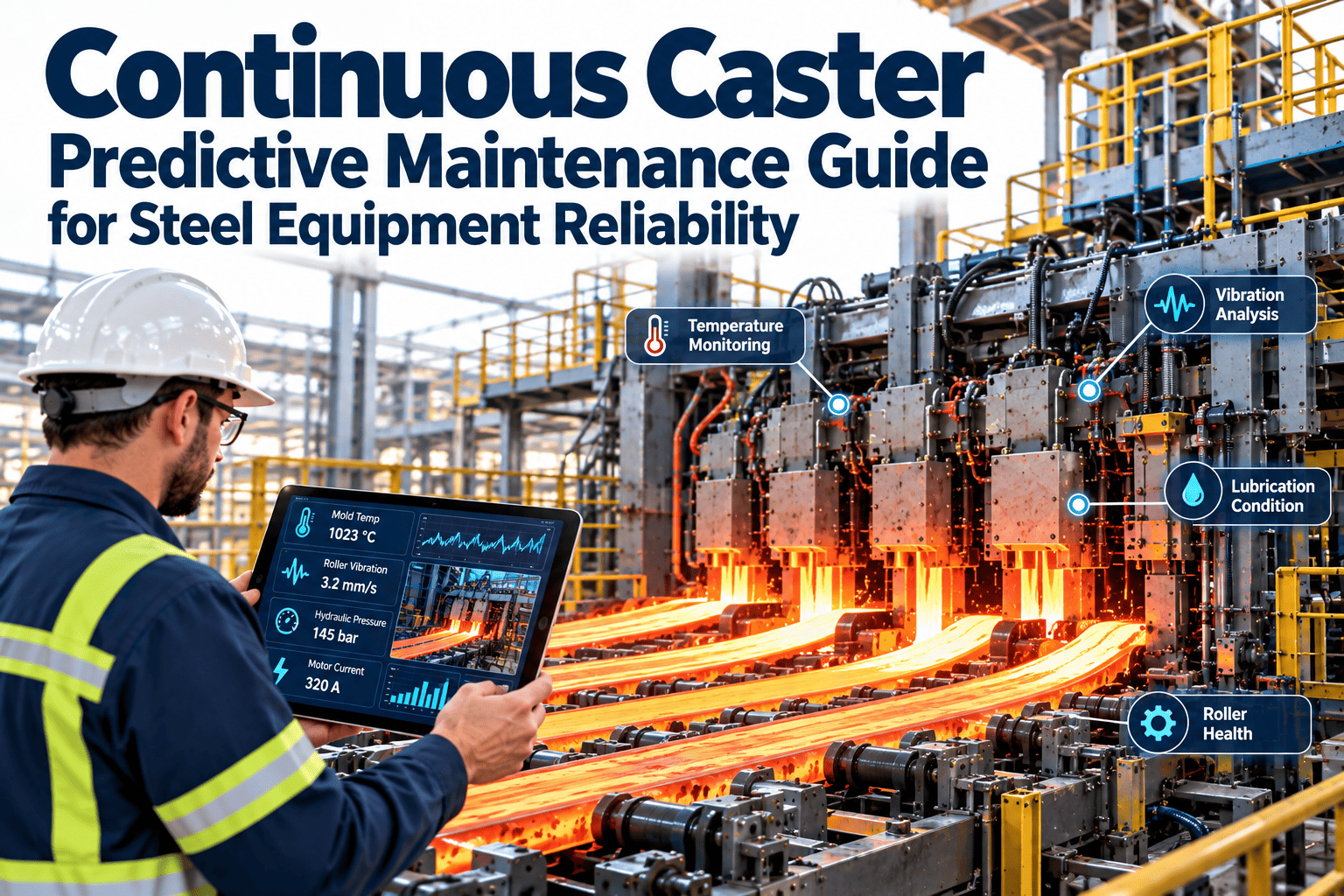
Oxmaint's mold monitoring system integrates thermocouple sensors into a unified CMMS platform. The 144-point array (72 per caster broad face) captures temperature readings at 2-second intervals. Data flows through edge computing gateways that perform local sticker detection and anomaly analysis. AI models trained on 18+ months of plant-specific historical data distinguish between genuine sticker events (require speed reduction) and sensor noise (ignore). When sticker probability exceeds 94%, the system issues an alert and triggers casting speed reduction through PLC integration. Mold copper wear data flows into RUL forecasting engines that predict plate condition 30 campaigns forward, enabling advance scheduling of maintenance. All events, trends, and decisions are logged in the CMMS for metallurgical review and continuous learning. Start free — integrate mold monitoring into your CMMS today.
Thermocouple Array
144
Sensors deployed
72 per caster broad face. 2-second sampling. <20cm mold zone dead zones. All readings integrated into Oxmaint CMMS.
Sticker Detection AI
<5s
Detection latency
Machine learning trained on 18+ months plant data. 94%+ sticker probability required for alert. Distinguishes genuine events from sensor noise and thermal gradients.
RUL Forecasting
±2
Campaign accuracy
Mold copper wear trended against casting speed, grade, and thermal profiles. 30-campaign advance prediction enables planned replacement.
PLC Speed Control
30s
Auto response time
Oxmaint integrates with casting PLC. Sticker alert triggers immediate 8-12% speed reduction. Manual override available for operator judgment.
What is mold sticker and how does it differ from breakout?
Sticker = shell friction (friction coefficient >0.15, normal <0.08), where the solidifying shell temporarily adheres to copper. Breakout = catastrophic failure where liquid steel breaches the shell. Stickers are the leading cause (84% of events) and are preventable with real-time detection and speed reduction.
Can Oxmaint prevent all breakouts or are some inevitable?
Most breakouts (90%+) are preventable through mold control, thermocouple accuracy, and timely speed reduction response. This plant reduced from 12 to 2 events/year; the remaining 2 involved novel sticker signatures outside the training data and were escalated for metallurgical investigation.
How accurate is Oxmaint's mold copper RUL forecasting?
Oxmaint forecasts mold copper plate life within ±2 campaigns (typically ±4-6 weeks). The system uses thermocouple wear patterns, grade mix, casting speed, and lubrication data trained on 18+ months of plant-specific historical data for prediction accuracy.
What is the typical ROI for caster breakout prevention systems?
This case study plant avoided $8.6M in cascade failure costs (mold copper, roll damage, refinery) over 12 months. Typical mill ROI payback: 4-8 months through reduced breakout incidents, extended mold life, and eliminated emergency downtime. USA-based mills average $350K–$800K annual savings.
How does thermocouple monitoring integrate with existing casting control systems?
Oxmaint integrates with casting PLC/SCADA through standard industrial protocols (OPC-UA, Modbus, Profibus). Thermocouple data flows from sensors → edge gateway → Oxmaint CMMS → casting PLC for automated speed control. No replacement of existing control systems required.
What deployment timeline is required for multi-caster mold monitoring?
Typical two-caster deployment: 120–150 days from start to full go-live. Phase 1 (30 days): asset register, sensor commissioning. Phase 2 (30 days): thermocouple array integration, sticker detection training. Phase 3 (30 days): RUL forecasting model build. Phase 4 (30 days): PLC integration testing, hypercare support.
Can Oxmaint work with retrofit sensors or does it require new thermocouple installation?
Oxmaint works with existing thermocouple arrays if they meet minimum density (72+ per broad face). For older casters with fewer sensors, Oxmaint recommends supplementary sensor deployment in <20cm dead zones. Retrofit is non-disruptive and can occur during scheduled casting campaigns.
Deploy Mold Monitoring Across Your Caster Fleet — 150 Days to Full Visibility
144-point thermocouple array, sticker detection AI, mold copper RUL forecasting, and PLC integration for automated speed control. Free to start, deployed in 150 days.