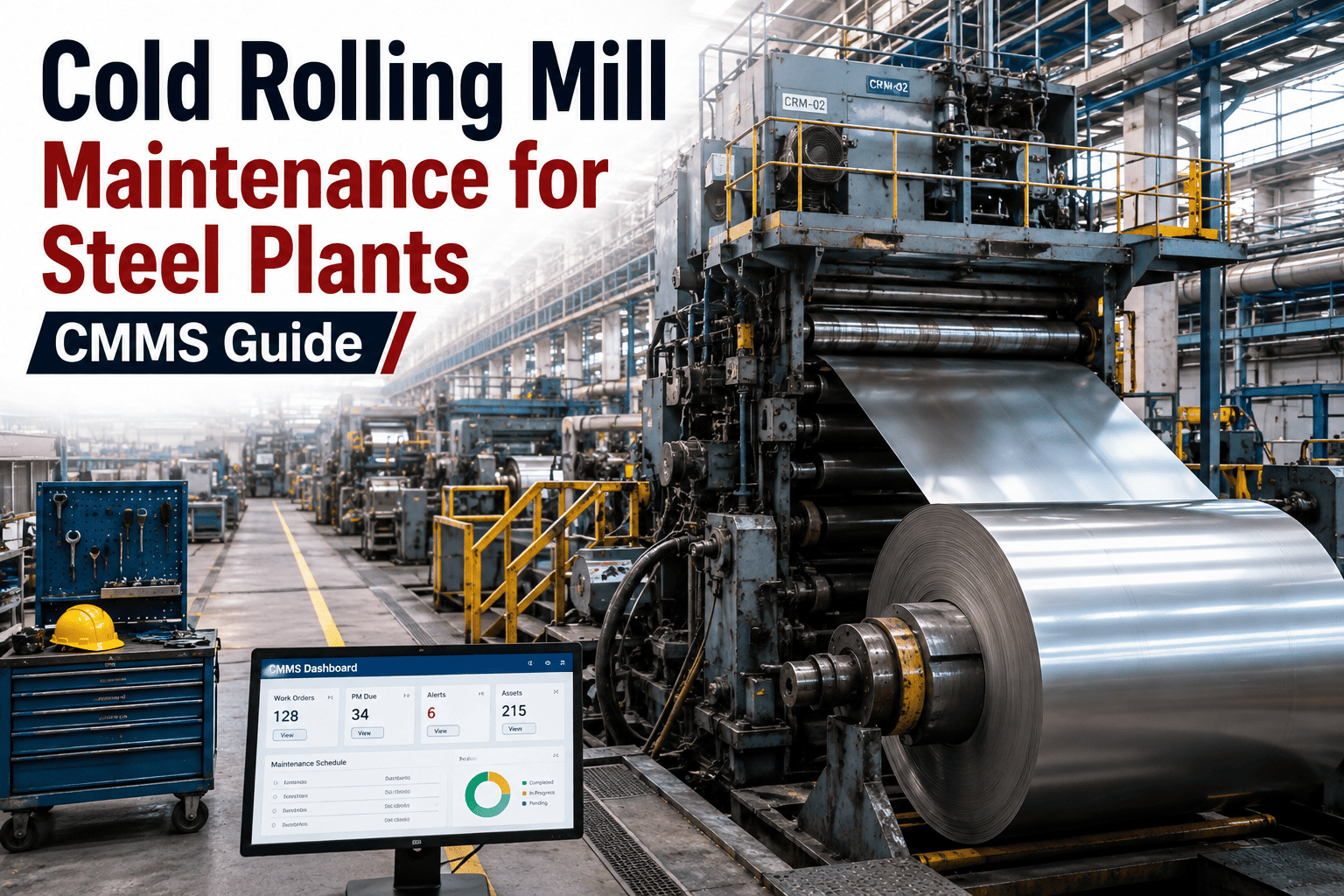
Cold rolling produces the surface and dimensional precision that defines product value — strip flatness tolerances measured in I-units, surface roughness profiles specified to the micron, and thickness tolerances held within fractions of a millimetre across full coil lengths. Maintaining this precision requires structured maintenance programmes across four interdependent systems: work roll and backup roll condition, flatness control actuators, emulsion management, and drive train integrity. When any one of these systems degrades undetected, the consequences show up in scrap rates, customer rejections, and unplanned mill stops that cost more than the entire quarterly maintenance budget. This article examines each system's maintenance requirements and how a CMMS built for precision rolling operations keeps all four under structured control. Book a demo to see Oxmaint.ai for cold rolling maintenance.
Cold Rolling Mill Maintenance: Roll Surface Quality, Flatness Control & Emulsion Systems
For maintenance heads, mill engineers, and operations directors managing tandem cold mills, skin-pass mills, or reversing cold mills — precision product quality begins with structured maintenance data, not reactive troubleshooting after the strip has already been rolled.
Why Cold Rolling Maintenance Demands Precision-Level Tracking
Cold rolling operates at the intersection of tribology, metallurgy, and mechanical precision. The contact between work rolls and strip occurs under enormous rolling forces — often exceeding 15,000 kN in a tandem mill stand — at speeds that generate heat, wear, and surface interactions that change measurably with each coil rolled. Unlike hot rolling, where surface variations can often be corrected downstream, cold rolling surface and shape defects are frequently irreversible and directly affect the final product received by the customer.
The maintenance challenge is not the complexity of any individual task. Mill engineers understand roll grinding schedules, HAGC calibration, and emulsion chemistry. The challenge is tracking these parameters systematically across every stand, every shift, and every campaign — with enough data fidelity to identify the slow-developing trends that precede quality events. This is exactly what Oxmaint.ai's precision maintenance tracking is designed to deliver.
Critical Maintenance Domains in Cold Rolling Operations
Four interconnected systems must be tracked at the component level to maintain cold mill precision. Each domain's condition directly affects the others — roll surface degradation increases emulsion contamination; emulsion chemistry problems accelerate roll wear; flatness actuator calibration errors cause shape defects that the roll grinding schedule cannot correct.
Work Roll & Backup Roll Surface Condition
Work roll surface quality is the primary determinant of cold strip surface finish. The initial grind roughness (Ra), the roughness transfer to the strip surface during rolling, and the progression of roll wear across the campaign must all be tracked to ensure the final product meets grade-specific surface specifications. For automotive exposed panels requiring Ra 0.8–1.2 μm, even modest deviations from the target grind profile produce surface defects that result in customer rejections.
Backup roll condition — particularly crown profile and surface chipping — affects strip flatness distribution and edge drop. A backup roll with an incorrect crown profile creates a systematic flatness error across every coil rolled until the roll is changed. Maintenance teams using per-stand roll condition tracking within Oxmaint.ai maintain complete grind history, crown measurement records, and surface defect logs for every roll in the mill inventory.
Flatness Control System & Actuator Health
Modern cold rolling mills achieve strip flatness through a combination of hydraulic gap control (HAGC) cylinders, work roll bending systems, intermediate roll shifting (in 6-high mills), and cooling spray zoning. Each of these actuator systems must be calibrated and maintained to the tolerances required by the flatness model — typically within 2–5% of the hydraulic setpoint. Degraded HAGC seals, biased bending cylinder response, or blocked cooling spray zones all produce systematic flatness errors that accumulate across the campaign.
The critical maintenance insight for flatness control is that actuator degradation is gradual and often invisible in real-time process data — it shows up as a slow widening of the flatness variance band over weeks and months. Trend monitoring within a CMMS allows maintenance engineers to track actuator response performance across campaigns and schedule calibration interventions before flatness capability degrades to the point where it affects product quality.
Emulsion System Condition & Chemistry Management
The rolling emulsion — a water-based oil-in-water mixture applied at the roll-strip contact — performs three simultaneous functions: lubrication to control friction and rolling force, cooling to manage strip and roll temperatures, and cleaning to carry away iron fines and debris from the contact zone. When any of these functions is compromised by degraded emulsion chemistry, the consequences appear in roll wear rate, strip surface quality, and thermal flatness distortion.
Emulsion management is one of the most data-intensive maintenance disciplines in cold rolling — requiring daily chemistry monitoring, weekly filter condition checks, and periodic tank cleaning to prevent bacterial contamination and iron particle accumulation. Teams using structured emulsion maintenance tracking capture the full chemistry history that makes cause-and-effect relationships between emulsion deviations and surface quality events visible and actionable. Schedule a demo to see how emulsion parameter logging is structured within the platform.
Bring Precision-Level Maintenance Tracking to Your Cold Mill
Oxmaint.ai gives cold rolling maintenance teams structured per-stand roll condition records, flatness actuator calibration histories, and daily emulsion chemistry logs — all in one mobile-accessible platform built for precision manufacturing environments.
How Oxmaint.ai Supports Cold Rolling Maintenance Teams
Purpose-built capability for precision rolling operations — not a generic CMMS configured for manufacturing use.
Per-Stand Roll Condition Database
Maintain complete roughness measurement history, campaign tonnage records, and surface defect logs for every work roll and backup roll, indexed by stand and grind cycle. Identify campaign length trends and correlate roll condition with downstream quality events.
Mobile Inspection on the Mill Floor
Maintenance technicians record roll measurements, emulsion samples, and actuator calibration results directly on mobile during mill stops — with photo attachments and measurement fields. Offline sync ensures records are captured even in areas with poor connectivity.
Emulsion Chemistry Trend Analysis
Log daily concentration, pH, temperature, and iron content readings per emulsion circuit. View trend charts across the full campaign to identify the slow chemistry drifts that precede surface quality events — before they reach the point where product is already affected. Start a free trial to configure your emulsion circuit structure.
Flatness Actuator Calibration Records
Store HAGC, bending system, and shapemeter calibration results per stand per maintenance window. Track calibration factor drift over time to identify degrading actuator performance before it causes systematic flatness errors. Generate calibration reports for quality system and customer audit requirements. Book a demo to see the calibration tracking module.
Manual Tracking vs. Oxmaint.ai: Cold Rolling Mill Maintenance
The operational impact of the data gap between spreadsheet-based maintenance records and a structured CMMS is measured in surface defect rates, roll campaign waste, and flatness quality loss that shows up in customer rejections.
| Maintenance Area | Manual / Spreadsheet Tracking | Oxmaint.ai |
|---|---|---|
| Work Roll Roughness History | Per-grind paper records, not searchable by roll or stand — no cross-campaign trend analysis | Per-roll digital grind records with campaign trend charts and automatic deviation flagging |
| Emulsion Chemistry Logs | Shift log entries in paper books — chemistry deviations identified retrospectively after quality events | Daily chemistry log with rolling trend charts and threshold alerts before deviation reaches critical level |
| Flatness Actuator Calibration | Calibration sheets filed in stand binders, not linked to subsequent quality data | Calibration records per stand with drift trend analysis and pre-campaign verification workflow |
| Surface Defect Root Cause | Post-event reconstruction from multiple disconnected log sources — time-consuming and incomplete | Defect events linked directly to roll condition, emulsion chemistry, and actuator calibration records at the time of rolling |
| Customer Audit Documentation | Manual compilation of maintenance records from multiple sources — typically incomplete under audit pressure | Complete campaign maintenance history exportable by stand, grade, or date range in minutes |
Scroll horizontally to compare on mobile
Before Oxmaint.ai, when a customer sent back a coil with pick-up marks, we spent two days trying to reconstruct which roll was in Stand 3, what the emulsion concentration was that week, and whether we had done the bending calibration on time. Now that data is all in one place, linked to the coil number. Our last customer audit took three hours instead of three days, and we could answer every question with actual records.— Quality Systems Manager, Cold Rolling Complex, Western Europe
Frequently Asked Questions
Can Oxmaint.ai track work roll and backup roll condition records independently for each stand in a tandem mill?
Yes. Each mill stand is configured as an independent asset within the cold rolling mill hierarchy. Work rolls and backup rolls are tracked as sub-components of each stand, with separate maintenance records, grind history, campaign tonnage logs, and surface defect classifications per roll position. Maintenance engineers can view the complete roll condition database for any specific stand or compare roll performance across all stands from a single dashboard view — enabling identification of stands with systematically higher roll wear rates that require investigation.
How does the platform support daily emulsion chemistry logging across multiple mill circuits?
Emulsion circuits are configured as inspection assets within Oxmaint.ai, with daily measurement checklists for concentration, pH, temperature, and iron content. Mobile entry allows mill operators to record chemistry readings directly from the sampling point. All readings are automatically compared against configured specification limits, and out-of-specification values generate immediate notifications to the designated maintenance team with the specific parameter deviation highlighted. Start a free trial to configure your emulsion circuit structure and specification limits.
Can flatness actuator calibration records be linked to downstream strip quality data?
Yes. Calibration records in Oxmaint.ai are timestamped and linked to the specific campaign periods during which they were in effect. When a flatness quality event is recorded — either from an in-line shapemeter alarm or a customer rejection — maintenance engineers can immediately retrieve the calibration records for all flatness actuators that were active during the affected rolling period. This direct linkage replaces the time-consuming retrospective reconstruction that typically consumes hours when investigating quality events under customer audit pressure. Book a demo to see the quality event linkage workflow.
Does Oxmaint.ai support skin-pass mill and reversing cold mill operations in addition to tandem mills?
Yes. Oxmaint.ai's asset hierarchy configuration adapts to any cold rolling mill configuration — tandem mills with multiple stands, single-stand reversing mills, and skin-pass mills with their distinctive work roll roughness transfer requirements. The roll surface roughness tracking is particularly critical for skin-pass operations where precise Ra control determines the strip's paint adhesion and press-forming characteristics. The platform's flexible maintenance template structure allows skin-pass-specific inspection fields to be added without affecting the standard roll maintenance workflow for other mill types.
How long does implementation take for an existing cold rolling facility?
Most cold rolling facilities are fully operational on Oxmaint.ai within two weeks of starting their free trial. The onboarding process covers mill asset hierarchy configuration (stands, roll inventory, emulsion circuits, actuator systems), inspection template creation for each maintenance domain, PM schedule setup aligned to existing roll change intervals, and mobile app deployment for maintenance technicians and shift operators. Historical roll grind data and emulsion chemistry records from existing spreadsheets can be imported during onboarding to establish the trending baseline from day one.
Cold Mill Precision Starts With Structured Maintenance Records
Roll surface quality, flatness actuator calibration, and emulsion chemistry are the three variables that determine whether your cold rolling output meets the specifications your customers require. Oxmaint.ai gives your maintenance team the per-stand, per-campaign data infrastructure to manage all three with the precision your product demands.