Comparing Steel Plant Maintenance Strategies: TPM vs RCM vs Lean Maintenance
By James smith on March 17, 2026
The choice of maintenance strategy in a steel plant is not a philosophical preference — it is a financial and operational decision with measurable consequences that compound over years. A blast furnace operator running Total Productive Maintenance will make fundamentally different decisions about operator involvement, failure response, and asset ownership than a rolling mill team built around Reliability Centered Maintenance.It presents what each strategy actually requires, what it actually costs, and where each produces its highest return in the context of integrated steel operations — drawing from AIST implementation studies, SMRP benchmarking data, and Oxmaint's deployment experience across flat-rolled, long products, and specialty steel facilities on four continents. The goal is to give maintenance directors the information they need to choose an appropriate strategy for their specific facility type, maturity level, and operational constraints — and to show how a modern CMMS supports the execution requirements of all three. Sign up for Oxmaint to implement any of these strategies on a platform built for steel plant maintenance complexity.
3
Dominant maintenance strategy frameworks used by top-quartile steel operations globally
18–36mo
Typical full implementation timeline to reach world-class performance under any of the three frameworks
65%
Of top-quartile steel plants use a hybrid strategy combining elements of two or more frameworks
Strategy Overview: The Core Philosophy of Each Framework
Before comparing implementation requirements and outcomes, it is worth establishing precisely what each strategy is optimizing for — because the fundamental objective differs, and that difference shapes every downstream decision about how work is organized, how assets are classified, and how performance is measured.
TPM
Total Productive Maintenance
Origin: Toyota Production System, Japan 1971
Optimizes for zero breakdowns and zero defects by involving production operators as the first line of equipment care. The fundamental belief is that the people closest to the machine are best positioned to detect early deterioration — and should be empowered to act on it.
Operator-owned autonomous maintenance
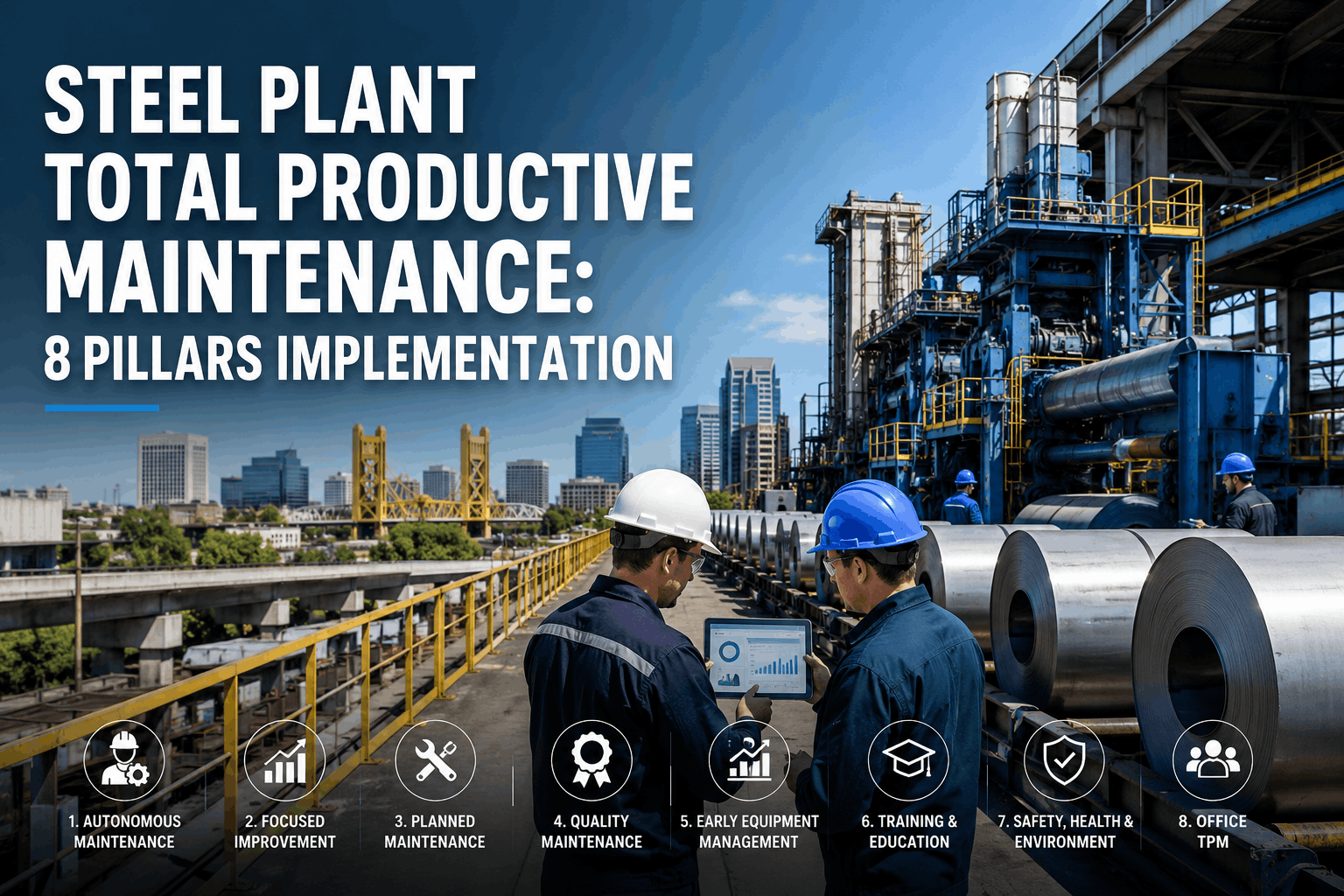
8 pillars including focused improvement (Kaizen)
OEE as the primary performance metric
Cross-functional teams — operations + maintenance
Best fit: rolling mills, finishing lines, coating operations
RCM
Reliability Centered Maintenance
Origin: Commercial aviation, SAE JA1011 standard 1999
Optimizes for maximum reliability at minimum cost by asking — for every asset — what failure modes exist, what their consequences are, and what maintenance task most cost-effectively prevents the worst consequences. The answer is often not a scheduled PM.
Failure Mode and Effects Analysis (FMEA) foundation
Consequence-driven task selection
MTBF and MTTR as primary reliability metrics
Analysis-intensive — typically specialist-led
Best fit: blast furnaces, continuous casters, BOF vessels
LEAN
Lean Maintenance
Origin: Toyota Lean Manufacturing, adapted for maintenance 1990s
Optimizes for elimination of waste in the maintenance process itself — waiting time, unnecessary inventory, rework, over-processing, and transportation. The focus is on making every maintenance hour as productive as possible through standardization, visual management, and flow.
5S workplace organization as the foundation
Visual management and standardized work instructions
Wrench time and labor efficiency as primary metrics
Pull-based work order systems — demand driven
Best fit: utility systems, facilities, general maintenance departments
Deep Comparison: Requirements, Costs, and Outcomes
The following three strategy profiles use the same structure as a technical equipment monitoring assessment — covering the core requirements of each strategy, what it demands from your organization, and the measurable outcomes documented in steel plant implementations. Book a strategy consultation to discuss which approach best fits your current operational maturity and facility type.
TPM
Total Productive Maintenance
TPM transfers basic equipment care — cleaning, inspection, lubrication, minor adjustments — from the maintenance department to production operators. In steel plants, this means rolling mill operators conducting daily equipment checks, documenting abnormalities, and performing first-level corrective actions before dedicated maintenance is required. The result, when executed well, is dramatically earlier defect detection and a maintenance team freed from routine tasks to focus on higher-complexity planned work.
Implementation Requirements
Operator training program — typically 40–80 hours per operator across all shifts
Visual management system — color-coded equipment standards, cleaned and inspected to baseline
Autonomous maintenance standards documented per machine — typically 3–6 months per production area
OEE measurement infrastructure — availability, performance, and quality data captured per shift
CMMS integration — operator-reported abnormalities create maintenance work orders automatically
Documented Outcomes in Steel Plants
+ 15–30% OEE improvement in rolling mill and finishing areas within 18–24 months
+ 40–60% reduction in minor stoppages and quality defects traced to equipment deterioration
+ 20–35% reduction in maintenance labor cost as operators absorb routine care tasks
− Requires sustained management commitment — TPM programs typically fail within 2 years without active sponsorship
− Limited effectiveness in high-heat zones where operators cannot safely access equipment — blast furnace perimeter, BOF vessel area
RCM
Reliability Centered Maintenance
RCM's core process — the FMEA-driven task selection analysis — produces a maintenance program where every scheduled task is justified by a specific failure mode it prevents or detects, and every task interval is based on the failure mode's probability distribution rather than a time-based assumption. For steel plants, this means blast furnace tuyere cooling systems receive different PM logic than blast furnace stove refractory, even though both are on the same asset — because their failure modes, consequences, and probability curves are entirely different.
Implementation Requirements
FMEA workshop process — typically 4–8 weeks per critical asset system with specialist facilitation
Failure mode library development — documenting all failure modes, effects, causes, and current controls per asset
Task selection logic per failure mode — PM task, condition monitoring, redesign, or run-to-failure decision
CMMS work order structure supporting RCM task types — time-based, condition-based, and failure-finding tasks
Reliability data collection — MTBF, MTTR, and failure cost tracking per asset system to validate analysis over time
Documented Outcomes in Steel Plants
+ 25–40% reduction in maintenance cost per critical asset within 24–36 months of full RCM implementation
+ 50–70% reduction in unplanned failures on RCM-analyzed assets — the strongest failure prevention result of any strategy
+ Optimized PM intervals — typically 30–40% of existing PMs are extended or eliminated as analysis shows they are not failure-effective
− High upfront analytical investment — a full-plant RCM implementation for a 2 MTPA facility takes 18–24 months of analysis before full task implementation
− Requires quality reliability data — RCM analysis is only as good as the failure history feeding it, making CMMS data quality a prerequisite
LN
Lean Maintenance
Lean Maintenance targets the waste embedded in how maintenance work is executed — not just what work is done. An industry study found that maintenance technicians in average facilities spend only 24–28% of their shift on actual repair work. Lean Maintenance attacks the other 72–76%: parts retrieval, waiting for permits, searching for documentation, rework from incomplete job preparation, and non-value-adding travel. The tools are largely procedural rather than analytical — standardized work, visual management, 5S, planned job packages, and pull-based work order systems.
Implementation Requirements
5S implementation across all maintenance areas — storerooms, workshops, field equipment locations
Standardized work instructions for all repetitive maintenance tasks — job packages with parts, tools, and sequence
Visual management system — kitted parts, tool boards, inventory bin labeling, color-coded work status
Pull-based scheduling — work orders released only when parts and permits are confirmed ready, not on calendar date
Wrench time measurement baseline — requires time study or digital work order tracking to establish starting point
Documented Outcomes in Steel Plants
+ 80–120% increase in wrench time — from industry average 24–28% to 50–58% — within 12–18 months
+ 20–30% reduction in maintenance labor cost for the same volume of planned work through efficiency gains
+ 25–40% reduction in parts storeroom inventory value through standardized kitting and pull replenishment
− Does not directly address failure prevention — Lean Maintenance makes execution more efficient but does not determine what work to do or when
− Requires process discipline to sustain — 5S workplaces and visual management systems degrade rapidly without audit processes and management reinforcement
Oxmaint supports all three strategies in a single platform. Whether your framework is TPM operator reporting, RCM condition-based task management, or Lean pull scheduling — Oxmaint's CMMS provides the work order, asset, and analytics infrastructure each strategy requires to execute and improve.
Decision Matrix: Which Strategy Fits Which Situation?
The following matrix evaluates each strategy across the dimensions that matter most when selecting a maintenance framework for a steel plant. No strategy scores highest on every dimension — the right choice depends on your current maturity baseline, the production area in question, and the organizational capabilities you can realistically sustain. Most world-class facilities use a hybrid approach: RCM for high-consequence assets, TPM in production-intensive areas, and Lean principles applied throughout to optimize execution efficiency. Sign in to Oxmaint to configure your platform for whichever strategic framework your facility is implementing.
Fast — early wins from 5S and autonomous maintenance within 3–6 months
Slow — analysis phase takes 12–18 months before full task implementation
Fast — wrench time gains visible within 60–90 days of 5S + job packages
Fit for high-consequence assets (blast furnace, BOF)
Low — operator access limitations in high-heat zones reduce autonomous maintenance effectiveness
Highest — consequence-driven task logic is designed precisely for this asset class
Medium — execution efficiency gains apply, but strategy selection logic is missing
Fit for production area assets (rolling mills, finishing)
Highest — operator proximity and shift continuity make autonomous maintenance natural and effective
Medium — applicable but analytically heavy relative to consequence level
Medium — lean execution applies well, failure logic still needed
Organizational change requirement
High — requires cultural shift in operator responsibility and cross-functional accountability
Medium — primarily affects maintenance planning and engineering teams
Low to medium — primarily procedural changes, lower cultural lift
CMMS data quality required
Low upfront — generates data as program matures
High — requires 2–3 years of failure history for reliable FMEA input
Medium — wrench time baseline and parts data needed for measurement
Long-term cost reduction potential
High — 20–35% labor cost reduction, 15–30% OEE gain
Highest — 25–40% direct maintenance cost reduction, strongest failure prevention
Medium — 20–30% labor efficiency gain, but no strategic failure prevention
Sustainability without ongoing management
Low — TPM degrades rapidly without active pillar management and leadership sponsorship
High — RCM task schedules are embedded in CMMS and execute without active program management
Medium — 5S sustains with audit processes; pull scheduling sustains with CMMS structure
Swipe horizontally on smaller screens
How World-Class Steel Plants Combine All Three Strategies
The premise of "pick one strategy" is increasingly outdated. McKinsey's analysis of top-quartile steel operations globally found that 65% use a hybrid approach: RCM for high-consequence rotating equipment and primary process assets, TPM in production areas where operator proximity and shift continuity make autonomous maintenance practical, and Lean principles applied across the entire maintenance operation to optimize execution efficiency regardless of which analytical framework determined the work. The following implementation sequence reflects this hybrid model and the role Oxmaint plays at each phase.
Phase 1 — Foundation
Months 1–4
Lean Maintenance
Implement 5S across all maintenance areas. Standardize work instructions for top-20 repetitive tasks. Establish wrench time baseline using Oxmaint digital work orders. Introduce pull-based scheduling for planned jobs. Build parts kitting process for scheduled PMs.
Target: wrench time above 40%, storeroom 5S complete
Phase 2 — Operator Integration
Months 3–10
TPM
Launch autonomous maintenance in highest-OEE-impact production areas — rolling mills and finishing lines first. Train operators on equipment standards. Deploy Oxmaint mobile for operator abnormality reporting. Establish OEE measurement per production line. Form cross-functional improvement teams.
Conduct FMEA workshops for highest-consequence assets — blast furnace, continuous caster, BOF. Build failure mode library in Oxmaint. Generate RCM-justified task schedules. Replace time-based PMs with condition-based tasks where failure mode analysis supports it. Track reliability metrics per analyzed asset.
Target: top-10 critical assets RCM-analyzed, condition-based tasks active
Phase 4 — Full Integration
Months 18–36
Hybrid
Expand RCM analysis to remaining critical assets. Advance TPM to autonomous maintenance steps 3–4. Implement focused improvement projects using Kaizen data from Oxmaint work order history. Track cost per tonne against global benchmark. Quarterly strategy review using Oxmaint analytics dashboard.
Target: top-quartile benchmarks on planned ratio, PM compliance, OEE, and cost per tonne
How Oxmaint Supports Each Strategy Framework
A CMMS is not strategy-neutral — the features and data structures it provides either support or constrain the maintenance framework a facility is trying to implement. Oxmaint was built to accommodate all three frameworks simultaneously, because the reality of a 2–4 MTPA integrated steel plant is that different production areas genuinely need different approaches. The following capability profiles show where Oxmaint's platform aligns to the execution requirements of each strategy.
TPMOxmaint + Total Productive Maintenance
Oxmaint's mobile application enables operator-reported abnormalities to create maintenance work orders directly from the production floor without dispatcher involvement. OEE dashboards per production line track availability, performance, and quality in real time. Autonomous maintenance standards can be documented as visual inspection checklists within the asset record, giving operators a structured reference for daily equipment care. Oxmaint's analytics module generates TPM pillar progress reports — tracking autonomous maintenance step completion, focused improvement count, and OEE trend by production area — so pillar committee meetings have data rather than anecdote.
RCMOxmaint + Reliability Centered Maintenance
Oxmaint stores the FMEA output for each asset system — failure modes, effects, causes, current controls, and selected maintenance tasks — directly within the asset record. RCM-generated tasks are supported across all four task types: time-based PMs, condition-based monitoring tasks, failure-finding inspections, and run-to-failure designations with documented consequence acceptance. MTBF and MTTR are tracked automatically from work order open and close timestamps. When actual failure data accumulates, Oxmaint's reliability analytics compares actual MTBF against the failure interval assumptions in the original RCM analysis — enabling task interval optimization as your plant's specific failure distribution data replaces generic industry assumptions. Sign in to Oxmaint to configure your RCM task structure.
LNOxmaint + Lean Maintenance
Oxmaint's pull scheduling model releases work orders only when all job prerequisites — parts confirmed in stock, permits issued, crew available — are verified, eliminating the most common source of technician idle time in average maintenance operations. Job package templates store standardized work instructions, required parts lists, and tool requirements against each recurring task type, so job preparation happens once during planning and not repeatedly at execution. Parts consumption data from completed work orders drives automatic reorder at optimized points, supporting lean inventory principles. Wrench time is tracked implicitly through work order open, travel, and active time timestamps on the mobile app, giving Lean project teams the data to identify and eliminate the highest-value waste categories without manual time study. Book a demo to see the Lean pull scheduling configuration in Oxmaint.
We spent two years trying to decide between TPM and RCM before we realized the question itself was wrong. Our blast furnace needed RCM — the consequences of a failure there are so severe that only consequence-driven task logic makes sense. Our hot strip mill needed TPM — operators are right there, they know the equipment, and involving them caught things we were missing on quarterly PMs. Our utility and facilities areas needed Lean — we were wasting enormous amounts of technician time on process, not on equipment. Oxmaint let us run all three simultaneously in the same platform without three separate systems fighting each other.
— VP of Maintenance, integrated carbon and alloy steel producer, 3.2 MTPA
Frequently Asked Questions
QWhich maintenance strategy produces the lowest cost per tonne in steel plants — TPM, RCM, or Lean?
Based on AIST and McKinsey benchmarking data, RCM-driven programs produce the lowest long-term maintenance cost per tonne — typically 25–40% below the reactive maintenance baseline — because they optimize task selection directly against failure consequence and probability. However, RCM requires 18–24 months of analytical investment before full cost reduction materializes. TPM produces faster initial gains (3–12 months) and is particularly effective in rolling and finishing areas. Lean Maintenance adds execution efficiency that amplifies the cost reduction from either analytical framework. The highest-performing facilities combine all three: RCM for task logic on high-consequence assets, TPM for production area engagement, and Lean for execution efficiency across the department. Sign up for Oxmaint to track cost per tonne as your strategy implementation progresses.
QHow long does a full RCM analysis take for a blast furnace system, and what does it cost?
A full RCM analysis for a blast furnace system — covering tuyere cooling, stove systems, casthouse equipment, top gas equipment, and ancillary systems — typically takes 6–12 weeks of workshop time with a facilitated team of 6–8 participants including maintenance engineers, operations, and reliability specialists. External facilitation fees for a qualified RCM analyst typically run $80,000–$150,000 for a comprehensive blast furnace analysis. The documented outcomes — 50–70% reduction in unplanned failures on analyzed assets — produce a payback period of 12–18 months based on avoided downtime cost alone. The resulting task schedule is then loaded into Oxmaint as RCM-justified work orders with full failure mode traceability. Book a demo to see how Oxmaint stores and executes RCM task output.
QCan TPM work in a steel plant environment given the safety restrictions around high-heat and high-hazard zones?
Yes, with deliberate zone stratification. TPM's autonomous maintenance pillar works best in areas where operators can safely perform visual inspection, cleaning, lubrication, and minor adjustments without specialized PPE or permit requirements — rolling mills, finishing lines, utility areas, and material handling systems. For high-heat zones (blast furnace perimeter, BOF vessel area, casting floor), autonomous maintenance scope is limited to pre-shift visual checks and abnormality reporting using Oxmaint mobile — the physical maintenance work remains with dedicated maintenance crews. This stratified approach, standard in Japanese and Korean integrated mills, captures the bulk of TPM's OEE benefit without compromising operator safety.
QWhat is the right starting point for a steel plant with no formal maintenance strategy currently?
For a facility starting from a reactive-dominant, low-CMMS-maturity baseline, the recommended starting sequence is Lean foundations first (months 1–4), then TPM in production areas (months 3–10), then RCM for critical assets (months 6–18). Beginning with Lean delivers immediate wrench time and storeroom efficiency gains that fund the investment in TPM and RCM. Beginning with RCM when failure history data is thin produces an analysis built on assumptions rather than plant-specific evidence — a common implementation failure. Beginning with TPM when basic processes are chaotic produces operator frustration as abnormalities raised create work orders that cannot be executed efficiently. Lean process discipline is the prerequisite for both. Start your Lean foundation in Oxmaint to build the process infrastructure the other two strategies depend on.
QHow does Oxmaint support strategy transitions when a facility is moving from one framework to another?
Oxmaint's flexible work order architecture supports multiple maintenance task types — time-based, condition-based, operator-initiated, failure-finding, and run-to-failure — simultaneously, so transitioning from a purely time-based PM program to a hybrid RCM/TPM model does not require restructuring existing work orders. New RCM-justified tasks can be added alongside existing PMs as the analysis covers each asset system, with the original time-based task suspended or retired as the RCM task is validated. TPM operator-initiated work orders flow through the same prioritization queue as planner-generated PMs, with asset linkage maintained so OEE impact is tracked regardless of work order origin. The strategy transition is supported by data continuity rather than disrupted by system changes.
Implement Your Maintenance Strategy on a Platform Built for Steel Complexity
Whether your framework is TPM, RCM, Lean, or a hybrid of all three, Oxmaint provides the CMMS infrastructure — work order management, asset records, analytics, and mobile execution — that each strategy requires to produce measurable results in steel plant operations.