Continuous Casting Machine Maintenance: AI-Driven Scheduling for Zero Breakdowns
By Michael Finn on March 4, 2026
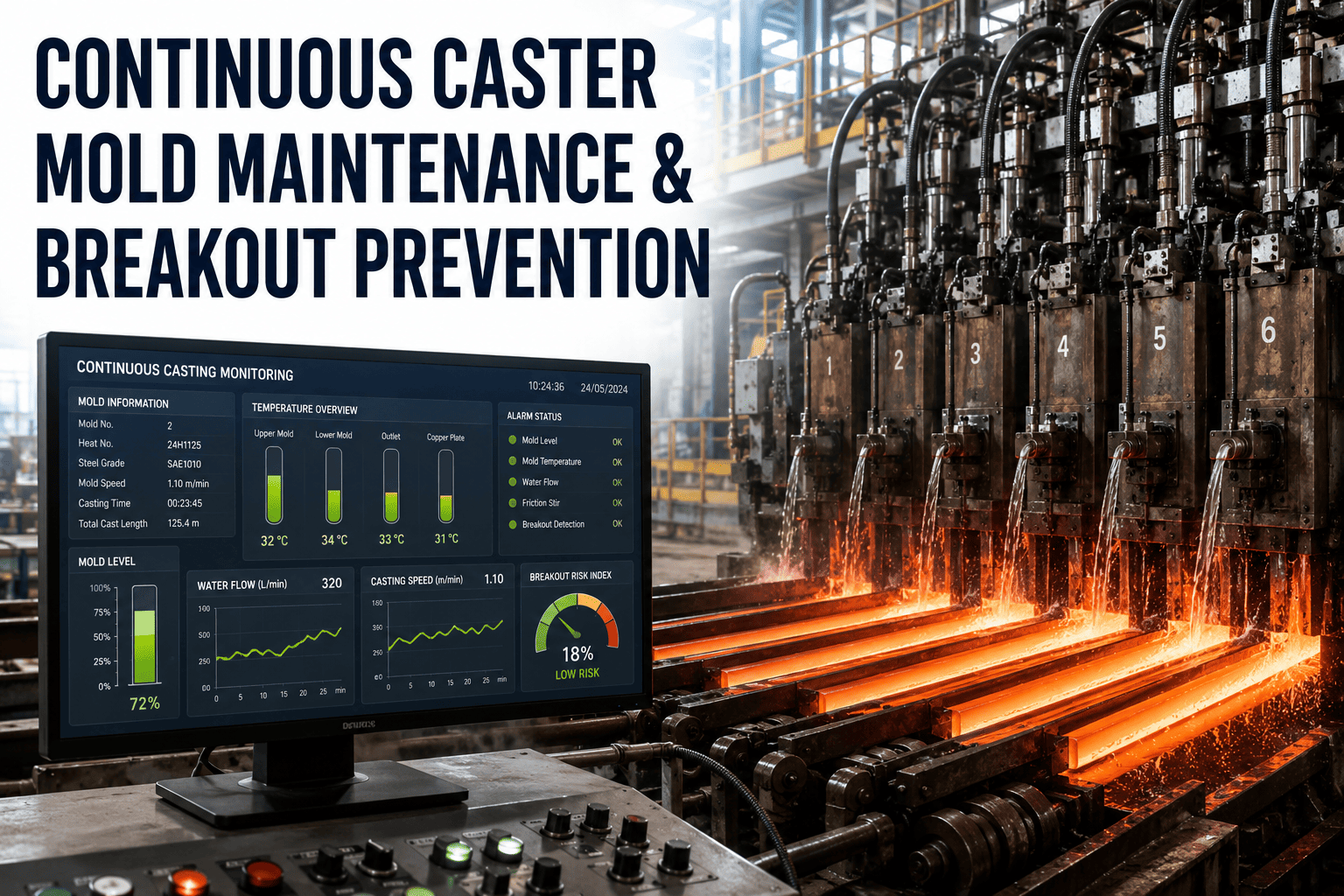
A breakout on a continuous caster doesn't just stop production—it destroys mold plates, damages strand guide rolls, contaminates the secondary cooling zone, and creates a safety emergency that shuts down the entire melt shop for 8–72 hours. The cleanup alone costs $200K–$500K. The lost production adds $800K–$3.5M depending on how long it takes to restart. And the root cause is almost always the same: a maintenance issue that was developing for days or weeks before the breakout—mold copper wear that exceeded limits, an oscillation hydraulic valve drifting out of spec, a secondary cooling nozzle clogging, a segment roll seizing. OXmaint's AI-driven maintenance platform monitors every subsystem on your continuous caster continuously, scheduling maintenance at the optimal moment—late enough to extract full component life, early enough to prevent the $1.5–4M breakout event that nobody saw coming.
Continuous Caster Maintenance by the Numbers
Why reactive maintenance on casters is unsustainable
$1.5–4MAverage cost per breakout event (repair + lost production)
6–12×/yrBreakout frequency at plants without predictive monitoring
3,200+Maintenance tasks per year on a single 2-strand caster
$12–28MAnnual unplanned maintenance cost per caster
The Eight Critical Caster Systems That Break Down
A continuous caster is eight interdependent systems running simultaneously at 1,500°C. When any one fails, the entire casting sequence stops—and restarting costs more than fixing the original problem. OXmaint's integrated maintenance platform monitors all eight as a connected system, catching degradation in one before it cascades into the others.
Continuous Caster Critical Maintenance Systems
Each system has unique failure modes and monitoring requirements
Critical
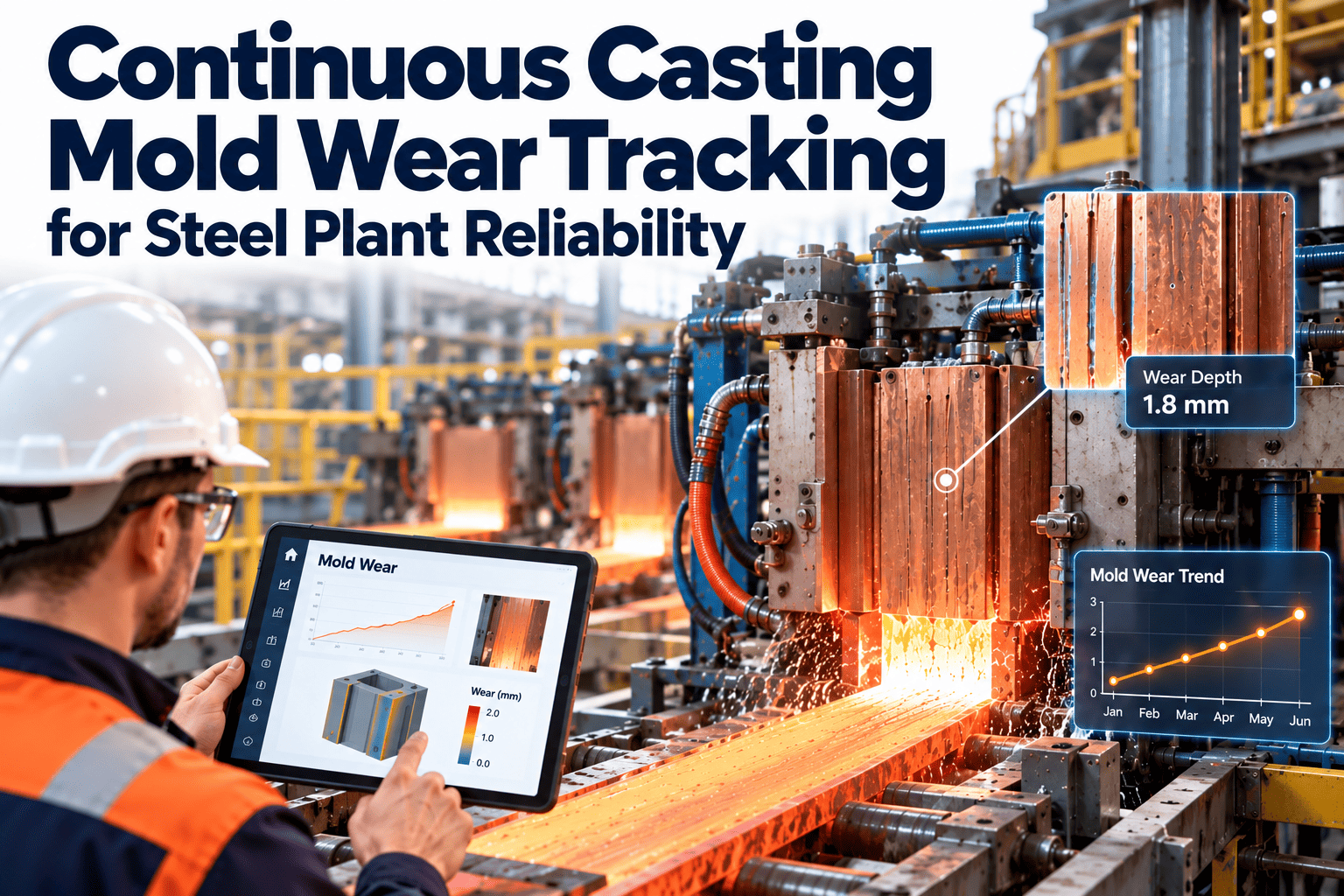
Mold Assembly
Copper mold plates, water channels, width adjustment mechanisms, and mold level control. Wear beyond 1.5mm depth or channel blockage directly causes breakouts—the most expensive caster failure.
OXmaint tracks: Mold copper thickness per face, heat flux distribution, thermocouple mapping for sticker detection, water delta-T per channel, mold level stability index
Critical
Mold Oscillation
Hydraulic servo system controlling oscillation stroke, frequency, and waveform. Deviations of ±0.2mm from target stroke cause surface defects. Complete hydraulic failure causes immediate breakout.
OXmaint tracks: Servo valve response time, accumulator pre-charge pressure, stroke accuracy, frequency stability, hydraulic oil particle count and temperature
High Priority
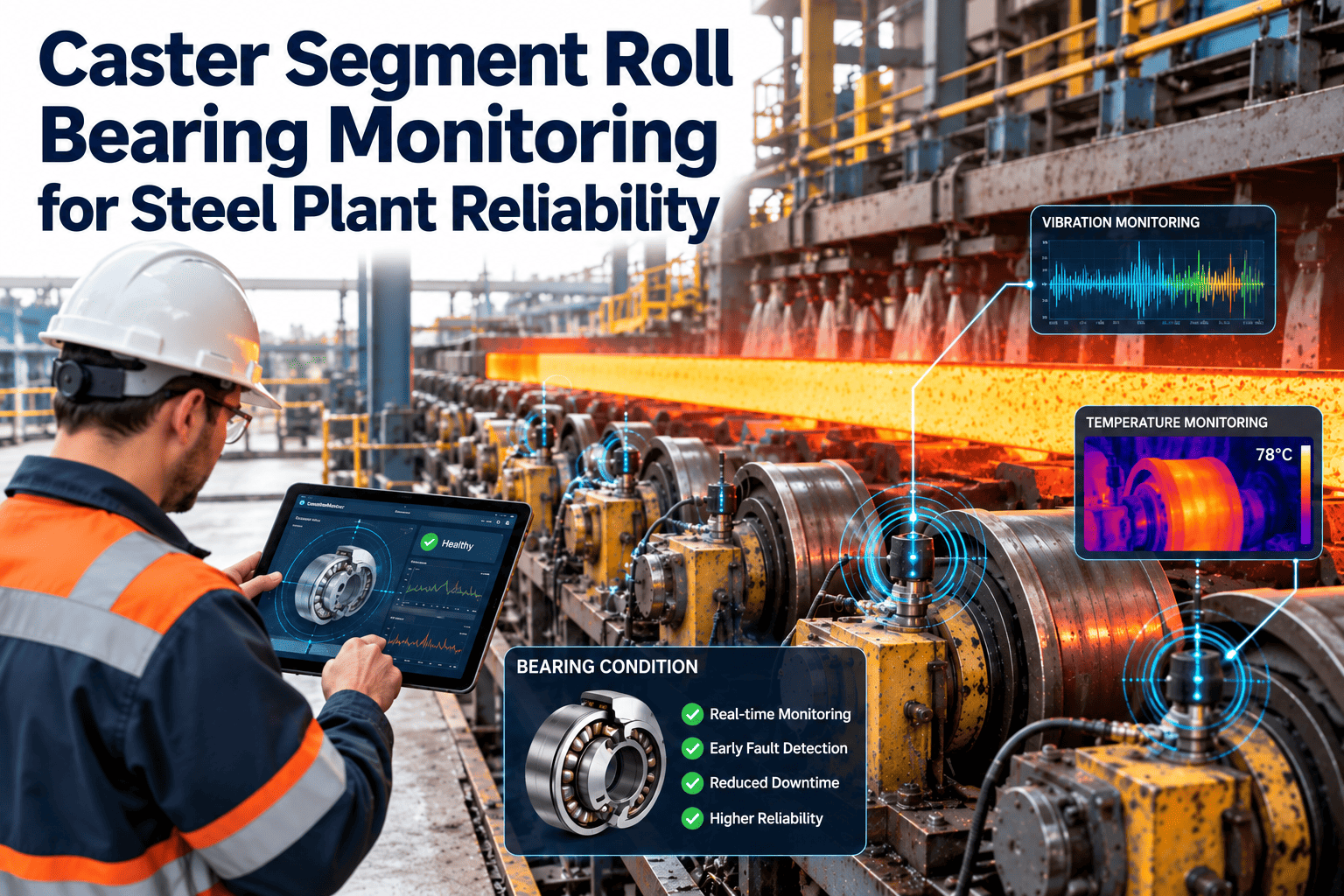
Segment Rolls & Bearings
200–400 rolls across 10–16 segments supporting and guiding the strand from liquid core to solid product. A single seized roll scores the strand surface, and bearing failure under 300+ ton strand load is catastrophic.
OXmaint tracks: Roll rotation speed vs casting speed (slip detection), bearing temperature per roll, segment gap measurements, torque resistance trending
High Priority
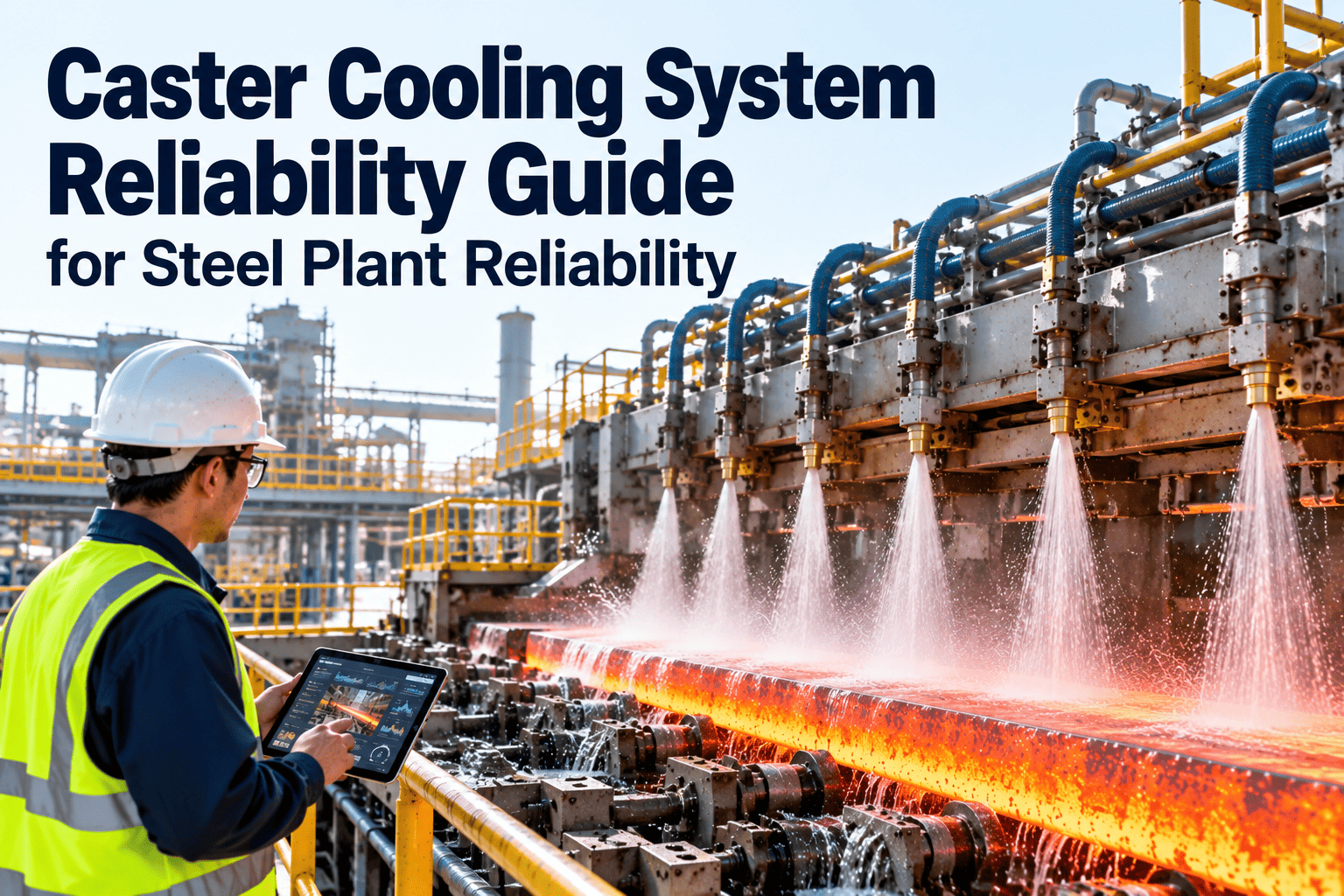
Secondary Cooling
400–800 spray nozzles delivering precisely controlled water patterns to solidify the strand uniformly. Clogged or misaligned nozzles create hot spots, uneven solidification, and internal cracks that escape surface inspection.
OXmaint tracks: Nozzle flow rates per zone, spray pattern coverage, water pressure differentials, strand surface temperature mapping, nozzle replacement schedules
Medium
Tundish & SEN System
Tundish refractory, submerged entry nozzles (SEN), stopper rods, and slide gates controlling steel flow from ladle to mold. SEN clogging changes flow patterns and causes asymmetric solidification.
OXmaint tracks: SEN bore erosion rate, stopper rod position trending, slide gate wear cycles, tundish refractory thermocouple data, casting speed stability
Medium
Withdrawal & Straightening
Drive rolls, gearboxes, and hydraulic pinch rolls that pull the strand through the machine and straighten it from curved to flat. Misaligned drives cause strand buckling and off-gauge product.
OXmaint tracks: Drive motor current signatures, gearbox vibration spectra, pinch roll pressure, strand speed consistency, straightening force profiles
Monitoring
Torch Cutting & Runout
Oxy-fuel torches cutting strands to length, roller tables, and slab/billet marking systems. Torch failures cause off-length cuts and production delays but rarely stop the caster.
OXmaint tracks: Torch tip condition, gas flow consistency, cut quality trending, roller table motor health, marking system accuracy
Monitoring
Instrumentation & Level 2
Mold level sensors, breakout detection thermocouples, strand surface pyrometers, and the process control system. Sensor drift causes incorrect control actions—the silent killer of casting quality.
OXmaint tracks: Sensor calibration schedules, thermocouple health, pyrometer accuracy validation, control system response times, alarm rationalization
The Breakout Problem: How $4K Issues Become $4M Events
Breakouts don't happen suddenly—they build over days or weeks through a predictable cascade. AI catches the first signal in the chain. Manual inspection typically catches the last one—if it catches anything at all before liquid steel breaches the strand shell.
Anatomy of a Breakout — The Failure Cascade
Every step is detectable by AI. Most are invisible to manual inspection.
Week 1
Mold Copper Wear Accelerates
Wear rate increases from 0.02mm/day to 0.06mm/day due to mold powder chemistry change or increased casting speed. Invisible to operators.
Fix: $4K mold plate rotation
↓
Week 2
Heat Flux Pattern Shifts
Thinning copper changes heat extraction profile. Mold thermocouples show 8–12°C deviation from baseline—within normal alarm limits but trending upward.
Fix: $8K mold change during sequence break
↓
Week 3
Shell Thickness Becomes Uneven
Thin shell at worn mold face. Simultaneously, a secondary cooling nozzle partially clogs in zone 2, creating a hot band. Two independent problems converge.
Fix: $15K mold + nozzle replacement
↓
Week 4
Sticker Event → Breakout
Thin shell sticks to worn mold face, tears on withdrawal stroke. Liquid steel pours into the secondary cooling zone, destroying spray nozzles, roll surfaces, and segment bearings.
Cost: $1.5–4M (repair + 8–72 hrs lost production)
OXmaint's AI catches the wear rate change at Week 1—scheduling a $4K mold rotation that prevents a $4M breakout. The system correlates mold wear, heat flux, and cooling data simultaneously, seeing the convergence that no single-system alarm can detect.
Stop Breakouts Before They Start
OXmaint monitors mold wear, oscillation health, cooling performance, and segment condition simultaneously—catching the cascade at stage 1, not stage 4.
Traditional caster maintenance uses fixed intervals—change mold every 800 heats, replace nozzles every 200 heats, rebuild segments every 50,000 tons. These intervals are conservative averages that waste good components early and miss degraded ones late. OXmaint's AI scheduling replaces time-based intervals with condition-based optimization, extracting 20–40% more life from healthy components while catching degraded ones weeks before failure.
Fixed Schedule vs AI-Driven Schedule
Side-by-side comparison across key caster components
Component
Fixed PM Interval
AI-Driven Timing
Improvement
Mold copper plates
Every 800 heats
600–1,100 heats based on actual wear rate
25% more life on healthy molds
Oscillation servo valves
Every 12 months
8–20 months based on response drift
Catches contamination events PM misses
Spray nozzles
Every 200 heats
150–350 heats based on flow measurement
40% fewer nozzle changes on clean water
Segment bearings
Every 50,000 tons cast
35K–80K tons based on vibration and temp
Prevents seizure that damages strand
Withdrawal drive gearbox
Every 24 months
18–36 months based on gear mesh analysis
$180K gearbox runs to actual limit
SEN / Stopper rod
Every sequence (fixed)
Position trending extends or shortens life
15% longer sequences on healthy nozzles
What AI Monitors — Sensor to Work Order
The process is the same for every caster subsystem. Sensors stream data continuously. ML models compare real-time patterns against known failure signatures. When degradation appears, OXmaint generates a prioritized work order with recommended action—scheduled for the next sequence break or planned maintenance window.
From Sensor Signal to Scheduled Repair
Automated workflow keeps casters running without surprises
Step 1
Continuous Data Collection
Mold thermocouples, oscillation sensors, spray flow meters, segment roll monitors, and drive current analyzers stream data every casting second. 500+ data points per strand.
↓
Step 2
Multi-System Correlation
AI correlates signals across systems—connecting mold wear with heat flux, cooling performance with strand temperature, oscillation health with surface quality. Single-system alarms miss these connections.
↓
Step 3
Remaining Life Estimation
Each component gets a remaining useful life (RUL) estimate updated every cast. The system recommends optimal replacement timing—maximizing component life without risking failure.
↓
Step 4
Scheduled Work Order
OXmaint generates a work order timed to the next sequence break or planned window—with failure type, recommended action, required parts, and priority. No emergency stops, no scrambling for spares.
Reactive approach:
Breakout at 2 AM → 8–72 hour emergency
AI-driven approach:
Scheduled repair during next sequence break
Replace Emergency Stops With Planned Maintenance Windows
Caster failures are uniquely expensive because they affect the entire upstream process. When the caster stops, the BOF or EAF has no place to send steel—forcing holds, delays, or emergency diversions that disrupt the entire plant flow.
Caster Failure Cost Breakdown
Direct and cascading costs per failure type
Breakout (mold or strand shell failure)
$1.5–4M
Segment roll seizure (strand damage + rebuild)
$600K–1.8M
Oscillation hydraulic failure (emergency stop)
$400K–1.2M
Withdrawal drive gearbox failure
$350K–1M
Secondary cooling zone failure (quality loss)
$200K–800K
SEN clogging (sequence termination)
$150K–500K
AI-driven scheduling prevents 70–85% of these events by catching degradation during the $4K–$15K repair window instead of the $500K–$4M failure window.
Detection Accuracy: AI vs Traditional Caster Monitoring
Failure Detection Comparison on Continuous Casters
Three approaches to catching caster degradation
Visual / Manual
30–45%
• Can't inspect inside active mold
• Segment condition assessed offline only
• Nozzle clogging invisible until quality drops
• Depends on sequence break access
Warning: 0–2 days (if caught at all)
Threshold Alarms
55–70%
• Fixed limits miss gradual degradation
• High false alarm rate (alarm fatigue)
• No cross-system correlation
• Breakout detection: last line of defense only
Warning: Minutes to hours (reactive)
AI Predictive
88–94%
• Correlates all 8 subsystems simultaneously
• Detects trend changes, not just limits
• False positive rate under 5%
• Learns from every cast sequence
Warning: 7–30 days (planned repair)
AI predictive monitoring detects 2–3× more developing failures than threshold alarms—with weeks of advance warning instead of minutes
Proven Results
Performance Improvements With AI-Driven Caster Maintenance
Real results from continuous caster implementations
82%↓
Breakout Events
From 8–12/yr to 1–2/yr
35%↓
Unplanned Downtime
More casting hours per year
28%
Longer Component Life
Molds, nozzles, rolls run to actual limit
$9.5M
Annual Savings
Per 2-strand slab caster
94%
Planned Work Ratio
Up from 55% pre-AI
60 days
Time to Full Value
ROI from first prevented breakout
Financial Impact
Annual Savings From AI-Driven Caster Maintenance
Single 2-strand slab caster, 2M tons/year capacity
$5.4M
Breakout Events Prevented
6–8 breakouts avoided × $700K–$900K average cost including production loss
$2.1M
Extended Component Life
20–40% more life from molds, nozzles, bearings, and segment rolls
$1.2M
Reduced Unplanned Downtime
35% fewer emergency stops, more casting hours per year
$800K
Quality Improvement
Fewer surface defects from optimized mold and cooling performance
Total Annual Value
$9.5M
Investment: $350K–$700K · Payback: first prevented breakout (typically 30–60 days)
Implementation: 60 Days to Full Coverage
60-Day Deployment Timeline
Days 1–14
Assessment & Setup
✓ Caster system audit (all 8 subsystems)
✓ Existing sensor inventory and gap analysis
✓ Additional sensor installation where needed
✓ Historical data migration from Level 2
Days 15–30
Model Training
✓ Baseline collection across all steel grades
✓ AI model calibration per subsystem
✓ Cross-system correlation rules built
✓ CMMS work order integration
Days 31–45
Parallel Run
✓ AI + existing monitoring side by side
✓ Alert accuracy validation
✓ Operator and technician training
✓ Scheduling workflow optimization
Days 46–60
Full Operation
✓ Independent AI scheduling live
✓ Condition-based intervals replace fixed PM
✓ KPI dashboards configured
✓ Continuous improvement cycle started
OXmaint connects to your existing caster Level 2 system, process historian, and sensor infrastructure—usually without requiring new hardware on the mold or strand guide. The platform works with all major caster OEMs and control system vendors. Learn how OXmaint's integrated platform manages caster maintenance end-to-end, or explore how AI failure detection adds predictive capability across your mill, how blast furnace digital maintenance extends to upstream operations, how spare parts supply chain integration ensures critical caster components are always available, and how surface defect inspection connects casting quality to maintenance decisions.
Zero Breakouts. Maximum Component Life. One Platform.
OXmaint's AI-driven scheduling manages every caster subsystem—mold, oscillation, segments, cooling, drives, and tundish—with condition-based timing that eliminates emergency stops while extracting full value from every component.
Can OXmaint integrate with our existing caster Level 2 control system?
Yes. OXmaint connects to all major caster control systems via OPC-UA, historian APIs, and standard industrial protocols. Mold thermocouple data, oscillation parameters, cooling flows, and casting parameters feed directly into the platform without modifying your existing control logic.
How does AI scheduling work with different steel grades that have different casting parameters?
The AI models are grade-aware. They learn that peritectic grades cause different mold wear patterns than low-carbon grades, and that high-speed billet casting stresses different components than slow slab casting. Component life estimates adjust automatically based on the actual grade mix being cast.
What breakout reduction should we realistically expect?
Plants implementing comprehensive AI monitoring typically reduce breakouts by 70–85% in the first year. The remaining events are primarily caused by sudden failure modes (tundish skull falls, stopper rod fractures) that have no precursor signals. Gradual degradation-related breakouts—which account for 80%+ of total events—are nearly eliminated.
How quickly does the system learn our specific caster's behavior?
Baseline models are effective from day one using pre-trained knowledge from similar caster types. Full adaptation to your specific machine—including grade-specific wear patterns, seasonal cooling variations, and your maintenance team's practices—takes 2–3 months of casting data. Accuracy improves continuously after that.
Does AI scheduling work for billet and bloom casters, or only slab casters?
All caster types. The subsystems are fundamentally the same—mold, oscillation, cooling, withdrawal—though configurations differ. OXmaint has models for slab, bloom, billet, beam blank, and round casters. Multi-strand configurations are supported with per-strand monitoring and scheduling.