A steel plant conveyor network can carry thousands of idler rollers across sinter, coke, and finished-product lines, and every one of them depends on two small bearings that quietly run twenty-four hours a day. When one seizes, it does not fail quietly — it drags against a moving belt, generates heat, and can tear steel-corded rubber that costs weeks to replace. Most plants still find seized idlers by walking the line and listening for the ones that scream, long after the failure was preventable. A maintenance system that registers every idler as a tracked asset, logs its acoustic and thermal baseline, and raises a replacement work order while the fault is still a bearing problem — not yet a belt problem — closes that gap. Book a demo to see how OxMaint tracks idler bearing health across a steel plant conveyor fleet.
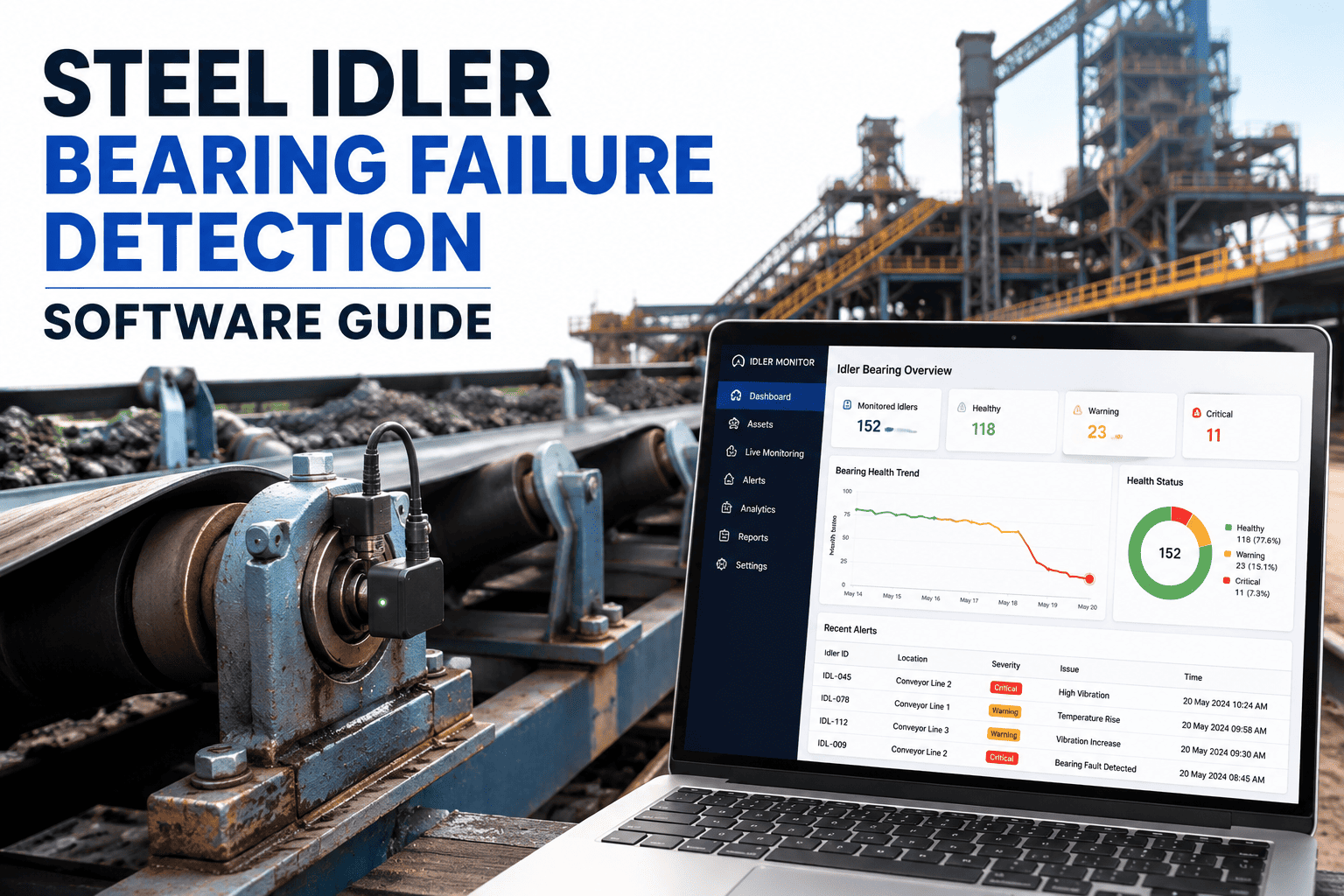
Steel Idler Bearing Failure Detection Software Guide
How steel plants register every idler as a maintainable asset, capture an acoustic and thermal baseline per roller, and generate a replacement work order before a bearing fault becomes a belt rip — turning thousands of scattered rollers into one connected condition-monitoring programme.
Why Idler Bearing Failure Is a Belt Problem in Disguise
An idler roller is a simple, cheap part — a steel shell on two sealed bearings, bolted into a frame under the belt. Its simplicity is exactly why it gets overlooked. A steel plant conveyor carrying sinter, coke, or hot briquetted iron can have hundreds of these rollers on a single flight, and a plant with several long overland runs can be managing tens of thousands of them across the site. Individually, each idler is low value. Collectively, they are one of the highest-frequency failure sources on the entire material handling network, because bearing wear is stochastic — it can happen at any position, at any time, without a predictable pattern.
The economics only make sense when the idler is viewed as part of a chain rather than as an isolated component. The roller itself might cost very little to replace on a bench. What it protects is the belt running over it, and belt replacement or splice repair on a wide, steel-corded conveyor is measured in weeks of lead time and a production line that cannot move material in the meantime. A maintenance programme that treats every idler as disposable and reactive is, in effect, gambling the belt on a part nobody is watching until it fails.
From First Pit to Seized Roller — The Bearing Failure Timeline
Idler bearings rarely fail instantly. Grit and moisture work past the seal, contaminate the grease, and begin pitting the raceway under repeated rolling contact. That pitting produces a faint high-frequency acoustic signature and a subtle vibration pattern long before it produces heat or drag. Left unaddressed, the pitting spreads to spalling, the bearing starts running hot, friction increases, and the roller eventually locks solid against a belt still moving at full speed. Steel plant environments — heat, iron fines, and moisture from wet material — accelerate every stage of this timeline compared to a clean indoor conveyor.
Bearing fatigue life is also load-sensitive rather than linear, which is why two idlers installed on the same day can fail years apart. A roller carrying design load in a well-aligned frame can run for years past its rated hours, while a roller absorbing extra radial load from a bent bracket or an offset troughing set can reach the pitting stage in a fraction of the time. This is the reason calendar-based replacement intervals consistently under-catch some positions and over-replace others — the actual driver of remaining life is load and contamination, not the number of months since installation.
The Four Failure Modes Behind Most Idler Bearing Replacements
What a Reactive Idler Programme Actually Costs
Plants that run idlers to failure often describe the parts cost as small and move on — a single roller and two bearings are inexpensive on paper. The real cost shows up downstream, in the belt, the labour, and the schedule disruption that a seized roller sets off. Comparing the reactive path against a monitored one makes the case for early detection clearer than any single statistic, and it is the comparison most maintenance budgets are missing when idler spend gets reviewed only at the parts-cost line.
Acoustic, Vibration, and Thermal — Comparing the Three Detection Methods
Three inspection methods are used to catch a degrading idler bearing before it seizes, and each has a different reach, cost, and lead time. Acoustic monitoring listens for the characteristic high-frequency signature of a pitted raceway. Vibration analysis reads the same fault through amplitude and frequency patterns picked up by an accelerometer. Thermal imaging simply looks for the roller running hotter than its neighbours. None of the three is complete on its own — a programme that combines them, and logs the findings against a fixed asset record, closes far more of the detection gap than any single method used in isolation.
The order matters as much as the method. Acoustic and vibration signatures typically appear first, while the fault is still confined to the raceway surface. Heat only becomes measurable once friction has already increased, meaning a thermal-only programme will always catch failures later than one that also listens and measures vibration. A visual walk-line, meanwhile, only confirms what has already become obvious — it is a safety net, not an early warning system, and should never be the only method a plant relies on.
| Method | What It Detects | Typical Lead Time | Practical Limitation | CMMS Trigger |
|---|---|---|---|---|
| Acoustic | Early raceway pitting via high-frequency noise signature | 4–8 weeks before seizure | Requires a quiet baseline reading and route-based capture | Deviation from recorded baseline opens an inspection work order |
| Vibration | Bearing fault frequency patterns and imbalance | 3–6 weeks before seizure | Sensor placement and access can be difficult across thousands of idlers | Amplitude threshold breach logs a bearing condition alert |
| Thermal | Frictional heat once wear has already progressed | 1–3 weeks before seizure | Later-stage indicator — heat appears after damage has begun | Temperature differential above baseline triggers replacement WO |
| Visual walk-line | Visible wobble, dust seal failure, obvious drag marks | Days, if the roller has already begun failing visibly | Depends entirely on inspector route coverage and timing | Logged as a defect against the idler's asset record |
OxMaint registers every idler as an individual asset, stores its acoustic and thermal baseline, and raises a replacement work order the moment a reading drifts past threshold — before the bearing seizes.
Acoustic Baselines and Vibration Routes — Building a Fault Library Per Idler
An acoustic route is walked or ridden along the conveyor at a fixed interval, capturing a short sound sample at each idler position. The first pass establishes a healthy baseline for every roller. Every subsequent pass is compared against that baseline rather than against a generic industry threshold, because background noise, belt speed, and material load vary from conveyor to conveyor. A roller that drifts from its own recorded baseline — even if it is still quieter than a neighbouring idler — is the one worth flagging first.
This baseline-per-asset approach is what separates a useful acoustic programme from a noisy one. Without a fixed asset record behind each reading, drift over time is invisible and every inspection starts from zero. Vibration routes follow the same logic — a handheld accelerometer reading taken at each idler position is only meaningful when it can be compared against that roller's own history, not a generic amplitude table copied from a bearing catalogue.
Registering Every Idler as a Maintainable Asset
A conveyor with a thousand idlers is not one asset — it is a thousand assets, each with its own installation date, bearing type, position, and failure history. Treating idlers as a single generic line item on a work order is the reason most plants cannot tell whether a given position is a chronic problem spot or a one-off failure. A tracked asset register turns that question into a report instead of a guess.
This also changes how spare parts are managed. Idler bearings and pre-assembled rollers typically need to be kept in stock rather than ordered on demand, because a seized roller left in place even briefly risks belt damage. Knowing which bearing type and size sits at which position, ahead of time, means the right spare is already on the shelf when a threshold breach opens a work order — instead of a maintenance planner discovering the correct part number after the roller has already locked up.
Idler bearings are not glamorous equipment, which is precisely why they get under-tracked. A steel plant conveyor network can carry tens of thousands of them, and any one can fail on any given day. Acoustic and vibration monitoring have been proven repeatedly to catch a pitted raceway weeks before it becomes a seized roller — the technology is not the barrier. The barrier is a system that ties every reading back to a specific idler position, watches for drift from that idler's own baseline, and turns a threshold breach into a work order automatically. Plants that build that discipline stop losing belts to rollers nobody was watching, and they stop treating every replacement as an emergency instead of a scheduled task.
Frequently Asked Questions
How early can acoustic monitoring detect a failing idler bearing?
A raceway pitting fault typically produces a detectable acoustic signature four to eight weeks before the bearing actually seizes, provided the reading is compared against that specific idler's own recorded baseline rather than a generic threshold. The lead time shortens for idlers at high-impact positions such as loading points. Book a demo to see acoustic baseline tracking per idler in OxMaint.
Why do idlers at transfer points fail faster than idlers on a straight run?
Idlers positioned directly under a chute or loading point absorb repeated impact loading from falling material, which accelerates raceway wear compared to idlers on an unloaded stretch of belt. These positions should be inspected on a shorter cycle than the rest of the conveyor.
Is vibration monitoring practical across thousands of idlers on one conveyor?
Fixed sensors on every idler are rarely economical given the sheer count involved, so most plants use route-based vibration and acoustic capture on a weekly or monthly cycle instead, prioritised toward high-load and loading-point positions first. Fixed sensors are then reserved for the small number of positions with a chronic failure history.
Why does misalignment shorten idler bearing life so significantly?
Bearing fatigue life is highly sensitive to load, so a misaligned frame or troughing set that raises radial load on the bearing can cut its service life by years without any single dramatic failure event pointing to the cause. A repeated early-failure pattern at one position is usually the first clue.
How does asset-level tracking change idler bearing replacement decisions?
Registering each idler by conveyor and position turns replacement history into a report instead of a guess, surfacing chronic failure positions that need a root-cause fix rather than another reactive swap. It also means the right spare is already known and stocked before the next failure occurs. See OxMaint's idler asset register in action.
Catch the Next Idler Bearing Failure Weeks Before It Tears a Belt.
OxMaint registers every idler across your conveyor network as a tracked asset, stores its acoustic, vibration, and thermal baseline, and raises a replacement work order automatically the moment a reading drifts — turning thousands of unwatched rollers into one connected maintenance record, with the correct spare already flagged before the roller ever locks up.