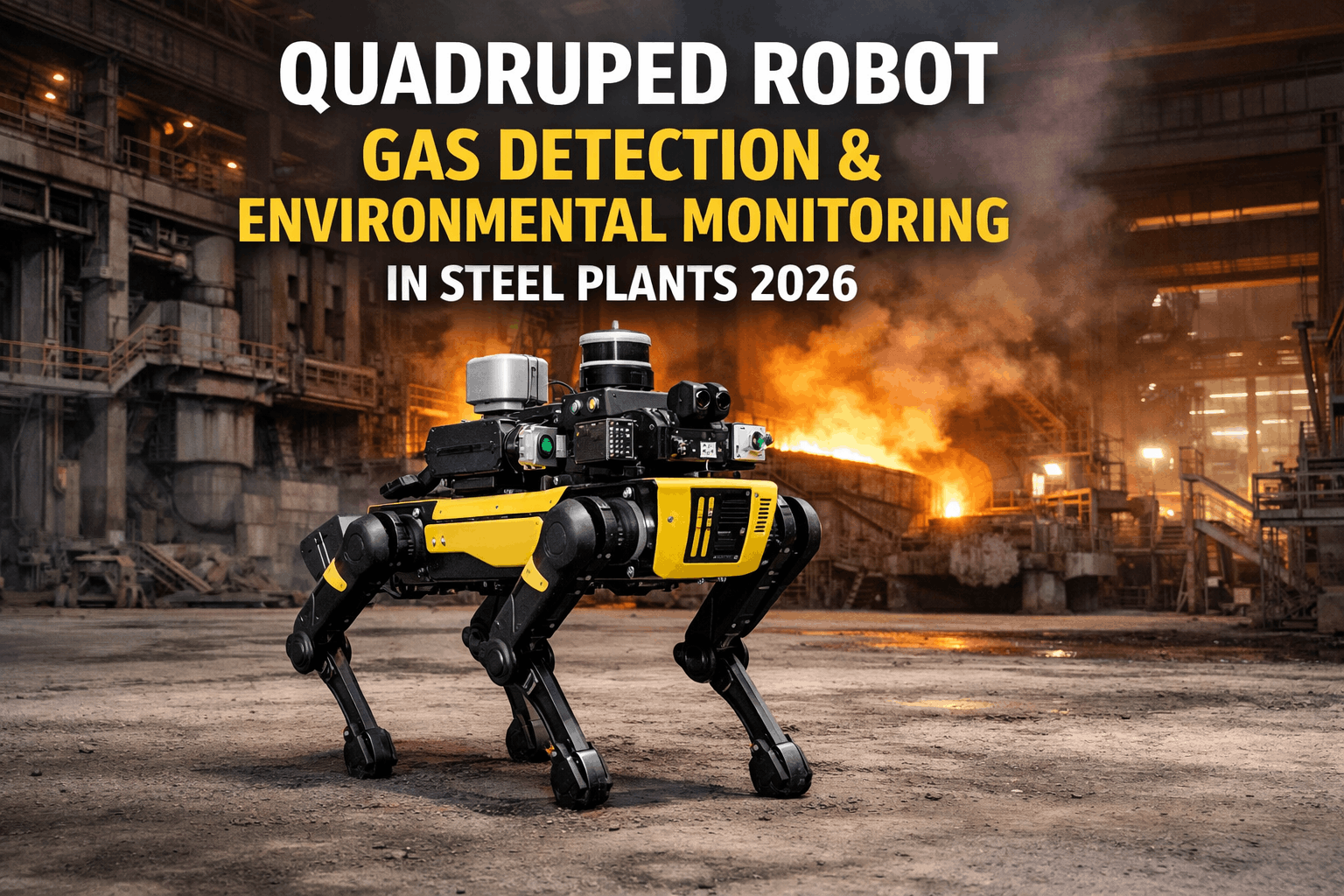
Steel plants operate some of the most hazardous, hard-to-access structures in heavy industry — blast furnace shells, tall stacks, crane runway rails at 30+ metres, and expansive roofing with active heat sources directly below. Traditional scaffold and rope-access inspection programmes are slow, expensive, and expose personnel to unnecessary risk. Sign in to OxMaint to connect your drone inspection findings directly to work orders, asset records, and maintenance schedules — or book a demo to see how drone-generated inspection data flows into your CMMS automatically.
Robotics & Automation / Steel Plant
Drone Inspection Programs for Steel Plants: Structural, Thermal & Environmental Surveys
From blast furnace shell surveys to gas stack thermal imaging — how steel plants are replacing high-risk manual inspections with UAV programmes that deliver faster data, safer access, and work orders that close the loop automatically.
$47B
Projected drone inspection market by 2034, growing at 15.5% CAGR from $12.94B in 2024
Zero
Personnel at height required for structural, thermal, or chimney inspection — drone replaces rope access
55min
Flight time on high-endurance platforms like DJI Matrice 300 RTK — covers large plant structures in a single sortie
24/7
Thermal drone capability — infrared operates in complete darkness, enabling night surveys of hot structures
Why Steel Plants Are the Perfect Drone Inspection Environment
Steel plant structures present inspection challenges that no other industry matches — extreme height, continuous thermal emissions, toxic gas environments, and structures that cannot be accessed during production without stopping the process. Drones address all four simultaneously: they operate without personnel at height, detect surface temperature anomalies with infrared sensors, carry gas sensors into emission zones, and collect data without any production interruption.
01
Structural Survey
Furnace shells · Crane runway rails · Stack exteriors · Roofing · Gantry steelwork
Detects: corrosion, weld cracks, deformation, refractory spalling, fastener loss
02
Thermal Imaging
Furnace shells · Ladle preheaters · Refractory linings · Electrical switchgear · Hot gas ducts
Detects: refractory hotspots, shell overheating, insulation failure, heat loss zones
03
Gas & Environmental
Stacks · Gas mains · Coke oven batteries · Tapping areas · Confined emission zones
Detects: CO leaks, H₂S concentrations, methane, blast furnace gas, regulatory exceedances
04
LiDAR Scanning
Stockyard volumes · Structural deflection · As-built verification · Deformation monitoring
Delivers: centimetre-accurate 3D point clouds — no ground survey required
Steel Plant Drone Survey Scope by Asset Type
| Asset |
Inspection Type |
What Drone Finds |
Traditional Alternative |
Frequency |
| Blast Furnace Shell |
Thermal + Visual |
Refractory wear, stave hotspots, shell deformation, leaks at tuyere zone |
Manual inspection from elevated platform — 2–3 day production impact |
Quarterly |
| Chimney / Stack |
Visual + LiDAR |
Lining cracks, corrosion bands, deformation from thermal cycling, cap damage |
Rope access inspection — specialist crew, 3–5 day programme |
Annual |
| Crane Runway Rails |
Visual + LiDAR |
Rail wear, fishplate looseness, weld cracking, gantry structure corrosion |
Manual track walk — production exclusion zone required |
Biannual |
| Plant Roofing |
Visual + Thermal |
Membrane failure, water infiltration, insulation breakdown, skylight seal failure |
Walking inspection — personnel at height risk, restricted access |
Biannual |
| Gas Mains & Ducts |
Gas sensor survey |
BF gas, CO, CH₄ concentrations above threshold — precise leak localisation |
Stationary fixed sensors — gap coverage between sensor locations |
Monthly |
| Electrical Switchgear |
Thermal |
Overloaded connections, failing insulators, thermal runaway in panels |
Handheld IR camera — requires panel access, personnel proximity |
Quarterly |
Connect Every Drone Finding to a Work Order in OxMaint
Drone-detected defects that do not generate a tracked work order are data, not maintenance. OxMaint closes the loop — from UAV finding to assigned technician, repair record, and asset history update.
Building a Steel Plant Drone Programme: The Four Pillars
1
Platform & Payload Selection
Match the drone platform to the inspection type. Structural and thermal surveys of furnace shells and stacks require multi-payload platforms with extended flight time — the DJI Matrice 300 RTK (55-minute flight time, 2.7 kg payload) is the industry benchmark for heavy industrial surveys. Confined-space structures like coke oven offtake systems require cage-protected platforms such as Flyability Elios 3. Gas detection surveys use platforms carrying remote laser methane detectors or electrochemical sensor arrays. Dual-sensor payloads — combining high-resolution RGB with radiometric thermal — are the most efficient choice for general structural surveys: one flight delivers both visual and thermal data.
2
Flight Safety & Permit Framework
Steel plants operate within restricted airspace categories in most jurisdictions. A drone programme requires regulatory approval (FAA Part 107 in the US, A2 CofC under EASA in Europe, equivalent national frameworks elsewhere), site-specific risk assessments, and coordination with plant safety management. Minimum distances from personnel, hot metal operations, and live electrical equipment must be defined in the programme's standing operating procedure. Every flight requires a pre-flight briefing, a designated observer, and a defined emergency procedure — including what happens when a drone fails over an active casting area or a gas emission zone. These are not bureaucratic steps; they are what separates a functioning drone programme from one that gets suspended after the first incident.
3
Data Capture Standards
Drone data without standards is just imagery. A steel plant drone programme needs defined coverage requirements — minimum overlap for photogrammetric models, required altitude and sensor angle for thermal surveys, minimum pixel resolution for crack detection on structural steel. Thermal surveys of furnace shells require radiometric calibration at a known surface emissivity — uncalibrated thermal images cannot be compared between surveys or used to set temperature alarm thresholds. Every survey must record GPS position, altitude, sensor settings, and environmental conditions (ambient temperature, wind speed) — these are the variables that determine whether two thermal images taken six months apart are comparable.
4
Finding-to-Work-Order Integration
The drone survey generates the finding. The CMMS converts it into maintenance action. Without this integration, drone inspection programmes produce large volumes of imagery that sit in folders while the defects they document continue to develop. Each identified defect — a shell hotspot, a crane rail crack, a stack corrosion band — must generate a work order in OxMaint with the asset ID, defect description, GPS coordinates or zone reference, severity classification, and attached image evidence. The work order is then prioritised, assigned, and tracked to completion like any other maintenance task. This is how drone data becomes maintenance value, not just inspection cost.
"
The technology question in steel plant drone inspection was solved five years ago. The operational question — how do you turn a thermal hotspot on a furnace shell into a closed work order with a verified repair — is still being answered badly at most facilities. I have reviewed drone inspection reports that identified 40 or 50 defects across a plant. Three months later, I cannot find evidence that more than a handful were actioned. The images went into a report. The report went to a manager. And then the process stopped. The drone programme budget is justified by the defects it finds. The value is only realised when those defects are repaired in a tracked, documented way. The CMMS is not optional infrastructure for a drone programme — it is the entire point of one.
How OxMaint Integrates with Your Drone Programme
Work Orders
Defect to Work Order in One Step
Log drone findings directly in OxMaint mobile — attach the thermal or visual image, classify the defect severity, and generate the work order against the asset record. The inspection finding and the repair record live in the same system.
Asset History
Survey Records Against Asset Timeline
Every drone survey is stored against the asset in OxMaint. Shell hotspot progression from survey to survey is visible in the asset history — the data that justifies reline timing, repair investment, and remaining life assessment.
Scheduling
Drone Survey Scheduling by Asset & Frequency
Configure drone survey frequencies per asset class — quarterly for furnace shells, annual for stacks, monthly for gas surveys. OxMaint generates the survey task at the right interval and tracks completion against the schedule.
Compliance
Inspection Records for Regulatory Compliance
Drone inspection records in OxMaint serve as documented evidence for environmental compliance, structural integrity programmes, and insurance surveys — with timestamps, asset linkage, and technician attribution on every record.
Drone Data Without a CMMS Is Just Cost. Connect Both in OxMaint.
OxMaint links your UAV inspection findings to work orders, asset history, and maintenance schedules — turning every thermal hotspot and structural defect into a tracked, documented repair.
Frequently Asked Questions
Can drones inspect blast furnace shells and refractory linings while the furnace is in production?
Yes — and this is one of the primary advantages of drone inspection in steelmaking. Radiometric thermal drones measure surface temperature on an operating furnace shell without any personnel at height and without any production interruption. Hotspots indicating refractory thinning or stave damage are identified by comparing measured surface temperature against expected values for a healthy shell at that production rate. The data supports reline planning based on actual condition rather than calendar intervals.
Sign in to OxMaint to store thermal survey records against your furnace assets and track shell condition across campaigns.
What qualifications does a drone pilot need to operate in a steel plant environment?
Pilots require both the regulatory qualification for commercial operations in the relevant jurisdiction — FAA Part 107, EASA A2 CofC, or national equivalent — and steel plant-specific site induction covering hot metal safety, gas hazard awareness, and the plant's permit-to-fly procedure. Many plants also require the pilot to carry liability insurance and to submit a site-specific risk assessment and flight plan before each survey is approved. Existing rope-access or confined-space qualifications are not transferable — drone operations in steel plants have distinct hazard profiles requiring dedicated training.
How is drone inspection data stored and made useful for future maintenance decisions?
Raw drone imagery and thermal maps should be stored linked to the specific asset in the CMMS — not in standalone folders or third-party platforms. Linking survey data to the asset record means that when a maintenance engineer reviews a furnace shell for reline planning or a stack for structural repair, the full visual and thermal history is immediately accessible alongside the work order and maintenance records for the same asset. OxMaint stores drone survey findings, attached images, severity classifications, and generated work orders all against the asset timeline — giving maintenance teams the longitudinal data needed to spot trends and justify capital decisions.
Book a demo to see the asset history and drone integration workflow.