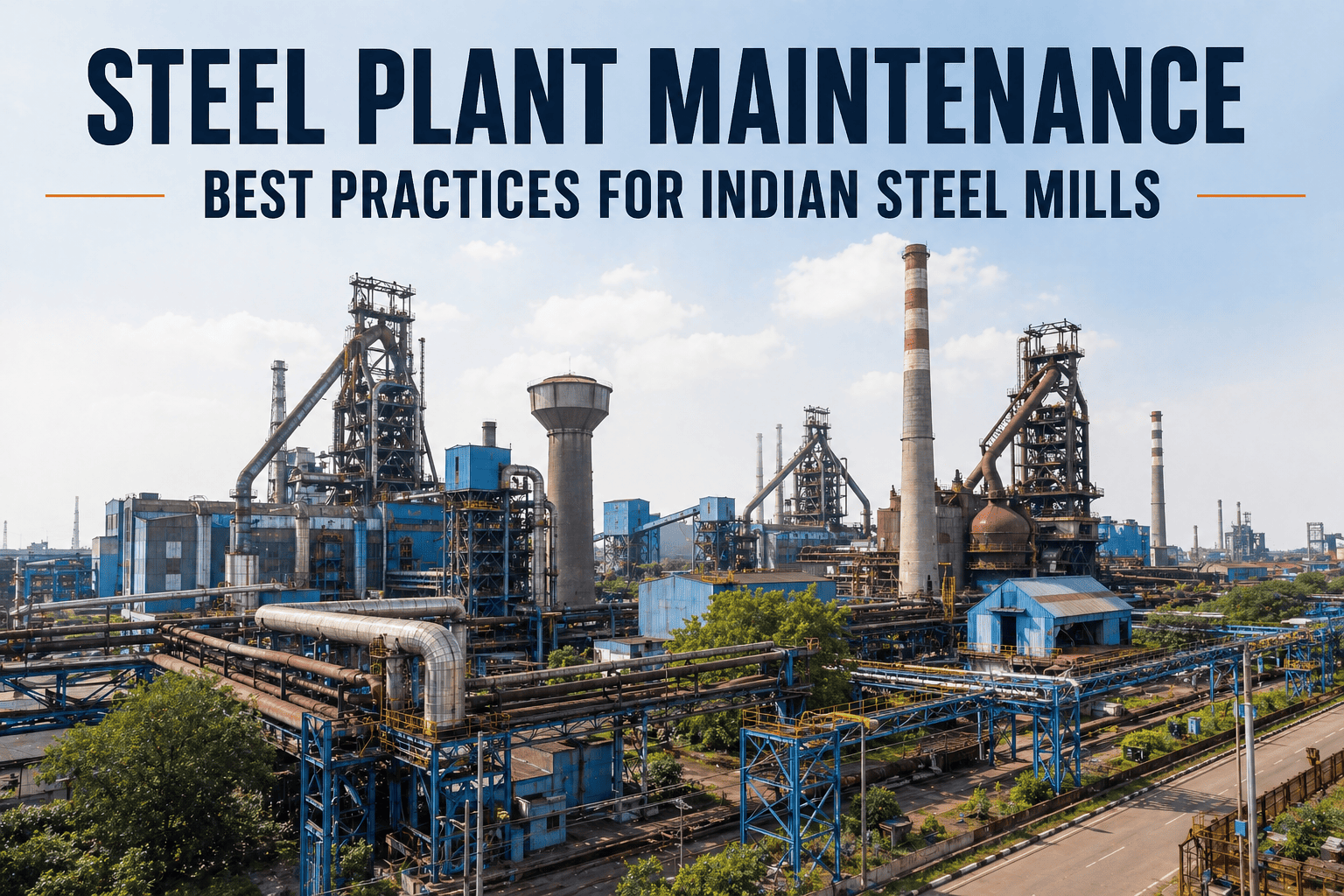
India is now the world's second-largest steel producer, with crude steel output reaching 96.08 MT in the first seven months of FY2025–26 alone — and the country's top mills are racing to match global maintenance standards. OxMaint's analytics and reporting platform is already helping Indian steel operations close the gap between reactive breakdowns and data-driven reliability. From BIS Quality Control Order compliance to predictive maintenance across blast furnaces, this guide covers what India's steel mills must prioritise in 2026.
Steel Plant Maintenance Best Practices for Indian Steel Mills — 2026 Guide
BIS compliance, CMMS-driven predictive maintenance, energy optimisation, and asset reliability strategies for Tata Steel, JSW, SAIL, and India's 30+ integrated steel plants.
QCO 2024 mandates BIS-certified input materials for all steel categories. Maintenance programmes must now integrate compliance traceability.
Industry leaders like JSW Steel now run AI-powered platforms across 2,900+ critical assets. CMMS-native integration is the new baseline.
CREP action points require plants to reduce energy and water intensity. Maintenance-linked energy tracking is now an audit obligation.
BIS Compliance as a Maintenance Discipline
The Steel and Steel Products Quality Control Order 2024, effective June 16, 2025, covers 151 Indian Standards under Chapters 72 and 73 of the ITC(HS) codes. For maintenance teams, this means every raw material and input used in production must trace back to a BIS-certified source — and documentation must survive a Steel Import Monitoring System (SIMS) audit.
Predictive Maintenance: India's Industry Leaders Show the Way
JSW Steel's Industry 4.0 transformation is the clearest benchmark for Indian steel maintenance. Their AI-powered Predictive Maintenance Platform, running across 10 plants and over 2,900 critical assets, avoided 25,000 hours of unplanned downtime in FY2024–25. Digital Twins delivered up to 12% downtime reduction and measurable maintenance cost savings. These are not aspirational targets — they are documented operational outcomes from Indian plants operating under Indian conditions.
| Maintenance Approach | Failure Detection | Cost Profile | Downtime Impact | India Adoption |
|---|---|---|---|---|
| Reactive (Run-to-Fail) | After failure | High emergency cost | Unplanned, often days | Small/mini mills |
| Calendar-based PM | At fixed intervals | Medium — over-maintenance risk | Planned, but may miss developing faults | Widely adopted |
| Condition-Based (CBM) | Sensor threshold breach | Lower — act only when needed | Planned, shorter windows | SAIL, Tata Steel |
| Predictive (AI/ML) | Days to weeks ahead of failure | Lowest — prevents failure entirely | Eliminated in most cases | JSW Steel (2,900+ assets) |
How Indian Steel Mills Should Structure CMMS Rollout
Inventory every critical asset — blast furnaces, casters, rolling mills, cranes, motors — with nameplate data, operating parameters, and maintenance history. This is the data foundation for all analytics.
Replace paper job cards with timestamped digital work orders. Every maintenance task — preventive, corrective, emergency — is logged with technician identity, parts used, and completion time. This creates the failure history that predictive models learn from.
Deploy vibration, temperature, and current sensors on critical rotating equipment. Connect sensor alerts directly to CMMS work order generation — eliminating the alert-to-action delay that wastes most condition monitoring investments.
Use CMMS analytics to track MTBF, MTTR, maintenance cost per tonne of steel produced, and compliance certificate status. These KPIs feed management reporting and serve as evidence during BIS and Factory Inspectorate audits.
See how OxMaint's analytics dashboard gives Indian steel plant managers real-time visibility across assets, work orders, and compliance status.
Energy Optimisation — India's CREP Obligations and Maintenance Link
India's Corporate Responsibility for Environmental Protection (CREP) initiative, coordinated between the Ministry of Steel and CPCB, requires major steel plants to reduce energy consumption, water intake, and solid waste generation beyond regulatory minimums. Critically, much of the energy efficiency gap in Indian steel plants is a maintenance problem: fouled heat exchangers, misaligned drives, steam trap failures, and compressed air leaks collectively waste 8–15% of energy input in plants without structured maintenance programmes.
Fouled surfaces on boilers, recuperators, and waste heat recovery units reduce thermal efficiency by 10–15%. Monthly cleaning schedules with fouling factor measurements prevent progressive efficiency loss.
Misaligned couplings and worn bearings on large drives — rolling mill motors, fans, pumps — increase energy draw by 3–8%. Vibration-based alignment checks during planned PM reduce this loss continuously.
Industry surveys find 20–30% of compressed air in Indian industrial plants is lost to leaks. Ultrasonic leak detection as part of monthly plant rounds, with immediate work order generation for leak repairs, eliminates this hidden energy cost.
Blast Furnace Gas (BFG) recovery systems require tight maintenance of seals, valves, and recovery infrastructure. JSW Steel's AI vision systems at Vijayanagar specifically target gas flaring reduction — documenting measurable recovery gains from maintenance-driven leak elimination.
Key Maintenance KPIs for Indian Steel Mills
| KPI | Measurement | Industry Target | Review Frequency |
|---|---|---|---|
| Maintenance Cost per Tonne | Total maintenance spend / Steel tonnes produced | ₹ 800–1,200 per tonne (integrated mills) | Monthly |
| Overall Equipment Effectiveness (OEE) | Availability × Performance × Quality | > 80% for critical equipment | Weekly |
| Mean Time Between Failures (MTBF) | Operating hours / Number of failures | Rising trend — target specific by asset class | Monthly |
| Planned vs. Emergency Maintenance Ratio | Planned work orders / Total work orders | > 75% planned | Monthly |
| BIS Certificate Compliance Rate | Valid certificates / Total required | 100% — zero lapses | Monthly CMMS alert |
| Energy Intensity (Maintenance-Attributable) | GJ per tonne after maintenance improvements | Track against CREP baseline targets | Quarterly |
What India's Steel Maintenance Leaders Say
The shift from paper-based job cards to CMMS digital work orders was the single most impactful maintenance change we made. Within six months of implementation, our MTBF on critical rotating equipment improved by 22% simply because we could now see patterns in failure data that were invisible when records were scattered across shift logbooks.
Chief Maintenance Engineer, Integrated Steel Plant, Odisha (18 MTPA capacity)BIS QCO compliance has changed the maintenance conversation in India. It is no longer just about equipment reliability — it is about traceability. Every material used in production now carries a certification trail that maintenance teams must understand and manage. Plants that have not yet integrated BIS certificate tracking into their CMMS are sitting on an invisible compliance risk.
Senior Metallurgist and Compliance Head, Mini Steel Mill Cluster, GujaratEnergy savings from maintenance are the fastest-payback investments available to Indian steel plants right now. We identified over ₹4.2 crore per year in recoverable energy losses from steam traps, compressed air leaks, and heat exchanger fouling in a single 4 MTPA plant — all through better maintenance scheduling and monitoring, without any capital expenditure.
Energy Auditor (BEE-certified), Steel Sector Energy Efficiency Programmes, MaharashtraFrequently Asked Questions
Give Your Indian Steel Plant a Maintenance System Built for 2026
OxMaint's analytics and reporting platform connects your maintenance data — work orders, asset health, BIS compliance status, and energy KPIs — into a single dashboard that drives decisions, not just records them.

.png)


