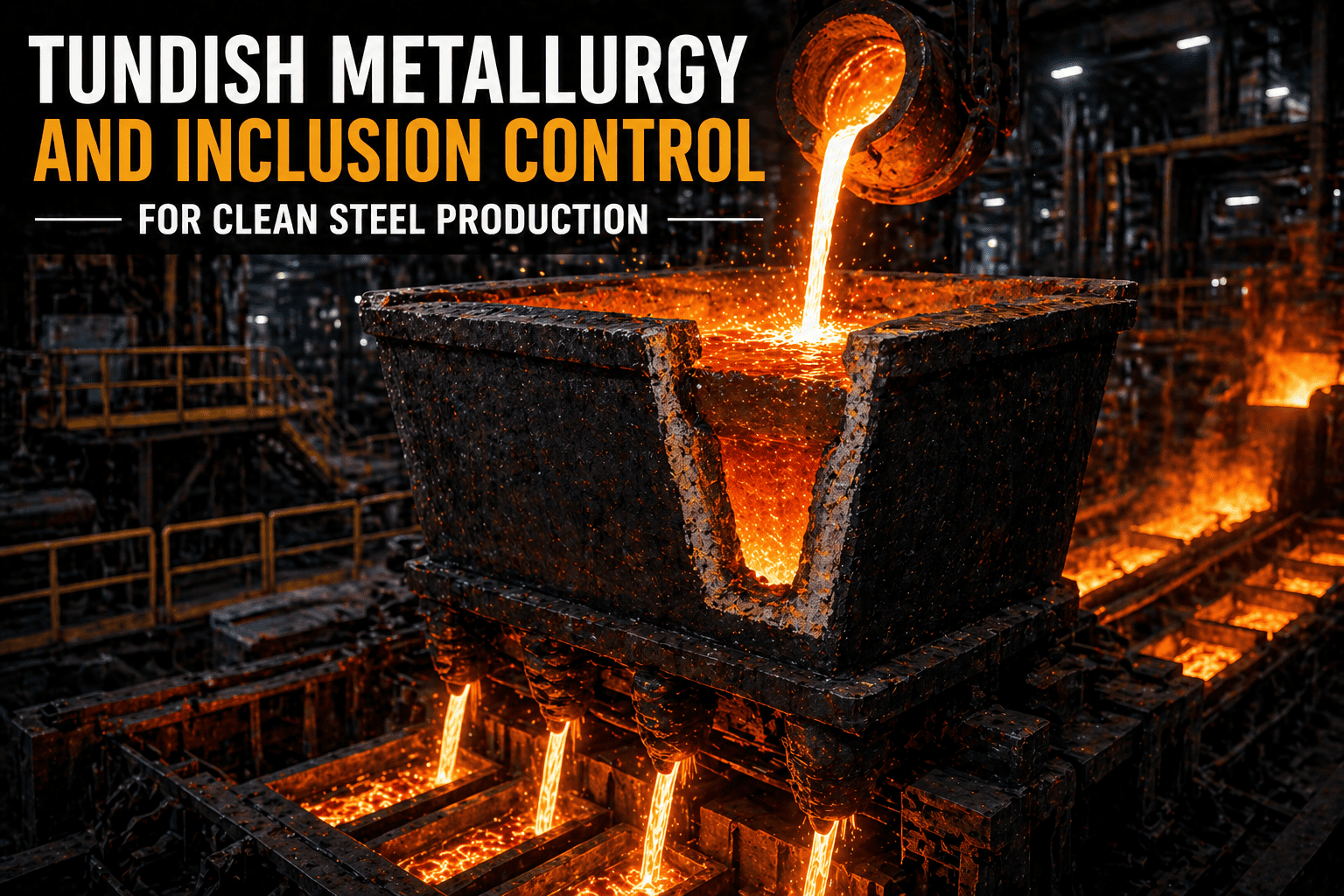
The tundish is the last metallurgical vessel through which liquid steel flows before solidifying in the continuous casting mold — and it is the final opportunity to control steel cleanliness before defects are locked permanently into the solidified product. Approximately 90% of the world's steel is continuously cast, making tundish performance a universal concern for steel quality. When tundish flow is optimized with dams, weirs, and turbulence inhibitors, inclusion removal rates increase from 30% to over 43%. When refractory integrity is compromised or flux management is inconsistent, inclusions exceeding 200 μm reach the mold and create surface defects, internal cracks, or subsurface voids that cause rejection at downstream processing or customer use. This guide covers the complete tundish metallurgy system — flow control, inclusion management, refractory monitoring, and how AI-powered CMMS integrates all four into a continuous quality and maintenance program. Book a demo to see how Oxmaint manages tundish PM and quality data in one platform.
Steel Product Quality
Predictive Maintenance AI
P1 — Critical
90%
Global steel output via continuous casting — tundish is in every heat
43.2%
Inclusion removal rate — optimized flow control vs. 30% baseline
21%
Reduction in inclusion area — optimized tundish flow, plant trials
200 μm
Critical inclusion size — above this, defects reach final product
Tundish as Metallurgical Vessel
What the Tundish Does — and What Happens When It Fails
01
Buffer Between Ladle and Mold
Maintains continuous steel flow to multiple mold strands while ladles are exchanged. Tundish volume and temperature control determine grade intermixing length during ladle changes and skull formation rates during sequence starts.
02
Inclusion Floatation and Removal
Molten steel residence time in the tundish determines how many non-metallic inclusions have time to float to the slag surface. Longer, plug-flow-dominant residence time removes more inclusions. Short-circuit flow paths reduce residence time and allow inclusions to bypass removal.
03
Temperature Homogenization
Temperature variation across tundish strands creates differential solidification rates, affecting as-cast microstructure and surface quality. Tundish heating systems and flow control devices minimize strand-to-strand temperature variation to within ±3°C.
04
Slag Entrainment Prevention
Tundish flux covers the steel surface and absorbs floating inclusions. Flux management failures — inadequate coverage, wrong chemistry, or degraded flux — allow slag re-entrainment into the flow path, sending macro-inclusions directly to the mold.
Flow Control Systems
Flow Control Devices and Their Impact on Inclusion Removal
Turbulence Inhibitor
Dampens ladle stream impact energy — prevents surface turbulence and slag entrainment at ladle shroud impact zone
High — prevents macro-inclusions from ladle stream turbulence
Inspect for erosion every heat; replace at 30% wear
Retaining Walls
Prevents surface reflux; confines impact zone; induces upward flow carrying inclusions to slag surface
High — medium/large inclusion removal from 23.7% to 9.1%
Refractory thickness measurement every 3–5 heats
Dams
Directs steel flow downward then upward, increasing residence time and promoting inclusion floatation before steel reaches the SEN
Medium-High — extends effective residence time by 15%+
Height measurement; replace when eroded below design height
Gas Curtain / Injection
Argon gas injection creates upward bubble curtain that promotes inclusion collision-aggregation and floatation
High — inclusion removal rate increases from 30.09% to 43.20%
Gas flow rate calibration before each heat; porous plug inspection
Subentry Nozzle (SEN)
Controls steel flow from tundish into mold; nozzle geometry determines mold flow pattern and meniscus stability
Medium — clogging creates asymmetric flow causing surface defects
Thermal imaging monitoring for clogging; replace per sequence limit
Refractory Monitoring
Tundish Refractory — The Highest-Risk Maintenance Item in Clean Steel
Tundish refractory failure is not a maintenance event — it is a casting event. A breakthrough, even a minor one, introduces refractory-derived inclusions directly into the steel stream at a point where no further removal is possible. A campaign extended beyond the erosion limit costs less than one heat's worth of rejected product in direct terms, but the reputational and customer cost of a cleanliness excursion in automotive or electrical steel grades is orders of magnitude higher.
Highest Risk
Working Lining — Impact Zone
Erosion accelerates at the ladle stream impact point. Thickness measurement every 3–5 heats. Replace when measured thickness reaches minimum safe limit. Never extend based on heat count alone.
Inspection: Every 3–5 heats
Tundish Floor Lining
Floor erosion from steel velocity is progressive. Laser profiling or physical measurement at each heat. CMMS tracks erosion rate trend — not just point measurements — enabling campaign end prediction 5–8 heats in advance.
Inspection: Each heat
Well Block and Nozzle Seat
Well block erosion affects steel drain rate and slag carry-over risk at heat end. Nozzle seat condition determines SEN sealing quality — gap wear allows secondary air ingress and reoxidation inclusion generation.
Inspection: Each campaign change
Safety Lining
Permanent safety lining behind the working lining. Inspected visually at each skull removal. Thickness survey using infrared temperature measurement of tundish shell — rising shell temperature indicates working lining consumption rate.
Inspection: Each skull removal
Inclusion Management System
Types of Inclusions, Their Sources, and Control Strategies
Link Tundish Maintenance Records to Cast Quality Data in Oxmaint
Oxmaint tracks refractory erosion trends, flow device inspection records, flux consumption data, and total oxygen measurements in a single tundish asset profile — so every inclusion excursion traces back to a specific maintenance event or process deviation.
Predictive Maintenance Integration
AI-Powered Tundish Monitoring — What to Measure and When to Act
01
Shell Temperature Trending
Infrared camera continuous monitoring of tundish shell. Rising temperature at any zone indicates working lining wear at that location. AI baseline per heat number detects acceleration in erosion rate 3–5 heats before the safety limit is reached — enabling planned campaign end rather than emergency stoppage.
02
Mold Thermal Mapping
Mold copper thermocouple arrays detect asymmetric temperature distribution caused by SEN clogging or misalignment. AI identifies the distinctive thermal pattern of partial SEN blockage 15–20 minutes before it causes meniscus instability — triggering a SEN change order before surface defects are generated.
03
Total Oxygen Trend Analysis
Continuous or per-heat total oxygen measurements in tundish steel. Upward trend indicates either increasing reoxidation (shroud integrity failure) or inclusion generation in the tundish (refractory reaction). AI distinguishes between the two signatures using concurrent temperature and flow data.
04
Argon Flow Optimization
AI correlates argon injection flow rates with inclusion removal efficiency data from downstream sampling. Optimizes flow rate per steel grade to maximize inclusion collision-aggregation without generating surface turbulence from excessive gas flow — a balance that fixed-rate injection cannot achieve.
Expert Review
What Steel Quality Engineers Say About Tundish Metallurgy
"The tundish is where clean steel programs are won or lost in practice. Ladle refining can achieve excellent cleanliness — and then a worn turbulence inhibitor, a misaligned shroud, or inadequate flux coverage destroys it in the first heat. Refractory erosion rate trending in a CMMS that links heat number to measured thickness is the most important predictive maintenance capability a steel plant can build for tundish quality control. The data exists. Most plants just are not using it systematically."
Steelmaking Process Engineer
Integrated Steel Plant — 2.8 MTPA, Automotive Grade Production
"The 21% reduction in inclusion area percentage we achieved through optimized flow control was not from capital investment in new equipment. It was from systematic tracking of retaining wall erosion and consistent turbulence inhibitor replacement at the correct heat interval — neither of which was being done reliably before we put the tundish refractory inspection on a CMMS work order cycle. Maintenance discipline is the most underrated lever in clean steel production."
Quality Manager — Continuous Casting
Electric Arc Furnace Steel Plant — Special Bar Quality, Central Europe
Frequently Asked Questions
Tundish Metallurgy and Inclusion Control — Common Questions
How does tundish flow control affect steel cleanliness?
Flow control devices — turbulence inhibitors, retaining walls, dams, and gas curtains — redirect steel flow from the ladle stream impact zone toward the SEN exit in a way that maximizes residence time and promotes upward flow of inclusions to the slag surface. Optimized flow control devices have demonstrated inclusion removal rate improvements from 30% to over 43%, and a reduction in medium-to-large inclusions from 23.7% to 9.1% in industrial plant trials.
Start a free trial to set up heat-by-heat flow device inspection tracking in Oxmaint.
What is the critical refractory wear indicator that triggers a tundish campaign change?
The primary indicator is working lining thickness at the impact zone — typically measured physically or by profilometry every 3–5 heats. Shell temperature measured by infrared camera provides a continuous, heat-by-heat indicator of total lining consumption. CMMS tracking of erosion rate (mm per heat) is more reliable than heat count alone, because erosion rate varies with steel grade, temperature, and ladle open eye size. AI trend analysis flags accelerating erosion rate 3–5 heats before the minimum thickness limit is reached.
Book a demo to see how Oxmaint manages tundish refractory lifecycle tracking.
How does argon injection in the tundish improve inclusion removal?
Argon injection creates a rising bubble curtain that promotes collision between small inclusions, causing them to aggregate into larger clusters that float more rapidly to the slag surface. Research using population balance models demonstrates that this collision-aggregation mechanism increases overall inclusion removal rates from 30.09% to 43.20%, with the most significant improvement in inclusions below 25 μm — the size range that fixed-flow-path devices like dams and weirs cannot efficiently remove. Optimal argon flow rates are grade-dependent and should be calibrated using downstream total oxygen data.
Start a free trial to link argon flow parameters to inclusion quality measurements in Oxmaint.
How can CMMS reduce inclusion-related rejections in continuous casting?
CMMS reduces inclusions by ensuring the maintenance-dependent drivers of inclusion generation — refractory erosion beyond limit, turbulence inhibitor wear, SEN clogging, flux coverage gaps — are detected and corrected before they compromise steel cleanliness. Oxmaint links every tundish PM work order to the corresponding heat number and downstream quality records, so rejection events can be traced to specific maintenance states. This traceability converts quality failures from unexplained incidents into correctable maintenance events.
Book a demo to walk through the tundish quality traceability workflow in Oxmaint.
Tundish Maintenance Is Clean Steel Maintenance. Make It Systematic.
Oxmaint connects tundish refractory erosion trending, flow device inspection records, argon flow calibration logs, and downstream quality data in one platform — so every inclusion excursion becomes a traceable, preventable maintenance event rather than an unexplained rejection.