The Middle East is warming at nearly twice the global average rate, with UAE temperatures reaching 51.8°C in August 2025 — one degree higher than the previous year's record. For GCC steel plant operators, this is not a climate statistic: it is a maintenance engineering constraint that reshapes every lubrication interval, bearing selection, electrical enclosure rating, and inspection frequency across every plant in the region. OxMaint's asset lifecycle management platform helps GCC steel mills build maintenance programmes calibrated to the actual operating environment — not European or US standards designed for temperate climates.
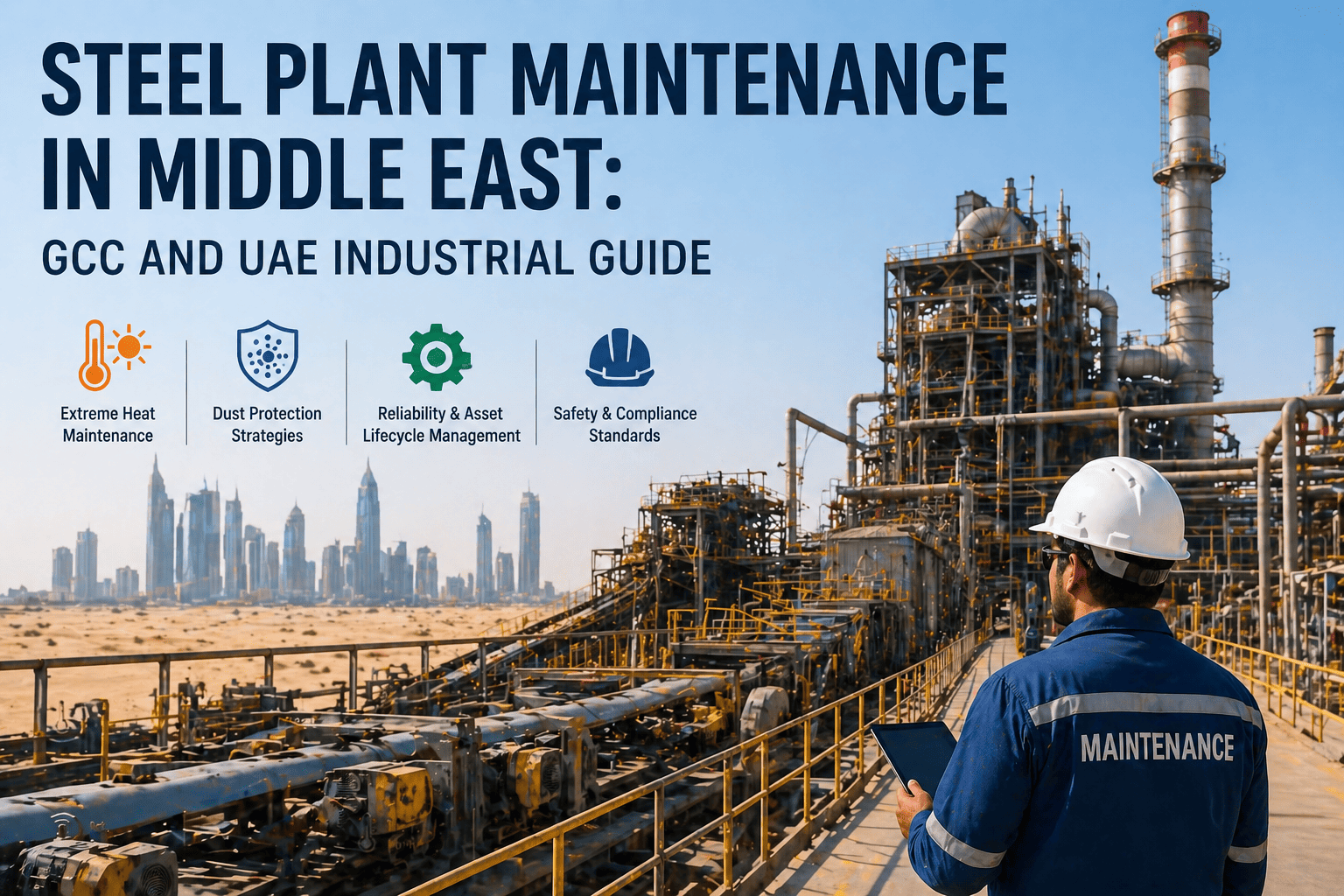
Steel Plant Maintenance in the Middle East: The GCC and UAE Industrial Guide
Extreme heat, windblown dust, coastal salt air, and weekend-shift regulatory frameworks create maintenance challenges that generic programmes cannot address. This guide covers what GCC steel mills must do differently — and why.
Four Climate Factors That Break Standard Maintenance Models
Ambient temperatures 40–52°C degrade lubricant viscosity, shorten bearing life, accelerate insulation breakdown, and reduce electrical component MTBF by up to 50% versus rated temperate-climate lifespans.
Shamal winds carry fine silica dust that infiltrates motor windings, control panels, and hydraulic systems. GCC plants report 3–5× higher filter replacement frequency than comparable European mills.
Salt-laden marine air accelerates corrosion on all exposed steel and electrical infrastructure. UAE coastal plant structures require corrosion protection grade C4–C5M under ISO 12944, not the C2–C3 standard for inland European sites.
GCC countries apply a mix of local standards (UAE ESMA, SASO in Saudi Arabia), OSHA-derived requirements, and project-specific specifications from NOCs and ARAMCO. Maintenance compliance requires tracking multiple frameworks simultaneously.
Heat-Adapted Lubrication and Bearing Management
Standard lubricant specifications — designed for 20–25°C ambient conditions — fail rapidly in GCC steel plants. At 45°C ambient, typical steel plant bearing temperatures run 30–40°C above ambient at the journal surface, placing operating temperatures at 75–90°C. This dramatically accelerates oil oxidation, degrades additive packages, and shortens relubrication intervals to fractions of temperate-climate schedules.
Dust Ingress Protection — Electrical and Mechanical Systems
Shamal and haboob dust storms deposit fine silica particulate across entire plant sites within hours. A single major dust event can block HVAC filters completely, infiltrate motor windings of any enclosure rated below IP55, and contaminate hydraulic systems through poorly sealed breathers. GCC steel maintenance programmes must treat dust as a primary failure mode, not a background nuisance.
OxMaint's asset lifecycle management tracks heat-adapted PM intervals, dust event response tasks, and corrosion inspection cycles — all in one platform built for GCC conditions.
Corrosion Management for GCC Coastal Steel Plants
Saudi Arabia, UAE, Qatar, Bahrain, and Kuwait all operate major steel facilities in coastal or near-coastal environments where chloride ion concentration in air and water is 10 to 100 times higher than inland European reference conditions. Asset lifecycle management in GCC steel plants must treat corrosion as the primary asset life limiter, not a secondary maintenance concern.
| Asset Category | Corrosion Risk (GCC Coastal) | Protection Specification | Inspection Interval |
|---|---|---|---|
| Structural Steelwork | C4–C5M (ISO 12944) | Hot-dip galvanising + duplex coating system; minimum 200 microns DFT | Annual — bi-annual in splash zones |
| Process Piping (water circuits) | High — chloride stress corrosion in SS | Duplex SS or lined CS; cathodic protection on buried sections | Bi-annual UT thickness check |
| Electrical Cable Trays | High — coating failure accelerated by UV + salt | Fibreglass or hot-dip galvanised; inspect coating continuity quarterly | Quarterly visual + annual coating check |
| Cooling Tower Structure | Very High — wet + salt + biological | FRP construction preferred; CS with epoxy lining at minimum | Semi-annual internal and external |
| Crane Gantry Structures | Moderate–High | Zinc-rich primer + epoxy mid + polyurethane top; recoat every 7–10 years | Annual full inspection |
GCC Regulatory Compliance: UAE ESMA, SASO, and Labour Safety
GCC steel plant maintenance programmes must navigate a dual regulatory landscape: technical standards for equipment and emissions (UAE ESMA, Saudi SASO, GSO standards) and labour safety frameworks governing outdoor work during peak summer heat. Saudi Arabia, UAE, and Qatar all mandate outdoor work bans during the hottest hours of the summer season, creating maintenance scheduling challenges for plants that depend on outdoor access for critical tasks.
What GCC Maintenance Engineers Say
European maintenance standards are a starting point, not an endpoint for GCC steel operations. Bearing relubrication intervals that work perfectly for 6 months in Germany fail within 8 weeks in a Saudi Arabian melt shop in July. Every PM interval on this site was re-engineered from first principles based on actual temperature data logged over three summer seasons.
Reliability Engineer, Integrated Steel Plant, Eastern Province, Saudi ArabiaDust storm response is a maintenance event, not a housekeeping event. After every major Shamal, we run a full insulation resistance check on every motor above 55 kW before returning to full load. We found three motors with significantly degraded winding insulation in the first year of this programme — all would have failed within 4 to 6 weeks without intervention.
Chief Electrical Engineer, Rolling Mill Complex, Abu Dhabi Industrial ZoneThe summer outdoor work ban is actually a planning opportunity, not just a restriction. We schedule all tasks requiring outdoor access before 10:00 AM and after 4:00 PM during June through September — and we use the midday window exclusively for indoor tasks, training, and documentation. With a proper CMMS, this scheduling is automatic, not manual.
Maintenance Manager, EAF Steel Plant, Dubai Industrial CityGCC Climate Acceleration Factors for Steel Plant Assets
| Asset | Standard Lifecycle (Temperate) | GCC Adjusted Lifecycle | Key Accelerator |
|---|---|---|---|
| Rolling Mill Bearings (Large) | 18–24 months | 10–14 months | Heat + dust contamination |
| Hydraulic Seals and Hoses | 24 months | 12–16 months | Heat-induced elastomer hardening |
| Motor Winding Insulation Class F | 20–25 years | 12–18 years | Continuous elevated temperature operation |
| External Coating Systems | 10–15 years | 5–8 years | UV + salt + thermal cycling |
| Panel Gaskets and Seals | 3–5 years | 1–2 years | UV degradation + dust abrasion |
| Belt Conveyor Components | 12–18 months | 8–12 months | Thermal expansion + dust loading |
Frequently Asked Questions
Build a Maintenance Programme Engineered for GCC Conditions
OxMaint's asset lifecycle management platform gives GCC steel plants heat-adapted PM scheduling, dust event response workflows, corrosion inspection tracking, and multi-standard compliance management in one system designed for the real operating environment.