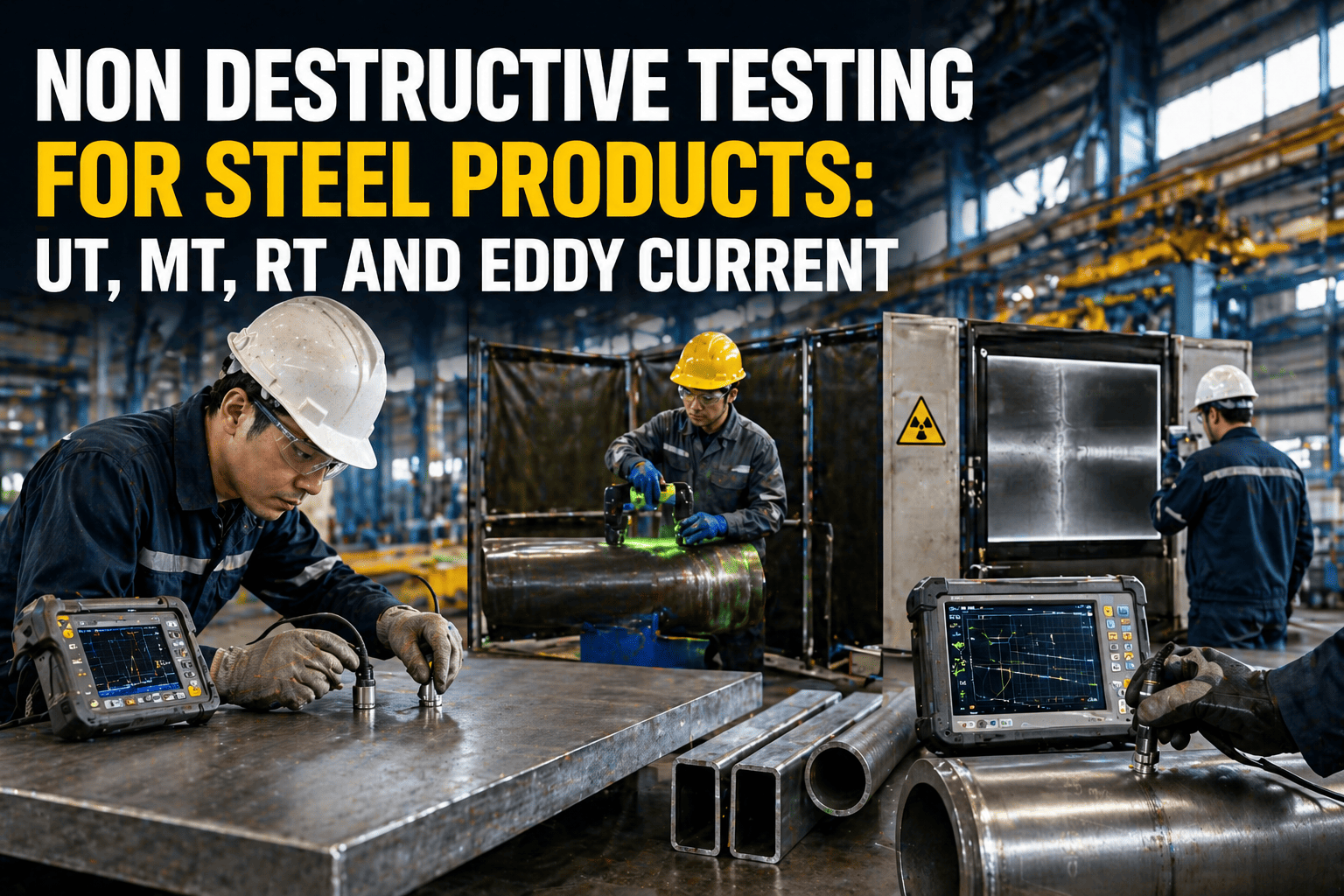
Steel product failures don't announce themselves — they develop invisibly inside welds, beneath coatings, and within the grain structure of critical components. Non-destructive testing gives quality teams the ability to detect those defects before product leaves the plant, protecting downstream safety, regulatory compliance, and your facility's reputation. OxMaint's Inspection & Monitoring module digitizes every NDT workflow — scheduling, findings, reporting — so nothing slips through. Book a free demo to see it live on steel inspection data.
Article · Steel Product Quality
Non-Destructive Testing for Steel Products: UT, MT, RT and Eddy Current
Why NDT Matters
The Cost of Skipping Inspection in Steel Manufacturing
A single undetected subsurface crack in a structural steel component can result in catastrophic field failure, product recall costs exceeding $4M, and regulatory shutdown of production lines. NDT is not a compliance checkbox — it is the final quality gate between your process and your customer.
$4M+
Average cost of a structural steel product recall
34%
Of steel weld defects are subsurface and invisible to visual inspection
8×
Cost of field failure vs in-plant NDT detection and rework
Method 01 — Ultrasonic Testing
UT: The Gold Standard for Internal Defect Detection
How It Works
High-frequency sound waves (1–25 MHz) are transmitted into the steel through a transducer. Internal flaws reflect the wave back at different amplitudes and time delays. The resulting A-scan, B-scan, or C-scan maps defect location, depth, and size with sub-millimeter accuracy.
Detection Depth
Up to 10 metres in steel
Resolution
Defects from 0.5 mm diameter
Speed
Automated UT: 2–5 m/min scan rate
Standard
ASTM A435, EN 10160, IS 1929
Best Applied To
Plate mill lamination detection
Structural weld volumetric inspection
Pipe seam and girth welds
Forged steel component integrity
Thickness measurement on corroded sections
Detects: Cracks · Voids · Inclusions · Laminations · Porosity
Method 02 — Magnetic Particle Testing
MT: Fast Surface and Near-Surface Crack Detection
How It Works
A magnetic field is induced in the ferromagnetic steel component. Fine iron particles — dry powder or wet fluorescent suspension — are applied to the surface. Discontinuities disrupt the magnetic field, causing particle accumulation that forms a visible indication directly over the defect.
Detection Depth
Surface to 3–5 mm subsurface
Sensitivity
Cracks as narrow as 1 micron wide
Inspection Rate
High — suitable for in-line use
Standard
ASTM E709, ISO 9934, IS 5334
Best Applied To
Hot-rolled bar and billet surfaces
Forged steel part inspection post-heat treatment
Casting surface and near-surface defects
Railway wheel and axle inspection
Weld toe and HAZ cracking
Detects: Surface cracks · Seams · Laps · Cold shuts · Fatigue cracks
Method 03 — Radiographic Testing
RT: Volumetric Inspection with Permanent Image Record
How It Works
X-ray or gamma radiation is passed through the steel component onto a film or digital detector. Denser material absorbs more radiation; internal voids, porosity, or inclusions appear as darker regions on the radiograph. Digital Radiography (DR) and Computed Radiography (CR) now allow real-time image acquisition and digital archiving.
Material Thickness
Up to 300 mm steel with gamma sources
Image Record
Permanent — regulatory archivable
Limitation
Radiation safety zone required
Standard
ASTM E94, ISO 17636, IS 1182
Best Applied To
Pressure vessel and boiler weld inspection
Pipeline girth weld certification
Casting porosity and shrinkage mapping
Structural fabrication weld sign-off
Code-compliant weld documentation
Detects: Porosity · Slag inclusions · Incomplete fusion · Cracks · Burn-through
Method 04 — Eddy Current Testing
EC: High-Speed Surface and Coating Inspection
How It Works
An alternating current through a probe coil induces eddy currents in the conductive steel. Defects or conductivity changes alter the eddy current flow, producing measurable impedance changes in the probe. The technique is fast, contact-free, and well-suited to automated in-line steel processing environments.
Speed
Up to 10 m/s in-line scan rates
Contact Required
No — lift-off tolerant
Also Measures
Coating thickness, conductivity
Standard
ASTM E376, ISO 15549, EN 1971
Best Applied To
Wire rod and bar in-line surface inspection
Tube and pipe seam weld monitoring
Coating thickness on galvanized steel
Heat exchanger tube array inspection
Sheet mill surface defect detection
Detects: Surface cracks · Seams · Coating variation · Conductivity changes
Method Comparison
Choosing the Right NDT Method for Steel Products
| Criterion |
UT |
MT |
RT |
Eddy Current |
| Defect Location |
Surface + Volumetric |
Surface + Near-surface |
Volumetric |
Surface only |
| Works on Non-Magnetic Steel |
Yes |
No |
Yes |
Yes |
| In-Line Automation Feasibility |
High |
Medium |
Low |
Very High |
| Provides Permanent Record |
Yes (digital) |
Photo only |
Yes (film/DR) |
Yes (digital) |
| Radiation Hazard |
None |
None |
Yes — zoning required |
None |
| Typical Cost per Inspection |
Medium |
Low |
High |
Low–Medium |
| Applicable Thickness Range |
0.5 mm – 10 m |
Any (surface) |
Up to 300 mm |
Thin to medium |
Digitize Every NDT Inspection — Schedule, Record, Report
OxMaint's Inspection & Monitoring module manages UT, MT, RT, and EC workflows in one platform — with automated scheduling, digital findings capture, and compliance-ready reports.
Expert Review
Industry Standards and Expert Perspectives
"The transition from analog to digital NDT data management is now the single most impactful quality improvement available to steel producers. Facilities that digitize inspection scheduling, findings, and trending data report 35–50% reductions in escape rates — defects that pass inspection undetected. The technology is mature; the barrier is process, not equipment."
— The Welding Institute (TWI), NDT Digital Transformation in Steel Industry, 2024
"Phased Array Ultrasonic Testing (PAUT) and Time-of-Flight Diffraction (TOFD), both derivatives of conventional UT, are now required by major structural steel codes including AWS D1.1 and API 650 for weld inspection on critical joints. Steel manufacturers investing in automated UT systems are reporting inspection throughput increases of 3–5× compared to manual contact UT, with equivalent or superior defect detection rates."
— American Society for Nondestructive Testing (ASNT) Annual Review, 2024
FAQs
Frequently Asked Questions
Which NDT method is most suitable for in-line steel mill inspection?
Eddy Current Testing is the leading choice for continuous in-line inspection due to its contact-free operation, high scan speeds (up to 10 m/s), and compatibility with automated handling systems. For internal defect detection at production line speeds, automated Phased Array UT systems are increasingly deployed on plate mills and pipe mills. MT can be integrated in-line for bar and billet inspection but requires demagnetization post-inspection.
Start free to configure in-line inspection schedules in OxMaint.
How does OxMaint manage NDT inspection scheduling and compliance records?
OxMaint creates NDT inspection work orders based on configurable schedules — per coil, per heat, per shift, or calendar-based — aligned to your quality plan. Inspectors capture findings digitally on mobile, including defect type, location, severity, and accept/reject decision. All records are timestamped, linked to the specific product heat or lot number, and exportable in formats accepted by third-party certifying bodies and customer quality audits.
Book a demo to see the inspection workflow.
What are the regulatory standards governing NDT for structural steel products?
Key standards include ASTM A435 and A578 (UT for plate), ASTM E709 and ISO 9934 (MT), ASTM E94 and ISO 17636 (RT), and ASTM E376 (EC coating thickness). For welded structural steel, AWS D1.1 and EN 1090 govern NDT method selection and acceptance criteria. Pressure-containing components fall under ASME Section V (NDT methods) and Section VIII (pressure vessel acceptance). OxMaint inspection templates can be pre-configured to each applicable standard.
Can NDT findings data in OxMaint be used for predictive quality analytics?
Yes. OxMaint aggregates NDT findings over time by equipment, production line, shift, raw material heat, and inspector. Trending this data reveals recurring defect patterns — for example, a correlation between a specific ladle chemistry and UT-detected porosity — enabling root cause elimination rather than repeated detection and rework. Facilities using inspection trend analytics report 25–40% reductions in defect escape rates within six months of digitization.
Inspection & Monitoring
Make Every NDT Inspection Traceable and Actionable
OxMaint schedules, captures, and reports every UT, MT, RT, and EC inspection — giving your quality team a live, searchable record of every finding and every decision.