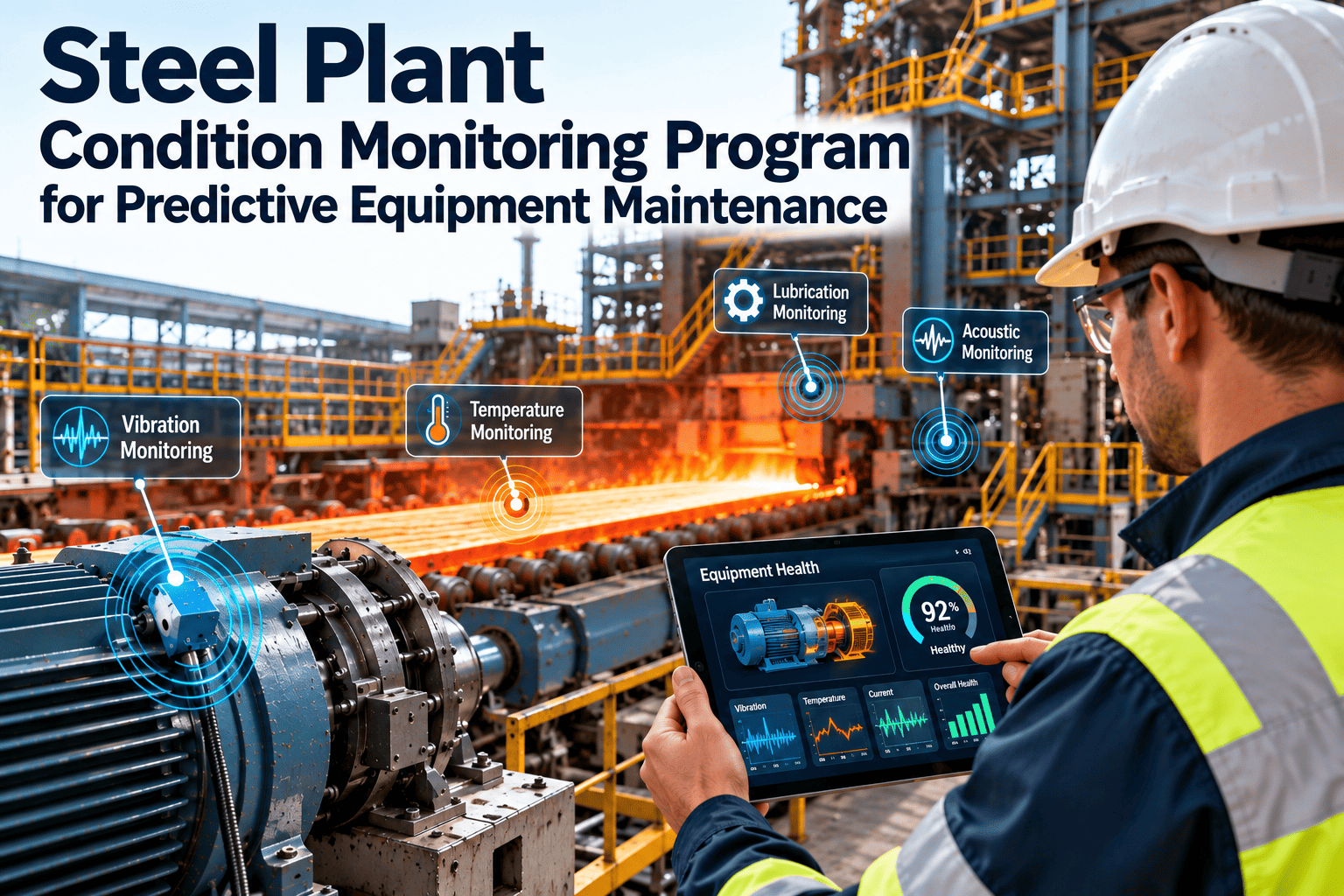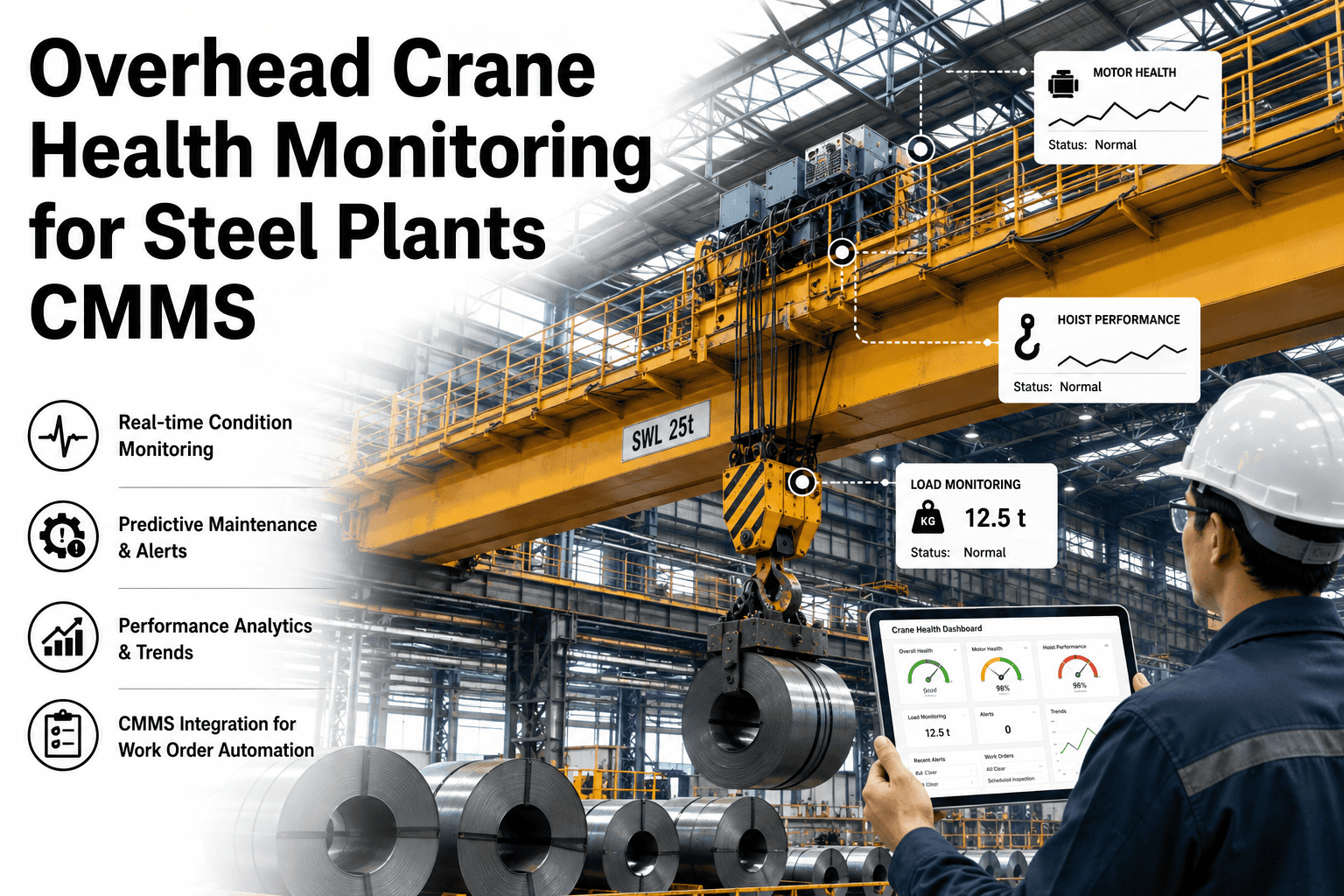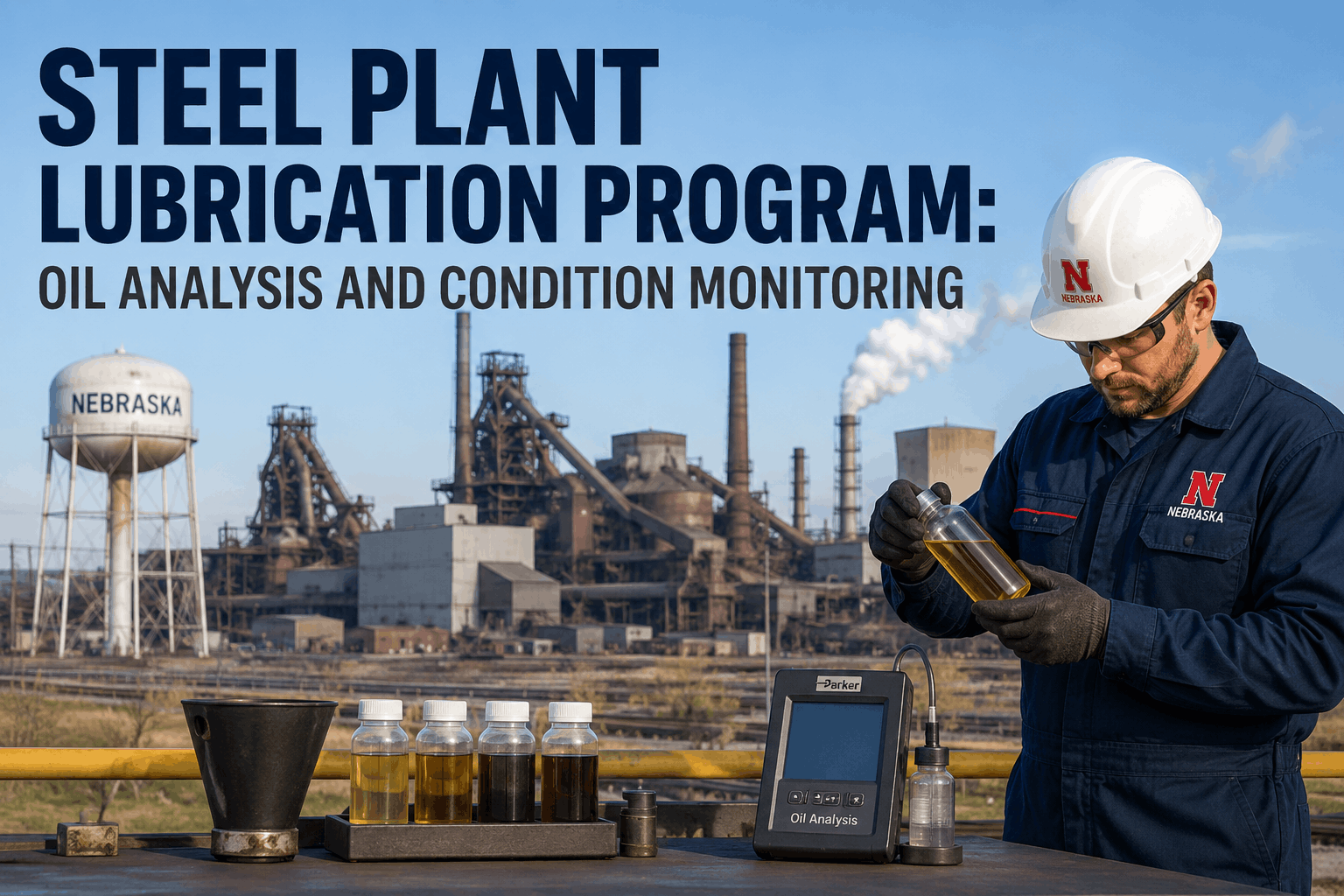
In the high-stakes environment of US steel manufacturing, reliability is not a luxury — it is a metric for survival. Transitioning from reactive "run-to-fail" maintenance to a proactive, data-driven strategy requires a standardized framework. ISO 17359 is the globally recognized umbrella standard for condition monitoring and diagnostics of machines, providing the roadmap for identifying asset criticality, selecting monitoring techniques, and setting scientific alarm thresholds. A CMMS-integrated condition monitoring program ensures that every vibration reading, oil analysis, and thermal scan is converted into an actionable record, closing the loop between data collection and maintenance execution. Sign Up Free to start building your ISO 17359 reliability roadmap today.
Stop Guessing. Start Monitoring Your Asset Health.
OxMaint gives reliability managers the tools to map asset criticality, trend condition data, and execute predictive work orders — all in one unified ISO 17359 compliance portal.
What is ISO 17359 for Steel Plants? The Reliability Roadmap
ISO 17359 provides the generalized procedure for implementing a condition monitoring (CM) program. For a US steel mill, this process begins with a rigorous asset criticality assessment — identifying the "bottleneck" equipment that can shut down the entire production line. Once the high-risk assets are identified, a Failure Mode and Effects Analysis (FMEA) is conducted to determine the best monitoring techniques, whether it be vibration analysis for rotating drives, oil analysis for hydraulic systems, or thermography for electrical switchgear. The standard emphasizes the setting of alarm thresholds and the continuous trending of data to identify the "Potential Failure" (P) before it becomes a "Functional Failure" (F). OxMaint digitizes this entire roadmap, ensuring that your reliability team is acting on data, not intuition. Book a Demo to see our ISO 17359 workflows.
Core Components of a CMMS-Driven Condition Monitoring Program
Asset Criticality & FMEA Register
Rank your assets by safety, environmental, and production risk. Document exactly which monitoring technique will detect each specific failure mode.
Vibration & Ultrasonic Trending
Log and trend mechanical health data. Identify bearing wear and unbalance weeks before the asset fails, allowing for planned weekend repairs.
Fluid Analysis & Contamination Control
Manage oil lab results for gearboxes and hydraulic units. Track water content and particle counts to prevent abrasive wear in high-value capital.
Infrared Thermography Surveys
Schedule recurring IR scans of motors, panels, and refractories. Document "hot spots" in OxMaint and track their resolution as high-priority work orders.
Threshold & Alarm Management
Configure "Alert" and "Danger" limits based on ISO standards or OEM specs. Automate the generation of corrective work orders when limits are breached.
Condition-Based Decision Support
Use the P-F curve lead time to plan parts procurement and labor. OxMaint turns "data" into "decisions" that protect your plant's bottom line.
Selection Matrix: CM Techniques by Machine Category
| Machine Category | Vibration | Oil Analysis | IR Thermal | Ultrasound |
|---|---|---|---|---|
| High-Speed Turbo Blowers | Primary (Probes) | Secondary | No | No |
| Mill Drives & Gearboxes | Primary (Seismic) | Primary | Secondary | No |
| Electrical Switchgear | No | No | Primary | Primary (Corona) |
| Refractory / Furnaces | No | No | Primary | No |
| Hydraulic Systems (HGC) | No | Primary | Secondary | Primary (Leaks) |
| Conveyor & Fan Motors | Primary | No | Secondary | Secondary |
Note: Applicability depends on asset criticality and specific failure modes identified in your FMEA. OxMaint manages the records for all techniques in a single history.
Implementing ISO 17359 with OxMaint
Rank Your Asset Criticality
Use OxMaint's built-in criticality matrix to score every asset based on its impact on safety and production. This ensures your condition monitoring budget is spent on the equipment that matters most. Sign Up Free to start your criticality audit.
Assign Monitoring Procedures to Assets
For every high-criticality asset, define its monitoring frequency and technique in the CMMS. Whether it's monthly vibration or quarterly oil samples, OxMaint automates the schedule and assigns the tasks to your reliability team.
Digitize Field Data Collection
Technicians use the OxMaint mobile app to log route-based data directly at the machine. Manual readings, thermographic images, and lab results are all centralized in a single asset history, eliminating paper logs and data silos. Book a Demo to see our mobile CM tools.
Trend Against Alarm Thresholds
OxMaint's trending engine visualizes your asset health over time. If a measurement exceeds the "Alert" threshold, the system triggers a diagnostic work order. If it hits "Danger," it generates an immediate emergency repair task.
Audit Your Reliability Progress
Generate automated reliability reports showing your "Lead Time to Failure" and total avoided downtime. Prove the ROI of your condition monitoring program to management and maintain the 5-year archive needed for ISO compliance.
Why Condition Monitoring Programs Fail — and How to Fix It
Too many plants collect vibration data but never act on the results. OxMaint forces action by linking every alarm threshold directly to a mandatory corrective work order.
Vague limits like "if it sounds loud" lead to failures. Use OxMaint to standardize thresholds based on ISO 10816 and OEM specs for every machine class in your mill.
If oil data is in a lab portal and IR is in a folder, you can't see the full picture. Centralize all condition monitoring techniques in OxMaint for a holistic asset health score.
If you don't track the downtime you've saved, your CM budget will be cut. Use OxMaint to document "Reliability Wins" and prove the financial value of your ISO 17359 program.
ISO 17359 Best Practices for US Steel Producers
Standardize the "Route-Based" Workflow
Use OxMaint to build recurring CM routes for your technicians. This ensures that every critical asset is touched and measured at the exact frequency required by your OHSMS.
Integrate Ultrasound for Leak Detection
Don't just monitor rotation. Use ultrasound to identify high-pressure air and hydraulic leaks. OxMaint tracks these "silent" failures that impact both energy costs and safety.
Leverage OEM Historical Data
Build your initial alarm baselines from OEM performance curves. As you accumulate data in OxMaint, refine these limits to match your specific plant environment and load profiles.
Prioritize Multi-Technique Monitoring
For your #1 most critical asset, use both vibration and oil analysis. Cross-verifying a failure mode in OxMaint provides the confidence needed to call for an expensive line stop.
Maintain "Birth-to-Death" Data Continuity
If you rebuild a gearbox, restart its CM baseline. OxMaint allows you to reset trends for major overhauls, providing a clean record of the asset's new performance life.
Audit Your Monitoring Compliance
Once a month, review your CM compliance report in OxMaint. Ensure that 100% of your critical routes were completed and every alarm was investigated and documented.
"Before we standardized our condition monitoring program under ISO 17359, we were drowned in data but starved for action. We had vibration consultants, oil labs, and IR teams all sending us separate reports that sat in binders. By centralizing all these techniques into OxMaint and linking them to our asset criticality matrix, we finally gained a 'single source of truth' for machine health. In our first year, we identified three major bearing failures in our hot mill gearboxes weeks before they would have seized. Those three catches alone saved us over $2.4M in lost production time. Our insurance carrier now cites our OxMaint records as a best-in-class example of industrial reliability management."
Ready to Master Your Asset Health?
Join the US steel mills using OxMaint to digitize their ISO 17359 programs, trend their condition data, and eliminate unplanned production failures.
Frequently Asked Questions
ISO 17359 provides a standardized, risk-based roadmap for implementing condition monitoring, ensuring resources are focused on the most critical assets.
OxMaint digitizes this roadmap, converting data into actionable work orders that prevent downtime and reduce overall costs.
Selection is based on a Failure Mode and Effects Analysis (FMEA), identifying which sensors can detect the specific early-warning signs of failure.
OxMaint stores these FMEA results against each asset, ensuring your monitoring program is always aligned with the highest probability risks.
Thresholds are specific measurement limits based on ISO standards, OEM specifications, or historical statistical baselines.
OxMaint trends your CM data and automatically generates a work order the moment a threshold is breached, closing the reliability loop.
Criticality assessment ensures your most expensive and production-vital equipment receives the highest level of monitoring frequency and detail.
OxMaint uses a built-in matrix to prioritize safety-critical and bottleneck assets, optimizing your reliability team's daily workflow.
IR thermography detects hot spots in electrical switchgear and refractory wear in EAFs before they lead to catastrophic fires or breakouts.
OxMaint schedules these surveys as recurring work orders, archiving thermal images in the asset history for long-term trending.
Yes, the system allows for the direct upload of lab reports or manual entry of parameters like viscosity, water, and particle counts.
Trending these in your CMMS helps US mills identify gear wear and hydraulic contamination early, extending the life of high-value capital.
The P-F Curve illustrates the time between a potential failure being detectable and the functional failure occurring; CM aims to maximize this interval.
OxMaint tracks the "Lead Time to Failure" for your assets, proving the ROI of your program by documenting avoided downtime costs.
Following the standard provides a defensible framework proving to insurers that your facility is managed proactively.
OxMaint maintains the 5-year auditable record of every CM measurement and corrective action, ensuring your facility is always audit-ready.