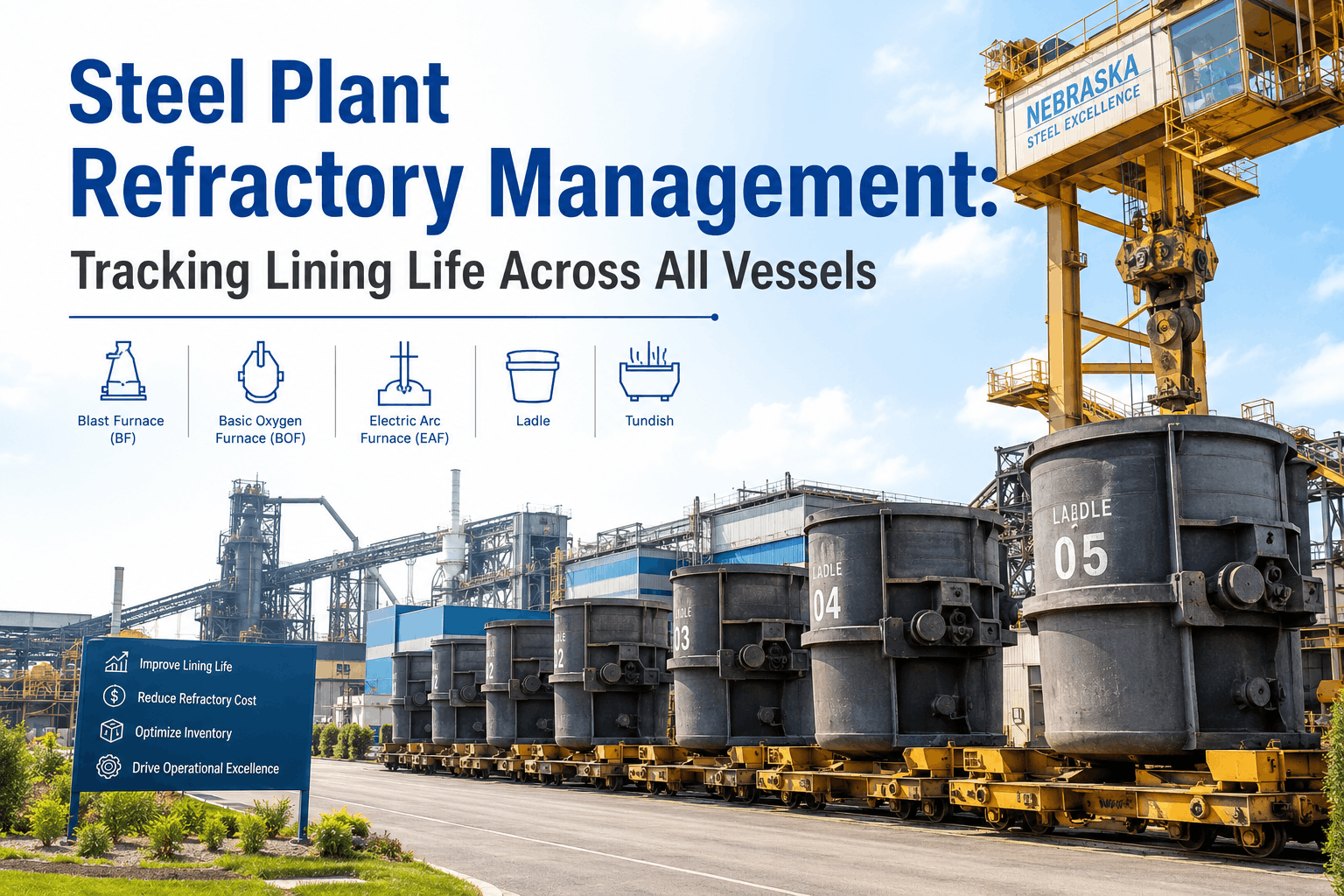
Refractory materials are the unsung heroes of steelmaking — they're the only thing standing between 1,600°C molten steel and the steel shell of every vessel in the plant. When refractory fails, the consequences range from expensive (unplanned reline costing $2-15 million) to dangerous (molten metal breakout threatening workers' lives). Yet refractory management at most steel plants is surprisingly primitive: wear data lives in spreadsheets that nobody updates, gunning decisions are made by feel, and campaign end dates are guessed rather than calculated.
World-class steel plants treat refractory as a precision-managed consumable, not an afterthought. They track wear rates by zone, correlate degradation with process variables, optimize slag chemistry for coating protection, and predict remaining life with enough accuracy to plan relines months in advance. Oxmaint's refractory management module brings this discipline to every lined vessel in the plant — from blast furnace hearth to tundish — tracking remaining lining thickness, trending wear rates, scheduling repairs, managing refractory inventory, and calculating cost-per-tonne for every campaign.
Every Millimeter of Lining Is Worth Thousands of Dollars. Track Every One.
Refractory Across the Steelmaking Route
Every vessel in a steel plant is lined with refractory, but each has radically different materials, wear mechanisms, campaign lengths, and economic impacts. Here's the complete map:
The 5 Pillars of World-Class Refractory Management
Steel plants that achieve top-quartile refractory performance — longest campaigns, lowest cost per tonne, fewest unplanned relines — consistently execute these five disciplines:
Wear Measurement & Mapping
Systematic measurement of remaining lining thickness by zone using laser scanning, ultrasonic thickness gauges, or thermal modelling. Data captured at defined intervals creates a 3D wear map of every vessel. Without measurement, you're guessing — and guessing wrong costs millions.
Wear Rate Correlation
Refractory doesn't wear at a constant rate — it's driven by process variables: slag chemistry (basicity, FeO content), temperature, gas stirring intensity, charging practice, and tapping conditions. Correlating wear rate with process data identifies the controllable factors that accelerate or slow degradation.
Repair Optimization
Mid-campaign repairs (gunning, patching, slag splashing) extend lining life at a fraction of reline cost. But repairs have diminishing returns — beyond a point, repair costs per heat exceed the value of additional campaign life. Optimizing the repair frequency and targeting repairs to the campaign-limiting zone maximizes ROI.
Campaign Economics
Every campaign generates a complete cost picture: initial lining material, installation labour, mid-campaign repairs, production losses during reline, and total heats produced. Dividing total cost by total heats gives the true refractory cost per heat — the single most important metric for benchmarking performance.
Inventory & Supplier Management
Refractory materials have long lead times (4-16 weeks for specialty bricks), high storage costs, and shelf-life limitations for some monolithics. Running out delays relines; over-ordering ties up capital. Linking consumption data to procurement planning ensures materials arrive when needed without excess inventory.
Stop Guessing When Linings Will Fail. Start Knowing.
Oxmaint transforms refractory management from reactive guesswork into predictive precision — extending campaigns, reducing costs, and eliminating the unplanned relines that shut down production.
Refractory Cost Breakdown: Where the Money Goes
Understanding the cost structure reveals optimization opportunities. Here's a typical annual refractory spend breakdown for an integrated steel plant producing 3-5 Mt/year:
Ladle Refractory: The Fleet Management Challenge
Ladle refractory is unique because it's a fleet problem, not a single-vessel problem. A typical BOF shop operates 15-30 ladles in rotation, each with its own campaign counter, wear profile, and maintenance needs. Managing the fleet requires balancing ladle availability with reline scheduling:
Working Lining (Slag Zone)
MgO-C bricks in the slag line, Al₂O₃-MgO-C in the barrel. Slag zone limits campaign at 80-200 heats. Wear rate driven by slag aggressiveness (FeO, basicity), stirring intensity, and tap temperature. Each ladle must be tracked individually — campaign life varies 30-50% between ladles in the same fleet.
Reline Scheduling & Rotation
Staggered reline scheduling ensures minimum ladle availability at all times. If 20 ladles serve a 2-converter shop, at least 14-16 must be available while 4-6 are in various stages of reline, preheat, and return to service. Oxmaint projects reline dates for every ladle and alerts when the schedule threatens minimum fleet availability.
Cost Optimization
Ladle refractory cost per heat varies $150-$500 depending on lining design, campaign length, and repair strategy. Top-performing plants achieve $150-250/heat through optimized brick quality, controlled slag chemistry, and data-driven repair decisions. Oxmaint calculates cost per heat for every ladle and identifies the variables that separate the best-performing ladles from the worst.
Oxmaint Refractory Dashboard
Real-time visibility across every lined vessel, every campaign, and every cost centre:
From Blast Furnace Hearth to Tundish Lining. Every Vessel. Every Campaign. One Platform.
Oxmaint manages the full refractory lifecycle across your entire plant — turning a $50-200M annual spend into a data-driven, optimized operation that extends campaigns and eliminates surprises.
Frequently Asked Questions
How does Oxmaint measure refractory wear without stopping production?
Oxmaint integrates with multiple measurement technologies depending on the vessel: laser scanning (BOF, EAF — during brief inter-heat stoppages), embedded thermocouples and thermal modelling (blast furnace hearth — continuous indirect measurement from shell temperatures), ultrasonic thickness gauging (ladle, torpedo — during reline or between campaigns), and visual inspection with calibrated photography (tundish, reheating furnace). Between direct measurements, the system estimates wear using heat-based models calibrated to each vessel's historical wear rates. Shell temperature monitoring provides continuous indirect validation — rising temperatures in a specific zone indicate thinning refractory.
What ROI can we expect from implementing systematic refractory management?
Typical ROI components for a 3-5 Mt/year integrated plant: Campaign extension (20-40% longer campaigns reduce reline frequency, saving $2-10M/year in avoided reline costs and production losses), repair optimization (targeting repairs to the right zone at the right time vs. blanket gunning saves 15-25% on repair material consumption), reduced unplanned relines (eliminating 1-2 emergency relines per year saves $3-10M each in combined reline cost and production loss), and inventory optimization (right-sizing refractory stock saves $500K-2M in working capital). Total annual savings: $8-25M for a typical integrated plant, with Oxmaint implementation cost recovered within 3-6 months.
How does slag chemistry affect refractory life and what can Oxmaint track?
Slag is the #1 controllable variable affecting refractory wear. High-FeO slags (>25%) aggressively attack MgO-C refractory, increasing wear rates 40-80%. Low basicity (CaO/SiO₂ <2.5) promotes chemical dissolution. High tapping temperatures (>1,680°C) accelerate both chemical and physical wear. Oxmaint logs slag chemistry data from every heat (from the plant's Level 2 system or manual entry) and correlates it with measured wear rates over time. The system identifies specific chemistry ranges that produce the fastest and slowest wear, enabling the melt shop to adjust practices. For slag splashing (BOF), Oxmaint tracks MgO content in retained slag — higher MgO produces more durable protective coatings.
Can Oxmaint manage refractory supplier performance?
Yes. Every refractory material in Oxmaint is tagged with supplier, batch number, grade, and installation location. When campaign results are analysed, the system can compare performance of different suppliers' materials in the same vessel zone across multiple campaigns. This creates an objective, data-driven basis for supplier evaluation: Supplier A's MgO-C bricks lasted an average of 4,200 heats in the BOF trunnion zone vs. Supplier B's 3,800 heats. Combined with price data, Oxmaint calculates true cost per heat by supplier — which sometimes reveals that the higher-priced material is actually cheaper per heat due to longer campaign life.
How does Oxmaint handle the blast furnace hearth — a 10-20 year campaign?
BF hearth monitoring is a specialized application requiring continuous thermal modelling. Oxmaint integrates with the hearth's thermocouple array (typically 200-500+ thermocouples embedded in the hearth wall and bottom) and uses temperature data to calculate remaining refractory thickness via inverse heat transfer modelling. The system tracks isothermal erosion lines — particularly the critical 1,150°C isotherm which indicates the boundary between solid protective skull and liquid iron contact. Trending of the 1,150°C isotherm position over months and years predicts hearth life remaining with enough accuracy to plan the multi-year, $50-150M reline project. Alert thresholds trigger cooling system adjustments (increased stave water flow) and operational changes (reduced hearth temperature) to slow erosion when it approaches critical limits.