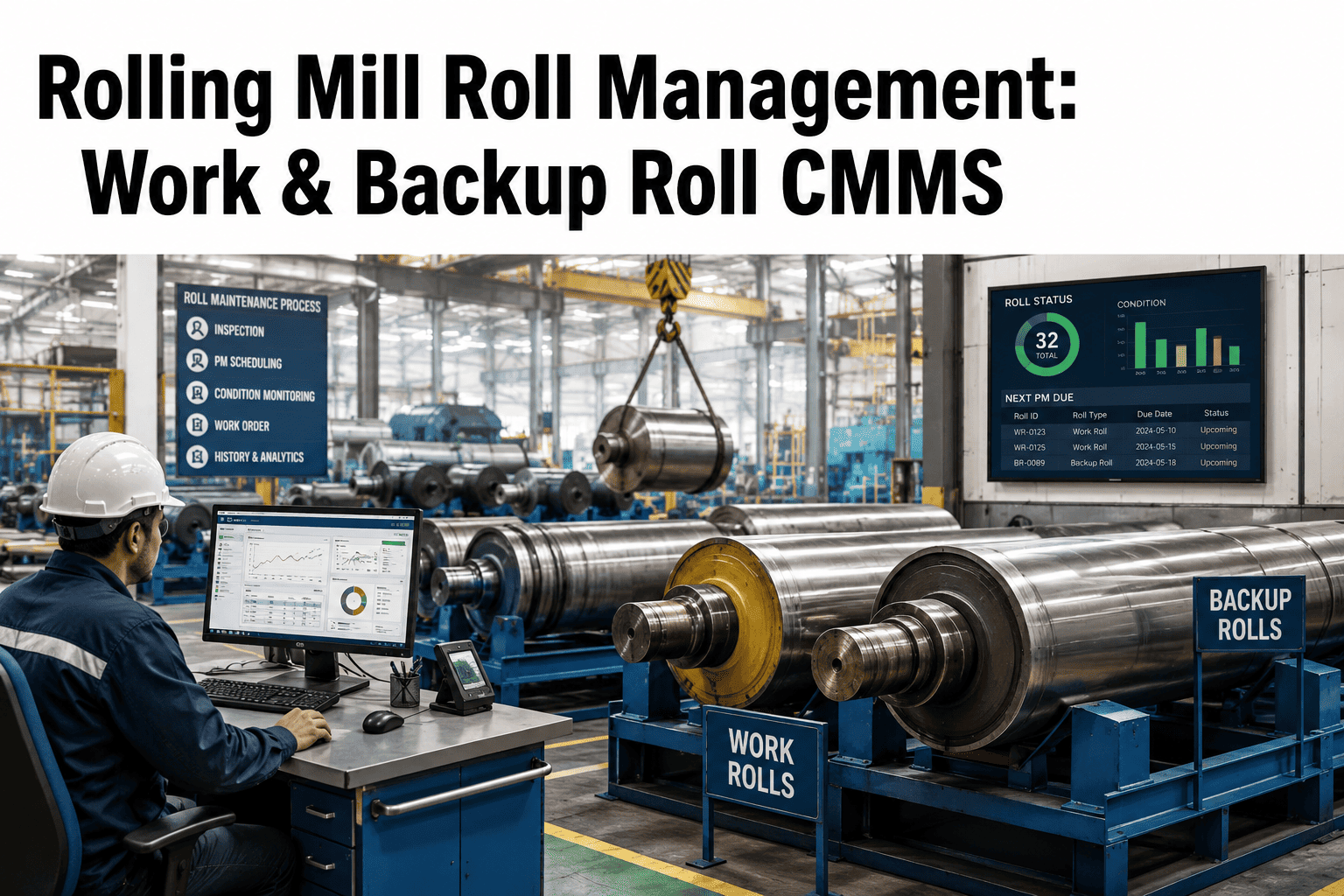
The roll shop is the operational heartbeat of any rolling mill facility. Every surface quality result, every flatness measurement, and every campaign length achieved on the mill floor originates in decisions made in the roll shop — the grind parameters applied to each roll, the bearing assembly procedures followed during roll change preparation, and the inventory management discipline that ensures the right roll is available at the right time. When roll shop operations are tracked in disconnected spreadsheets, paper grind tickets, and verbal handovers, the data that should drive continuous improvement is systematically lost. This article covers the three operational domains of structured roll shop management and how a purpose-built CMMS transforms roll shop data into measurable mill performance. Book a demo to see Oxmaint.ai for roll shop management.
Roll Shop Management: Grinding Campaigns, Bearing Assembly & Roll Inventory with CMMS
For roll shop supervisors, maintenance managers, and operations directors running hot or cold rolling facilities — structured digital tracking of grinding records, assembly procedures, and roll inventory is the foundation that connects roll shop output to mill performance.
Why Roll Shop Management Determines Mill Performance
Most rolling facilities treat the roll shop as a support function — a place where rolls are ground and stored between campaigns. The facilities that achieve best-in-class surface quality and campaign life treat the roll shop as a data-generating operation where every grind cycle, bearing assembly, and inventory movement produces information that should feed back into mill optimisation. The gap between these two approaches is structural. Without a CMMS that connects roll shop records to mill performance, the correlation between grind parameters and surface defect rates, between bearing assembly quality and roll chatter incidents, and between inventory management discipline and unplanned mill stops remains invisible.
Grinding Campaign Management
Each roll grind cycle removes material to restore surface roughness and profile. The parameters applied — stone specification, traverse speed, dressing interval, and final Ra target — determine both the roll's performance on the mill and its remaining service life. Without per-roll grind records, campaign optimisation is impossible.
View grinding checklist →Bearing Assembly & Roll Change Preparation
Bearing condition, chock assembly torque, and lubrication application at each roll change directly affect roll performance and bearing service life. Assembly errors that are undetected at the roll shop level appear as vibration, chatter, and premature bearing failures on the mill — expensive problems with a preventable origin.
View assembly checklist →Roll Inventory & Asset Lifecycle Tracking
Every roll in the mill inventory represents significant capital. Tracking barrel diameter reduction across grinds, cumulative tonnage rolled, and remaining service life per roll prevents both premature disposal of rolls with remaining life and the continued use of rolls that have reached their discard limit — a safety and quality risk.
View inventory checklist →Roll Shop Management Domains: Detailed Tracking Requirements
Each domain below requires structured records at the individual roll level — not at the aggregate inventory level. Roll-by-roll data is what makes root cause analysis possible and campaign optimisation achievable.
Grinding Campaign Records & Surface Profile Management
Surface Quality FoundationThe grinding record is the most important document in the roll shop. It is the only source of information that connects what happened to a roll in the grind bay to what the roll produces on the mill. For work rolls in cold mills, the grind record must capture the initial Ra and Rz measurements, the axial profile (crown), uniformity across the barrel, and the stone specification used — because all four parameters affect strip surface finish and shape. For hot mill work rolls, the grind record captures the profile restoration that determines strip crown and flatness capability for the coming campaign. Maintenance teams using digital grind record management within Oxmaint.ai build a complete per-roll history that enables the correlation analysis their counterparts using paper grind tickets cannot perform.
The most valuable insight that emerges from structured grinding data is the relationship between grind parameters and campaign length. Rolls ground to the same Ra target using different stone specifications, traverse speeds, or dressing intervals produce measurably different wear rates on the mill. This variation is invisible without a database that links grind parameters to subsequent campaign tonnage — exactly what Oxmaint.ai's roll campaign tracking provides.
Bearing Assembly, Chock Preparation & Roll Change Readiness
Mechanical Reliability CriticalRoll bearing failures are among the most expensive unplanned events in a rolling mill — causing immediate mill stops, potential damage to adjacent equipment, and the time cost of emergency roll change under production pressure. The majority of premature bearing failures originate in the assembly process: contaminated bearing housings, incorrect clearance settings, inadequate lubrication application, or improper chock bolt torque that allows fretting under dynamic rolling loads. A structured bearing assembly record that captures each step of the process — with the responsible technician identified and the acceptance criteria documented — is the primary control against assembly-origin bearing failures.
Roll change preparation is equally important. A roll set that is not ready at the planned change time delays the entire schedule, creates pressure on operators to shortcut assembly checks, and compounds into unplanned stops when the hastily-assembled roll fails on the mill. Teams who use digital roll change preparation checklists in Oxmaint.ai ensure every step is completed and verified before the roll leaves the roll shop — eliminating the single largest source of avoidable bearing failures.
Roll Inventory Management & Asset Lifecycle Tracking
Capital Asset ProtectionA rolling mill's roll inventory represents capital investment in the range of several million dollars for a major integrated facility. Managing this asset base without per-roll lifecycle tracking — knowing exactly which rolls are in service, which are in the grind queue, which are awaiting assembly, and which have reached their discard diameter — is operationally hazardous and financially wasteful. Rolls that have reached their discard limit and continue in service are a safety risk and a quality liability. Rolls that are discarded prematurely due to poor tracking waste capital. Both outcomes are preventable with structured inventory management within a CMMS that tracks every roll's lifecycle from receipt through final discard.
CVC (Continuously Variable Crown) rolls and special profile rolls require additional tracking dimensions — the roll shift history, the CVC curve condition after each campaign, and the remaining shift range available before the roll must be reground to restore the designed curve. Without digital tracking of these parameters, the full capability of CVC flatness control systems is progressively eroded across campaigns without the maintenance team being aware of the degradation.
Connect Your Roll Shop Records to Mill Performance
Oxmaint.ai gives roll shop teams per-roll grind history, bearing assembly records with technician attribution, and real-time inventory status — all accessible from the roll shop floor and linked to the mill maintenance data that explains why campaigns perform the way they do.
Oxmaint.ai Capabilities for Roll Shop Operations
Purpose-built roll shop management — not a generic work order system adapted for rolling operations.
Per-Roll Grind History Database
Maintain complete roughness measurement records, grind parameters, and campaign outcomes for every roll, indexed by roll serial number and stand assignment. Trend campaign length against grind parameters to identify the combinations that deliver optimum service life for each product grade.
Assembly Checklist with Technician Attribution
Digital bearing assembly checklists capture every inspection step, measurement value, and acceptance decision — with the responsible technician identified at each stage. When a bearing failure occurs, the entire assembly record is immediately retrievable, eliminating the guesswork that currently consumes hours of failure investigation time.
Real-Time Roll Inventory & Status Tracking
Every roll's current status — in service, in grinding, in assembly, in storage, or quarantined — is visible across the entire inventory in real time. Start a free trial to configure your roll inventory register and eliminate the unplanned stops caused by unavailable rolls at scheduled change times.
Discard Limit & Lifecycle Projection
Track remaining barrel material per roll against the discard diameter limit. Automatic lifecycle projections flag rolls approaching discard to enable planned procurement rather than emergency replacement. Book a demo to see the roll lifecycle dashboard and capital planning reports.
Manual Tracking vs. Oxmaint.ai: Roll Shop Management
The data gap between paper grind tickets and a structured CMMS is measured in campaign losses, unexplained bearing failures, and roll capital wasted through poor lifecycle management.
| Roll Shop Area | Paper / Spreadsheet Tracking | Oxmaint.ai |
|---|---|---|
| Grind Record Management | Paper grind tickets filed by date — not searchable by roll serial number, stand, or product grade | Per-roll digital records with grind parameters, measurements, and campaign outcomes linked to roll serial number |
| Bearing Assembly Documentation | Assembly checklist on paper, technician initials only — no measurement values recorded or retrievable | Digital assembly records with measurement values, torque data, grease batch, and technician attribution per step |
| Roll Inventory Visibility | Whiteboard or spreadsheet updated manually — status frequently out of date or unknown | Real-time inventory status for every roll with location, current condition, and next action required |
| Discard Limit Management | Diameter tracked intermittently — rolls sometimes reach discard limit undetected and continue in service | Automatic discard limit approach alerts with remaining campaign estimates and procurement lead time flags |
| Campaign Optimisation | No cross-campaign data analysis — grind schedules based on fixed intervals rather than measured wear rates | Grind parameter vs. campaign length correlation across full roll history enables evidence-based schedule optimisation |
Scroll horizontally to compare on mobile
We had three bearing failures in six months on the same chock position in Stand 2. With paper assembly records, we could confirm a bearing was assembled each time but couldn't tell you what grease was used, what clearance was set, or who did the assembly. After implementing Oxmaint.ai, the next bearing event showed us immediately that the same technician had been applying 30% over the recommended grease quantity on that position for over a year. A training correction solved what had looked like a metallurgical problem.— Roll Shop Supervisor, Cold Rolling Complex, North America
Frequently Asked Questions
Can Oxmaint.ai track rolls across multiple mill stands and multiple product grade assignments?
Yes. Each roll is configured as an individual asset within the mill hierarchy, with its own grind history, campaign records, and inventory status. When a roll is assigned to a specific stand, the assignment is logged with the date and product grade. Rolls that rotate between stands — common in cold rolling where rolls are stepped down from finish stands to breakdown stands as their diameter reduces — maintain their complete history across all stand assignments, enabling the cross-stand performance comparison that reveals systematic differences in roll wear patterns between stand positions.
How does the platform handle grind record entry for roll shop operators who are not familiar with digital tools?
Oxmaint.ai's mobile app is designed for industrial shop floor use — large input fields, numeric measurement entry with configurable units, and step-by-step checklist workflows that guide operators through the grind record process without requiring them to navigate complex menus. Grind records are structured as pre-configured templates that match the existing paper forms used in the roll shop, making the transition from paper to digital straightforward. Most roll shop operators are comfortable with the mobile entry workflow within their first week of use. Start a free trial to review the grind record template configuration.
Does Oxmaint.ai support CVC and special profile roll tracking in addition to standard cylindrical rolls?
Yes. CVC rolls, parabolic crown rolls, and other special profile types can be configured with additional measurement fields specific to their geometry — CVC amplitude, crown radius, and edge relief profile. CVC shift range history is tracked per roll per campaign, and the platform flags rolls where cumulative shift usage has reduced the effective shift range below the minimum required for the grade mix assigned to that stand. This capability prevents the gradual erosion of CVC flatness control authority that occurs when special profile rolls are managed on standard cylindrical roll tracking systems. Book a demo to see the CVC roll configuration options.
Can the platform generate reports for customer quality audits that require roll maintenance traceability?
Yes. Oxmaint.ai stores the complete maintenance history for every roll that was in service during any given production period — grind records, bearing assembly documentation, and campaign tonnage — with precise timestamps and technician attribution. Reports can be filtered by roll serial number, stand, product grade, or date range and exported in formats suitable for IATF 16949, ISO 9001, and customer-specific quality audit requirements. The ability to produce a complete roll maintenance record for any coil rolled in the facility within minutes has directly improved audit outcomes for customers using the platform.
How long does it take to migrate existing roll inventory records and grind history into Oxmaint.ai?
Roll inventory registration — entering each roll's serial number, material grade, current diameter, and initial status — is typically completed within 1–2 days for a full mill roll inventory. Historical grind records from existing spreadsheets can be imported in bulk using the platform's data import tooling, or new records can be started from the go-live date with historical context added progressively. Most roll shops are fully operational on Oxmaint.ai within two weeks of starting their free trial, with roll inventory registered, grind templates configured, and assembly checklists active.
Your Roll Shop Data Should Be Driving Mill Decisions
Every grind parameter, every bearing assembly measurement, and every roll lifecycle record contains information that improves campaign performance, reduces unplanned bearing failures, and extends the productive life of your roll inventory. Oxmaint.ai gives your roll shop team the digital infrastructure to capture, analyse, and act on that information — from the grind bay to the mill floor.