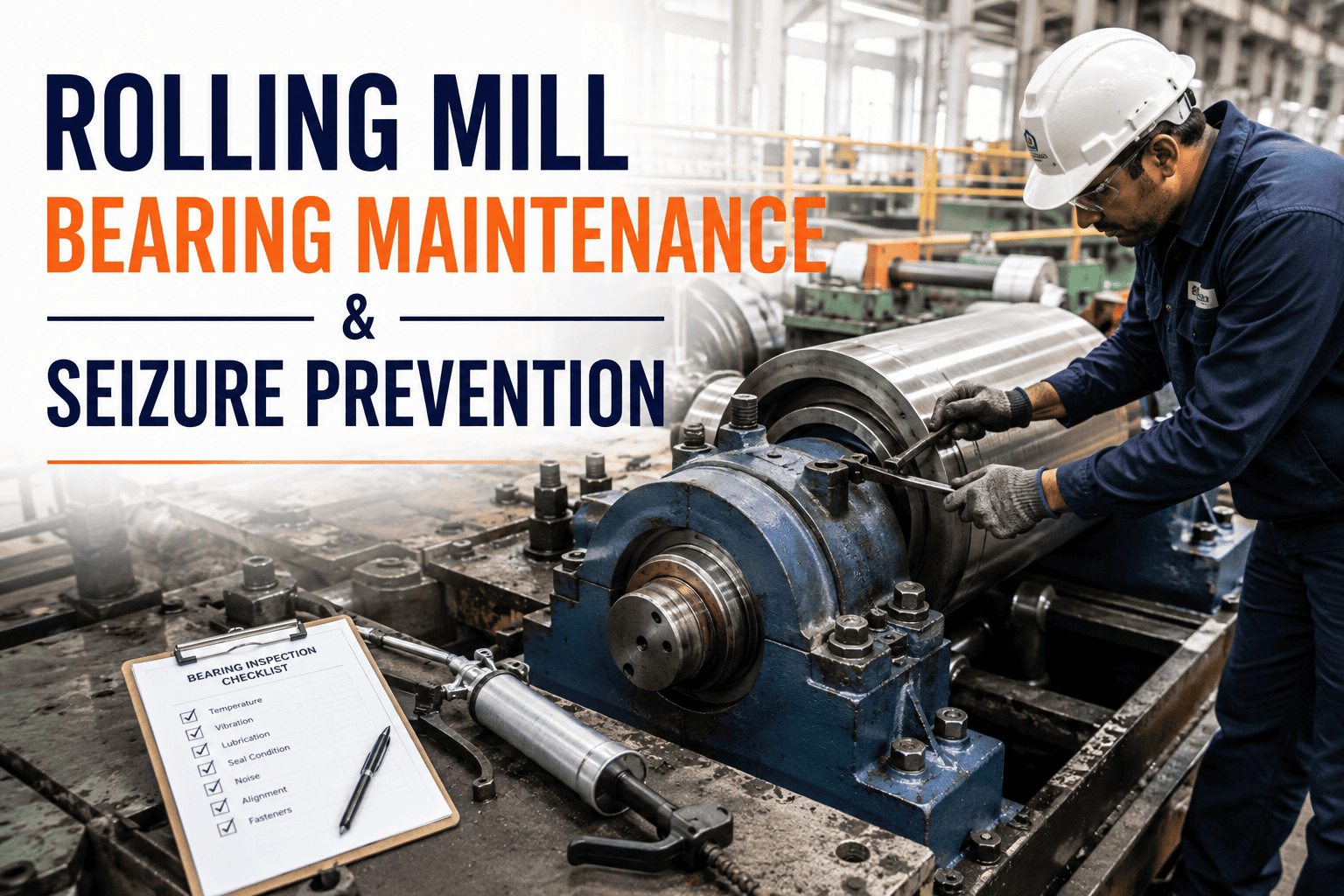
Rolling mill bearing maintenance is the single highest-leverage discipline in steel production: one seized backup-roll chock bearing can idle a hot strip mill for 3–7 days and destroy roll bodies, bearings and housings worth $80K–$250K per event. This guide covers rolling mill bearing maintenance and seizure prevention — lubrication precision, chock rebuild cycles, thermal monitoring, vibration analysis, load-path inspection and how a CMMS-driven bearing program cuts catastrophic failures by 40–70%. If your team is still tracking lubrication intervals on spreadsheets, Start Free Trial of OxMaint and digitise the entire bearing PM workflow in under a week.
Rolling Mill Bearing Maintenance & Seizure Prevention
One seized backup-roll bearing can stop your mill for a week. Are your bearing PM intervals built to prevent it?
A single bearing seizure in a hot strip mill can cost $250K in damage and lost production. Disciplined, CMMS-driven rolling mill bearing maintenance — precision lubrication, chock rebuilds, vibration trending and thermal monitoring — prevents 40–70% of catastrophic failures before they start.
$250K
Average cost per seized backup-roll bearing event — mill downtime, roll damage, tooling and lost tonnage combined.
Cost of Inaction
Why rolling mill bearing seizures are the most expensive failure in steel
A bearing seizure is not a wear-out failure — it is a thermal-mechanical event where the lubricant film collapses, metal-to-metal contact welds the roller to the race, and the cage disintegrates in seconds. The damage cascade that follows is what makes it catastrophic.
3–7 days
Typical mill downtime per backup-roll bearing seizure while the chock is stripped, rebuilt and re-aligned.
$80K–$250K
Direct cost per event: replacement bearing, roll regrinding, chock machining, and lost production tonnage.
40–70%
Of bearing seizures are preventable through disciplined PM — lubrication, inspection, and condition monitoring.
12–18 mo
Typical chock bearing rebuild interval — missed by even one cycle and seizure risk multiplies three-fold.
WORKED EXAMPLE — HOT STRIP MILL
A 5-stand hot strip mill running 340 days/year experienced two backup-roll bearing seizures in a single quarter — one on stand 2, one on stand 4. Combined cost: $310K in bearings and roll damage, plus 9 days of lost production worth an estimated $1.2M in margin. Root-cause analysis found that lubrication intervals had drifted from 8 hours to 14 hours on two chocks, and vibration trend data was buried in paper logs no one reviewed. After implementing a CMMS-driven bearing PM program with automated lubrication triggers and vibration alerting, the mill ran 22 months seizure-free.
Step-by-Step Program
How to build a rolling mill bearing maintenance program that prevents seizures
A seizure-proof bearing program is built in five sequential layers — each one closes a specific failure mode. Skip a layer and the one above it cannot compensate.
Lock down grease type, volume, and interval per chock
Most seizures start with lubricant starvation or wrong grease. Define the exact grease (NLGI grade, base oil viscosity, EP additive package), the volume per shot (typically 15–40 g per bearing depending on bore size), and the re-lubrication interval (4–12 hours for continuous-cast rolls, 8–24 hours for hot strip mill chocks). Automate the interval in your CMMS so no chock is missed when shifts change or operators are busy. Verify grease flow through the feed tube at every chock rebuild — a blocked passage is invisible until the bearing seizes.
Rebuild every chock on a fixed 12–18 month cycle
Every chock must be stripped, cleaned, inspected, and reconditioned on a strict calendar cycle — not "when it feels rough." During rebuild, measure bore wear, seal groove condition, lubrication passage flow, and bearing internal clearance. Replace bearings that show spalling, fretting, or cage wear beyond manufacturer limits. Log the rebuild in your CMMS as a structured work order with photos, measurements and parts consumed — this becomes the audit trail for ISO 55000 compliance and the data foundation for predictive analytics.
Trend bearing temperature on every operating chock
A bearing running 15–20°C above its baseline is telling you the lubricant film is thinning or the internal geometry is degrading. Install RTD or thermocouple sensors on each chock and trend the data continuously — not just alarm on an absolute threshold. Set a rate-of-change alarm (e.g., +5°C in 10 minutes) and a deviation-from-baseline alarm (e.g., +15°C above 7-day rolling average). Route temperature alarms directly to the shift maintenance lead via the CMMS mobile app so response begins within minutes, not the next shift handover.
Detect spalling and cage failure before seizure
Vibration analysis is the most reliable predictor of bearing failure — spalling generates characteristic defect frequencies (BPFI, BPFO, BSF, FTF) that appear weeks before a seizure. Take monthly velocity spectra (1–10 kHz) on each chock and trend the defect-frequency amplitudes. A 3× rise in BPFI amplitude over baseline means the inner race is spalling — schedule a chock change at the next roll change, not the next breakdown. Integrate vibration data into your CMMS so each alert auto-generates a work order with the bearing defect type pre-filled.
Inspect roll neck, chock liner, and mill housing wear
Bearings do not fail in isolation — uneven load distribution from roll neck taper wear, chock liner wear, or mill housing window wear concentrates load on a fraction of the roller complement and accelerates fatigue 3–5×. During every roll change, inspect the roll neck taper for fretting and measure chock liner clearance with feeler gauges. When liner clearance exceeds specification, shim or replace before re-installing the chock. A CMMS asset hierarchy that links each chock to its specific mill stand and roll position makes this traceable across change cycles.
Inspection Checklist
Mill chock bearing inspection checklist — what to check every roll change
Use this checklist at every roll change (typically every 4–8 weeks for hot strip mill rolls). Each item takes 5–15 minutes and together they catch 80%+ of failure precursors before they escalate.
Lubrication System
- Verify grease flow through chock feed tube — no blockage or back-pressure
- Check automatic greaser reservoir level and battery status
- Inspect grease condition at purge point — no water, metal particles or oxidation
- Confirm grease grade matches specification for bearing size and speed
Bearing Condition
- Rotate bearing by hand — smooth, no notchiness, no clicking
- Check internal clearance with feeler gauges against specification
- Inspect seals for tears, hardening or grease leakage
- Record vibration velocity trend — flag any defect frequency rise
Thermal & Load Path
- Download and review temperature trend since last change
- Check RTD/thermocouple wiring and calibration
- Measure chock liner clearance — shim or replace if beyond spec
- Inspect roll neck taper for fretting, scoring or material transfer
| Inspection Task | Frequency | Critical Threshold | CMMS Action |
|---|---|---|---|
| Grease flow verification | Each roll change | No flow or back-pressure | Auto-generate corrective WO |
| Bearing temperature trend review | Continuous + weekly | +15°C above 7-day baseline | Escalate to reliability lead |
| Vibration spectra (velocity) | Monthly | 3× rise in defect frequency | Schedule chock change |
| Chock liner clearance | Each roll change | Exceeds OEM specification | Create shim/replacement WO |
| Full chock rebuild | 12–18 months | Calendar-based — no deferral | Planned maintenance shutdown |
ROI & Payback
Cost of a CMMS-driven bearing program vs. one seizure event
The economics are not subtle. A CMMS-driven bearing maintenance program pays for itself by preventing a single seizure — and most mills experience 1–3 per year without one.
Seizure Prevention ROI Formula
ROI = (Avoided Seizure Cost × Annual Seizure Reduction %) − Annual Program Cost
Example: $250K avoided cost × 60% reduction (1.2 seizures/yr prevented) − $48K annual program cost = $102K net annual savings per mill line.
| Cost Component | Without CMMS Program | With OxMaint CMMS |
|---|---|---|
| Bearing seizure events per year | 2–3 | 0–1 (60–70% reduction) |
| Direct damage cost per event | $80K–$250K | $0–$40K (early intervention) |
| Mill downtime per event | 3–7 days | 0 (planned changeover) |
| Lost production margin per event | $150K–$400K | $0 |
| Lubrication compliance rate | 60–75% (missed intervals) | 98%+ (automated triggers) |
| Annual program cost (software + labor) | $0 (reactive) | $35K–$55K |
| Net annual savings per mill line | $0 | $100K–$250K+ |
OxMaint CMMS for Bearing Programs
How OxMaint helps prevent rolling mill bearing seizures
OxMaint is an AI-powered CMMS and EAM platform purpose-built for maintenance and reliability teams. Every capability below maps directly to a bearing failure mode — and to a measurable outcome you can audit.
Automated Lubrication PM Triggers
Schedule re-lubrication work orders by operating hours, calendar interval, or tonnage — OxMaint auto-generates and assigns each WO to the shift technician with the exact grease grade and volume. Result: lubrication compliance rises from 60–75% to 98%+, eliminating the #1 root cause of bearing seizure.
Vibration & Temperature Alerting
Integrate condition-monitoring data (vibration spectra, RTD temperature) and set rate-of-change and deviation-from-baseline alarms. OxMaint auto-generates a work order with the defect type pre-filled when a threshold is breached. Result: bearing failures are caught 2–6 weeks earlier — during planned changeovers, not mid-run seizures.
Chock Asset Hierarchy & Rebuild Tracking
Link each chock to its mill stand, roll position and bearing serial number. Track rebuild history, measurements, parts consumed and photos in a structured asset record. Result: zero missed rebuild cycles and a full ISO 55000-compliant audit trail for every bearing in the mill.
Spare Bearing Inventory Auto-Replenishment
When a chock rebuild WO consumes a bearing, OxMaint automatically decrements inventory and triggers a reorder at the minimum-stock threshold. Result: the right bearing is always in stock when a vibration alert demands an early change — no emergency procurement at 3 AM.
Stop the Next Seizure Before It Starts
See OxMaint on your mill assets — book a 30-minute demo
Walk through a live bearing PM workflow: automated lubrication triggers, vibration alert-to-work-order, chock rebuild tracking and inventory auto-replenishment — configured for your mill.
Frequently Asked Questions
Rolling mill bearing maintenance — your questions answered
What causes rolling mill bearing seizures?
The most common root cause is lubricant film collapse — either from missed or delayed re-lubrication, wrong grease grade, blocked grease passages, or contamination by water and roll coolant. Once the film fails, metal-to-metal contact generates heat rapidly, the rollers weld to the race, and the cage disintegrates. Secondary causes include excessive load from chock liner wear, misalignment from roll neck taper damage, and bearing fatigue from missed rebuild cycles. Over 40% of seizures trace back to a lubrication interval that was simply not followed on the night shift.
How often should mill chock bearings be lubricated?
For hot strip mill chock bearings under continuous operation, re-lubrication intervals typically range from 8 to 24 hours depending on bearing size, speed, load and grease type. Heavy-duty backup-roll bearings in a hot strip mill may need grease every 8–12 hours, while work-roll chocks in a cold rolling mill may extend to 24 hours. The interval should be locked into your CMMS with automated work-order generation so it is never skipped — a single missed cycle on a hot chock can initiate a seizure within hours.
What is the typical chock bearing rebuild interval?
Most steel mills rebuild chock bearings every 12 to 18 months on a calendar basis, regardless of apparent condition. High-load positions (backup rolls on early stands) may require 10–12 month cycles, while lighter-duty positions can extend to 18 months. The rebuild includes stripping the chock, cleaning, measuring bore and liner wear, replacing seals and bearings that exceed wear limits, and verifying grease passage flow. Never defer a rebuild cycle — deferral is the #2 cause of seizure after lubrication failure. You can schedule and track every rebuild cycle automatically in OxMaint — Book a Demo to see the chock rebuild workflow.
Can vibration analysis predict bearing seizures?
Yes — vibration analysis is the most reliable early-warning method for bearing failure. Spalling on the inner race, outer race, rollers or cage generates characteristic defect frequencies (BPFI, BPFO, BSF, FTF) that appear in the velocity spectrum weeks before a seizure. A 3× amplitude rise in any defect frequency over baseline is a clear indicator that the bearing should be changed at the next planned roll change. When integrated into a CMMS like OxMaint, each vibration alert automatically generates a work order with the defect type and recommended action pre-filled.
How does a CMMS prevent bearing seizures in a rolling mill?
A CMMS prevents seizures by closing the three gaps that cause them: missed lubrication intervals, ignored condition-monitoring data, and deferred rebuilds. OxMaint automates lubrication work-order generation by operating hours or calendar, integrates vibration and temperature alerts that auto-create corrective work orders, and enforces rebuild cycles with no deferral path. Mills using OxMaint typically cut unplanned bearing-related downtime 30–50% in the first year and achieve 98%+ lubrication compliance. Start Free Trial to digitise your bearing PM program this week.
Start Your Bearing Maintenance Program Today
Prevent the next $250K seizure — digitise your bearing PM in days, not months
Join maintenance and reliability teams using OxMaint to automate lubrication, track chock rebuilds, and catch bearing failures weeks before they become seizures. Free 14-day trial, no credit card required.
Free 14-day trial · No credit card