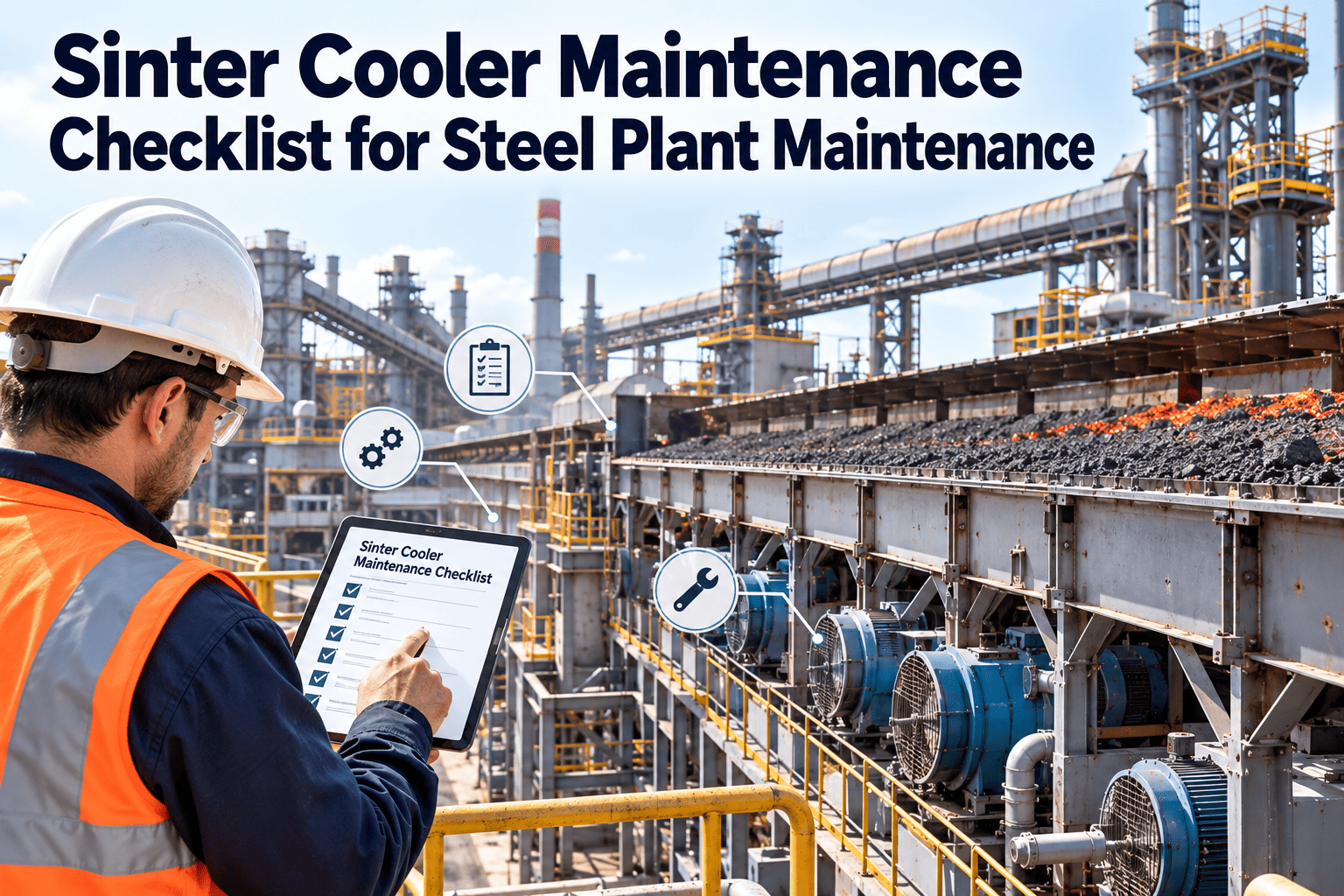
A sinter cooler rarely fails without warning, but the warnings are easy to miss. A fan drifts out of balance, a seal skirt wears thin, a drive current creeps upward, and discharge temperature rises a few degrees each week. Left alone, these small shifts end in belt damage, dust emissions or a forced stop that starves the blast furnace of sinter. A structured sinter cooler maintenance checklist turns scattered observations into dated records, and steel plant maintenance software keeps those records tied to the exact asset.
Sinter Cooler Maintenance Checklist for Steel Plant Maintenance
Inspect cooler fans, bearings, chains, drives, seals, temperature and cooling performance with one structured checklist, so cooler problems become planned work orders instead of unplanned sinter plant stops.
Why the Sinter Cooler Deserves Its Own Checklist
The cooler sits between the sinter machine and everything downstream. If it cannot bring sinter down to a safe temperature, screens, conveyors and storage bins all suffer.
Without a structured checklist
- Inspections depend on who walks the area that shift
- Vibration and temperature readings stay in notebooks
- Worn seals are noticed only when dust becomes visible
- Fan and drive faults surface during hot, loaded operation
- Shutdown scope is guessed from memory
With a digital checklist
- Every round follows the same asset-specific route
- Readings are logged, trended and compared with limits
- Seal wear is flagged early and scheduled for repair
- Abnormal findings raise work orders from the inspection
- Shutdown scope is built from recorded defects
How to Use This Checklist
Each item carries a frequency tag. Adapt the limits to your cooler type, whether circular or straight-line, and to the original equipment manufacturer manuals.
Cooling Fans and Airflow
Fans deliver the cooling air, so any loss of airflow shows up directly in discharge temperature and bed uniformity.
- SRecord motor current for every cooler fan and compare it with the baseline for the same damper position; a rising trend suggests fouling, damper issues or mechanical drag.
- SListen and feel for abnormal noise, vibration or pulsation at the fan casing, inlet and outlet ducts during normal running.
- WCheck impeller blades for dust build-up, erosion and cracks, because uneven deposits cause imbalance that accelerates bearing wear.
- WConfirm damper and inlet vane position matches the control signal, and that linkages move freely without play.
- MInspect flexible joints, expansion bellows and duct flanges for leaks, which waste air and reduce cooling on that zone.
- ABalance impellers, check shaft run-out and inspect foundation bolts and anti-vibration mounts during shutdown.
Bearings and Lubrication Points
Bearings on fans, rollers and drive shafts sit in hot, dusty surroundings, so lubrication discipline decides their life.
- SMeasure or touch-check bearing housing temperature on fans and drive shafts, and log any reading above the alarm value set for that bearing.
- WCollect vibration readings at each fan and motor bearing and compare overall velocity and high-frequency trends with previous rounds.
- WCheck grease points are accessible, clean and receiving the correct grease quantity; replace damaged fittings and blocked lines.
- MInspect labyrinth and contact seals on bearing housings for grease purging, dust ingress and discolouration from heat.
- MReview oil level, colour and breather condition on any oil-lubricated bearing, and sample oil where a program exists.
- AReplace bearings approaching their service interval and record clearance, fit and torque values at installation.
Chains, Pallets, Rollers and Rails
The moving bed carries hot sinter continuously. Wear here causes misalignment, spillage and sudden structural damage.
- SWalk the cooler and watch bed travel for jerking, tracking drift, uneven speed or visible spillage at the sides.
- WCheck trolley or pallet bodies for cracks, distortion, missing grates and loose fasteners, and tag damaged units for replacement.
- WInspect chain links, pins and sprockets, or wheels and track surface on circular units, for wear marks and abnormal noise.
- MMeasure chain elongation or wheel and rail wear against the limits in the manufacturer drawings and record the result.
- MVerify tensioning devices, take-up travel and guide rollers are within range and free to move.
- ASurvey rail or track alignment and level, and inspect welded structure for fatigue cracks near load points.
Drives, Gearboxes and Hydraulics
The drive sets cooler speed, which controls bed depth and cooling time, so unstable torque affects both output and temperature.
- SLog drive motor current, speed and any hydraulic pressure, and flag torque spikes or hunting compared with normal operation.
- WCheck gearbox oil level, leaks, temperature and breather, and listen for gear mesh noise or knocking.
- WInspect couplings, guards and torque arms for looseness, cracked elastomers and missing hardware.
- MFor hydraulic drives, inspect hoses, fittings, cylinders and filters, and check pressure against the recorded setting.
- MTest overload, speed and zero-speed protection to confirm the drive stops safely on a fault.
- ATake a gearbox oil sample, inspect gear contact patterns where access allows, and renew oil per condition.
Put the Cooler Round on a Mobile Checklist
Assign each item to an asset, capture readings in the field and raise a work order the moment something falls outside its limit.
Seals, Skirts, Hoods and Ducts
Seal condition controls how much cooling air reaches the bed and how much dust escapes into the building.
- SLook for visible dust leakage at skirts, hoods, feed chutes and discharge points, and note the location on the round sheet.
- WCheck water seal troughs, if fitted, for correct level, sludge build-up, and blocked drains or overflow lines.
- WInspect rubber or metallic skirt seals for wear, gaps and hardening caused by heat exposure.
- MExamine hood plates and ducting for hot spots, thinning metal, warped sections and failed insulation.
- MVerify dust extraction connections and hoppers are clear, and that discharge valves operate without sticking.
- AReplace worn seals as a set, clean air plenums and inspect internal ducts for abrasion and deposits.
Temperature and Cooling Performance
Performance checks confirm the cooler is doing its job, not just that its parts are turning.
- SRecord sinter discharge temperature at the same point each round and compare it with the target set by downstream belt and screen limits.
- SNote bed depth and visual uniformity across the width, since channeling points to uneven airflow or segregation.
- WCompare inlet and outlet air temperatures per zone to spot a zone that is no longer removing heat effectively.
- WReview any thermography images of hoods, ducts and structure and log hot spots with location and photo.
- MTrend discharge temperature against production rate, fan current and ambient conditions to separate seasonal effects from degradation.
- MWhere heat recovery equipment is fitted, check recovered heat output against its expected range.
Structure, Chutes and Safety
Hot sinter, dust and moving equipment make this area high risk. Safety checks belong in the same round.
- SConfirm guards, emergency stops, pull cords and interlocks are in place and undamaged before any hands-on checks.
- WInspect feed and discharge chutes for liner wear, build-up and blockages that could push hot material onto walkways.
- WCheck walkways, handrails and access ladders for damage, dust accumulation and trip hazards.
- MVerify lockout points, isolation labels and permit-to-work records match the current equipment layout.
- MInspect support steelwork, anchor bolts and welds for corrosion, cracking and heat damage.
- AComplete wall thickness checks on hoods and ducts, and update the repair backlog with photos and measurements.
Inspection Rhythm at a Glance
Match inspection depth to the time available. Short rounds catch change early, and shutdown work corrects what rounds reveal.
Failure Risk Matrix for the Sinter Cooler
Rank each failure by likelihood and impact on sinter flow. Review the ranking after every shutdown and major finding.
| Failure Mode | Early Signal | Likely Impact | Priority |
|---|---|---|---|
| Fan imbalance or bearing wear | Rising vibration and housing temperature | Reduced airflow, forced fan stop | High |
| Drive or gearbox fault | Current spikes, oil contamination, noise | Cooler stops, sinter backs up | High |
| Chain, wheel or rail wear | Elongation, jerking, misalignment | Spillage, structural damage | High |
| Seal and skirt wear | Dust leaks, uneven cooling | Air loss, emissions, housekeeping load | Medium |
| Duct or hood damage | Hot spots, thinning plate | Heat loss, safety exposure | Medium |
| Damper or vane sticking | Position mismatch with signal | Poor temperature control | Medium |
From Reading to Action: Condition Triggers
A reading only matters if it triggers a response. Define limits per asset and the action each one starts.
| Parameter | Watch For | Suggested Action |
|---|---|---|
| Fan motor current | Sustained rise at constant damper position | Inspect impeller and ducts for fouling |
| Bearing vibration | Upward trend across several rounds | Schedule lubrication check, then bearing work |
| Bearing temperature | Reading above the set alarm value | Check grease, alignment and load |
| Discharge temperature | Rising at steady production rate | Review zone airflow and seal condition |
| Gearbox oil | Wear metals, water or darkening | Plan oil change and internal inspection |
| Chain or wheel wear | Approaching manufacturer limit | Order parts and plan replacement window |
Limits shown are examples of logic, not fixed values. Set numeric thresholds from manufacturer data and your own baseline history.
Turning the Checklist Into a Maintenance Workflow
A paper checklist records problems. A connected workflow closes them. This sequence shows how a finding moves from the cooler floor to a completed repair.
Register the assets
List each fan, drive, gearbox, bearing set and seal group with its location and criticality.Build the route
Attach checklist items and frequencies to each asset so rounds follow a repeatable path.Capture on mobile
Inspectors enter readings, notes and photos in the field, including time and name.Raise work orders
Out-of-limit results create corrective work orders with priority, parts and permits.Plan and schedule
Group findings into shutdown packages and reserve spare bearings, seals and chain parts.Review and adjust
Use dashboards to compare recurring defects and tune frequencies and limits.Where Oxmaint Fits in Sinter Cooler Maintenance
Oxmaint supports the checklist workflow with tools maintenance teams already use day to day.
- Preventive maintenance: time and meter-based tasks for lubrication, seal checks and fan inspections.
- Inspections: reusable checklists with pass, fail and numeric entries for each cooler zone.
- Work orders: corrective jobs created straight from failed inspection items.
- Inventory: track critical spares such as bearings, skirt seals and chain components.
- Condition-based workflows: use logged readings to trigger work as trends worsen.
- Reporting: keep dated records for audits, shutdown planning and reliability reviews.
KPIs to Track for Cooler Reliability
Measure outcomes the checklist should improve. Trend them monthly and review against shutdown results.
Common Checklist Mistakes to Avoid
- Copying generic checklists without adjusting to your cooler design and operating limits.
- Recording pass or fail only, with no readings to build trends.
- Skipping seal and duct checks because they are hard to reach or dirty.
- Logging defects without owners, due dates or linked work orders.
- Never reviewing the checklist after a failure that it did not catch.
Sinter Cooler Checklist FAQs
How often should a sinter cooler be inspected?
Run short shift rounds for currents, temperatures and leaks, with deeper weekly and monthly checks. Add shutdown tasks for wear parts.
What are the first signs of cooler fan trouble?
Rising vibration, bearing heat, motor current drift and noise usually appear first. Log them every round to spot trends early.
Can this checklist be used for predictive maintenance?
Yes. Numeric readings logged over time support condition-based triggers. Start building routes to capture that history.
Which cooler seals matter most?
Skirt, hood and water seals matter because they control air loss and dust. Check them weekly and replace worn sets together.
How do I set up this checklist in Oxmaint?
Register cooler assets, add inspection items and link failures to work orders. Book a walkthrough for your setup.
Keep Sinter Flowing With a Cooler Checklist That Gets Done
Replace paper rounds with mobile inspections, linked work orders and trend records for every cooler asset. Start with one cooler, then extend the routine across the sinter plant.