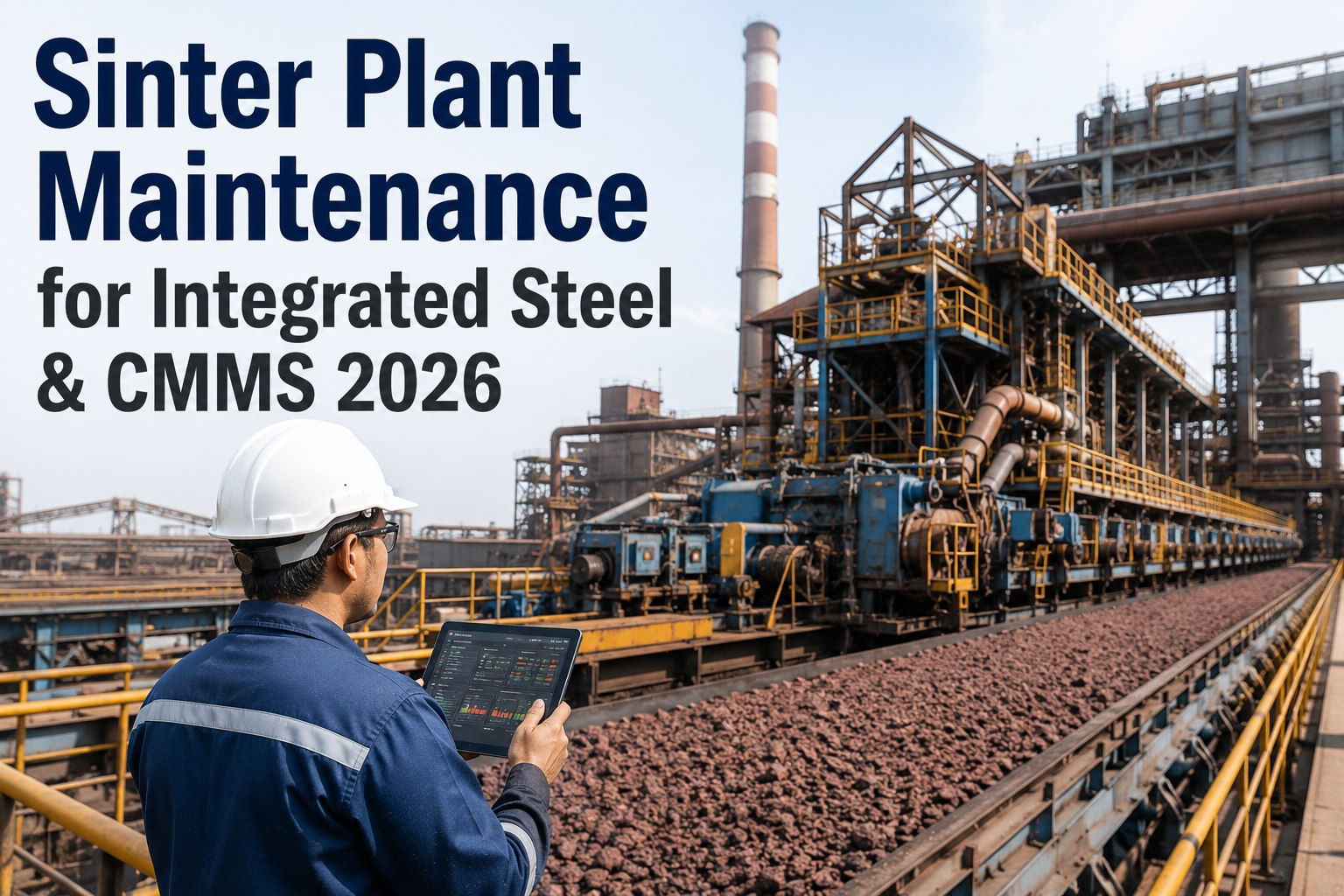
The sinter plant is the invisible constraint in most integrated steel mill production systems. When sinter quality degrades — because the windbox suction is uneven, because the hearth layer depth is inconsistent, because the ignition hood burners are fouled — the blast furnace feels it within hours. Increased coke rate. Unstable burden distribution. Reduced productivity. The connection is direct and quantifiable, yet sinter plant maintenance consistently receives less systematic attention than the blast furnace, converter, and rolling mill systems whose dependence on sinter quality makes them vulnerable to every maintenance gap upstream. A 50-tonne-per-hour sinter shortfall costs an integrated mill $8,000–$15,000 in lost production per hour when the blast furnace must be throttled — but the root cause sits in a maintenance backlog in the raw mix conditioning section that accumulated over weeks. Getting sinter plant maintenance right is not just about keeping one process running. It is about protecting the production output of every downstream process that depends on consistent, high-quality sinter reaching the blast furnace at design specification. Schedule a free sinter plant maintenance assessment with our metallurgical engineering team and quantify the downstream production value your current maintenance program is protecting — or failing to protect.
Sinter Plant Process Overview: What Maintenance Must Protect
Effective maintenance management begins with understanding the process well enough to know which equipment failures have immediate downstream consequences and which can be managed with brief intervention windows. In a sinter plant, the distinction between tolerable short-duration stoppages and blast furnace-impacting failures is precisely the knowledge that transforms a reactive maintenance crew into a production-protecting asset management operation.
Iron Ore Sintering Process Flow — Critical Maintenance Intervention Points
1
Raw Material Receipt
Iron ore fines, coke breeze, limestone, dolomite, return fines, mill scale
Conveyor systems, weigh feeders, moisture meters
›
2
Raw Mix Conditioning
Primary mixing drum — water addition, coke breeze blending, mix homogenization
Mixing drum shell, lining, drive gear, water spray nozzles
›
3
Granulation
Secondary granulation drum — pellet formation, moisture optimization for permeability
Drum shell wear, discharge end ring, trunnion bearings
›
4
Sinter Strand
Hearth layer charging, ignition hood, main sinter bed — burn-through point control
CRITICAL: Pallets, grate bars, windboxes, suction fans
›
5
Sinter Crushing & Screening
Single-roll crusher, screens — return fines separation, hot sinter sizing
Crusher teeth, screen panels, hot material handling bearings
›
6
Gas Cleaning & Suction System
Windbox manifold, main suction fan, electrostatic precipitator or bag filter
Main fan impeller, seals, gas duct expansion joints
Production Impact
Sinter plant availability directly gates blast furnace production. Every 1% reduction in sinter plant availability at a 2-million-tonne-per-year integrated mill costs approximately $2.4M in annual production value. A well-maintained sinter plant operating at 94%+ availability versus a poorly maintained one operating at 88% represents a $14.4M annual production difference — all attributable to maintenance program quality.
Critical Equipment Deep-Dive: The Five Systems That Define Sinter Plant Availability
Sinter plant availability is determined by a small number of critical equipment systems that, when they fail, cannot be bypassed or substituted. Understanding the failure modes, maintenance requirements, and CMMS management approach for each of these systems is the foundation of a high-availability sinter plant maintenance program.
Primary Failure Modes
Grate Bar Burnout
Excess heat penetration from over-dry mix or thin hearth layer — grate bar alloy failure above 1100°C
Immediate strand shutdown — hot sinter breakthrough to windbox
Pallet Rail Wear
Continuous cyclic loading, thermal cycling, abrasive fines under pallet wheels
Increasing pallet bounce causing mix charging disruption, quality variation
Drive Sprocket/Chain Wear
Abrasive environment, thermal expansion mismatch, inadequate lubrication
Strand speed instability affecting burn-through point control
PM Program Requirements
Shift
Visual grate bar inspection through windbox inspection ports — any through-burn indication requires immediate hearth layer correction
Weekly
Pallet rail wear measurement at defined gauge points — replace section when wear exceeds 8mm from baseline
Monthly
Grate bar thickness measurement on cold pallets — identify thin bars before they reach burnout threshold. Swap-out damaged pallets into repair cycle
Shutdown
Full strand track alignment survey, drive sprocket profile measurement, chain elongation check, tension adjustment
CMMS Management
Individual pallet records with grate bar condition history — replace before 60% life consumption to avoid in-service failures
Grate bar consumption tracked as KPI — increasing consumption rate signals mix chemistry or hearth layer issue
Rail wear trend analysis predicts replacement timing — eliminates emergency track repairs during production
Work order sequence for annual shutdown strand overhaul — ensures all critical path items are scheduled against planned outage window
Primary Failure Modes
Impeller Erosion
Abrasive dust particles (iron ore, coke fines, lime) at high velocity — leading edge erosion of fan blades
Progressive vibration increase, suction capacity reduction, eventual blade failure
Bearing Failure
High thermal environment, dusty atmosphere, lubricant contamination — accelerated bearing wear
Fan shutdown — complete production stop. Most unplanned sinter plant downtime events
Shaft Seal Failure
Thermal cycling, abrasive atmosphere, seal material degradation
Gas leakage, suction efficiency loss, environmental emission compliance risk
PM Program Requirements
Shift
Bearing temperature and vibration reading — record against baseline. Any reading outside +15% of baseline requires immediate investigation
Weekly
Vibration signature analysis — trend RMS velocity at bearing housings, compare against ISO 10816-3 alert and alarm bands
Monthly
Oil sample from bearing housing — check contamination, degradation, and metal particle content. Change on condition, not calendar interval
Shutdown
Impeller blade thickness measurement, erosion profile mapping, dynamic balancing after any blade repair or replacement
CMMS Management
Vibration baseline established at commissioning or last overhaul — all subsequent readings compared against this specific machine baseline, not generic ISO bands
Bearing temperature trending with automatic alert generation — predictive maintenance triggered at 85% of alert threshold
Oil analysis results stored against fan asset record — trend viscosity, acid number, and wear metals to predict optimal change interval
Impeller erosion history linked to ESP/bag filter performance — accelerated impeller wear signals dust collection system degradation
Primary Failure Modes
Windbox Partition Burn-Through
Direct flame contact from grate bar burnout, inadequate partition wall thickness
Cross-contamination between windbox chambers, suction distribution imbalance, uneven burn-through point
Expansion Joint Failure
Thermal cycling fatigue, abrasive gas flow, corrosion from condensing gases
Hot gas leakage, pressure loss, environmental emission, structural damage potential
Duct Wear and Perforation
Abrasive dust-laden gas stream, thermal cycling, condensate corrosion
Suction system efficiency loss, gas leakage, emission compliance issues
PM Program Requirements
Shift
Visual inspection of expansion joint external surfaces — heat discoloration, deformation, or gas smell indicating leakage
Monthly
Windbox suction distribution measurement — record suction at each windbox and compare against design distribution. Deviation indicates leakage or blockage in affected zone
Shutdown
Full windbox internal inspection, partition wall thickness measurement, expansion joint replacement assessment, duct wall thickness survey at high-wear zones
CMMS Management
Windbox suction measurement records plotted against strand position — deviation pattern identifies specific zones with developing problems
Duct wall thickness survey results stored with position references — corrosion rate calculation triggers replacement work order before perforation
Expansion joint installation dates tracked — proactive replacement based on thermal cycle count, not visual inspection alone
Primary Failure Modes
Burner Tip Fouling
Carbon deposition, scale buildup, mix material impingement on burner tips
Uneven flame distribution across hood width — poor surface ignition, reduced yield, hot spots on grate bars
Refractory Lining Spalling
Thermal shock from rapid temperature cycling during starts/stops, differential expansion
Heat loss through shell, flame impingement risk, cold zone on sinter surface under damaged area
PM Program Requirements
Weekly
Infrared thermal imaging of hood external surface — hot spots indicate refractory damage. Map hot spot locations against burner positions
Monthly
Burner tip cleaning and inspection during brief production gap — flow test each burner to confirm delivery at specification ±5%
Shutdown
Full refractory inspection and repair, burner replacement cycle, gas manifold leak test, combustion air flow balance
CMMS Management
Thermal imaging results stored as image attachments to hood asset record — progressive hot spot mapping identifies refractory deterioration rate
Burner flow test results linked to individual burner assets — identify burners with chronic fouling tendency that warrant specification review
Correlation between ignition hood condition and sinter return fines ratio — quantifies production cost of deferred hood maintenance
Primary Failure Modes
Drum Lining Wear
Abrasive mix material, inadequate liner thickness, worn lifting flights reducing mix tumbling
Reduced mixing efficiency, suboptimal moisture distribution, granule size inconsistency
Trunnion Bearing Failure
Abrasive contamination from mix material ingress, inadequate sealing, lubricant degradation
Drum stop — complete loss of mixing and granulation, forced production halt
Water Spray System Blockage
Scale buildup in nozzles, debris in supply lines, nozzle wear changing spray pattern
Moisture distribution non-uniformity — poor granule formation, mix permeability reduction
PM Program Requirements
Shift
Check water spray system — confirm all nozzles operating. Spray pattern visual check from inspection port
Monthly
Trunnion bearing temperature and lubrication inspection. Drum shell radial runout measurement — increasing runout indicates shell distortion or bearing wear
Shutdown
Drum lining thickness survey, lifting flight height measurement, trunnion ring wear profile, complete nozzle replacement
CMMS Management
Lining thickness measurement history predicts replacement campaign timing — avoid mid-campaign failures
Correlation between drum condition metrics and sinter plant yield — documents production value of lining maintenance
Water spray nozzle replacement tracked as consumable inventory against drum assets — automatic reorder at minimum stock level
Every Critical Sinter Plant Asset — Managed in One System
Oxmaint links every sinter plant asset to its PM schedule, inspection history, spare parts inventory, and failure mode library — giving maintenance engineers the complete picture needed to protect sinter plant availability and the blast furnace production that depends on it.
Sinter Plant Maintenance KPIs: Connecting Maintenance Performance to Production Value
Sinter plant maintenance cannot be justified on maintenance metrics alone. The maintenance organization must speak the language of production — availability, yield, quality, and cost per tonne — to demonstrate value to mill management and secure the investment needed for world-class maintenance performance. These KPIs bridge maintenance activity and production outcome in terms that blast furnace operators, production managers, and financial controllers all understand.
94%+
Mechanical Availability
Percentage of scheduled production time the plant is mechanically available. World-class target — below 90% indicates systematic maintenance failure.
< 2%
Unplanned Downtime Rate
Unplanned stops as percentage of scheduled hours. Above 4% requires root cause investigation and PM program revision.
800+ hrs
MTBF — Main Fan
Mean time between unplanned failures on the main suction fan — the most common single-point production stopper in sinter plants.
< 25%
Return Fines Ratio
Sinter below 10mm returned to blend. Increasing return fines ratio signals ignition hood, windbox distribution, or granulation degradation — all maintenance-driven.
75–85%
Sinter Plant Yield
Sinter produced as percentage of raw mix charged. Yield trend is the composite indicator of process stability — maintenance quality shows directly in this number.
±1 bar
Windbox Suction Uniformity
Deviation from mean suction across all windbox positions. Uniformity deviation indicates leakage or blockage — direct quality impact on sinter bed combustion.
> 80%
Planned Maintenance Ratio
Planned PM hours as percentage of total maintenance hours. Below 70% indicates the program is structurally reactive — accumulating failure risk continuously.
100%
PM Compliance Rate
Critical safety and availability PM tasks completed within window. No safety-critical PM should be deferred without formal risk assessment and authorization.
< 30 days
Spare Parts Stock-Out Events
Average days between critical spare parts stockout events — grate bars, fan bearings, drum lining segments. Any stockout that extends a shutdown extends production loss.
Sinter Plant Shutdown Planning: The Annual Maintenance Campaign
The planned annual shutdown is the primary opportunity to perform the major inspection, measurement, and repair work that cannot be done on-line. Sinter plant shutdowns are characteristically short — typically 5–10 days — and intensely resource-loaded, with simultaneous work fronts on the strand, the fan, the gas cleaning system, the raw material handling equipment, and the ignition hood. Work that is not pre-planned, pre-staged, and pre-permitted before the outage begins will not be completed within the shutdown window.
Strand Isolation & Cooling
Pallet & Grate Bar Campaign
Track & Rail Survey & Repair
Windbox Internal Inspection
Gas Duct Wall Thickness Survey
Ignition Hood Refractory Repair
Mixing Drum Lining & Bearing
ESP / Bag Filter Overhaul
Crusher & Screen Maintenance
Electrical & Instrumentation
Critical Path — Strand Systems
Auxiliary Process Systems
Plan Your Sinter Plant Shutdown in Oxmaint — Start to Finish
Oxmaint's shutdown planning module links every work order to the outage schedule, pre-stages material and permit requirements, and tracks real-time progress against the critical path — so your 8-day shutdown delivers full scope without overruns that cost blast furnace production time.
Common Sinter Plant Maintenance Program Failures
Sinter plant maintenance programs fail in ways that are consistent across facilities regardless of geography, technology generation, or production scale. The following failure patterns represent the most frequent root causes of below-target sinter plant availability — identified through analysis of maintenance records and incident reports across integrated steel facilities.
01
Grate Bar Management as Reactive Replacement Rather Than Planned Rotation
Grate bars are typically replaced only when burnout is observed or a pallet fails mechanically. This reactive approach means grate bars are replaced individually during production, frequently under time pressure, with quality inspections that cannot be performed adequately during brief gaps. A planned grate bar rotation program — where complete pallets are cycled through a maintenance bay on a schedule — reduces total grate bar consumption by 15–25% through earlier intervention at consistent quality, and eliminates the production interruption caused by emergency replacements.
02
Main Fan Vibration Monitoring Without Baseline Comparison
Many sinter plant maintenance programs take vibration readings on the main fan but compare them against ISO generic alarm bands rather than the specific machine's baseline signature established at commissioning or last overhaul. A fan with a baseline vibration of 2.8 mm/s RMS at the bearing housing will trigger the ISO 10816-3 "alert" band at 4.5 mm/s — but a change from 2.8 to 3.5 mm/s (25% increase) represents a significant trend that is invisible when only compared against the absolute standard. Machine-specific baseline comparison detects developing bearing failures 2–4 weeks earlier than generic band monitoring.
03
No Connection Between Sinter Quality Metrics and Maintenance Records
Return fines ratio, sinter tumble index, and blast furnace sinter consumption rate are process quality metrics tracked by operations. Maintenance records are tracked in the CMMS. When these data streams exist in separate systems with no analytical connection, the progressive relationship between ignition hood condition and return fines, or between granulation drum wear and permeability index, is never quantified. Integrating CMMS maintenance records with process quality data creates the feedback that allows maintenance engineers to quantify the production cost of deferred maintenance in terms that justify the investment needed to address it.
04
Shutdown Scope Defined by Budget Rather Than Equipment Condition
When annual shutdown scope is determined by financial budget allocation rather than the condition assessment data from the preceding 12 months of inspections and measurements, critical work that was identified during on-line monitoring may be deferred because it was not in the original budget. This approach consistently results in either over-spending on work that data shows is not yet needed, or under-spending on work the data clearly requires — with the latter causing mid-year production incidents. CMMS-based condition-driven shutdown scoping produces better availability outcomes at lower total maintenance cost than budget-driven scoping.
05
Ignition Hood Treated as a Refractory Problem, Not a Process Problem
Ignition hood refractory maintenance is typically assigned to the refractory maintenance team, while the performance consequences — uneven sinter ignition, increased return fines, reduced yield — are owned by the process operations team. This organizational split means the refractory team patches the hood on a calendar schedule without understanding which specific zones have the greatest process impact, and the process team accepts deteriorating yield without connecting it to the maintainable asset condition upstream. Integrating ignition hood condition data with sinter quality metrics in the CMMS produces a cross-functional maintenance priority that neither team can develop from their own data alone.
Frequently Asked Questions
01
How often should sinter plant main fan bearings be replaced on a planned basis versus condition basis?
Main suction fan bearings in sinter plant service operate in an exceptionally demanding environment — elevated temperatures, abrasive dust, and high rotational loads. Condition-based replacement, guided by vibration trending and oil analysis, consistently outperforms calendar-based replacement by reducing unnecessary bearing changes while eliminating in-service failures. The key is establishing a machine-specific vibration baseline immediately after each bearing installation and tracking the absolute vibration level and the rate of change from that baseline. A vibration increase of 50% above baseline OR a rate of change exceeding 0.5 mm/s per week should trigger replacement planning. Oil analysis provides complementary data — increasing iron and copper particle count in bearing lubricant oil indicates developing wear that may precede measurable vibration increases. With this dual-indicator approach, most main fan bearings achieve 12,000–18,000 operating hours between planned replacements, compared to the 8,000–10,000 hour calendar intervals that many plants apply, reducing total bearing replacement cost while maintaining zero unplanned bearing failures.
02
What is the most effective way to manage sinter pallet inventory across a large sinter strand with 200+ pallets?
Large sinter strand pallet fleets require a systematic rotation management approach rather than individual pallet tracking at the grate bar level. The most effective model assigns each pallet a unique identifier and tracks it through three states in the CMMS: in-service on the strand, in the pallet maintenance bay undergoing grate bar replacement and inspection, and in the spare holding area. The rotation cycle is driven by service life data — each pallet's average daily exposure on the strand, multiplied by the measured pallet condition at each maintenance bay visit, generates a predicted remaining life that schedules the next maintenance bay entry. Target is to maintain 15–20% of the fleet in or pending the maintenance bay at any time, ensuring sufficient spare pallet inventory to swap out degraded pallets without production interruption. Grate bar consumption per pallet per rotation cycle is tracked as a fleet-level metric — increasing average consumption signals a process condition issue (too thin a hearth layer, too dry a mix, uneven ignition) rather than a pallet maintenance issue, directing the investigation to the correct root cause.
03
How should the CMMS be configured to capture the connection between sinter plant maintenance and blast furnace performance?
The CMMS connection between sinter plant maintenance and blast furnace performance is built through three linked data elements. First, process quality KPIs — return fines ratio, sinter yield, sinter size distribution, tumble index — should be entered into the CMMS as production meter readings against the sinter plant as an asset, not just tracked in the process historian. Second, major sinter plant maintenance events — significant unplanned stoppages, major PM completions, equipment condition rating changes — should generate automated notifications to blast furnace operators and engineers, creating visibility of upstream condition changes that affect furnace operating parameters. Third, post-maintenance performance verification work orders should be created for the 24-48 hour period following significant sinter plant maintenance events, capturing whether quality metrics improved to expected levels. This three-element integration builds the longitudinal dataset that allows engineers to quantify the production value of each major sinter plant maintenance investment — the kind of evidence-based justification that secures future maintenance budget approval.
04
What are the critical spare parts that must be held in stock to prevent extended unplanned sinter plant downtime?
Critical sinter plant spares strategy must protect against the failure modes that have the longest production loss consequence. Main fan bearings — one complete set for each bearing position on the main fan — are the highest priority insurance spare, given that bearing failure is the most frequent single cause of unplanned sinter plant production stops and replacement requires 8–16 hours. A complete set of main fan mechanical seals should be held alongside the bearings. Grate bar inventory should maintain a minimum of 2 full pallet sets (typically 400–600 bars depending on pallet design) at all times — consumption rate tracking in the CMMS ensures automatic reorder before stockout. Mixing drum spray nozzle complete sets (all positions) are low-cost, fast-to-install, and frequently required. Windbox expansion joint sections for the highest-wear positions (first and last windboxes, which see the most thermal cycling) should be held as cut-to-length pre-formed sections. Ignition hood refractory repair mortar and replacement tile inventory for the most critical zones avoids delays caused by procurement lead times that typically run 4–8 weeks for specialist refractory materials.