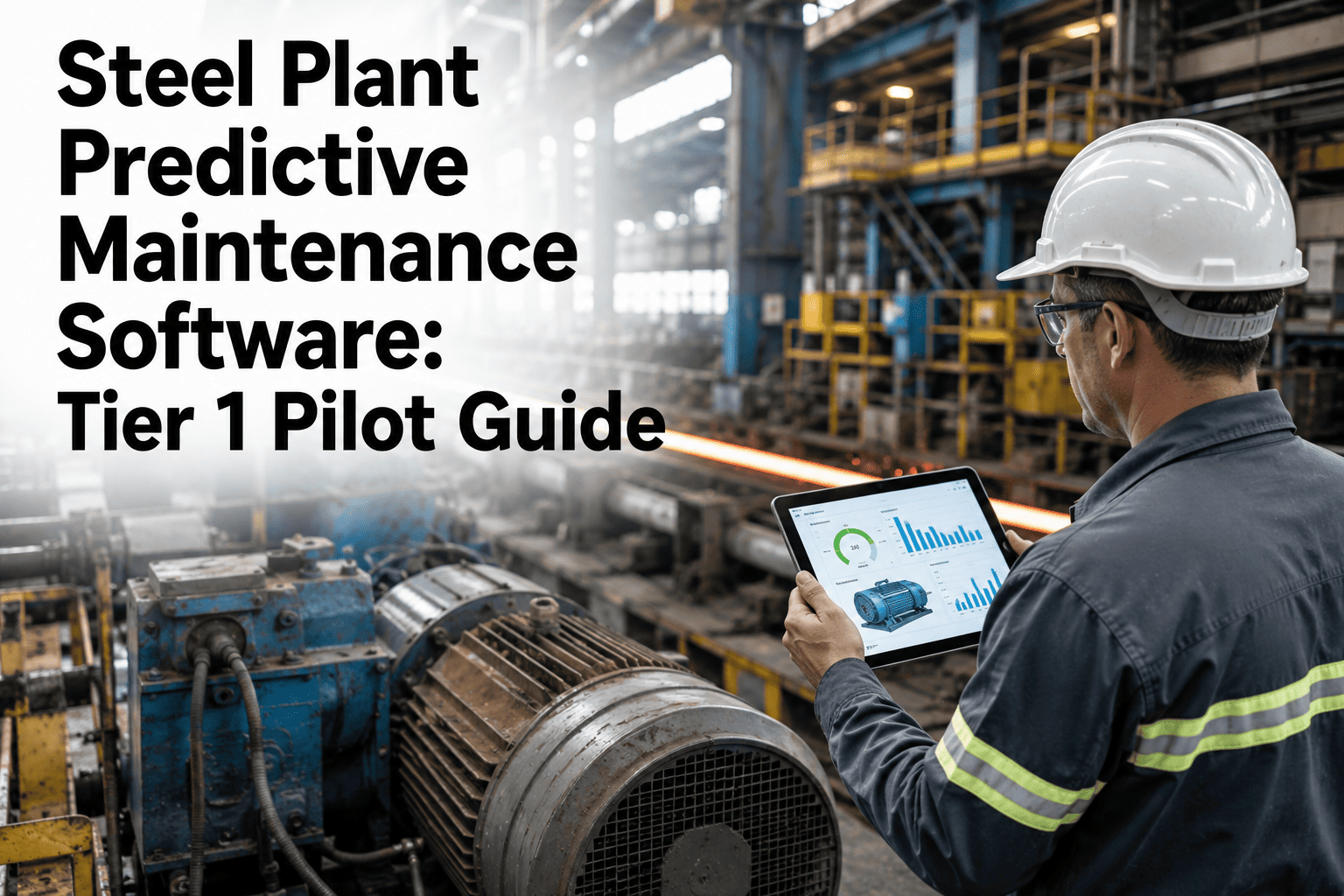
A steel producer in Indiana ran a six-month AI pilot on its hot strip mill, using vibration sensors and a prediction model to catch bearing failures before they caused an unplanned stop. The pilot line cut downtime by 31% and paid for itself in eleven weeks, and everyone in the room agreed it should roll out across the plant. Eighteen months later, the same pilot was still running on that one line, because nobody had built the software layer that could carry the model, the alerts, and the maintenance workflow to the other nine lines without starting over each time. Steel plants across the country tell the same story: strong pilots that never become production systems, not because the AI was wrong, but because there was no path built to carry it forward. OxMaint's scale-path layer for CMMS is built to close exactly that gap.
Turn One Successful Pilot Into a Plant-Wide Standard
Model packaging, rollout tracking, and work-order alerts — all built into OxMaint's CMMS, so a pilot that works on one line does not have to be rebuilt for the next nine.
70%
of industrial AI pilots never reach a second production line, let alone plant-wide use
31%
average downtime reduction reported by successful predictive maintenance pilots in steel mills
9-14 mo
typical time lost rebuilding pilot infrastructure separately for every additional line
Why Steel AI Pilots Die Before They Scale
A pilot proves the model works. It rarely proves the organization can carry that model anywhere else. These four gaps are where most steel plant AI initiatives quietly stall after a successful proof of concept.
01
No Model Home After the Pilot Ends
Pilot models often live on a data scientist's laptop or inside a vendor's sandbox account. Once the pilot team moves to the next project, nobody owns the model, and it quietly stops getting retrained or monitored.
02
Every Line Starts From Zero
Without a shared software layer, each new line needs its own sensor mapping, threshold tuning, and integration work — turning what should be a two-week rollout into a six-month rebuild, line by line.
03
Alerts Never Reach the Work Order
A pilot that emails an engineer is not the same as a system that opens a work order, assigns a technician, and tracks the repair. Most pilots stop at the email and never touch the maintenance workflow.
04
No Proof for the Budget Committee
Plant managers can show a chart from the pilot, but not a dollar figure tied to maintenance records — and a dollar figure tied to real records is what finance actually needs to approve a plant-wide rollout.
Scale Path — OxMaint
Give Every Pilot a Home to Grow Into
Instead of a pilot that lives in a spreadsheet and a slide deck, OxMaint gives your model a permanent place inside the CMMS your technicians already use — so scaling to the next line is a configuration task, not a rebuild.
The Four-Stage Scale Path
Moving from one working pilot to a plant-wide standard is not one big jump. It is four distinct stages, each with its own risk of stalling, and each with its own checkpoint inside OxMaint.
Stage 1
Validate
Confirm the pilot's savings against real CMMS work order and downtime records, not just raw sensor output, so the business case is built on numbers finance already trusts.
Stage 2
Standardize
Package the model, its thresholds, and its alert rules into a reusable template that does not depend on the original pilot team's tribal knowledge to configure correctly.
Stage 3
Replicate
Apply the template to each additional line or plant, with a rollout dashboard that shows exactly which lines are live, which are pending, and which have stalled.
Stage 4
Govern
Monitor every deployed model for accuracy drift, retrain it on a set schedule, and keep one single record of which model version is running on which line, at all times.
Pilot vs Production — Where Steel AI Scaling Usually Stalls
These benchmarks come from steel plant rollouts across single-line pilots, multi-line expansions, and full plant-wide standards, showing where each stage typically breaks down.
Scale Stage
Typical Timeline
Where It Usually Stalls
OxMaint Checkpoint
Single-Line Pilot
8-16 weeks
Model never leaves the original line
Auto-packages model and workflow at pilot close
Multi-Line Rollout
3-6 months
Each line re-tunes sensors and thresholds by hand
Shared template applied per line automatically
Plant-Wide Standard
6-12 months
No single owner tracks which lines are live
Rollout dashboard shows exact status per line
Multi-Plant Network
12-24 months
Models drift silently after six or more months
Automated drift alerts and scheduled retraining
What Actually Changes Between a Pilot and a Production System
The technical model rarely changes much between pilot and production. What changes is everything around it — ownership, data, alerting, and how success gets reported.
Pilot Stage
Owned informally by a data science team or an outside vendor
Runs on a sample of sensor data from one line
Sends an email or dashboard alert to one engineer
Not connected to the maintenance work order system
Success measured in a slide deck after the fact
Production Stage
Owned jointly by maintenance and IT inside the CMMS
Runs continuously on the full plant data stream
Opens and assigns a work order automatically
Fully connected to every technician's task list
Success measured in tracked downtime and cost records
Our predictive maintenance pilot sat on one line for over a year because scaling it meant redoing the integration work from scratch every time. Once we moved it into OxMaint, the second and third lines went live in under three weeks each, using the same template. We finally had a rollout our board could actually track.
— VP of Maintenance, integrated steel mill, Midwest US
Frequently Asked Questions
How long does it take to move a steel AI pilot into production with OxMaint?
Most plants move a validated pilot to a second line within four to six weeks once the model and workflow are packaged in OxMaint. Full plant-wide rollout typically takes another two to four months, depending on the number of lines involved.
Do we need to replace our existing CMMS to scale an AI pilot?
No. The scale-path layer sits inside your existing maintenance workflow and connects pilot alerts directly to work orders rather than replacing records you already rely on.
What happens if a model's accuracy drops after it is rolled out to more lines?
OxMaint tracks each model's live accuracy against the maintenance outcomes it predicts and flags any model that drifts past your threshold, prompting a scheduled retrain before it causes a missed failure.
Can we scale a pilot across multiple plants, not just multiple lines?
Yes. The same template and rollout dashboard used across lines within one plant extends across multiple plants, giving one view of which sites have adopted which model version.
How do we justify the rollout budget to finance?
OxMaint ties every model's predictions to CMMS-recorded downtime and cost savings, giving finance a dollar-for-dollar record instead of a pilot slide deck.
Book a demo to see a sample rollout report.
Scale Path — OxMaint
Stop Rebuilding the Pilot. Start Scaling It.