A blast furnace still running past 2030 without a documented Scope 1, Scope 2, and Scope 3 emissions baseline is not just an environmental liability — it is a plant that will lose EU market share the moment CBAM certificate costs make its steel pricier than a decarbonised competitor's. Steel is one of the most carbon-intensive materials on the planet, and from January 2026 the EU's Carbon Border Adjustment Mechanism turned that carbon intensity into a line-item cost on every tonne of iron and steel entering Europe. Plant managers, sustainability leads, and capital planning teams need a working 2026 checklist that turns emissions baselining, DRI-EAF conversion, and CBAM reporting into scheduled, trackable actions — not a slide deck nobody opens until the next audit. This free roadmap checklist, and the OxMaint CMMS platform that runs it live on your shop floor, gives your team a structured path to certified low-carbon steel production.
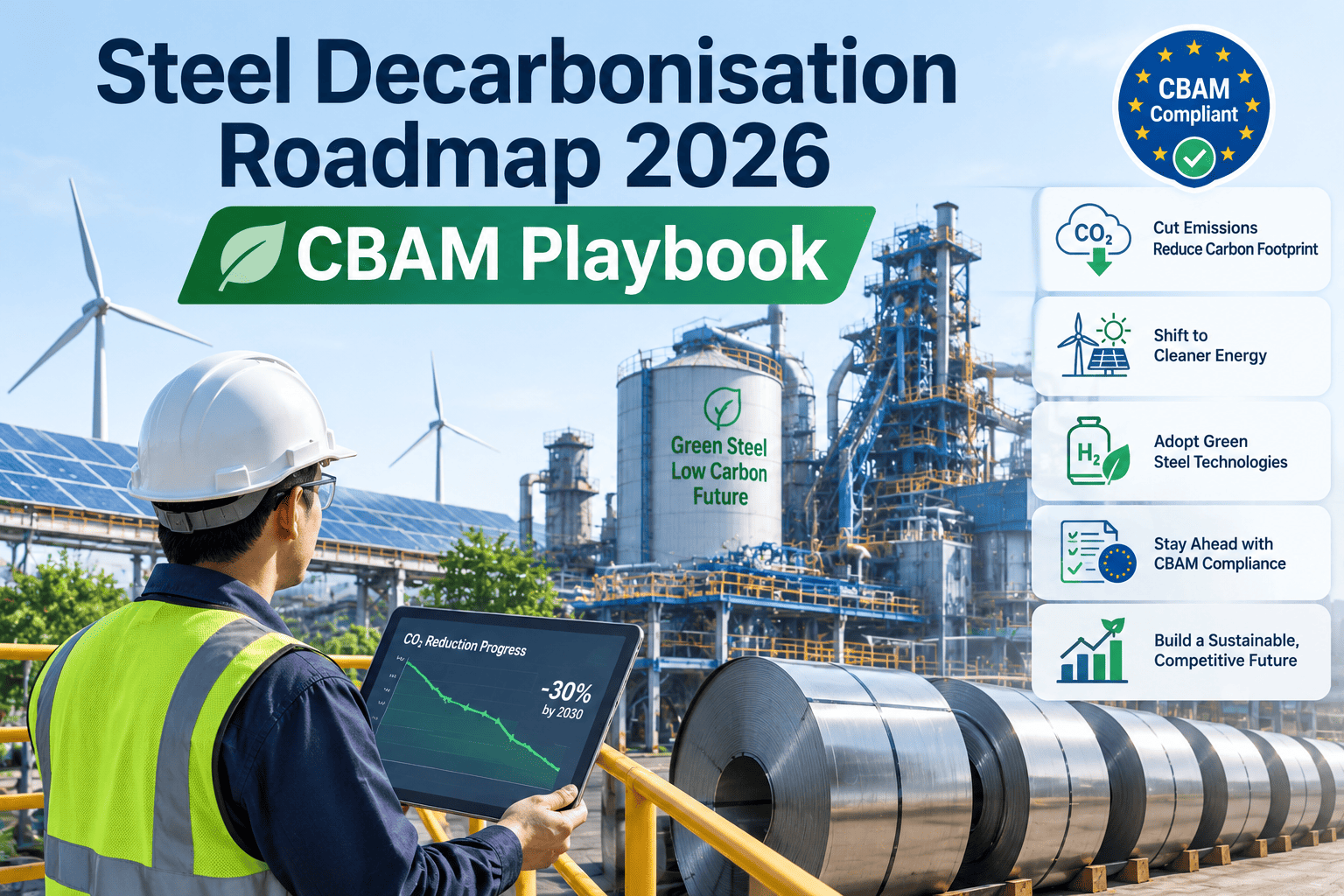
Steel Decarbonisation Roadmap 2026: Free Checklist & CBAM Compliance Playbook
A complete, plant-ready checklist covering Scope 1-2-3 emissions baselining, CBAM reporting readiness, DRI-EAF conversion sequencing, and green steel certification — structured so every action is tracked live inside OxMaint instead of a static PDF nobody updates after Q1.
Six Ways 2026 Rewrites the Cost of Running an Unconverted Steel Plant
Emissions Baseline & Scope 1-2-3 Data Foundation
Before any conversion decision, capital request, or CBAM declaration can be defended, the plant needs installation-level emissions data that a third-party verifier will accept — not a spreadsheet estimate carried over from last year's sustainability report.
CBAM Reporting & Declaration Readiness
CBAM's definitive period requires annual declarations built on verified, installation-specific data, with default values used only where actual data is unavailable or unverified — and default benchmarks are rarely flattering to the plant they're applied to.
A checklist trapped in a PDF cannot tell you which furnace missed its emissions target this quarter or which CBAM data point is still unverified. OxMaint turns every item above into a tracked workflow — asset-level emissions logs, conversion schedules, and documentation trails, all in one platform your maintenance and sustainability teams both use.
DRI-EAF Conversion Sequencing
Converting from a blast furnace-basic oxygen furnace route to direct-reduced iron feeding an electric arc furnace is the single largest emissions lever available to an integrated plant, and also the largest capital and scheduling risk if sequenced without a maintenance plan.
Green Steel Certification & Financing Alignment
A converted plant with no certification pathway leaves value on the table — certified low-carbon steel commands premium offtake agreements, and transition-linked financing rewards plants that can prove milestone delivery against a documented roadmap.
Continuous Verification & Roadmap Governance
A roadmap that is not revisited becomes inaccurate within a single reporting cycle as production mix, energy contracts, and CBAM benchmark values all shift year over year — continuous verification is what keeps it audit-ready rather than aspirational.
Key CBAM Dates and Obligations Steel Exporters Cannot Miss
| Milestone | Requirement | Status |
|---|---|---|
| Oct 2023 – Dec 2025 | Transitional phase: quarterly reporting of embedded emissions, no certificate purchase required | Completed |
| Jan 1, 2026 | Definitive phase begins: annual declarations, verified data, certificate cost exposure starts | In effect |
| Feb 1, 2027 | CBAM certificate sales open via the common central platform | Upcoming |
| Sep 30, 2027 | First certificate surrender deadline, covering emissions from 2026 imports | Upcoming |
| From 2028 | Proposed scope expansion to steel and aluminium-intensive downstream goods | Proposed |
Five Metrics That Prove the Checklist Is Actually Working
| Metric | How to Measure | Review Frequency |
|---|---|---|
| Verified Data Coverage | Installations with verified actual emissions data / Total installations | Quarterly |
| CBAM Declaration Accuracy | Declarations submitted without correction requests / Total declarations | Annual |
| Conversion Milestone Adherence | DRI-EAF project milestones met on schedule / Total milestones planned | Monthly |
| Emissions Intensity per Tonne | Total verified tCO2e / Tonnes of crude steel produced | Monthly |
| Default Value Exposure | Tonnes reported under default benchmarks / Total tonnes reported | Quarterly |
Frequently Asked Questions
What products does CBAM cover in the steel sector?
CBAM currently applies to iron and steel alongside cement, aluminium, fertilisers, electricity, and hydrogen, with a proposal to extend coverage to steel and aluminium-intensive downstream products from 2028. Exporters should track scope expansion using a live compliance tracking platform rather than a static reference sheet.
When do CBAM certificate purchases actually begin?
Certificate sales open via the common central platform on February 1, 2027, with the first surrender deadline set for September 30, 2027, covering emissions embedded in goods imported during 2026. The definitive phase itself began January 1, 2026.
Can a steel plant use default emissions values instead of measuring its own data?
Default values remain available but are capped for complex goods and tend to apply mark-ups that overstate actual emissions compared with verified installation-level data. Verified data typically reports a lower carbon intensity than the benchmark default.
Why sequence DRI-EAF conversion instead of converting all at once?
A phased sequence — often starting with natural gas DRI before a full green hydrogen transition — spreads capital exposure, avoids stranding recent blast furnace relines, and gives the plant time to secure the renewable electricity an EAF-heavy route depends on.
What happens if a CBAM declaration is late or inaccurate?
Non-compliance carries penalties calculated per tonne of unreported or undeclared emissions, with no upper cap, plus the cost of a mandatory audit. Teams tracking declarations manually are the most exposed; book a walkthrough to see how a tracked checklist closes that gap.
Every Item Tracked. Every Emissions Point Verified. Every CBAM Deadline Met.
OxMaint converts this checklist into a live plant workflow — asset-level Scope 1-2-3 data capture, DRI-EAF conversion scheduling, and CBAM documentation trails, all in one platform your maintenance and sustainability teams share.