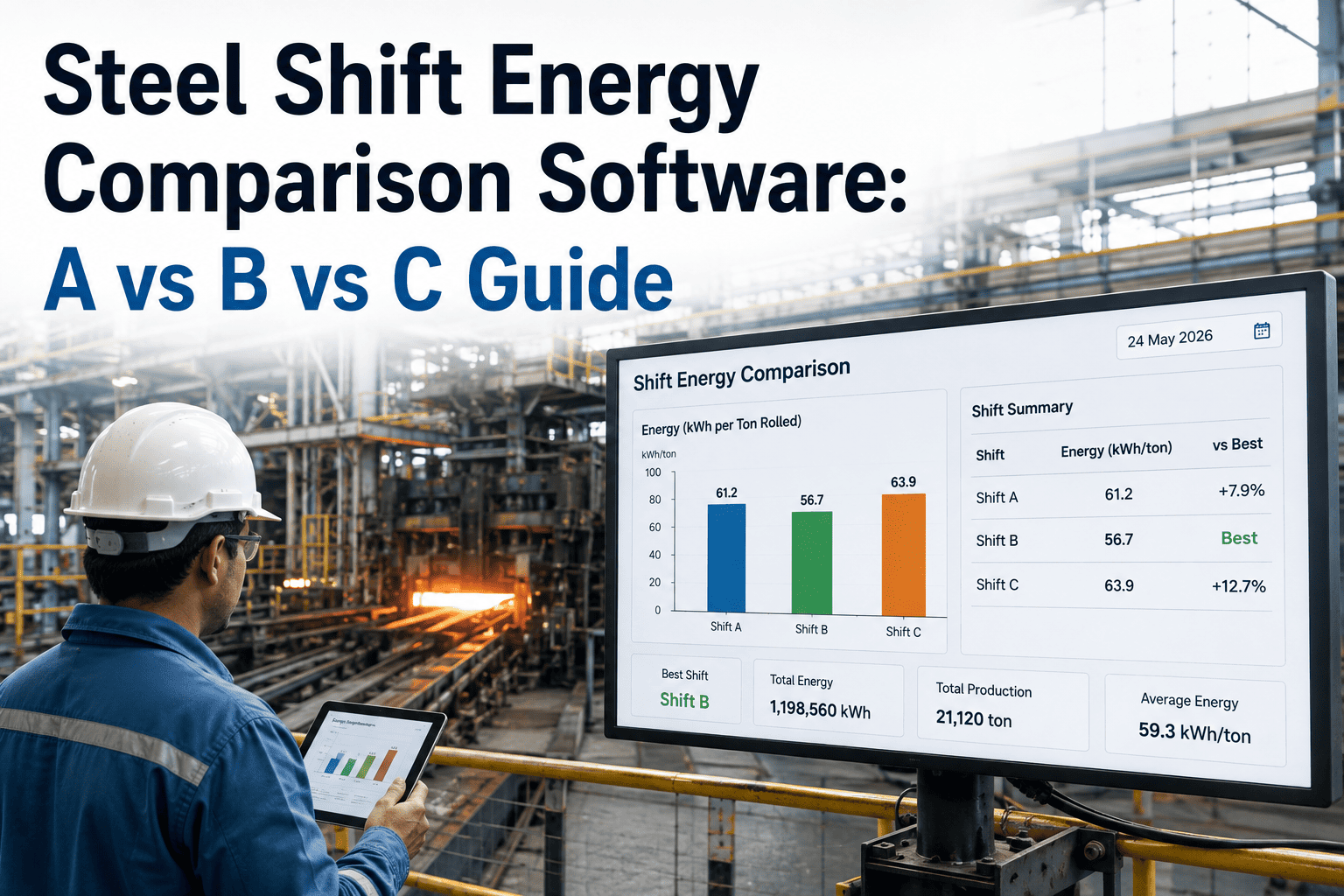
Electric arc furnaces are the beating heart of every steel mini-mill, and the electricity bill that comes with them is the single largest controllable cost after scrap itself. A furnace running at 430 kWh per tonne when a similar shop next door holds steady at 350 kWh per tonne is not a rounding error — at 400,000 tonnes a year that gap alone can cost well over two million dollars annually. Melt shop managers are judged on tap-to-tap time, power-on time, and kWh per heat every single day, yet most plants still calculate these numbers hours after the heat has already tapped. Electrode wear, scrap mix, power-off delays, and foamy slag practice all move the needle on every heat, and small deviations compound fast across hundreds of heats a month. OxMaint turns EAF energy data into a live, heat-by-heat scorecard instead of an end-of-shift memory that arrives too late to act on.
Steel Plant Energy Management
See Your Real kWh-Per-Heat Number in Your First Week
OxMaint's CMMS captures power-on time, tap-to-tap duration, and kWh per heat automatically from your furnace data — no spreadsheets, no end-of-shift guesswork.
The Three Numbers Every Meltshop Manager Defends to the Plant GM
Every plant GM asks the same three questions at the monthly review: what is our kWh per heat, what is our power-on time, and why did tap-to-tap time creep up last week. These three figures are the scoreboard of EAF performance, and every other metric — electrode consumption, refractory life, off-gas temperature — ultimately feeds back into one of them. A shop that cannot answer these questions with heat-level precision is managing energy by instinct, not by data. OxMaint's furnace monitoring module calculates all three automatically for every single heat, comparing each one against a rolling baseline built from that grade's own history rather than a generic plant-wide average.
EAF Energy Benchmarks by Furnace Class
Published industry data puts modern EAF energy consumption anywhere between 300 and 700 kWh per tonne, with most industrial furnaces clustering between 400 and 500 kWh per tonne. Furnace size, scrap quality, and operating discipline explain almost all of that spread — a well-run large furnace on clean scrap can beat a poorly scheduled smaller unit by more than 100 kWh per tonne. The table below lines up typical ranges so a meltshop manager can see where their own furnace should realistically sit.
| Furnace Class | Typical kWh/Tonne | Tap-to-Tap Target | Primary Energy Driver |
|---|---|---|---|
| Small EAF (under 50T) | 450-700 | 75-95 min | Scrap mix variability |
| Mid-size EAF (50-100T) | 400-500 | 55-75 min | Power-off delays |
| Large EAF (100T+) | 300-450 | 40-60 min | Electrode and arc stability |
| Best-in-class (scrap preheat) | 300-350 | 35-50 min | Foamy slag and preheat discipline |
What Actually Drains kWh Per Heat
Energy loss in an EAF rarely comes from one dramatic event — it accumulates from small, repeated inefficiencies that operators stop noticing after a while. Understanding where the kWh actually goes is the first step to clawing it back.
Inconsistent Scrap Mix
Light-gauge or dirty scrap takes longer to melt and traps more entrained moisture, driving up both power-on time and electrode wear on every affected heat.
Extended Power-Off Delays
Every minute the arc is off for charging, slag door work, or electrode changes still burns fixed furnace overhead without melting a single kilogram of steel.
Weak Foamy Slag Practice
A thin or unstable slag blanket lets arc heat radiate away instead of transferring into the bath, forcing longer power-on time to hit tap temperature.
Delayed Anomaly Detection
When kWh deviation is reviewed only at end-of-shift, three or four off-target heats have already tapped before anyone reacts to the trend.
Heat-by-Heat Energy Visibility
Stop Reviewing Energy Performance After the Heat Has Already Tapped
OxMaint flags kWh and power-on deviations in real time so the next heat can be corrected — not the one after that.
How OxMaint Manages EAF Energy for Steel Plants
A CMMS built for steel melt shops does more than log maintenance tickets — it becomes the system of record for every energy figure the plant reports internally and externally. OxMaint connects to existing furnace instrumentation and turns raw signal into decisions the meltshop team can act on before the next charge, not after the monthly report is compiled.
Heat-Level Energy Logging
Every heat is logged automatically with kWh per tonne, power-on minutes, and tap-to-tap duration, building a grade-specific baseline that grows more accurate over time.
Real-Time Deviation Alerts
When a heat trends above its baseline mid-melt, the shift supervisor is alerted immediately, not at shift-change review three hours later.
Electrode and Refractory Tracking
Electrode consumption per tonne and refractory wear trends are tied back to the same heat records, connecting energy cost to consumable cost.
Shift and Grade Reporting
Energy performance rolls up automatically by shift, crew, and steel grade, giving plant GMs the comparison data they actually ask for in reviews.
Real-Time Sensor Data: From Furnace Signal to Meltshop Decision
The biggest shift in EAF energy management over the past few years has nothing to do with a better electrode grade or a new slag additive — it is the ability to read furnace instrumentation continuously instead of pulling a report once a shift. Power meters, off-gas temperature sensors, and electrode position data already exist on most modern furnaces; the gap has always been turning that raw signal into a decision an operator can act on before the next charge goes in. A furnace trending 20 kWh above its grade baseline halfway through melt-down is a solvable problem in real time, and a completely different, much more expensive problem three heats later when the shift report finally gets reviewed. Connecting that signal to a CMMS closes the loop between what the furnace is doing and what the crew decides to do about it. It also replaces the guesswork of tribal knowledge — the senior operator who "just knows" when a heat is running hot — with a consistent, repeatable standard that holds up across every shift, every crew, and every new hire the plant brings on.
Live Power Curve Monitoring
Power draw is tracked continuously against the expected curve for that grade, surfacing deviation the moment it starts rather than after tap.
Off-Gas and Refractory Correlation
Off-gas temperature trends are linked to refractory wear records, connecting energy loss patterns to the maintenance schedule that actually fixes them.
Demand Peak Flagging
Instantaneous MW draw during melt-down is flagged against utility demand thresholds so peak charges are managed before the billing period closes.
Crew and Shift Scorecards
kWh per heat, power-on time, and tap-to-tap duration roll up automatically by crew, giving supervisors an objective coaching tool instead of a gut feeling.
The Real Cost of an Unmanaged Energy Gap
A 50 kWh-per-tonne gap between a plant's actual performance and its achievable baseline sounds small on paper, but multiplied across a real production schedule it becomes one of the largest line items a meltshop manager controls. At 300,000 tonnes a year and a blended industrial power rate, that gap alone can run into seven figures annually — before counting the secondary costs of extra electrode wear, longer tap-to-tap time reducing furnace throughput, and the refractory damage that comes from longer, hotter heats. None of this shows up as a single dramatic failure. It shows up as a slow, steady erosion of margin that is easy to miss without heat-level data and easy to underestimate until someone adds up a full year of it. Closing even half that gap through better visibility and faster in-shift correction is consistently one of the highest-return investments available to a steel plant, well ahead of most capital equipment upgrades. It is also one of the few improvements a plant can start capturing within weeks rather than waiting on a multi-year retrofit or rebuild cycle to see the benefit show up on the utility bill and in the monthly cost-per-tonne report the GM reviews.
We used to find out our kWh per heat was drifting three days after it happened, buried in a spreadsheet nobody opened until month-end. With OxMaint flagging deviations heat by heat, our crew corrected practice within the same shift. We brought average consumption down by close to 30 kWh per tonne in under four months across two furnaces.
Melt Shop Operations Manager — Mid-size EAF steel producer
Common Challenges Steel Plants Face With EAF Energy Tracking
Data Trapped in the Furnace PLC
Most furnace control systems record energy data locally but never surface it in a format the maintenance or operations team can act on across shifts, so the same insight has to be rediscovered manually every day.
No Grade-Specific Baseline
Comparing every heat against one plant-wide average hides the real story — a stainless heat and a low-carbon heat have entirely different legitimate kWh targets, and flat benchmarking generates false alarms or missed ones.
Demand Charges Nobody Owns
Peak power draw during melt-down sets the utility demand charge for the entire month, yet in most plants no single role is responsible for watching and managing that peak in real time.
Energy and Maintenance Living in Separate Systems
When electrode consumption, refractory condition, and kWh per heat are tracked in three unconnected tools, diagnosing a real energy deviation takes far longer than it should, and the root cause often gets missed entirely until the next planned outage.
Electrode and Refractory: The Hidden Energy Partners
Electrode consumption and refractory wear rarely get discussed in the same breath as kWh per tonne, but the three are tightly linked. An unstable arc caused by inconsistent scrap charging or poor electrode positioning burns more graphite per tonne and radiates more heat into the furnace shell, which in turn shortens refractory campaign life and forces longer power-on time to compensate for heat loss. Tracking electrode consumption and refractory condition alongside energy data — rather than in separate systems maintained by separate teams — is what lets a meltshop manager tell the difference between a scrap problem, an arc stability problem, and a refractory problem when kWh per heat starts drifting. Plants that manage all three together consistently report faster root-cause diagnosis and fewer repeat deviations, because the team is no longer trying to reconcile three different spreadsheets to find the actual cause of an energy spike.
Electrode Positioning Drift
Small misalignments in electrode position reduce arc efficiency and increase both graphite consumption and power-on time needed to reach tap temperature.
Refractory Hot Spots
Localized refractory thinning lets heat escape through the shell, forcing the furnace to run longer and hotter to reach the same tap temperature every heat.
Frequently Asked Questions
What is a good kWh per tonne target for an EAF steel plant?
Most industrial EAFs run between 400 and 500 kWh per tonne, while best-in-class shops using scrap preheating and tight tap-to-tap control reach 300 to 350 kWh per tonne. OxMaint benchmarks your own furnace against its heat history rather than a generic industry number.
How does tap-to-tap time affect energy consumption?
Longer tap-to-tap time usually means more power-off minutes spent on delays rather than melting, and every extra minute the furnace sits idle still radiates heat and burns electrode without producing tapped steel.
Why does scrap mix matter for EAF energy performance?
Light, dirty, or moisture-laden scrap takes longer to melt and burns more electrode per tonne, pushing kWh per heat above target even when furnace practice itself has not changed.
Can a CMMS actually reduce EAF electricity costs?
Yes — by logging kWh, power-on time, and tap-to-tap per heat automatically and alerting on deviation in real time, crews correct practice within the same shift instead of after a month-end report. Book a demo to see OxMaint's EAF energy dashboard.
How much can scrap preheating save on EAF energy?
Using furnace off-gas to preheat incoming scrap typically reduces electrical consumption by 30 to 50 kWh per tonne, one of the largest single-lever savings available without a furnace rebuild.
Turn Every Heat Into a Data Point You Can Act On
OxMaint's CMMS gives steel plants heat-by-heat kWh tracking, power-on monitoring, and grade-specific benchmarks — so energy performance is managed in real time, not reviewed after the fact.