Steel finishing lines — continuous galvanizing lines, continuous annealing lines, temper mills, and organic coating lines — represent the final manufacturing step before product leaves the plant, and the one with the least tolerance for variability. A zinc pot temperature deviation of 5°C on a CGL changes coating adhesion and spangle uniformity. A furnace atmosphere imbalance on a CAL affects recrystallisation texture and mechanical properties. A work roll surface defect on a temper mill transfers directly to every coil processed until the roll is changed. These are quality failures that reach customers, not just production stops that appear on OEE reports. Oxmaint's finishing line condition monitoring and surface quality tracking gives finishing operations teams the systematic maintenance visibility needed to prevent these quality-linked failures before they generate customer complaints.
Steel Finishing Line Maintenance: CGL, CAL, Temper Mill ; Coating Guide
How structured CMMS programmes track zinc pot chemistry, furnace atmosphere control, temper mill roll condition, and coating line performance across continuous galvanizing, annealing, and organic coating operations to eliminate quality failures and unplanned stoppages.
Why Finishing Line Maintenance Failures Are Quality Failures, Not Just Production Stops
Finishing lines occupy a fundamentally different maintenance risk category from upstream rolling and casting equipment. When a rolling mill bearing fails, the production stop is immediate and visible — the line halts, the team responds, and the root cause is investigated. When a CGL zinc pot pump degrades, a CAL furnace zone drifts in temperature uniformity, or a temper mill work roll develops surface marking, the production continues — but the quality degrades incrementally across every coil processed until the condition is detected and corrected.
This quality-linked failure mode is what makes finishing line maintenance uniquely consequential. Surface defects reaching automotive or appliance customers generate warranty claims, delivery holds, and long-term commercial damage that far exceeds the cost of the equipment failure itself. The steel plants that have systematically reduced finishing line quality failures share a common characteristic: they maintain CMMS condition records for finishing line equipment that enable intervention before the degradation reaches detectable quality impact. Sign up for Oxmaint to begin structured condition tracking across your finishing lines.
Zinc Pot Health Monitoring, Snout Condition, and Air Knife Tracking
The zinc pot is the most maintenance-intensive element of any continuous galvanizing line, and the one with the most direct connection to surface quality. Zinc temperature variation of ±3°C from the target affects coating crystallisation and spangle morphology. Aluminium content in the zinc bath drifting outside the 0.18 to 0.22% window for GI product affects inhibition layer formation and coating adhesion. Bottom dross accumulation on the pot hearth contaminates the strip surface with black spot defects. All three parameters require daily monitoring and CMMS-maintained trend records to detect the gradual drifts that precede quality failures.
Zinc Pot Chemistry, Snout Integrity, and Air Knife Gap Monitoring
Zinc pot temperature is maintained by induction heaters whose performance degrades with refractory condition and coil age. CMMS-scheduled thermal profiling across all pot zones — compared against the target temperature distribution — identifies developing non-uniformity in pot heating before it produces coating weight variation detectable at the coating weight gauge. Temperature non-uniformity of more than 4°C across the pot width is the investigation threshold that triggers induction heater inspection before quality impact occurs.
Snout condition monitoring is the most overlooked maintenance activity on most CGLs. The snout seal between the annealing furnace atmosphere and the zinc pot is a wear item that degrades through abrasion from strip edge contact and thermal cycling. A deteriorating snout seal allows nitrogen-hydrogen atmosphere to oxidise at the pot interface, producing bare spot defects on the strip surface. CMMS-scheduled snout inspection records — tracking seal condition, strip clearance measurements, and refractory integrity — provide the advance notice needed to plan snout maintenance during a scheduled strip join rather than an unplanned line stop. Book a demo to see CGL asset tracking configured in Oxmaint.
Air knife gap and pressure settings directly determine coating weight uniformity. Gap measurement per wipe length, logged against each production order's coating weight target, creates a process-linked maintenance record that identifies mechanical drift in air knife positioning systems before coating weight non-conformance appears in gauge data.
Furnace Zone Temperature Uniformity and Atmosphere Control Monitoring
Continuous annealing furnace maintenance directly determines the mechanical property consistency of the finished strip. Temperature non-uniformity within a furnace zone — from thermocouple drift, radiant tube failure, or refractory hotspot — produces mechanical property variation across the strip width and coil length that manifests as hardness variation in forming operations at the customer. Unlike surface defects that are visible, mechanical property variation is invisible until it causes forming failures or springback inconsistency in automotive press shops.
Radiant Tube Condition, Thermocouple Calibration, and Atmosphere Dew Point Tracking
Radiant tube furnaces in continuous annealing lines fail through gradual wall thinning from oxidation and thermal fatigue. A CMMS programme that maintains individual tube inspection records — recording wall thickness measurements from ultrasonic inspection at each annual furnace survey — enables predictive tube replacement scheduling based on remaining wall thickness rather than reactive replacement after tube rupture. Tube rupture during production contaminates the furnace atmosphere with combustion products, requiring extended purge cycles before strip threading can resume.
Thermocouple calibration records are a regulatory compliance requirement as well as a maintenance need. Strip temperature measurement used for process metallurgy calculations must be traceable to calibration standards. CMMS-maintained calibration records per thermocouple — with calibration date, drift measurement, correction applied, and next calibration due date — create the documentation chain required for quality system audits. Thermocouples drifting more than ±3°C from calibrated reference require immediate recalibration or replacement to maintain process control integrity. Sign up for Oxmaint to configure thermocouple calibration tracking for your annealing furnaces.
Atmosphere dew point monitoring — measuring hydrogen-nitrogen gas moisture content in each furnace zone — is the primary indicator of atmosphere system seal integrity. Dew point rising above the specification limit indicates air ingress through a damaged seal, roll pass-through, or furnace wall joint, and produces surface oxidation that manifests as dulling, patchy appearance, or poor coating adhesion on downstream processing lines.
Surface Defect Reduction With Real-Time Finishing Line Quality Monitoring
Steel manufacturers implementing real-time quality monitoring on finishing lines achieve up to 20% reduction in surface defect rates. The mechanism is detection speed: a surface quality system that identifies an emerging defect pattern within 10 coils of onset allows intervention before 50 coils are processed with the same defect — a 5× reduction in customer-risk material in the warehouse requiring dispositioning.
Combined with CMMS-maintained equipment condition records that correlate defect patterns to specific maintenance events — roll changes, bath chemistry adjustments, furnace zone repairs — Oxmaint creates the traceability chain needed to identify the root cause of recurring quality issues and design preventive maintenance intervals that address them. Start your free Oxmaint account to begin building quality-linked maintenance records for your finishing lines.
Work Roll Surface Condition, Elongation Control, and Roll Force Trending
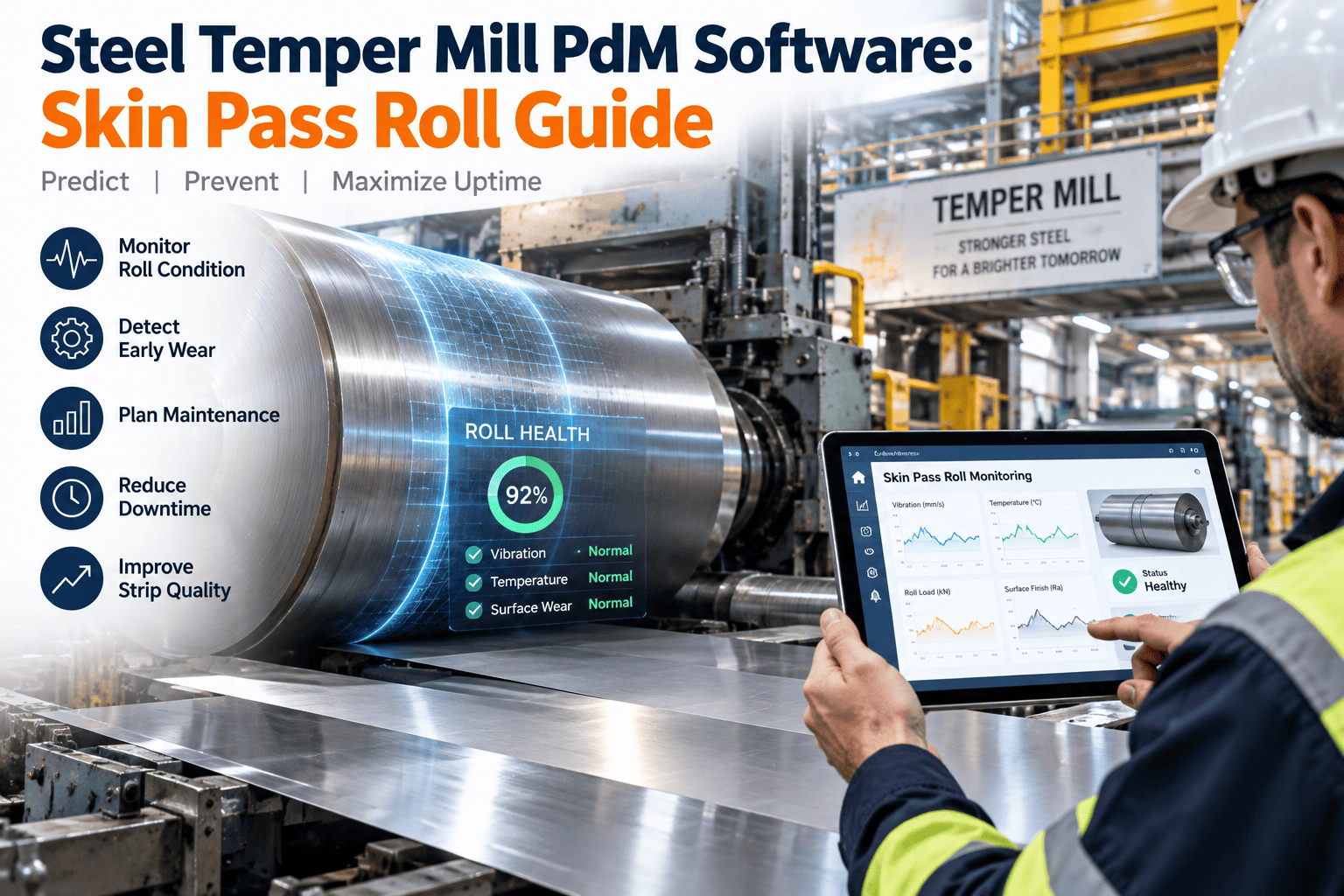
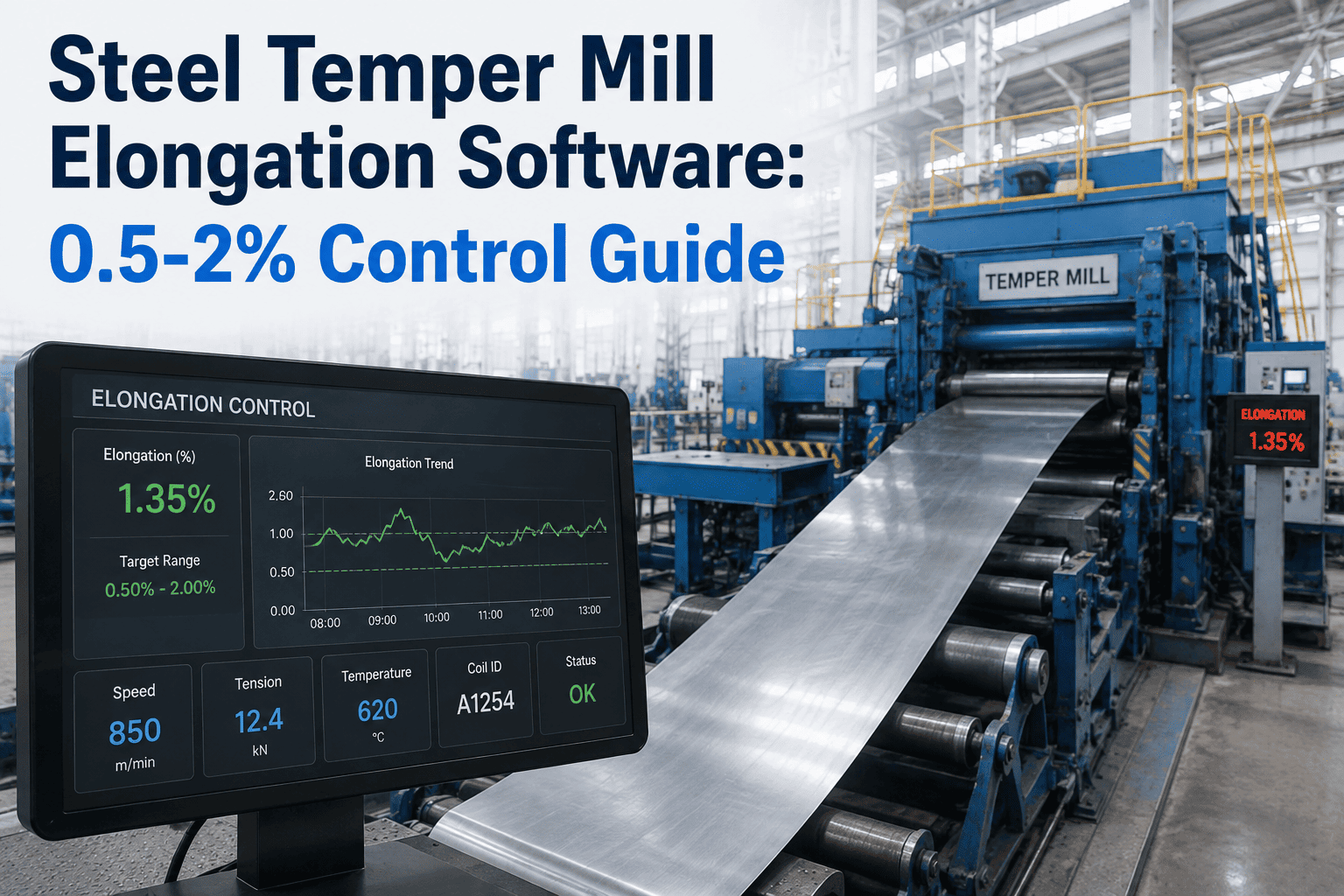
Temper mills in finishing lines perform two simultaneous functions: eliminating yield point elongation through a controlled reduction pass, and imparting a defined surface texture to the strip through work roll topography transfer. Both functions degrade together as rolls wear in service. A work roll with declining roughness Ra transfers decreasing texture to the strip surface, producing coils with surface gloss deviation that generates customer complaints in forming operations where strip-to-die friction matters. A work roll with mechanical surface damage — caused by strip welding during a line stop, hard inclusion in the strip, or roll handling damage — transfers the defect to every metre of strip processed until the roll is changed.
Roll Roughness Tracking, AGC Force Trending, and Elongation Control Monitoring
Work roll surface roughness tracking is the most critical temper mill maintenance activity for surface quality assurance. Roll roughness Ra is measured at the roll grinder before each campaign, recorded against the roll serial number in the CMMS, and compared against the product-specific surface specification range. Rolls ground to Ra values outside specification — below minimum for products requiring high roughness texture, or above maximum for bright surface products — are returned to the grinder before campaign start, preventing the systematic surface non-conformance that results from texturing rolls that are out of specification.
AGC roll force trending across a campaign provides the mechanical condition indicator complementary to the surface quality data. Roll force required to achieve target elongation at a fixed entry thickness and speed should remain stable for a given roll pair and strip grade. Force trending upward across a campaign indicates increasing roll surface hardness loss from frictional heat — a workable trend to manage around. Force trending erratically indicates mechanical issues in the screwdown hydraulic system or backup roll bearing degradation requiring investigation. Book a demo to see temper mill roll tracking configured in Oxmaint.
Coating Weight Monitoring, Oven Temperature Uniformity, and Chemical System Tracking
Organic coating lines add the most complex chemistry-to-equipment interaction of any finishing line operation. Primer and topcoat application systems — roll coaters, spray systems, or combinations — must deliver consistent wet film thickness across the full strip width at line speeds of 60 to 120 m/min. Oven curing must achieve precise peak metal temperature (PMT) across the strip cross-section to ensure full coating cure without over-baking that embrittles the organic film. Chemical pre-treatment systems must maintain bath concentration, temperature, and conductivity within narrow specifications to ensure adhesion. Each system has its own degradation pathway and its own CMMS monitoring requirement.
Applicator Roll Condition, Curing Oven PMT, and Pre-Treatment Bath Chemistry
Applicator roll condition — surface hardness, rubber hardness for rubber-covered rolls, and surface runout — determines coating weight uniformity across the strip width. Rubber roll hardness increases with heat and chemical exposure over service time, changing the nip geometry that determines wet film thickness. CMMS-tracked rubber hardness measurements at each roll change, compared against the acceptable hardness range for each coating product, enable roll change scheduling before film thickness deviation becomes detectable in dry coating weight measurements.
Curing oven PMT profiling using thermocouple surveys conducted during scheduled maintenance windows identifies temperature non-uniformity developing from burner drift, refractory deterioration, or airflow imbalance. PMT variation exceeding ±5°C across strip width produces differential cure quality — visible as gloss variation or adhesion inconsistency across the coil width at the customer. CMMS-maintained PMT profile history per oven zone enables trending of temperature uniformity deterioration between surveys, providing the predictive maintenance window needed to schedule burner servicing or refractory repair before strip quality is affected. Sign up for Oxmaint to configure coating line PMT trending and chemical system monitoring.
Track All Four Finishing Line Types in One Platform
CGL zinc pot health, CAL furnace atmosphere, temper mill roll condition, and coating line PMT — all configurable in Oxmaint with quality-linked CMMS tracking.
Finishing Line Failure Modes, Risk Levels, and PM Trigger Intervals
Use this reference when configuring finishing line asset PM schedules and monitoring thresholds in Oxmaint.
| Line / Component | Primary Failure Mode | Quality Impact | Risk Level | PM Trigger |
|---|---|---|---|---|
| CGL Zinc Pot Temperature | Induction heater degradation causing non-uniformity | Coating weight variation, spangle inconsistency | Critical | Daily temperature profile per zone |
| CGL Bath Chemistry | Al and Fe content drift from spec | Coating adhesion failure, dross contamination | Critical | Daily chemistry sample per shift |
| CGL Snout Seal | Seal wear allowing atmosphere oxidation | Bare spot defects on strip surface | High | Weekly seal inspection + clearance measurement |
| CAL Radiant Tubes | Wall thinning from thermal fatigue | Tube rupture — extended furnace purge stop | Critical | Annual wall thickness survey per tube |
| CAL Thermocouples | Drift causing inaccurate temperature control | Mechanical property variation across coil | High | 6-monthly calibration check per TC |
| CAL Atmosphere Dew Point | Air ingress raising moisture above spec | Surface oxidation, poor coating adhesion | High | Continuous monitoring with alert threshold |
| TMP Work Roll Roughness | Ra below spec from wear in service | Strip surface texture non-conformance | Critical | Ra measurement at grinder before each campaign |
| OCL Applicator Roll Hardness | Rubber hardening changing nip geometry | Coating weight non-uniformity across width | High | Hardness measurement at each roll change |
| OCL Curing Oven PMT | Burner drift causing temperature non-uniformity | Differential cure — gloss and adhesion variation | High | Quarterly PMT profile survey per zone |
| Trigger intervals based on typical finishing line operating conditions. Adjust in Oxmaint for your line speed, product mix, and quality specification requirements. | ||||
How Oxmaint's CMMS Addresses Each Finishing Line Maintenance Need
Line Performance Tracking and OEE Monitoring
Oxmaint tracks finishing line production rate, speed, stops, and yield against planned targets in real time. Stop reason coding — distinguishing maintenance-related stops from operational and quality holds — creates the data foundation for identifying which equipment categories are driving the highest downtime contribution. Line performance data is linked to the asset condition records driving it, so every OEE loss event has a maintenance root cause attached. Sign up free to configure line performance tracking.
Surface Quality Monitoring and Defect-to-Maintenance Traceability
Surface inspection system data — defect type, location, coil ID, and line conditions — is integrated into Oxmaint work order records. When a defect pattern emerges, the maintenance history of the upstream finishing line equipment is immediately accessible for correlation: was this defect pattern preceded by a zinc pot chemistry event, a snout inspection that identified wear, or a roll change that deviated from specification? This traceability eliminates the investigation time that currently separates quality complaints from root cause identification. Book a demo to see quality-to-maintenance traceability configured.
Condition Monitoring with L2 and Process Data Integration
Oxmaint connects to finishing line Level 2 systems via OPC-UA and REST API to receive real-time process data — zinc pot temperatures, furnace zone temperatures, dew point readings, coating weights, and roll force measurements. These are logged against each asset's condition history and compared against specification limits, with automated work order generation when parameters trend toward out-of-specification conditions. Process data drives PM triggers for chemistry-based assets, replacing calendar-based schedules with condition-based intervention.
Roll and Chemistry Consumable Life Tracking
Finishing lines consume rolls, rubber applicators, chemical bath replenishment, and process gas at rates linked to production throughput — not calendar time. Oxmaint tracks consumable life against production volume metrics: zinc consumption per tonne galvanized, roll roughness decay per tonne annealed, rubber roll hardness increase per tonne coated. This drives replenishment and replacement scheduling aligned with actual consumption rather than fixed intervals that either waste serviceable consumables or extend worn ones past their effective life.
"Quality issues discovered at shipping cost 5 to 10 times more to resolve than quality issues identified at the point of process deviation. The plants achieving 20% defect reductions are not using better equipment — they are using better maintenance data to catch process drift before it produces out-of-specification product."
Frequently Asked Questions
Build Quality-Linked Maintenance Tracking for Your Finishing Lines
CGL zinc pot monitoring, CAL furnace condition tracking, temper mill roll management, and coating line PMT trending — all configured in Oxmaint with surface quality integration and L2 connectivity for steel finishing operations.