Steel plants experience average hourly downtime costs exceeding $500,000 — and for blast furnace failures, even minor unplanned repairs require a minimum of 8 days comprising 4 days cooling, 1 day repair, and 3 days restart, representing millions in lost production. Emergency maintenance consumes 30% of maintenance budgets at reactive-dominant facilities and costs 3 to 5 times more per event than the same work performed as planned preventive maintenance. World-class steel operations maintain emergency work below 10% of total maintenance activity by building rapid diagnosis capabilities, maintaining critical spare inventories, and implementing structured emergency response protocols that mobilize the right resources within minutes rather than hours. OxMaint's emergency work order system converts chaotic emergency response into documented, traceable procedures that reduce reaction time and capture lessons learned after every critical failure.
Steel Plant Emergency Maintenance Response: Rapid Diagnosis and Repair Procedures
Build an effective emergency maintenance response capability covering rapid diagnosis procedures, emergency repair kits, call-out protocols, emergency work order workflows, and structured lessons learned processes that convert reactive incidents into preventive improvements.
Defining True Maintenance Emergencies in Steel Plants
Not every unplanned failure qualifies as an emergency. Effective response protocols begin with accurate classification that distinguishes true emergencies requiring immediate mobilization from reactive maintenance that can wait for normal business hours. Steel plants that fail this classification test waste emergency response capacity on routine failures while simultaneously under-responding to genuine safety threats. The four-question severity assessment determines whether immediate emergency protocol activation is required.
Immediate Safety Risk
Does the failure pose direct risk to personnel safety — including potential for catastrophic release, fire, explosion, structural collapse, or exposure to hazardous materials above permissible limits?
Production Continuity Threat
Will the failure halt critical production processes within the current shift — including blast furnace campaigns, continuous casting sequences, or rolling mill operations where shutdown causes product quality loss or equipment damage?
Environmental Release Risk
Does the failure create potential for environmental release exceeding permit limits — including hazardous material spills, air emissions above consent thresholds, or cooling water contamination events?
Cascading Failure Potential
Will delayed response cause secondary equipment damage, process upsets in dependent systems, or extend recovery time beyond acceptable limits for business continuity?
8-Step Emergency Maintenance Response Framework
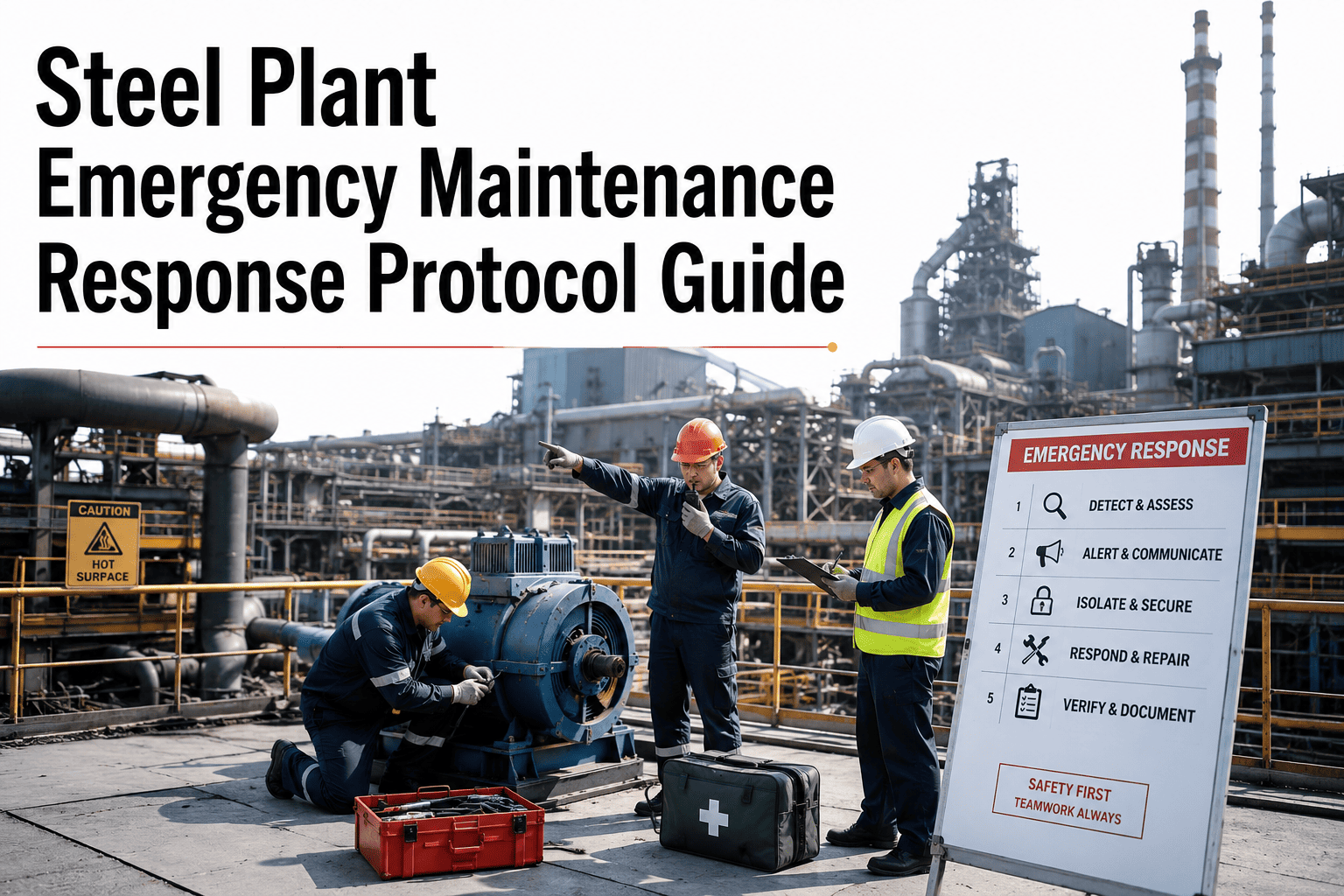
Every emergency follows the same fundamental response sequence. The difference between controlled recovery and chaotic improvisation is whether your team has practiced this framework enough times that execution becomes automatic under pressure. Steel plants with documented emergency procedures and quarterly drill programs resolve critical failures 40% faster than facilities relying on institutional knowledge and ad-hoc coordination.
Immediate Safety Isolation
Secure the hazard zone before attempting diagnosis. Execute emergency shutdown sequences per equipment-specific procedures, evacuate non-essential personnel from affected areas, establish physical barriers preventing unauthorized entry, and activate ventilation or suppression systems as required by the failure type. Do not proceed to diagnosis until the scene is secured.
Emergency Work Order Creation
Open emergency work order in CMMS immediately with failure description, affected equipment ID, safety isolation status, and preliminary severity classification. This timestamped record becomes the documentation foundation for all subsequent actions including parts procurement, labor tracking, and post-incident analysis.
Rapid Diagnosis Execution
Conduct systematic failure diagnosis following equipment-specific troubleshooting trees. Access CMMS maintenance history for recent work on failed equipment, review process data from DCS or SCADA systems immediately preceding failure, and perform physical inspection documenting observations with timestamped photos. Avoid assumption-based repairs that waste time on wrong root cause.
Resource Mobilization
Activate call-out procedure for off-shift specialists if failure exceeds on-shift capability. Verify critical spare parts availability in storeroom or trigger emergency procurement with expedited shipping. Coordinate contractor support for specialized equipment requiring OEM technicians. Every minute spent waiting for resources that could have been ordered earlier extends downtime unnecessarily.
Lockout Tagout Implementation
Execute energy isolation per equipment-specific LOTO procedure before repair work begins. Verify zero energy state with test instruments, apply individual locks from each technician performing work, and document isolation points in emergency work order. Rushing LOTO procedures under time pressure is the leading cause of maintenance fatalities in steel plants.
Repair Execution and Testing
Perform repair following manufacturer specifications or approved plant procedures. Document repair steps and parts consumed in emergency work order as work progresses. Test repaired equipment at reduced capacity before returning to full operation — do not skip commissioning steps that verify proper function and prevent immediate re-failure.
System Restoration and Handover
Remove LOTO devices following reversal sequence of isolation procedure. Return equipment to operations control with documented confirmation of repair completion, operating limitations if any temporary repairs were implemented, and monitoring requirements for initial operation period. Operations must acknowledge handover and understand any post-repair precautions.
Emergency Work Order Closure
Close emergency work order with complete documentation including root cause determination, corrective actions taken, parts consumed with costs, total labor hours by craft and overtime classification, and preliminary lessons learned. This record becomes the input for formal post-incident analysis and preventive action identification.
Digitize Emergency Response Workflows
OxMaint's emergency work order system guides technicians through each response step with required photo evidence, automatic notifications to call-out personnel, and real-time status tracking visible to operations and management.
Start Free Trial Book a DemoCritical Spare Parts and Emergency Repair Kits
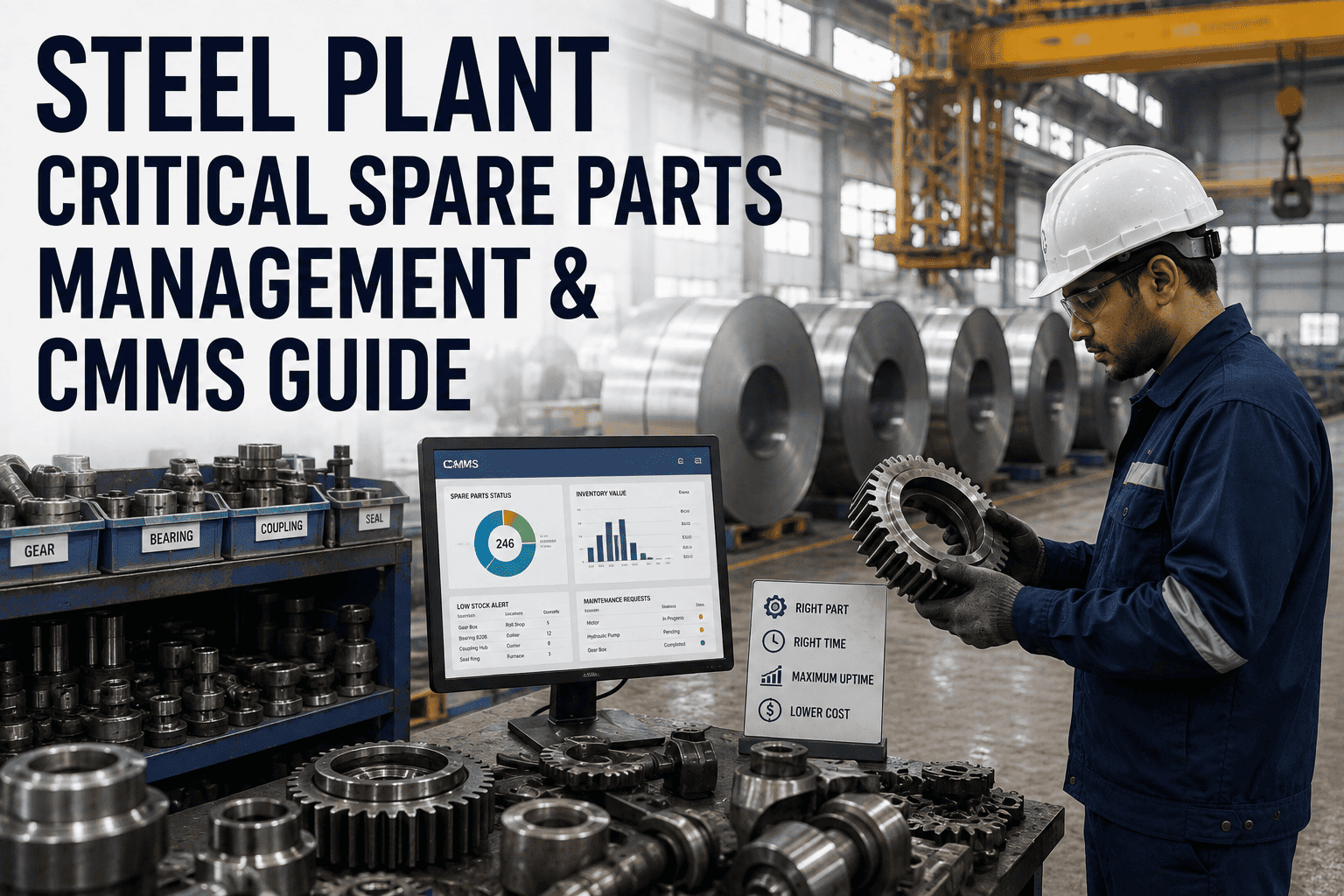
The difference between 2-hour and 12-hour emergency repairs is often whether the critical spare part is in your storeroom or on a truck 400 kilometers away. Steel plants optimizing emergency response maintain strategically positioned repair kits containing the components most likely to fail catastrophically, pre-staged at high-risk equipment locations rather than centralized in distant warehouses.
| Equipment Type | Critical Spares for Emergency Kit | Failure Mode Addressed | Typical Response Time Impact |
|---|---|---|---|
| Blast Furnace Tuyeres | Pre-assembled tuyere complete with cooling jacket, refractory block sets, high-temperature gaskets | Tuyere burnout or cooling failure | Reduces repair from 12+ hours to 4-6 hours |
| Continuous Caster | Mold copper plates, oscillator drive motors, hydraulic cylinders, spray nozzles complete sets | Mold failure during active casting | Minimizes steel loss and equipment damage |
| Rolling Mill Drives | Motor bearings matched sets, coupling components, encoder assemblies, brake assemblies | Bearing seizure or drive failure | Eliminates procurement delay entirely |
| Hydraulic Systems | Pump cartridge assemblies, accumulator bladders, servo valve sets, high-pressure hoses | Contamination or pressure surge damage | Enables same-shift repair completion |
| Cooling Water Pumps | Mechanical seal assemblies, impellers, wear rings, motor starters, coupling halves | Seal failure or impeller damage | Prevents secondary equipment damage |
| Electrical Distribution | Circuit breakers matched ratings, contactors, relay sets, fuses complete range | Electrical fault or overload failure | Restores power within 1-2 hours |
Failure Mode Analysis
Stock emergency kits based on historical failure frequency and consequence severity rather than vendor recommendations. Review emergency work order history annually to identify parts that were expedited more than twice — these belong in emergency inventory.
Strategic Positioning
Locate emergency kits at equipment sites rather than central storeroom. A blast furnace emergency kit stored in the cast house saves 20 minutes of transport time compared to retrieval from a warehouse 500 meters away when every minute of downtime costs thousands.
Kit Integrity Verification
Inspect emergency kits quarterly to verify all components present, no expired shelf-life items, and no unauthorized borrowing for routine maintenance. Use CMMS inspection schedules to track kit audits and trigger restocking work orders when items are consumed.
Replenishment Discipline
Establish automatic replenishment triggered when emergency kit items are issued during repairs. The time to restock critical spares is immediately after consumption, not when the next emergency reveals the kit is incomplete.
After-Hours Emergency Response Team Activation
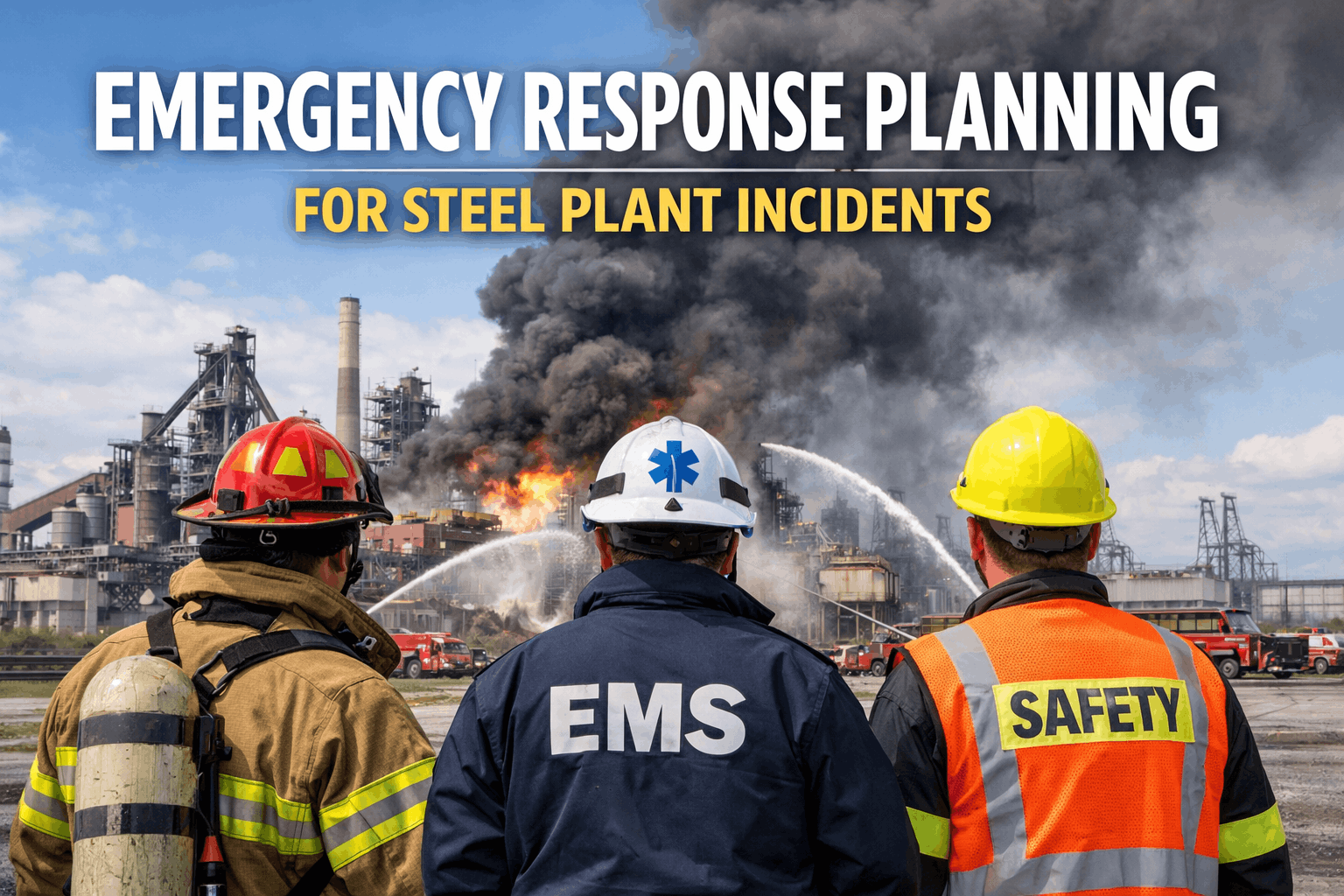
Emergency failures do not respect shift schedules. Steel plants operating 24-7 require documented call-out procedures that mobilize off-shift specialists within target response times. The three-tier escalation model balances cost control with technical capability requirements.
On-Shift Response
Maintenance technicians and electricians on normal shift rotation handle routine emergency repairs within their competency level. Tier 1 response requires no call-out authorization and covers approximately 60% of emergency events in well-maintained facilities.
Specialist Call-Out
Off-shift specialists called in when failure exceeds on-shift capability — including instrumentation technicians, PLC programmers, millwrights for precision alignment work, or equipment-specific experts. Requires shift supervisor authorization and accounts for 30% of emergency responses.
Management Escalation
Plant manager authorization required for external contractor call-outs, OEM technician mobilization, or emergency procurement exceeding spending authority limits. Reserved for catastrophic failures with extended downtime exposure. Represents less than 10% of emergencies.
Post-Emergency Analysis and Preventive Action
Every emergency represents a preventive maintenance failure. World-class steel plants conduct structured post-incident reviews within 48 hours of emergency work order closure to determine why the failure was not predicted, what warning signs were missed, and what preventive actions prevent recurrence. Facilities that skip this analysis repeat the same emergencies year after year.
Root Cause Investigation
Assemble multi-disciplinary team including operations, maintenance, and engineering to review emergency event timeline. Use 5-Why analysis or fishbone diagrams to trace root cause beyond immediate failure mechanism. Document findings in CMMS linked to emergency work order for permanent record.
Preventive Action Identification
Determine specific actions that would have prevented this failure — including additional PM tasks, condition monitoring implementation, operating procedure changes, or equipment modifications. Assign ownership with completion deadlines and track as corrective action work orders.
Similar Equipment Assessment
Identify all similar equipment across the plant with identical failure vulnerability. Deploy preventive actions plant-wide rather than limiting corrections to the failed asset. A continuous caster hydraulic failure should trigger inspection of all caster hydraulic systems, not just the one that failed.
Response Protocol Refinement
Evaluate emergency response effectiveness — were diagnosis procedures adequate, were critical spares available, did call-out procedures work as designed? Update emergency procedures based on lessons learned. The best time to improve response protocols is immediately after discovering their weaknesses.
Knowledge Base Documentation
Capture diagnostic procedures, repair techniques, and parts requirements discovered during emergency response in CMMS knowledge base articles. The next technician facing this failure should have access to everything learned during this emergency, not restart problem-solving from zero.
Expert Perspective on Emergency Response
"The plants that excel at emergency response are the ones that treat every emergency as a preventive maintenance failure requiring investigation. They ask hard questions about why their condition monitoring did not catch degradation early, why spare parts were not positioned properly, and why operating procedures allowed conditions that led to catastrophic failure. Emergency response excellence is not measured by how fast you repair broken equipment — it is measured by how effectively you prevent the next emergency from occurring."
Key Recommendations from Maintenance Leaders
Practice emergency response quarterly. Drill programs that simulate critical failures identify procedure gaps and train new technicians without the pressure of actual downtime. The time to discover your LOTO procedures are incomplete is during a drill, not during a live emergency.
Track emergency maintenance ratio. Calculate emergency work orders as percentage of total maintenance work. World-class targets are below 10%. If your ratio exceeds 20%, your preventive program has fundamental gaps that require strategic correction, not just more resources.
Invest in diagnostic training. Technicians who can diagnose failures systematically resolve emergencies 40% faster than those relying on trial-and-error troubleshooting. Equipment-specific diagnostic trees and access to historical maintenance data are force multipliers during emergency response.
Document everything in real-time. The work order documentation created during emergency response becomes invaluable input for root cause analysis. Timestamped photos, parts replaced, and observations recorded during the event cannot be recreated accurately three weeks later during incident review.
How OxMaint Transforms Emergency Maintenance
Mobile Emergency Work Orders
Technicians open emergency work orders directly from mobile devices at failure location with automatic timestamp, GPS coordinates, and equipment ID captured from QR code scan. No delay returning to office to create paperwork before repairs begin.
Automated Call-Out Notifications
Emergency work orders trigger automatic SMS and push notifications to on-call specialists based on equipment type and shift schedule. No manual phone tree coordination when minutes count. System tracks response acknowledgment and escalates if no response within target time.
Critical Spare Parts Tracking
Emergency kits maintained as inventory locations with automatic restocking work orders generated when components issued during repairs. Real-time visibility into kit status across all plant areas prevents discovering missing parts during emergency response.
Integrated Lessons Learned Workflow
Post-emergency analysis tracked as corrective action work orders linked to original emergency event. Management dashboard shows preventive action completion rates and identifies recurring failure patterns requiring strategic intervention beyond reactive repairs.
Common Emergency Maintenance Questions
Convert Emergency Chaos Into Documented Response
OxMaint replaces scattered emergency procedures with structured workflows that guide technicians through rapid diagnosis, resource mobilization, and lessons learned capture — reducing response time and preventing recurrence.