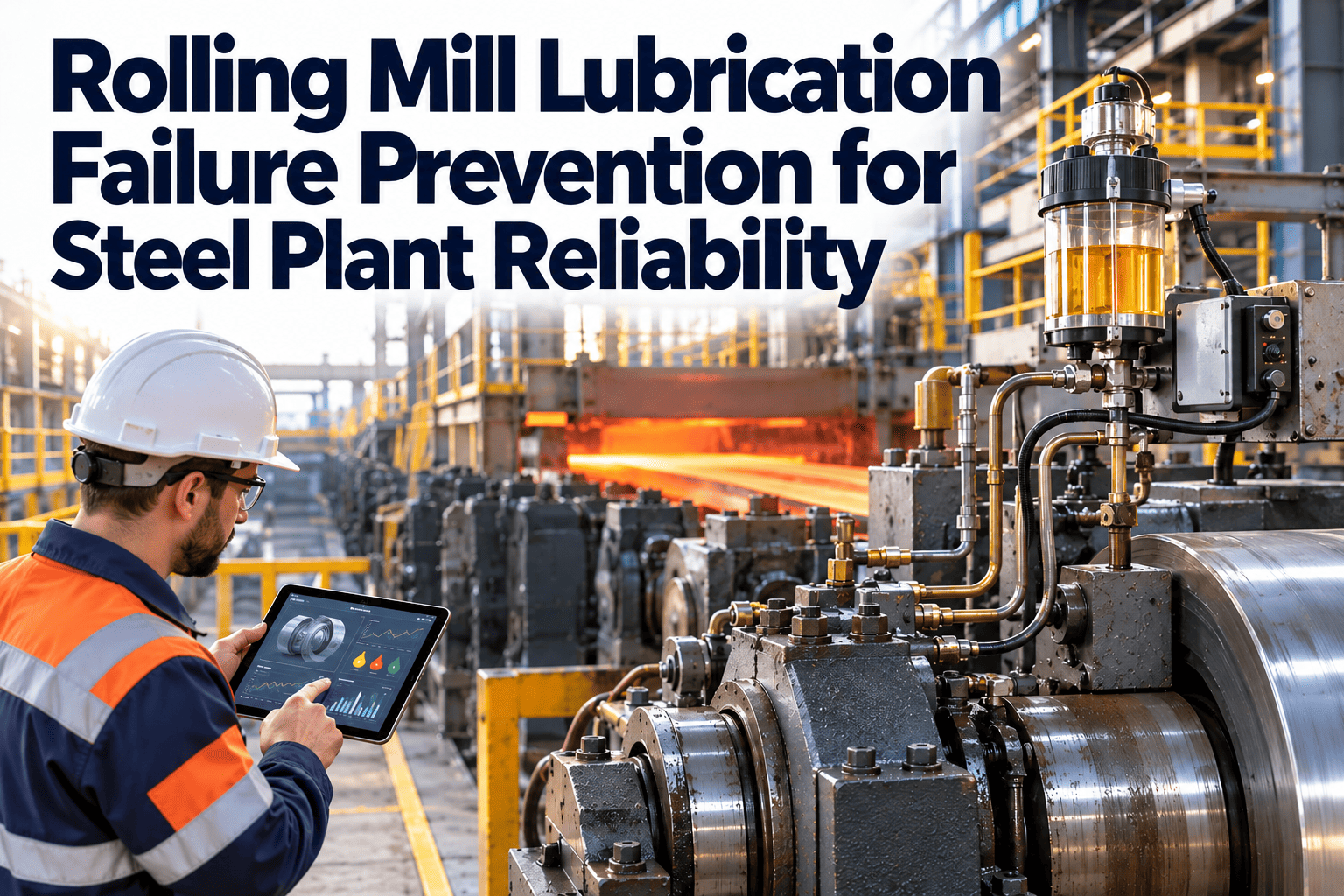
Forty to fifty percent of bearing failures in steel plants are caused by inadequate or incorrect lubrication — not by the bearings themselves wearing out. A bearing that receives the right lubricant, in the right quantity, at the right interval, from a contamination-free delivery system will routinely exceed its L10 design life. A bearing that receives slightly too much grease, applied at slightly too long an interval, through a contaminated grease gun from an unlabelled container, will fail prematurely — creating an unplanned work order, a production stoppage, and a maintenance cost that is four to five times higher than the planned relubrication it was meant to replace. Lubrication management in steel is not a routine task — it is the single highest-leverage, lowest-cost intervention available to extend equipment reliability. The difference between a steel plant with a disciplined lubrication programme and one without is measurable in bearing replacement frequency, unplanned downtime rate, and total maintenance cost per tonne of output.
Steel Plant Lubrication Management: The Foundation of Equipment Reliability
How a structured lubrication programme — right lubricant, right quantity, right interval, contamination-free delivery — reduces bearing failures by up to 50% and cuts total maintenance cost per tonne at every asset category in the steel plant.
The Six Lubrication Failure Modes That Destroy Steel Plant Bearings
Understanding which failure mode is present determines the corrective action. Most steel plant lubrication programmes address one or two of the six failure modes — typically over-greasing and contamination — while leaving the others unmanaged. A world-class lubrication programme addresses all six simultaneously through systematic controls. Book a demo to see how OxMaint structures lubrication PM tasks to address each failure mode.
Insufficient Lubrication
Too little grease or oil reaches the bearing contact zone. Starved lubrication causes metal-to-metal contact, rapid heat generation, and accelerated spalling. Most common cause: grease interval too long, incorrect relubrication quantity, or blocked automatic lubricator nozzle.
Over-Greasing
Excess grease churning in bearing cavity generates heat through viscous shear, degrades lubricant faster than the nominal interval, and pressurises seal lips — accelerating seal failure and creating a pathway for contaminant ingress. The most commonly misunderstood failure mode because it looks like insufficient lubrication when the bearing fails.
Contamination
Water, process dust, scale particles, and cross-contamination from incompatible greases entering the bearing cavity. Steel plant environments produce extremely high contamination loads — water from spray cooling, oxide scale from hot metal handling, and fine particulate from grinding and cutting operations. Contamination accelerates wear three to ten times relative to clean-operating equivalents.
Wrong Lubricant
Incorrect viscosity grade, incorrect base oil type (mineral versus synthetic, PAO versus ester), or incorrect NLGI grease consistency for the operating temperature and speed. In steel plants, incorrect lubricant selection most commonly occurs when relubrication is performed from an unlabelled or mislabelled container during a shift when the correct product is unavailable.
Lubricant Degradation
Oxidation, thermal breakdown, water contamination-induced emulsification, and additive depletion reduce lubricant performance below the threshold required for adequate film formation. In steel plant environments with high temperatures and water exposure, lubricant service life is significantly shorter than manufacturer recommendations based on standard conditions — especially for circulating oil systems on rolling mill drives.
Relubrication Interval Mismatch
Manufacturer-recommended relubrication intervals are derived from standard operating conditions — moderate load, moderate speed, clean environment, ambient temperature. Steel plant operating conditions are rarely moderate on any of these parameters. A bearing on a continuous caster segment roll operating at high load, high temperature, and high contamination level needs relubrication at 40–60% of the manufacturer's standard interval recommendation.
Building a World-Class Steel Plant Lubrication Programme: Six Components
A world-class lubrication programme is not a longer PM task list. It is a systematic architecture of six components, each addressing a specific failure mode, working together to ensure that every bearing in the plant receives the right lubricant at the right quantity and interval from a contamination-free delivery system — and that deviation from any of these requirements generates a detectable signal before failure occurs. Sign up to configure OxMaint's lubrication PM templates — free.
A steel plant running 40+ lubricant types creates storage complexity, cross-contamination risk, and wrong-lubricant application probability proportional to the number of products in the system. Lubricant rationalisation audits the plant's actual lubricant usage against requirements — identifying where different products can be consolidated to a single specification without performance compromise. Most steel plants can reduce their lubricant portfolio from 40+ products to 12–18 without any equipment impact.
Each approved lubricant in the rationalised portfolio is assigned a standardised colour code and label system applied to all storage containers, grease guns, and oil dispensing equipment. A technician can identify the correct lubricant by colour before reading the label — eliminating the wrong-lubricant failure mode from misidentification in the field. OxMaint PM work orders reference the standardised lubricant code, not a brand name, ensuring compatibility regardless of approved supplier.
Relubrication intervals and quantities must be calculated for steel plant operating conditions — not taken directly from manufacturer data sheets written for standard conditions. The SKF relubrication interval formula, for example, includes correction factors for bearing size, speed, and operating temperature, but does not automatically account for the extreme contamination levels present in blast furnace, caster, or rolling mill environments. Steel plant operating conditions typically require a contamination correction factor of 0.4–0.6 applied to the calculated interval — meaning a bearing that the formula suggests should be relubricated every 500 operating hours in a clean environment should be relubricated every 200–300 hours in the actual steel plant environment.
Quantity calculation uses the formula Q = 0.005 × D × B (where D is bearing bore diameter in mm and B is bearing width in mm) as a starting point, then adjusts for application geometry, vertical versus horizontal orientation, and automatic lubricator delivery rate. Over-greasing is as damaging as under-greasing — quantity must be calculated, not estimated. Book a demo to see how OxMaint's PM templates store calculated interval and quantity for each bearing.
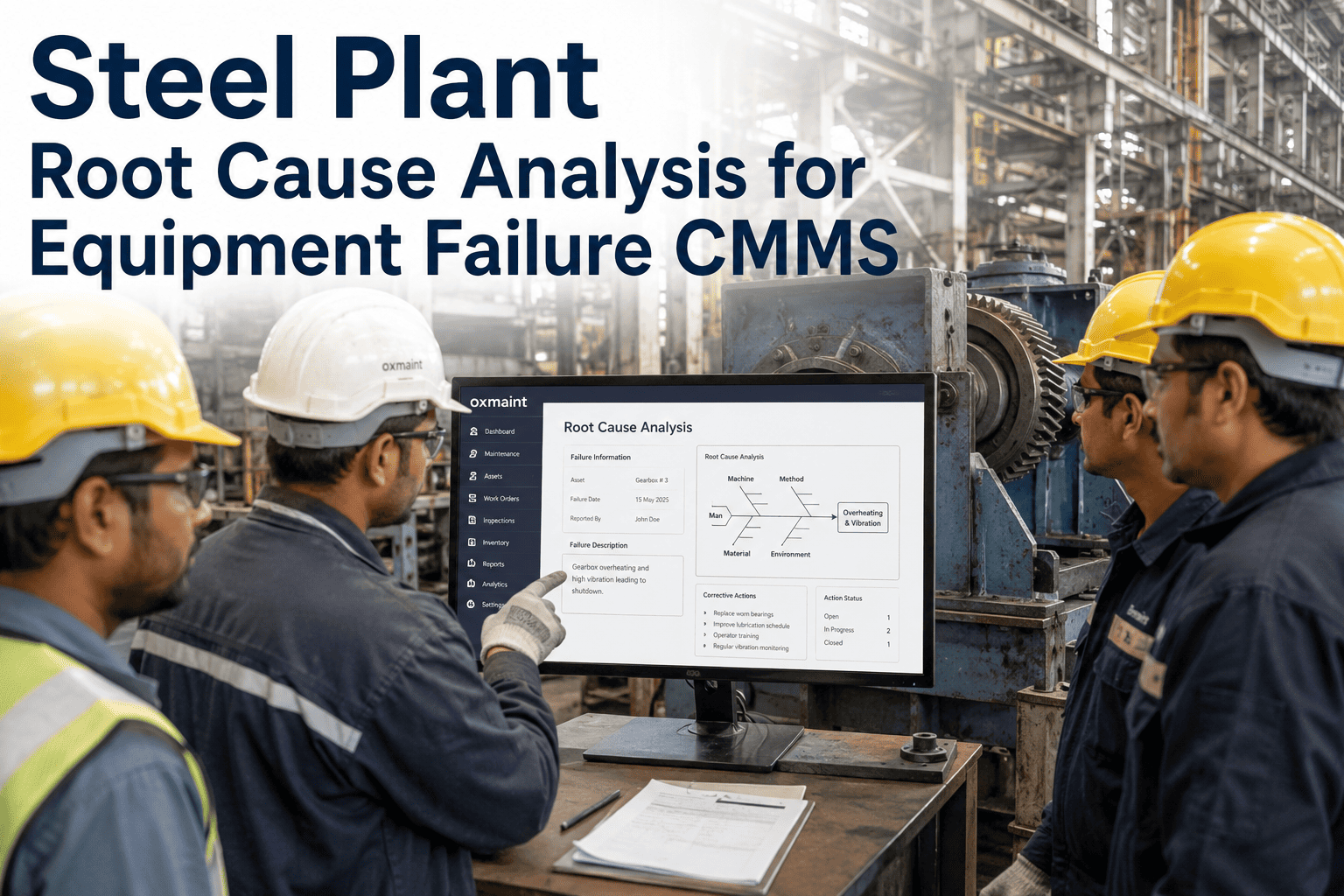
The relubrication schedule — every bearing in the plant, with its calculated interval and quantity — must live in the CMMS work order system, not in a paper schedule or a shared spreadsheet. As a CMMS work order, relubrication tasks have the same visibility, dispatch, escalation, and completion documentation as reactive maintenance tasks. An overdue relubrication fires an alert to the supervisor. A completed relubrication generates a timestamped, technician-attributed record in the bearing's asset history. A relubrication deferred under reactive pressure is visible on the supervisor's dashboard rather than silently missed.
Oil analysis is the primary condition monitoring tool for circulating oil systems — rolling mill drives, cooling tower gearboxes, hydraulic systems, and turbine oil reservoirs. Routine oil samples analysed for wear metals, viscosity, water content, particle count, and additive depletion provide a continuous health signal for each lubricated system. A bearing failing inside a gearbox produces measurable iron and copper in the oil before it produces any external symptom; an oil sample collected at the correct interval catches this signal weeks before a bearing failure event.
OxMaint PM work orders for oil analysis include: sample collection procedure, laboratory submission, result logging in the work order, and automatic escalation when any parameter exceeds its threshold. Sample results link directly to the asset record — creating a longitudinal oil health trend that identifies degradation trajectories and catch lubricant condition before it causes equipment damage. Sign up to configure oil analysis PM work orders in OxMaint — free.
Seventy percent of lubricant degradation in steel plant environments is contamination-driven — yet most contamination is introduced not by the operating environment but by maintenance practice: open grease containers stored in the workshop near grinding equipment, grease guns wiped clean on a rag before application, transfer containers used for multiple products without cleaning, and bulk oil systems with breather caps missing or damaged. Contamination control means establishing and enforcing handling standards at every point where a lubricant is touched between its storage container and the bearing it lubricates.
A lubrication programme without measurement is a programme that cannot improve. Four KPIs should be tracked in the CMMS to measure lubrication programme effectiveness: lubrication PM completion rate (percentage of scheduled relubrication tasks completed on time), bearing replacement frequency by asset category (reducing with programme maturity), unplanned bearing-related work orders as a percentage of total (should decline over 12–18 months of programme implementation), and oil analysis exception rate (percentage of samples triggering a parameter threshold). These four metrics, tracked monthly in OxMaint, provide the data to identify where the programme is working and where it is not — and to optimise intervals and quantities based on actual observed bearing life rather than theoretical calculations. Book a demo to see OxMaint's lubrication programme KPI dashboard.
Automatic Lubrication Systems in Steel Plants: When They Add Value and When They Do Not
Automatic lubrication systems (ALS) — single-line, dual-line, progressive, and circulating systems — are widely deployed in steel plants for bearings in locations that are difficult to access safely during operation, or where relubrication frequency is too high for manual execution at design interval. ALS are not a replacement for a lubrication programme — they are a tool within one. An ALS that delivers the wrong quantity, at too-long a cycle, from a contaminated reservoir, through a blocked distribution line is not reducing bearing failures — it is producing a false assurance of reliability while the same failure modes advance undetected. Sign up to configure ALS inspection work orders in OxMaint — free.
- Bearings in hot, high-access-difficulty locations (caster segment bearings, furnace roller bearings)
- High-frequency relubrication requirements where manual execution is impractical — typically below 50-hour intervals
- Locations where manual relubrication requires plant shutdown or confined space entry
- High-contamination environments where each manual relubrication event introduces contaminants through the access point
- Bearings requiring operator visual condition inspection at each relubrication — ALS eliminates the inspection opportunity
- Applications where manual relubrication interval is longer than 250 hours — manual programmes are adequate and lower maintenance overhead
- Environments where the ALS reservoir or distribution lines are exposed to process temperatures exceeding lubricant thermal stability limits
- Applications where programme discipline is insufficient to maintain ALS inspections on the required schedule — a poorly maintained ALS is worse than a well-maintained manual programme
We tracked our unplanned bearing replacements for 12 months before and after implementing a structured lubrication programme. Before: 94 unplanned bearing replacements per year across the hot mill. After: 41. We did not change the equipment, the operating conditions, or the engineering team. We changed the lubricant inventory from 38 products to 14 with a colour code system, we put every relubrication task into OxMaint as a work order with the calculated quantity in grams, and we started doing monthly oil analysis on the 12 highest-value gearboxes. The bearing cost reduction alone paid for the programme in 4 months. The downtime reduction was additional.
Frequently Asked Questions
What percentage of steel plant bearing failures are caused by lubrication issues?
How do you calculate the correct grease relubrication quantity for a steel plant bearing?
How does oil analysis integration work in OxMaint for steel plant gearboxes?
The Right Lubricant. The Right Quantity. On Schedule. Documented Every Time.
OxMaint stores every bearing's calculated relubrication interval and quantity as a structured PM work order — with overdue escalation, completion documentation, and oil analysis integration. The lubrication programme that reduces bearing failures by 50% starts with every relubrication in the queue.