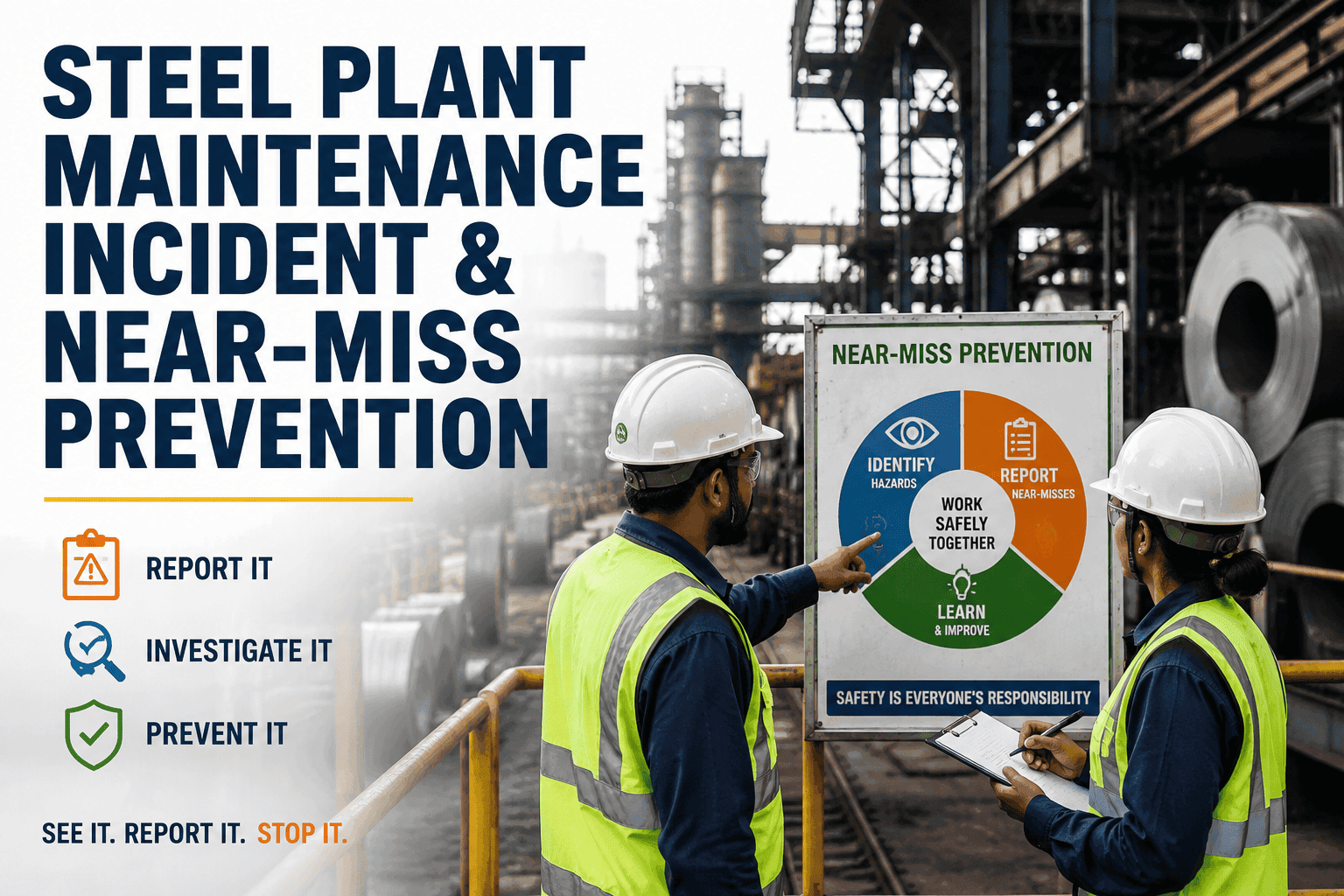
A rolling mill operator feels a sleeve brush a nip point and steps back just in time. A crane rigger notices a load shift half a second before it would have swung into a walkway. A furnace technician moves off a platform seconds before a slag splash lands exactly where they were standing. None of these become an incident report, yet each one is the clearest warning a steel plant will ever get before someone actually gets hurt. Most mills only start counting after an injury happens, which means the plant is reacting to its own history instead of preventing what comes next. Start a free trial of Oxmaint's incident and near-miss tracking module and see how close calls turn into corrective actions before they repeat.
NEAR-MISS REPORTING · HAZARD IDENTIFICATION · CORRECTIVE ACTION · CMMS SAFETY TRACKING
Stop Waiting for the Injury to Learn the Lesson
Steel plants that report zero near-misses are not safer, they are blind. See how mills at furnaces, casters, and rolling mills turn everyday close calls into a documented, trackable early-warning system.
The Near-Miss Pyramid: What Your Plant Isn't Seeing
Safety researchers who studied hundreds of thousands of industrial accident records found a consistent pattern: serious injuries sit at the top of a much larger base of smaller events. Early research put the ratio at roughly 29 minor injuries and 300 near-misses for every major injury, and a later review of well over a million incident reports pushed the near-miss base even wider. Industry practitioners debate the exact multiplier, and rightly note that major failures often trace back to systemic gaps rather than one unsafe act, but the underlying lesson holds up everywhere it has been tested: the close calls happening this week are the injuries that will show up on next quarter's log if nobody writes them down.
The Steel Plant Incident Pyramid
1
Serious Injury or Vessel Failure
10–29
Minor Injuries & Recordable Incidents
30–60
Property or Equipment Damage Events
300–600
Unreported Near-Misses Happening Right Now
Every layer above the base is built from the layer below it. A mill that captures the near-misses at the bottom is the mill that never reaches the top.
70–80%Of serious steel plant incidents had an earlier, unreported near-miss with the same root cause
3–5xMore near-misses get logged once reporting is anonymous and blame-free versus a formal write-up process
48 hrsTarget window to close a corrective action before a reported hazard becomes routine again
$40K–$250KTypical cost avoided per prevented recordable incident, including investigation and downtime
Where Near-Misses Cluster on a Steel Plant Floor
Near-misses are not random. They repeat at the same stations, the same shift changes, and the same equipment interfaces, which is exactly what makes them predictable once someone is tracking the pattern instead of the individual event.
Blast Furnace & Casthouse
Slag splash near tap holes, cooler tube pressure checks skipped under time pressure, workers stepping into hot metal runner zones during tapping.
Rolling Mill & Coilers
Loose clothing or gloves near nip points, guards left open after maintenance, coil handling near unshielded pinch zones during changeovers.
Overhead Cranes & Rigging
Load shift during ladle transfer, riggers under a suspended load, signal miscommunication between operator and floor crew during hot metal moves.
Confined Space & Hot Work
Atmosphere testing skipped in furnace stoves, sparks landing near flammable material during cutting, cooler tube welds attempted without isolation confirmed.
Why Reporting Dies Without a No-Blame Culture
Ask any maintenance crew why near-misses go unreported and the answer is rarely apathy — it is fear that a report becomes a write-up, that admitting a close call slows the shift down, or that nothing will change even if they take the time to log it. Fixing the reporting rate means fixing those three reasons at once.
1
Separate Reporting from Discipline
A near-miss report should never trigger a performance conversation. The moment it does, reporting rates collapse within weeks and the plant goes back to flying blind.
2
Make Reporting a 30-Second Task
A mobile form with a photo, a location tag, and three tap-to-select fields gets used on the floor. A multi-page paper form gets left in a drawer.
3
Close the Loop Visibly
When a reported hazard gets a work order, a fix, and a follow-up photo the crew can see, the next report comes faster. Silence after a report is what kills the program.
4
Review Trends, Not Just Events
One near-miss at a coiler guard is a data point. Five in a month at the same station is a pattern that needs an engineering fix, not another toolbox talk.
From Near-Miss to Corrective Action: Closing the Loop with a CMMS
A near-miss report that sits in a binder protects nobody. A near-miss report that automatically opens a work order, assigns an owner, and tracks the closure date is what actually reduces incident rates. Oxmaint's near-miss and safety observation module links every reported hazard to a corrective action, a due date, and a verification step, so hazards get fixed instead of forgotten.
| Leading Indicator | Weak Program | Strong Program | Why It Matters |
|---|
| Near-misses reported per 100 employees / month | <2 | 15–25 | Low numbers usually mean fear, not safety |
| Time to close corrective action | >30 days | <7 days | Slow closure lets the same hazard repeat |
| Repeat hazard rate at same location | >25% | <10% | Repeats signal a root cause was never fixed |
| Anonymous vs named reports ratio | Mostly named | Mixed, trending anonymous down | Trust in the system reduces need for anonymity |
Turn Every Close Call Into a Fixed Hazard
Log near-misses from the floor in seconds, route them straight to a work order, and track closure before the pattern becomes an injury.
Frequently Asked Questions
What counts as a near-miss on a steel plant floor?
Any event that could have caused injury, equipment damage, or a process upset but did not — a load that shifted, a guard left open, a splash that missed someone by inches. If it made someone flinch, it belongs in the report.
Why do near-miss reporting rates stay low even with a formal program?
Most programs fail because reports feel like paperwork with no visible outcome, or because crews fear a report will be read as an admission of fault. Fixing both usually doubles reporting within a quarter.
How do we measure whether our near-miss program is actually working?
Track reports per 100 employees per month, average time to close the corrective action, and repeat hazard rate at the same location. Rising reports paired with falling closure time and falling repeats is the signal you want.
Oxmaint calculates all three automatically from logged work orders.
Should near-miss reports be anonymous?
Anonymous options increase volume early on, but the goal is a culture where named reports are just as safe as anonymous ones. Track the ratio over time — a shift toward named reporting means trust is building.
How fast should a reported hazard be fixed?
High-risk hazards near furnaces, cranes, or pressurized systems should be addressed within 24–48 hours or receive an interim control immediately.
Book a demo to see how automated routing keeps closure times inside that window.
Build the Reporting Discipline That Prevents the Next Incident
Give your crew a 30-second way to report, an automatic corrective action trail, and a dashboard that shows every hazard from report to fix.