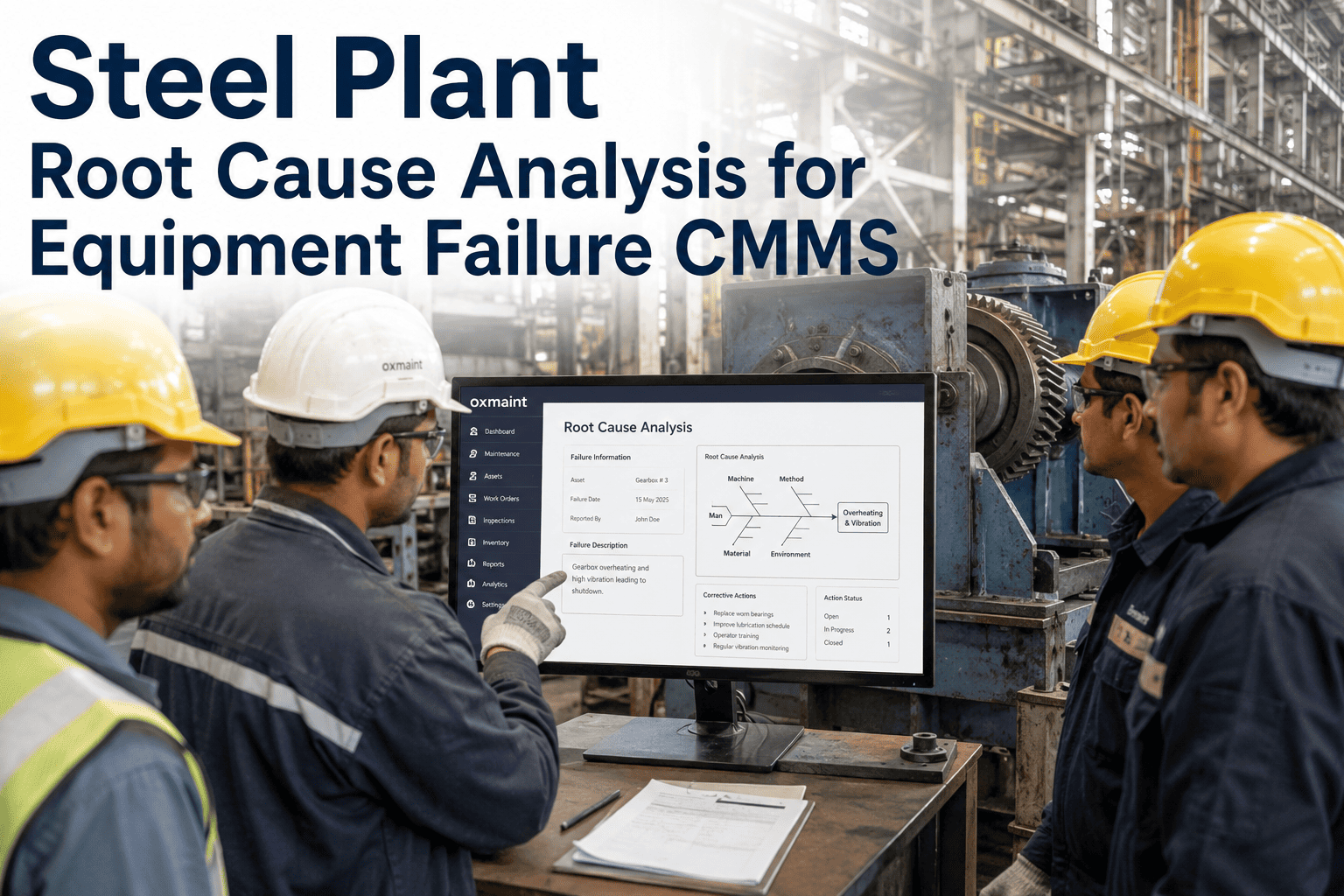
In a steel meltshop, the gap between "sample pulled" and "chemistry confirmed" is one of the most expensive gaps in the plant, and it rarely shows up on a single line item. It shows up as holding heats, re-blowing BOF vessels, adding costly ferroalloys twice, and casting product that later fails a customer's certificate of analysis. When that loop is tracked on paper tickets or a disconnected LIMS screen, the plant loses the one thing a converter or ladle furnace cannot get back: time at temperature , start a free trial with OxMaint
Meltshop Quality Operations
Every extra minute waiting on chemistry is a minute of heat loss you pay for twice
Offline sample-to-result loops, missed reblow alerts, and disconnected LIMS data quietly drain steel meltshops of millions each year in off-spec heats, reprocessing, and delayed casts. A connected CMMS closes that loop.
The Real Cost
Chemistry turnaround is a production constraint, not a lab metric
Modern spark optical emission spectrometers (OES) can return an elemental result in well under a minute once a sample reaches the analyzer. That speed is not the bottleneck most plants actually fight.
The bottleneck is everything around the analyzer: a runner walking a sample across the shop floor, a queue behind other heats, a result sitting in a LIMS screen nobody is watching, or a supervisor manually re-keying the reading into a spreadsheet before anyone decides whether to add ferroalloy, reblow, or hold the heat.
None of that idle time is captured by "spectrometer speed." It is captured by how fast a result becomes a decision — and that is a workflow problem, not an instrument problem.
Root Causes
Why the sample-to-alert loop breaks down in most plants
Chemistry data lives outside the maintenance and operations record
The LIMS or spectrometer software reports a result, but nothing automatically ties that result to the heat, the vessel, or a corrective work order. A supervisor has to notice, interpret, and act manually.
No standard threshold for "off-spec, act now"
Without a configured alert band per grade, a borderline carbon or manganese reading gets judgment-call treatment instead of a consistent, auditable response every shift.
Sample logistics are informal
Runners, pneumatic tube status, and lab queue position are tracked by habit, not by a system — so nobody can say how long a specific sample has actually been waiting.
Reblow and correction actions aren't logged as maintenance events
A second oxygen blow or a late alloy addition is a real operational cost, but if it isn't recorded against the heat and vessel, the plant never sees the pattern driving repeat corrections.
Operational Impact
What a slow chemistry loop actually costs a meltshop
The direct cost of a late or missed chemistry alert rarely appears as a single number on a P&L. It is spread across several categories that only add up when someone tracks them together.
| Cost Category | How It Shows Up | Why Chemistry Speed Matters |
|---|---|---|
| Reblow / re-treatment | Extra oxygen blow, extra ladle furnace time, extra argon stir | Late results mean corrections happen after temperature has already dropped |
| Off-spec heats | Downgraded to a lower grade or scrapped chemistry | A missed alert window means the heat tapped before correction was possible |
| Cast sequence delay | Tundish or caster idle while a heat is held for chemistry | Downstream casting can't proceed without a confirmed, in-spec result |
| Alloy overuse | Operators over-add ferroalloys "to be safe" without live data | Uncertainty about turnaround pushes teams toward costly buffer additions |
| Customer claims | Certificate of analysis disputes, returned coils or billets | A chemistry result confirmed too late to correct still ships |
Closing The Loop
What "closing the sample-to-alert loop" actually means
Closing the loop does not require replacing the spectrometer. It means connecting the result the instrument already produces to a system that tracks the heat, applies the grade-specific threshold, and triggers the next action automatically.
Sample logged against the heat
Every sample pull is tied to a heat number, vessel, and grade target the moment it leaves the furnace — not after the result comes back.
OES or LIMS result ingested automatically
The elemental reading flows into a connected CMMS record instead of sitting in an isolated lab terminal, with a timestamp that starts the clock on response time.
Grade threshold checked instantly
Carbon, manganese, sulfur, phosphorus, and residual element targets for that grade are compared automatically — no manual lookup against a spec sheet.
Out-of-spec triggers an alert and a work record
A reading outside tolerance notifies the shift metallurgist and melter in real time, and opens a corrective action record — alloy addition, reblow, or hold — tied to the heat.
Turnaround time captured for every heat
Sample-to-alert time is logged automatically, so the plant can see which shifts, vessels, or grades are consistently running slow.
See your sample-to-alert time, heat by heat
Book a walkthrough and we will map how OxMaint can connect your OES or LIMS output to real-time work orders and grade-threshold alerts.
Before / After
A mid-size EAF meltshop: what changes when the loop closes
Consider a plant running two electric arc furnaces and a ladle furnace, casting 20–30 grades across a typical week. Chemistry results currently arrive on a LIMS screen in the quality office, several buildings from the furnace platform.
- Melter finds out about an out-of-spec reading by walking to the quality office or waiting for a phone call
- Reblow and alloy correction decisions depend on who happens to notice the result first
- No record of how long a heat actually waited on chemistry before tap
- Grade-threshold checks depend on operators remembering spec limits from memory
- Out-of-spec readings push an alert to the melt deck the moment the result posts
- Corrective work orders are generated automatically, with the grade target attached
- Every heat has a logged sample-to-alert time, visible on a shift dashboard
- Repeat off-spec patterns by grade, shift, or vessel surface in weekly reporting instead of staying invisible
The plant is not buying a faster spectrometer. It is removing the manual hand-offs between a result and a decision — the part of the process that was actually costing time.
Where OxMaint Fits
How OxMaint helps meltshops manage the chemistry-to-action loop
OxMaint is a CMMS built for asset-intensive operations, and meltshop quality response is fundamentally an asset and workflow problem: a reading from one system needs to reliably trigger action on the shop floor.
Heat-linked work orders
Out-of-spec chemistry alerts can generate a work order tied to the specific heat and vessel, with the corrective action, responsible crew, and timestamp captured automatically.
Mobile alerts to the melt deck
Shift metallurgists and melters receive alerts on mobile devices instead of relying on someone walking to a lab screen, so corrective action starts within seconds of a result posting.
Turnaround time reporting
Dashboards show sample-to-alert and alert-to-correction time by shift, vessel, and grade, making chronic delays visible instead of anecdotal.
Inspection and compliance records
Every corrective action, reblow, or alloy addition is logged against the heat record, giving quality teams an audit trail for certificate-of-analysis disputes.
FAQ
Frequently asked questions about meltshop chemistry turnaround
How fast should chemistry results reach the melt deck?
Once a sample reaches an OES analyzer, results are typically available in under a minute. The realistic target for a plant is getting that result in front of the person who can act on it within one to two minutes of the analyzer finishing — which requires an automated alert, not a manual check.
Is this a LIMS replacement?
No. A CMMS like OxMaint does not replace laboratory information management systems or the spectrometer itself. It connects the result those systems already produce to a work order, alert, and record that operations and maintenance teams can act on and report against.
What causes most off-spec heats if the spectrometer is fast?
Most off-spec heats trace back to a delay between the result being available and someone acting on it — a missed alert, a manual lookup of grade limits, or unclear ownership of the correction decision — rather than the analysis itself being slow.
Can this help reduce alloy overuse?
Yes. When operators trust that an out-of-spec reading will reach them immediately, they can add alloys to target instead of over-adding as a buffer against uncertain turnaround, which reduces both cost and variability.
Does OxMaint integrate with existing spectrometer or LIMS software?
OxMaint connects to plant data sources through standard integration methods so chemistry results can trigger alerts and work orders automatically. Book a demo at calendly.com/oxmaintapp/30min to review your specific lab and process-control stack.
Stop losing heats to a chemistry alert nobody saw in time
Connect your sample-to-result loop to real work orders and real turnaround data — before the next off-spec heat hits the ladle.
Free 14-day trial · No credit card