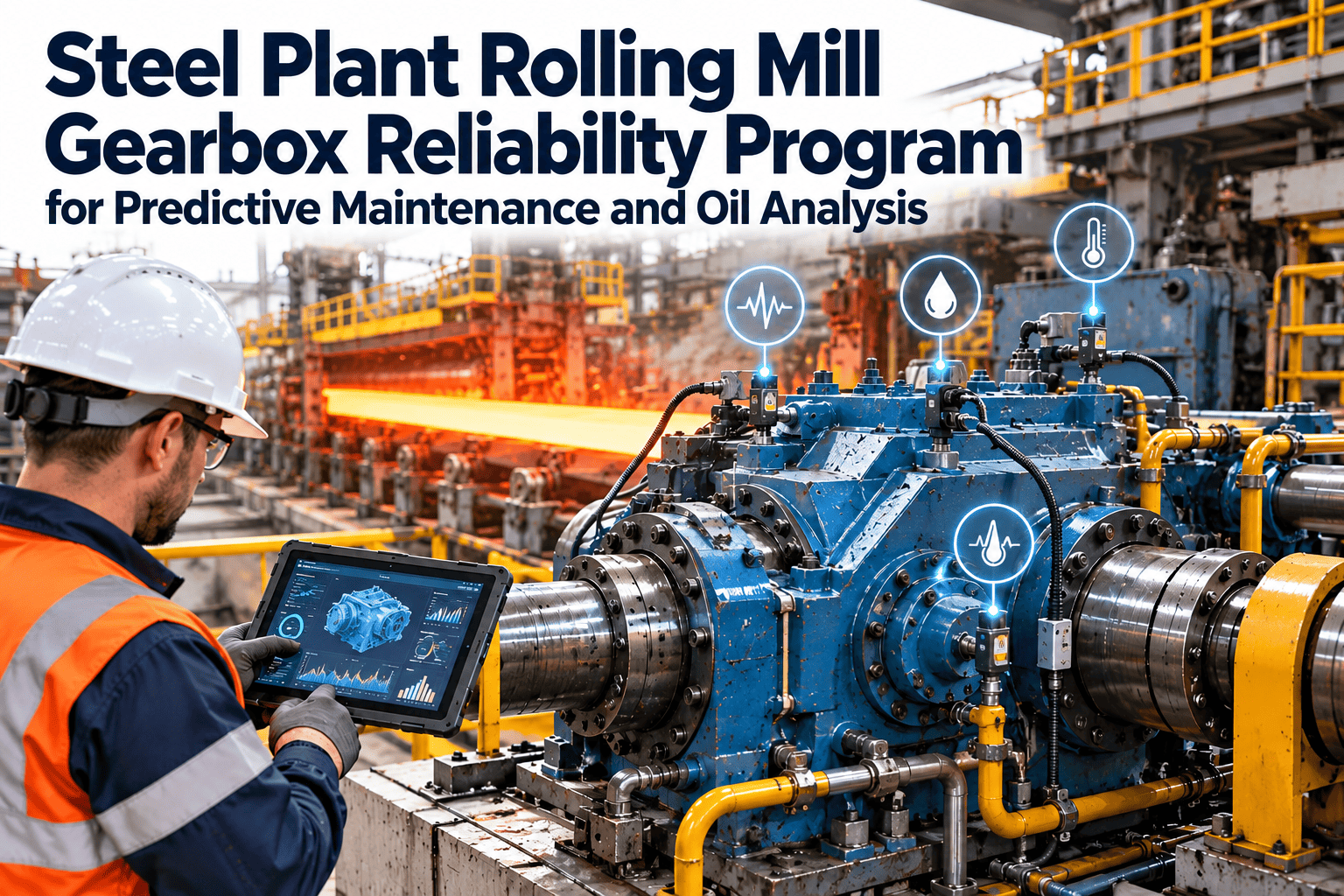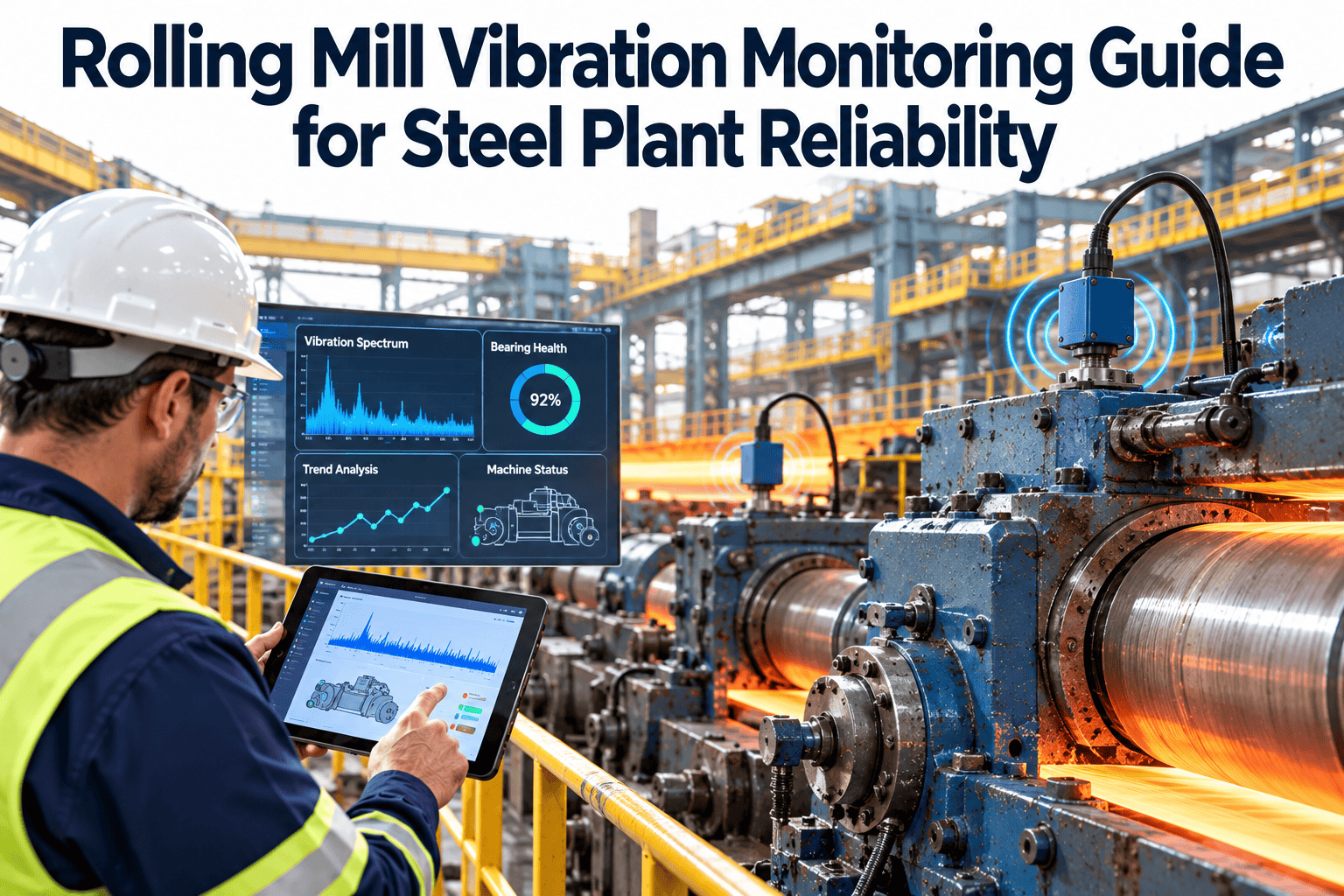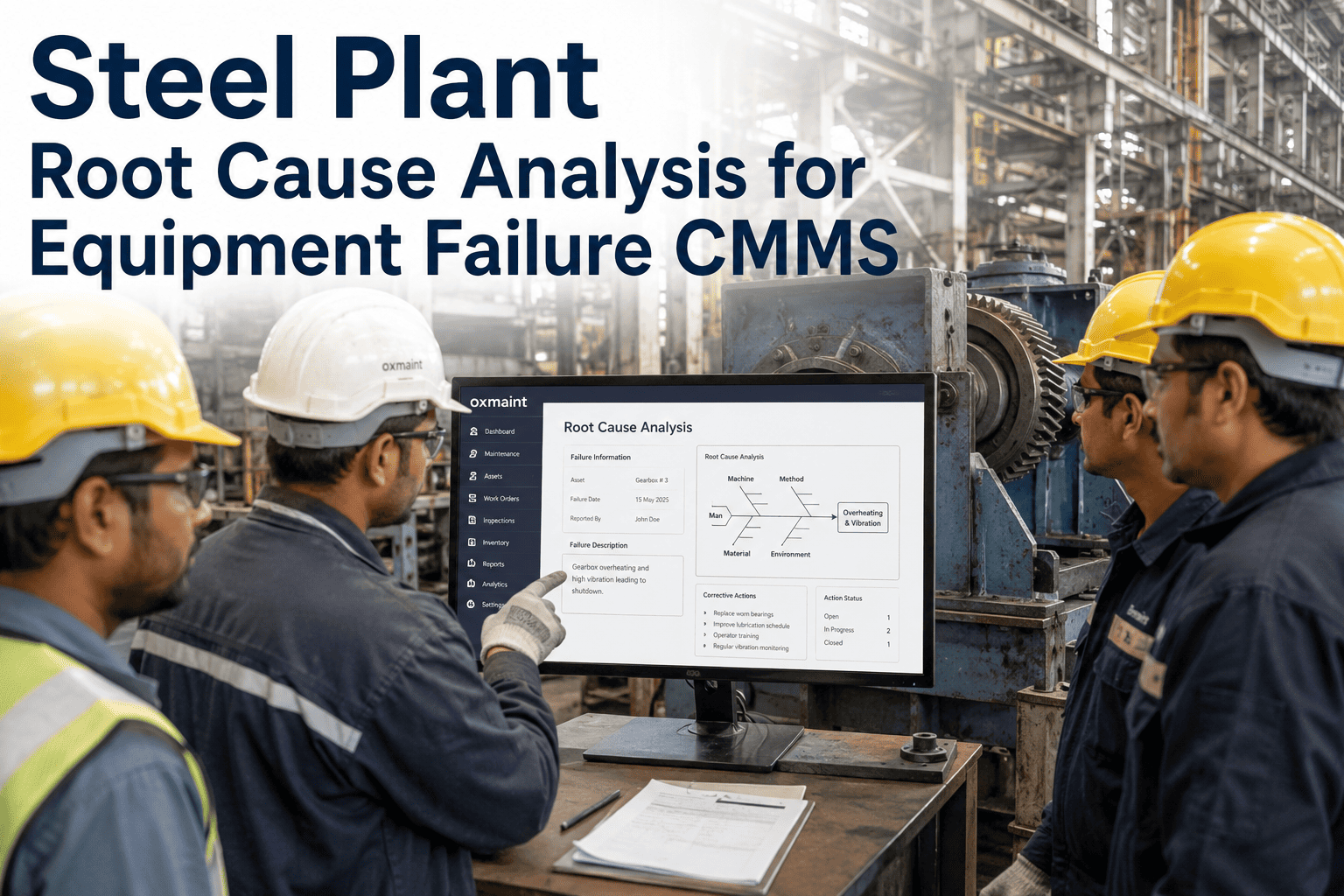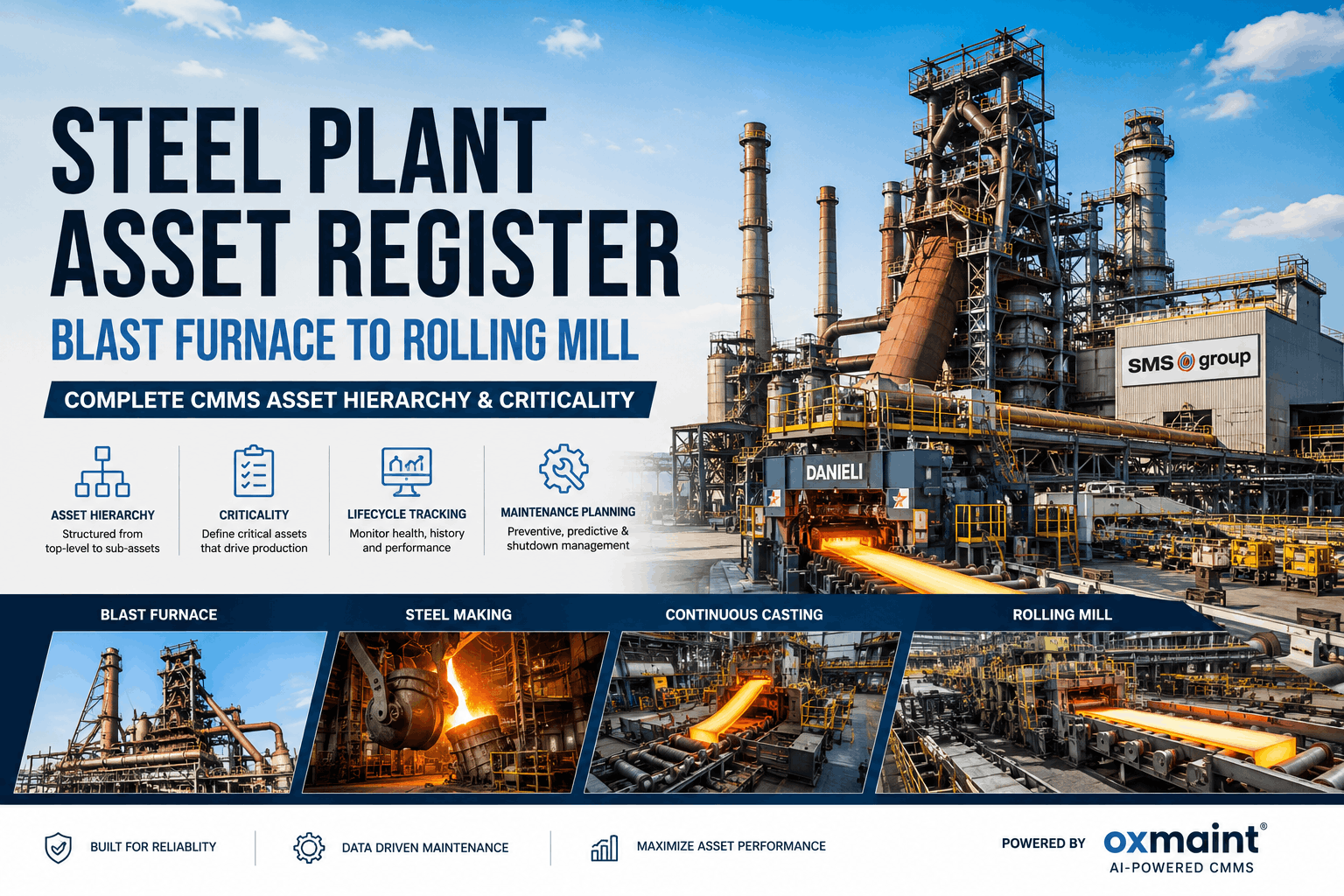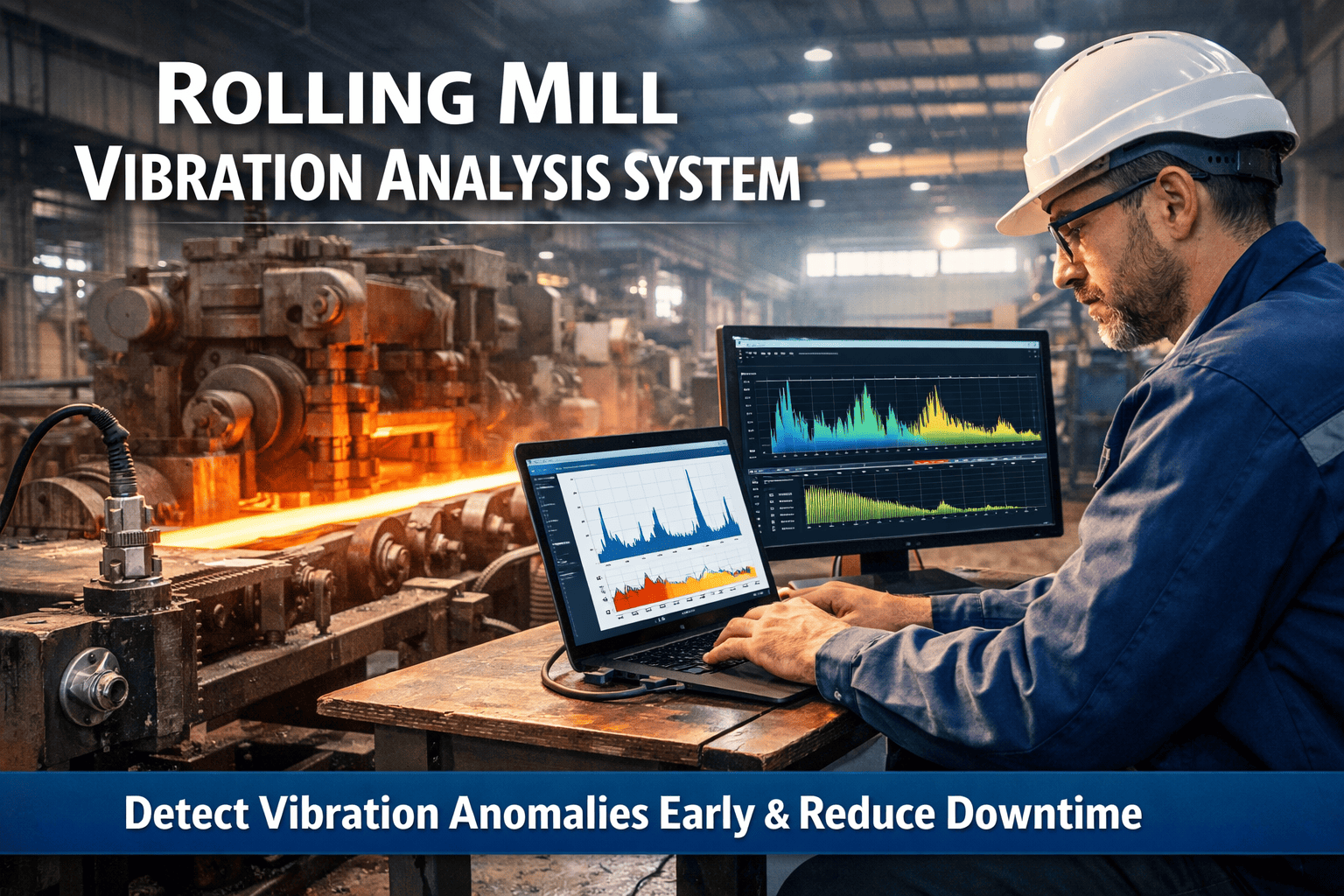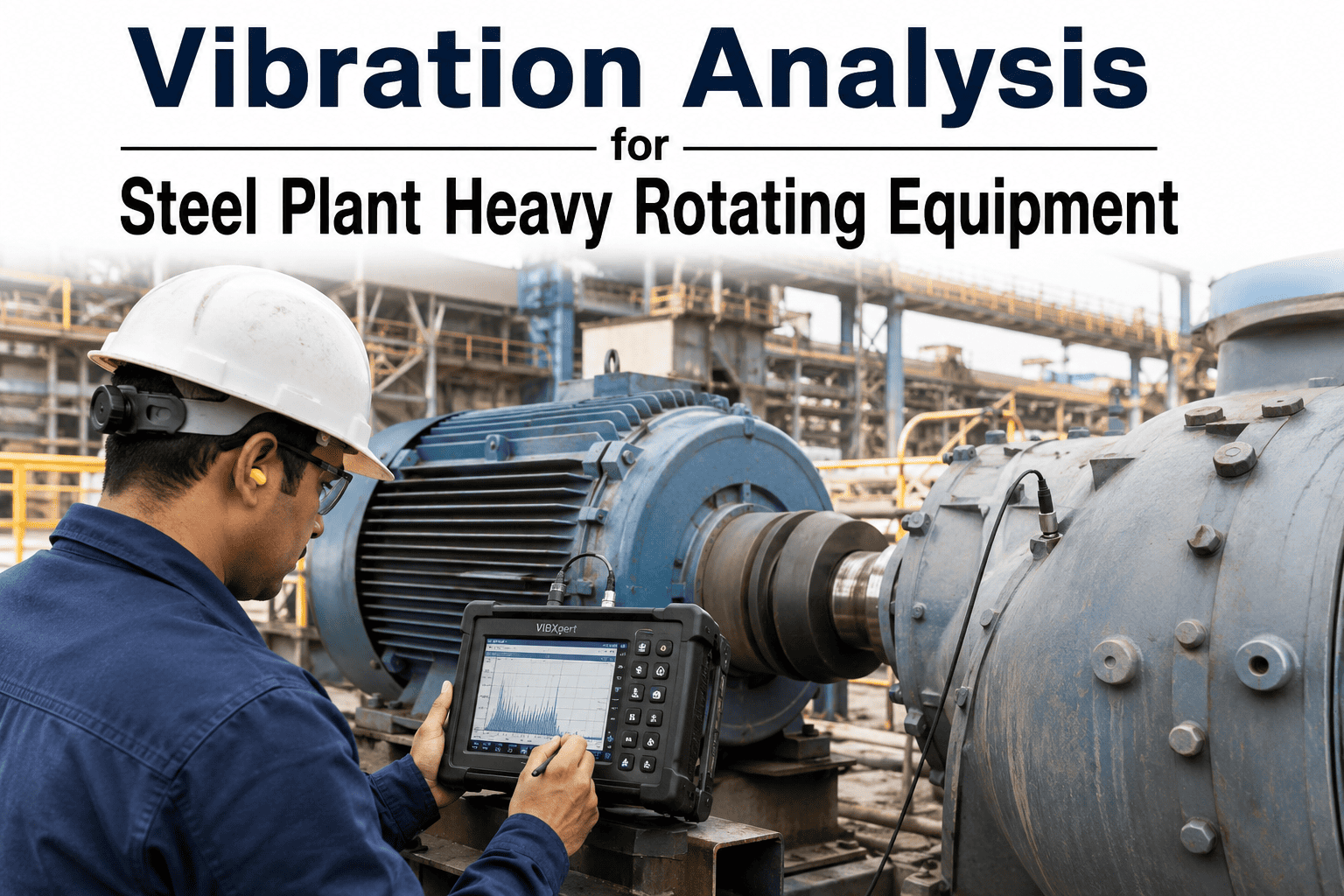
Vibration analysis for steel plant heavy rotating equipment is the foundation of any mature predictive maintenance program, catching bearing wear, misalignment and resonance in blast furnace blowers, rolling mill drives and caster withdrawal motors weeks before catastrophic failure. In an environment where a single unplanned line stoppage can exceed $200K per hour in lost production, transitioning from reactive firefighting to condition-based monitoring is critical. By tracking amplitude, frequency and phase data, maintenance teams can pinpoint exact defect frequencies and schedule corrections during planned outages. OxMaint's AI-powered CMMS integrates directly with vibration sensors and condition-monitoring software to automatically generate prioritized work orders the moment thresholds are breached, so you can Start Free Trial and move from spreadsheet tracking to predictive asset management today.
PREDICTIVE MAINTENANCE GUIDE
Are bearing failures and unplanned downtime derailing your steel production?
Vibration analysis identifies hidden defects in heavy rotating equipment up to 8 weeks before failure. Stop reacting to catastrophic breakdowns and start predicting asset health with OxMaint's AI-driven condition monitoring integration.
CRITICAL ASSETS
Vibration Monitoring for Steel Plant Rotating Equipment
Not all rotating assets carry the same risk. A failure on a cooling water pump is an operational nuisance; a failure on a blast furnace blower or primary mill drive halts production across the entire plant. Prioritizing vibration analysis based on asset criticality and failure history is the first step toward a reliable steel plant maintenance program.
Blast Furnace Blowers
High-speed turbo blowers operating above 3,600 RPM are highly sensitive to rotor unbalance and aerodynamic cross-coupling. Continuous displacement monitoring at bearing housings detects sub-synchronous whirl before thrust-bearing damage occurs.
Rolling Mill Drives
Spindle couplings and gearboxes in roughing mills endure massive shock loads. Vibration analysis targets gear mesh frequencies (GMF) and sidebands to catch tooth wear, backlash, and misalignment before gear fragmentation.
Caster Withdrawal Motors
Variable Frequency Drive (VFD) controlled withdrawal units experience electrical fluting and bearing current erosion. High-frequency envelope analysis detects bearing race defects before strand surface quality degrades.
Crane Hoists & Trolleys
Overhead hot metal cranes face structural fatigue and gearbox wear from intermittent heavy lifting. Portable vibration spot-checks on hoist gearboxes identify bearing deterioration in harsh, high-ambient-temperature environments.
DIAGNOSTIC FRAMEWORK
How to Interpret Vibration Data for Heavy Steel Equipment
Effective steel plant vibration monitoring relies on translating raw waveforms into actionable maintenance triggers. Acceleration, velocity and displacement each reveal different fault mechanics depending on the RPM of the equipment being monitored.
Overall Velocity (RMS) for Wear & Fatigue
Measured in mm/s RMS, velocity is the industry standard for assessing mechanical degradation in the 10 Hz to 1 kHz band. ISO 10816 alarms trigger maintenance when rolling mill bearing housings exceed 7.1 mm/s RMS for rigidly mounted machines.
Acceleration (Peak) for Gear & Bearing Impacts
High-frequency acceleration in g's highlights impulsive forces—like gear tooth pitting or early bearing cage damage—that velocity often misses in noisy caster environments. Spikes above 15g peak on a mill gearbox warrant immediate spectral review.
Displacement (Peak-to-Peak) for Low-Speed Shafts
Slow-speed machinery, such as 120 RPM cooling bed gearboxes, requires displacement (measured in microns) to capture shaft bow, unbalance and structural resonance, as velocity readings appear artificially low at reduced operating speeds.
Envelope Analysis for Early Bearing Defects
Demodulated envelope spectra isolate high-frequency impacts caused by BPFI (Ball Pass Frequency Inner race) and BPFO defects. This allows reliability engineers to identify blast furnace blower bearing flaws months before secondary damage ruins the rotor.
FAULT FREQUENCIES
Vibration Fault Frequencies in Steel Mill Drives
Every mechanical defect leaves a unique frequency signature. The table below outlines the most common vibration fault frequencies observed during steel vibration analysis and their root causes, forming the foundation of a targeted CMMS trigger workflow.
| Fault Signature | Primary Frequency (1X) | Diagnostic Indicator | Common Root Cause |
|---|---|---|---|
| Mechanical Unbalance | 1X Running Speed | High radial amplitude, stable phase | Mill roll thermal bow or dirt buildup |
| Misalignment | 1X and 2X Running Speed | High axial vibration, 180° phase shift | Thermal growth on motor-pump coupling |
| Looseness | Multiple harmonics (1X, 2X, 3X...) | Non-synchronous peaks, high noise floor | Grout degradation, loose pedestal bolts |
| Bearing Inner Race Defect | BPFI (with sidebands) | Impacts in envelope spectrum | Overload, electrical discharge (VFD) |
| Gear Tooth Wear | Gear Mesh Frequency (GMF) | Sidebands around GMF | Shock loading, inadequate lubrication |
PLATFORM INTEGRATION
How OxMaint CMMS Solves Steel Plant Vibration Monitoring
Collecting vibration data is only half the battle. Without an automated maintenance system to trigger and execute corrective work orders, diagnostic insights sit idle in spreadsheets while machines continue to degrade. OxMaint bridges the gap between condition monitoring and maintenance execution, turning raw vibration alerts into AI-prioritized, parts-ready work orders. See OxMaint on your assets and Book a Demo to experience the workflow firsthand.
Automated Vibration Work Orders
OxMaint ingests API data from your vibration sensors (e.g., SKF, Pruftechnik). When ISO 10816 thresholds are breached, the AI engine instantly generates a prioritized work order with defect type, eliminating manual data entry.
Outcome: Cuts unplanned downtime by 30–50% by acting on early warning alerts automatically.
Predictive Trend Dashboards
Visualize RMS velocity, acceleration and envelope trends over time for every blast furnace blower and mill drive. OxMaint's AI forecasts remaining useful life (RUL) based on degradation curves and historical failure data.
Outcome: Optimize preventive maintenance intervals, reducing unnecessary PMs by up to 25%.
Linked Spare Parts Inventory
When a bearing defect work order triggers, OxMaint automatically checks spare parts inventory for the exact replacement roll bearing and reserves it, ensuring parts are kitted and ready before the planned outage window opens.
Outcome: Cuts mean time to repair (MTTR) by 40% by eliminating parts-hunting delays.
Audit-Ready Compliance Logs
Every vibration reading, alarm limit change, and resulting repair is permanently logged in the asset history. Export compliance reports for ISO 55000 and internal audits with one click, proving your condition-based maintenance program is actively managed.
Outcome: Eliminate paper logs and pass reliability audits in minutes, not days.
Stop reacting to catastrophic steel mill failures. Start predicting them.
Let OxMaint turn your vibration data into automated, parts-ready work orders. Book a 30-minute demo to see how our AI-powered CMMS protects your heaviest rotating equipment.
REAL-WORLD IMPACT
The ROI of Vibration-Triggered CMMS Work Orders
Consider a mid-sized steel plant operating 180 critical rotating assets, currently spending $42,000 annually on reactive repairs and unplanned production losses tied to undetected bearing failures. Moving from manual rounds to an integrated vibration-CMMS workflow generates immediate, measurable returns.
Downtime Cost Avoided Formula:
Total Savings = (Prevented Failures/Yr × Avg Failure Cost) + (Reduction in MTTR × Hourly Line Rate) - CMMS & Sensor Cost
Example: Preventing 2 caster motor failures ($440K) + reducing MTTR by 20 hours ($200K) against a $35K software/sensor investment = $605K net first-year ROI.
FREQUENTLY ASKED QUESTIONS
Steel Plant Vibration Analysis FAQs
Why is vibration analysis critical for steel plant heavy rotating equipment?
Vibration analysis is critical because heavy steel plant assets—like rolling mill drives and blast furnace blowers—operate under extreme loads and speeds where sudden failures cost over $200K per hour in downtime. It detects mechanical faults like bearing wear and misalignment weeks before secondary damage occurs, allowing repairs to be scheduled during planned outages rather than mid-cast.
How often should steel mills collect vibration data on critical equipment?
Critical equipment like turbo blowers and primary mill drives should have continuous online vibration monitoring with automated data streaming. For lower-tier assets like auxiliary pumps, monthly portable routes are sufficient. Integrating these routes into a CMMS ensures data collection intervals are tracked and missed readings automatically generate corrective work orders. You can set up these automated routes when you Start Free Trial of OxMaint.
What vibration standard is used for steel plant equipment?
Most steel plants use the ISO 10816 standard (or its successor, ISO 20816) to establish alarm limits for housing vibration on heavy rotating machinery. This standard categorizes machine zones (A, B, C, D) based on shaft speed and mounting rigidity, providing a benchmark for acceptable RMS velocity limits in mm/s.
How does a CMMS integrate with vibration monitoring systems?
A modern CMMS integrates with vibration sensors via API connections or IoT gateways. When a vibration monitoring system detects a threshold breach, it pushes an alert to the CMMS, which uses AI to prioritize the fault, check spare parts availability, and automatically generate a work order for maintenance technicians—closing the loop between condition detection and maintenance execution.
What is the most common vibration fault in rolling mill gearboxes?
Gear mesh wear and backlash are the most common vibration faults in rolling mill gearboxes due to severe shock loading. These appear as elevated amplitude at the Gear Mesh Frequency (GMF) with sidebands spaced at the running speed of the pinion, indicating tooth wear or misalignment between the pinion and bull gear.
Ready to modernize your steel plant maintenance program?
Join reliability leaders using OxMaint to predict failures, automate work orders, and protect heavy rotating equipment. Book a demo to see the platform in action.
Free 14-day trial · No credit card