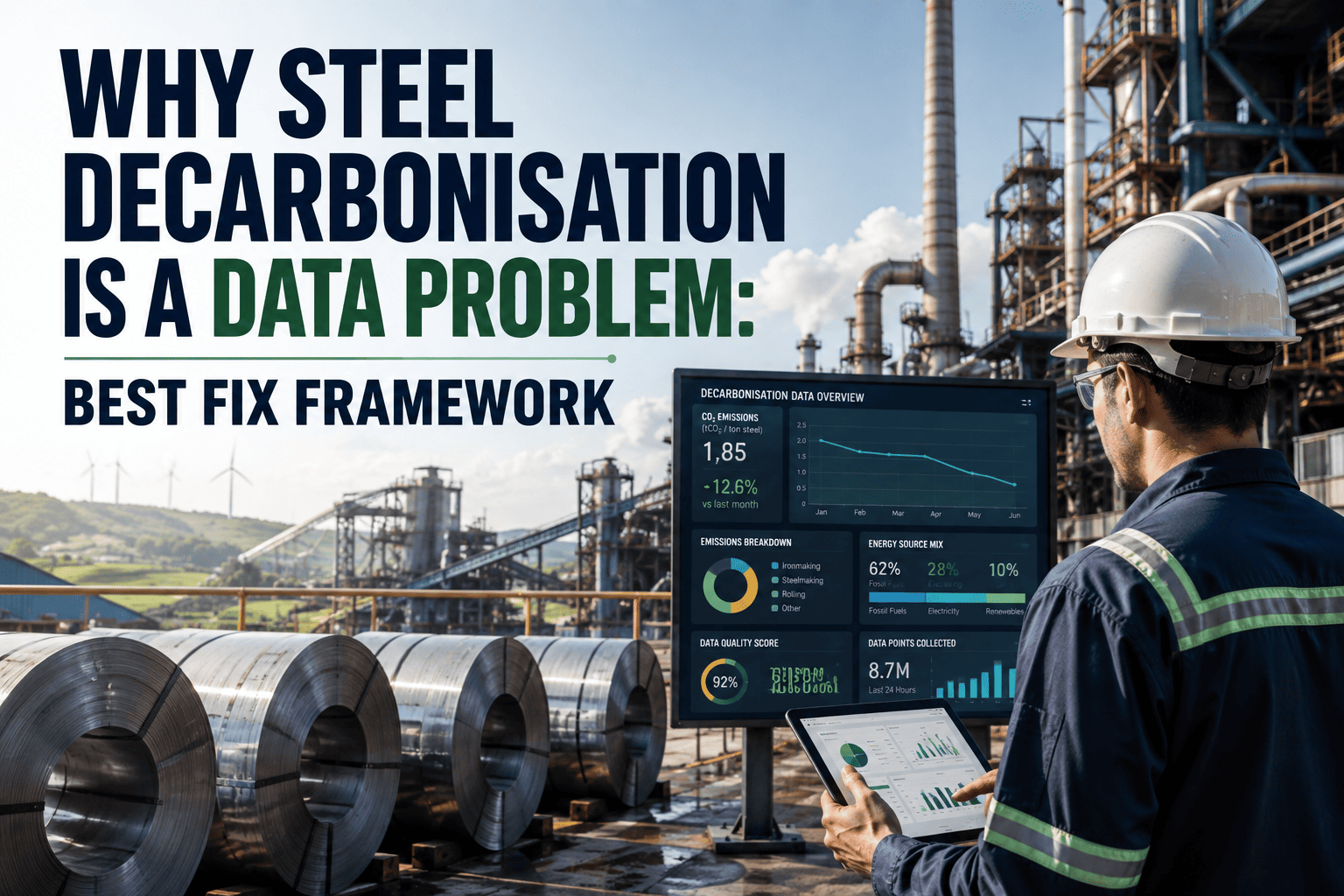
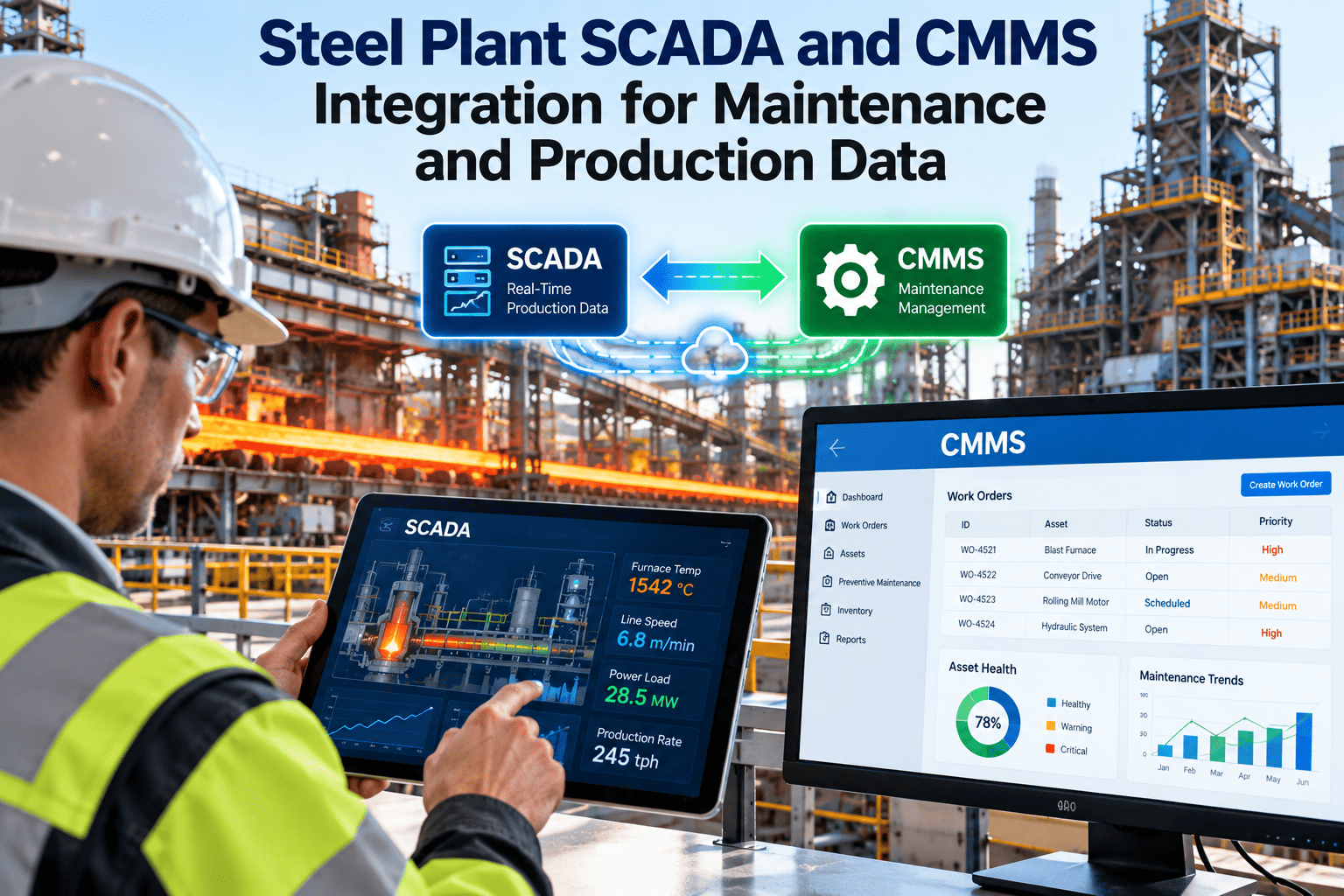
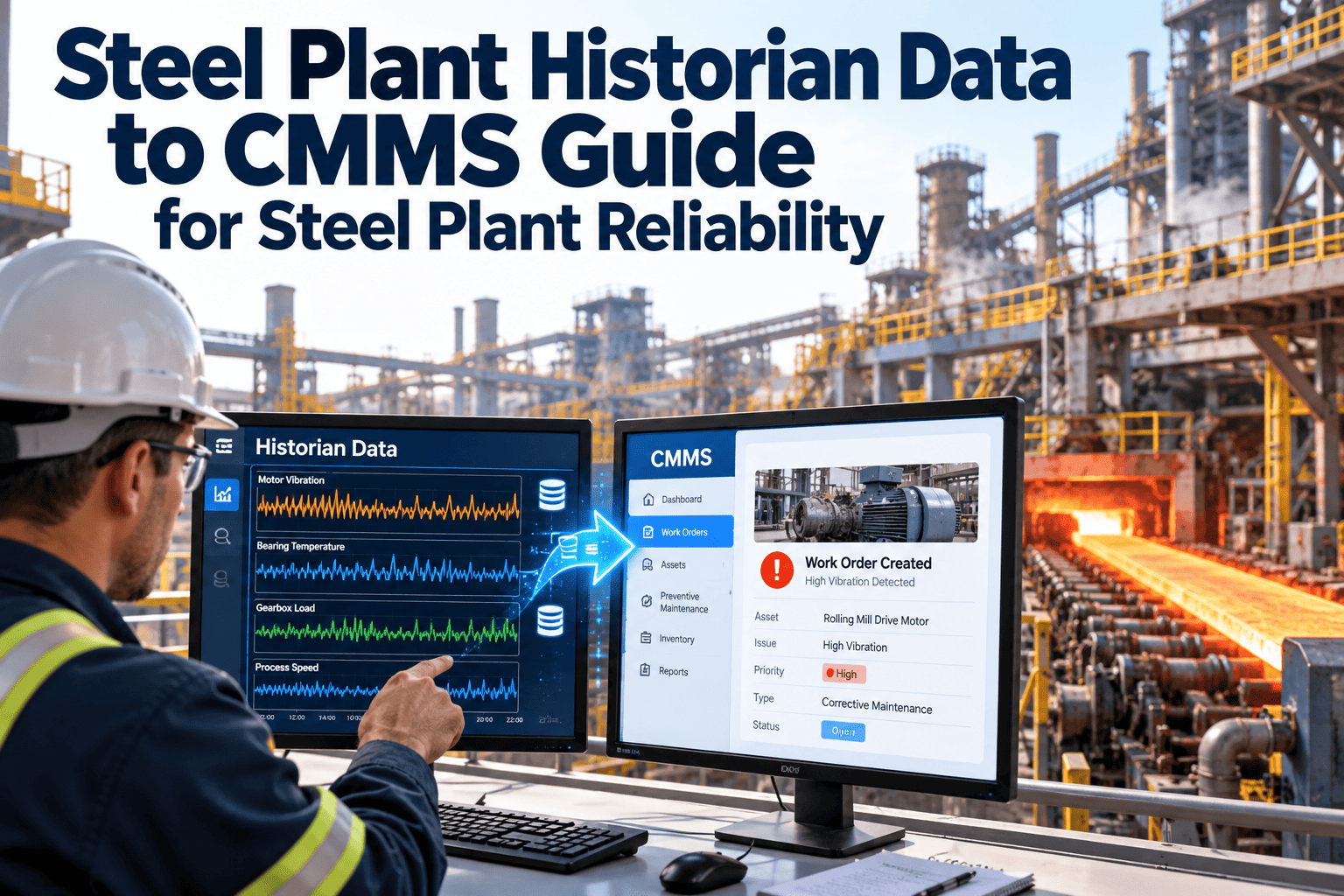
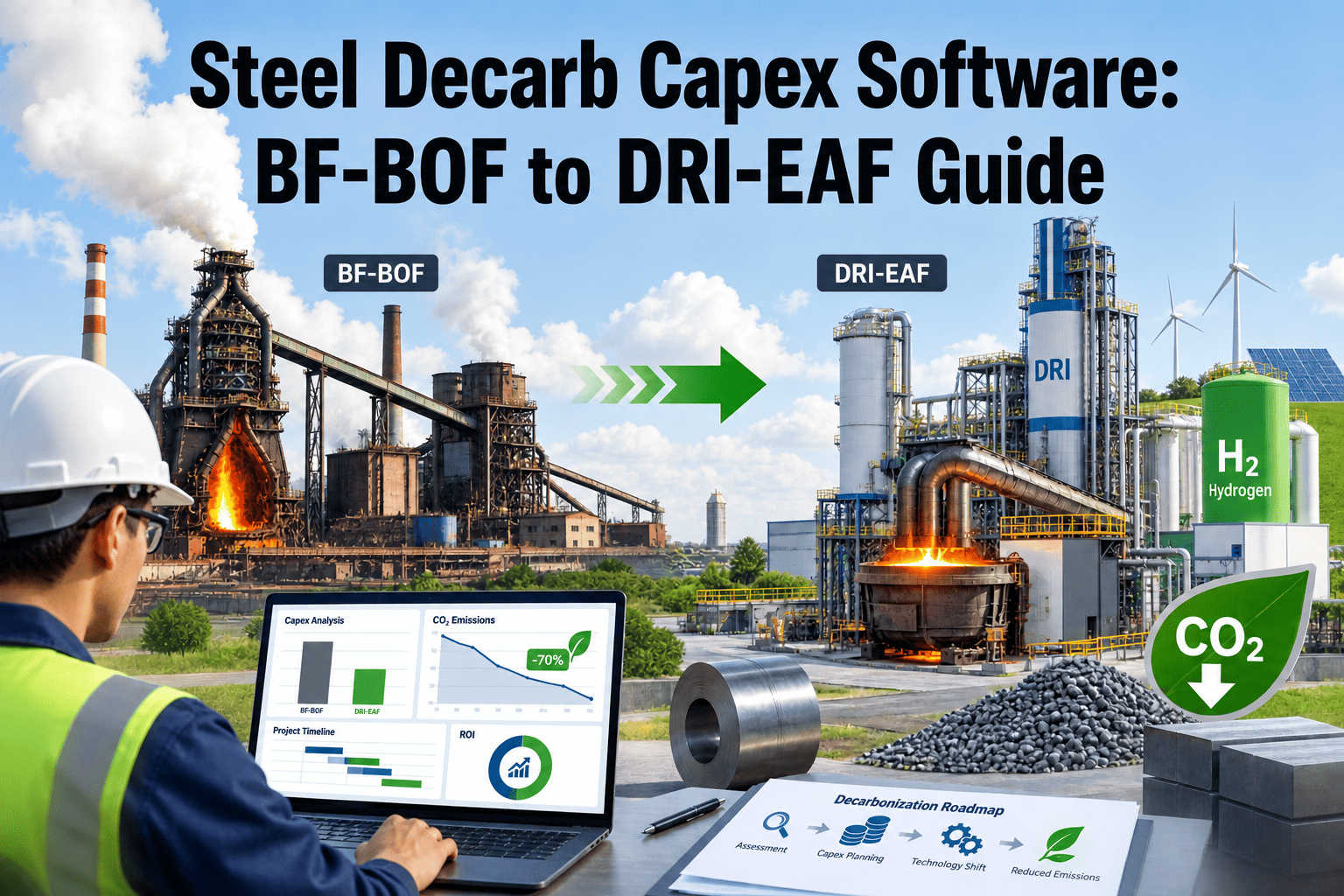
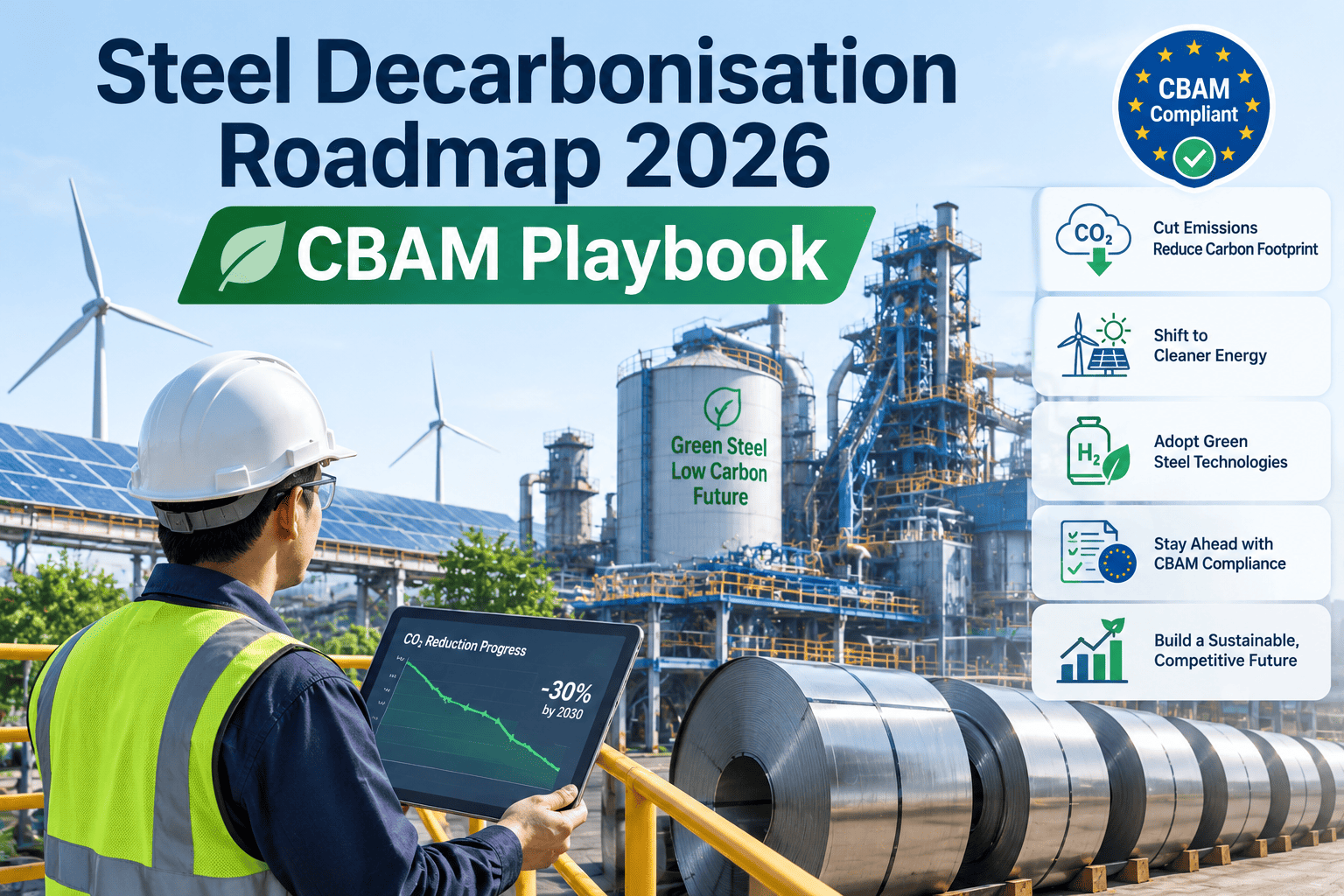
Every steel producer with a public net-zero pledge is now discovering the same uncomfortable truth: the commitment was the easy part. What comes next is proving it, tonne by tonne, furnace by furnace, shipment by shipment, to auditors, customs officers, and buyers who no longer accept a sustainability report as evidence. CBAM wants installation-level embedded emissions. CSRD wants Scope 1, 2, and 3 figures that survive third-party assurance. US manufacturing credits want documented, facility-level production records tied to every claim. None of this can be reconstructed from a spreadsheet after the fact, which is why so many decarbonisation programmes stall at the exact moment they need to produce a number. See how a connected CMMS closes that gap before your next filing deadline.
Steel Decarbonisation · Data Infrastructure
Steel Decarbonisation Was Never a Commitment Problem. It Is a Data Problem.
CBAM, CSRD, and IRA-linked manufacturing credits all ask the same question in different words: can you prove it, at the installation level, with a paper trail an auditor cannot pick apart? Most steel plants cannot answer that today.
1.92
tCO2 per tonne of crude steel, global industry average
78%
emissions gap between EAF and BF-BOF production routes
€100
CBAM penalty per excess tonne for incomplete or incorrect data
3
overlapping regimes now demanding facility-level proof: CBAM, CSRD, IRA
The Core Issue
Why Decarbonisation Plans Fail Before They Reach a Regulator
Ask any plant manager how much carbon a specific coil of steel embodies and the honest answer is usually an estimate, not a record. The gap is not ambition. It is the absence of a system that captures production data at the moment it is generated and keeps it traceable back to a specific furnace run, shift, and material batch.
01
Emissions are estimated once a year for a sustainability report instead of captured continuously against actual production runs and maintenance events
02
Energy, fuel, and material consumption data lives in separate systems — SCADA, ERP, paper logs — with no shared identifier linking them to a single heat or coil
03
Maintenance history that directly affects combustion efficiency and yield loss is never connected to the carbon-intensity calculation for that production period
04
When an auditor asks for installation-level evidence, the response is a scramble across departments instead of an export from one system of record
Scope 1-2-3 Traceability
The Three Layers Every Steel Plant Must Now Prove
Scope 1, 2, and 3 are not three separate reporting exercises anymore — they are three layers of the same data stack, and each layer is thinner on evidence than the one below it. Getting Scope 3 right is impossible if Scope 1 was never captured at source.
Scope 1 — Direct Emissions
Combustion in blast furnaces, BOF, EAF, and reheat furnaces. This is the layer CBAM cares about most for iron and steel imports, and the layer with the most granular plant data available if the system captures it at the equipment level.
Scope 2 — Purchased Energy
Electricity drawn for EAF melting, rolling lines, and auxiliary equipment. Grid intensity varies by region and shift pattern, so consumption logs need timestamps that match actual production windows, not monthly averages.
Scope 3 — Value Chain Emissions
Scrap sourcing, precursor materials like sintered ore and DRI, inbound logistics, and downstream processing. This layer typically accounts for the majority of a company's total footprint and is the hardest to evidence without supplier-linked records.
Regulatory Pressure
Three Regulations, One Missing Ingredient: Verifiable Plant Data
CBAM, CSRD, and US manufacturing tax credits were written by different regulators for different purposes, yet they converge on the same requirement — emissions and production data that can be traced to a specific facility, verified by a third party, and defended under audit.
The EU's Carbon Border Adjustment Mechanism entered its compliance phase on January 1, 2026. Annual declarations are due September 30 each year, and from 2026 all reported emissions data must be independently verified. Incomplete or incorrect reporting carries a penalty of €100 per excess tonne, and post-consumer scrap must be documented separately since it carries zero embedded emissions under the rules.
The Corporate Sustainability Reporting Directive, as revised under the Omnibus simplification package, now applies mandatory reporting to companies above 1,000 employees and €450 million turnover, phased in through FY2028. Where climate is material, ESRS E1 requires gross Scope 1, 2, and 3 emissions reported separately from any carbon credits, with no netting allowed.
US manufacturing production credits tied to the Inflation Reduction Act require detailed, facility-level documentation of the production process, output volumes, and sales to substantiate every claim. Credits phase down starting in 2030, and manufacturers without auditable per-facility records are the first to lose eligibility on review.
At a Glance
What Each Framework Actually Demands From Your Plant Floor
| Requirement |
CBAM |
CSRD (ESRS E1) |
IRA-Linked Credits |
| Data granularity |
Installation level |
Entity and value chain level |
Facility and production-line level |
| Verification |
Independent, accredited verifier |
Limited assurance, moving toward reasonable assurance |
IRS documentation and audit review |
| Reporting cadence |
Annual, due September 30 |
Annual, phased by company size |
Annual tax filing with production records |
| Penalty for gaps |
€100 per excess tonne |
Greenwashing and assurance failure risk |
Credit disallowance on audit |
| Underlying data need |
Direct emissions per production route |
Scope 1, 2, 3 traceable to source |
Production volume tied to facility record |
OxMaint for Steel Manufacturers
Stop Rebuilding Your Carbon Data Every Filing Season
A connected CMMS captures production, maintenance, and energy data at the source, tags it to the equipment and shift that generated it, and keeps it audit-ready year round — so the next CBAM declaration or CSRD disclosure is an export, not a fire drill.
The Shift
From Spreadsheet Reconstruction to System of Record
The difference between a plant that dreads audit season and one that treats it as routine is not effort. It is whether the underlying data was ever designed to be traceable in the first place.
The Spreadsheet Era
Emissions estimated retroactively from utility bills and production totals
Maintenance logs on paper, disconnected from energy or yield data
No link between a specific heat or coil and its carbon intensity
Weeks of manual reconciliation before every regulatory deadline
The Connected CMMS
Emissions calculated per production route as work is completed
Maintenance events linked to combustion efficiency and downtime loss
Every batch traceable to the equipment, shift, and fuel source behind it
Filing becomes a scheduled export from a single, audit-ready system
The Fix Framework
Capture. Connect. Calculate. Comply.
Solving the steel decarbonisation data problem is a sequence, not a single tool purchase. Each step depends on the one before it, which is why plants that skip straight to reporting software without fixing capture almost always end up back at square one.
01
Capture
Record fuel, energy, and material consumption directly against work orders and production runs on the plant floor, at the moment they happen, not from a monthly summary.
02
Connect
Link maintenance history, equipment condition, and downtime events to the production periods they affected, so efficiency losses show up in the carbon-intensity picture.
03
Calculate
Apply the correct methodology per production route — BF-BOF, EAF, DRI — so the reported figure reflects the actual process, not an industry default value.
04
Comply
Export verified, traceable records straight into CBAM declarations, CSRD disclosures, or manufacturing credit filings, with a full history behind every number.
Inside OxMaint
What the Platform Actually Does on Your Plant Floor
OxMaint is built as a maintenance and operations system first, which is precisely why it becomes reliable carbon data infrastructure — the emissions record is a byproduct of work that was already being tracked, not a separate reporting exercise bolted on afterward.
Equipment-Level Data Capture
Every work order, fuel log, and energy reading is tagged to a specific asset, shift, and production run from the moment it is recorded.
Production-Route Calculation
Carbon intensity is calculated separately for each route in the plant, so a BF-BOF line and an EAF line never share an inaccurate blended figure.
Maintenance-to-Emissions Link
Combustion efficiency losses, unplanned downtime, and yield drops are connected to the maintenance events that caused them.
Audit-Ready Export
Verified records export in the formats CBAM declarations, CSRD disclosures, and manufacturing credit filings require, with full traceability intact.
Fleet-Wide Dashboard
Plant leaders see carbon intensity, maintenance compliance, and production data for every line and furnace on one screen, without opening individual records.
Supplier and Scrap Traceability
Inbound scrap and precursor material records are logged against each batch, supporting the Scope 3 evidence buyers and auditors increasingly ask for.
FAQ
Frequently Asked Questions
Why is steel decarbonisation described as a data problem rather than a technology problem?
Most plants already have the equipment data they need scattered across SCADA, ERP, and paper logs. The missing piece is a system that links it all to a specific furnace run and keeps it traceable.
Start a free trial to see how capture works in practice.
Can OxMaint calculate emissions separately for BF-BOF, EAF, and DRI production routes?
Yes. Each route is configured independently in the system, so carbon intensity reflects the actual process behind a batch instead of a plant-wide average.
Book a demo to walk through route-specific calculation.
Does the platform support CBAM's installation-level reporting requirement?
Records are captured and tagged at the equipment and production-run level, which is the granularity CBAM's definitive-phase declarations require, with an independent verifier able to trace each figure back to source.
How does OxMaint help with Scope 3 evidence for scrap and precursor materials?
Inbound scrap and precursor batches are logged against supplier records, giving buyers and auditors a traceable chain rather than an estimated value-chain average.
Start free to configure supplier-linked tracking.
Is OxMaint suitable for a plant that has never tracked emissions data digitally before?
Yes. Because the platform is built around maintenance and production work orders first, plants can start capturing traceable data immediately without a separate carbon-accounting rollout.
Book a demo to plan an onboarding path.
OxMaint — Steel Decarbonisation Data Framework
The Regulations Are Not Waiting. Your Data Infrastructure Should Not Either.
CBAM certificates, CSRD assurance, and manufacturing credit audits all reward one thing: a system of record that was built before the deadline, not assembled the week of it. OxMaint gives steel plants equipment-level capture, route-specific calculation, and audit-ready export in one connected platform.