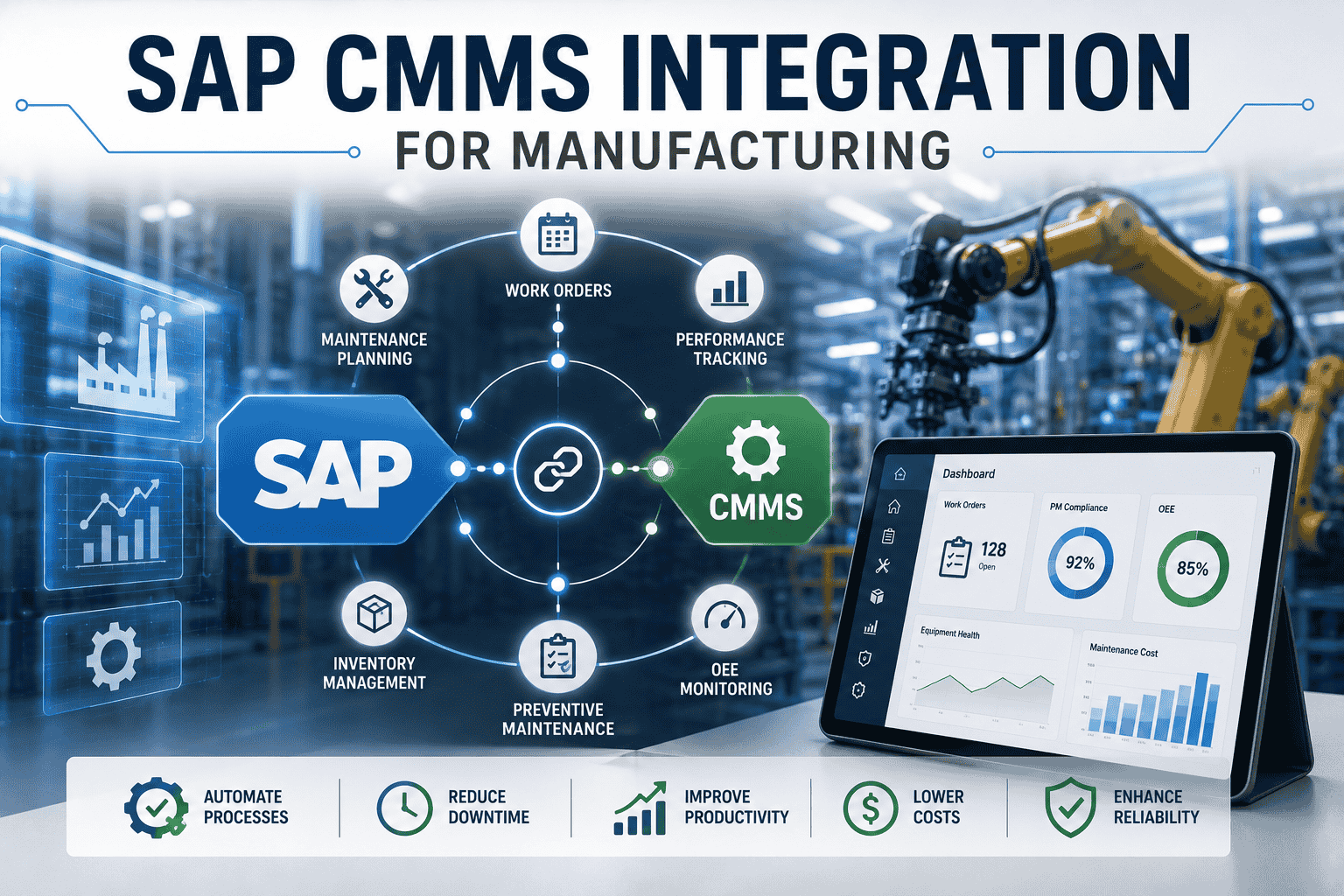
How SAP and CMMS Integration Enables AI-Powered Maintenance Analytics
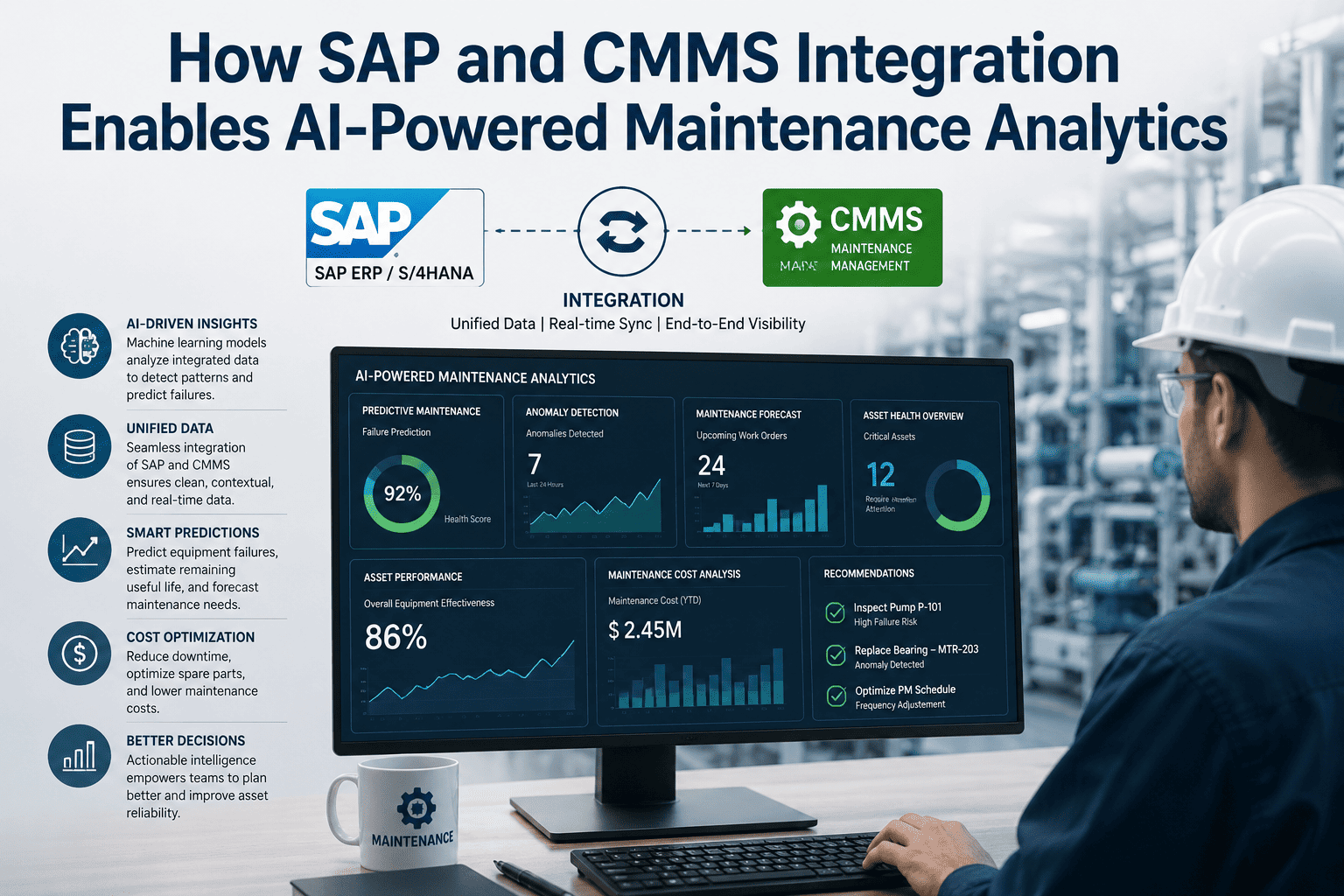
Your SAP system holds purchasing records, work order history, and asset master data. Your CMMS captures real-time maintenance execution, technician findings, and equipment signals. Two platforms. Two databases. Two partial truths about the same operation. Without integration, AI cannot see the complete picture. When SAP and CMMS data converge into a unified intelligence layer, machine learning models predict failures weeks ahead, optimize spare parts inventory, and forecast maintenance budgets with precision impossible from either system alone. The integration unlocks insights neither platform delivers independently—and that is where modern maintenance analytics begins.
SAP × CMMS × AI
Two Systems. One Intelligence Layer.
Bridge enterprise SAP records with operational CMMS telemetry — and let AI surface the patterns no team can spot manually.
30–50%Downtime cut
±8%Budget accuracy
18moPayback
The Two-System Problem Every Maintenance Leader Faces
SAP Plant Maintenance was designed for enterprise transactions: financial postings, procurement workflows, master data governance. CMMS platforms were designed for the maintenance floor: mobile work orders, IoT sensor feeds, real-time technician input. Both are essential. Neither is complete on its own. Deloitte's 2024 Predictive Maintenance research found that roughly 70% of manufacturers cite data fragmentation between enterprise and operational systems as the primary barrier to AI-driven maintenance. Your most powerful analytics models train on incomplete data—and incomplete data produces unreliable predictions, regardless of how sophisticated the algorithm is.
What Each System Captures (And What It Misses)
Enterprise Layer
SAP Plant Maintenance
Asset master records & equipment hierarchy
Procurement, MM inventory & spare parts costs
Cost center charges & FI/CO budget data
Real-time vibration, temperature, pressure feeds
Technician notes, photos & failure context
Operational Layer
CMMS Platform
IoT sensor streams & condition monitoring
Mobile work order execution & completion data
Inspection photos, root-cause notes, MTBF logs
Enterprise procurement & GL postings
Cross-plant cost roll-ups & financial controls
The fragmentation creates a measurable cost. Plants running disconnected SAP and CMMS environments typically rebuild the same asset record across two systems, reconcile parts data manually, and lose the connective tissue between financial outcomes and operational events. When a bearing fails, SAP records the cost. The CMMS records the symptoms. Without integration, no model can correlate the two to predict the next failure. Manufacturers ready to break this silo can sign up free to map their SAP and CMMS data architecture and see where integration delivers the fastest analytical wins.
The SAP + CMMS + AI Convergence Architecture
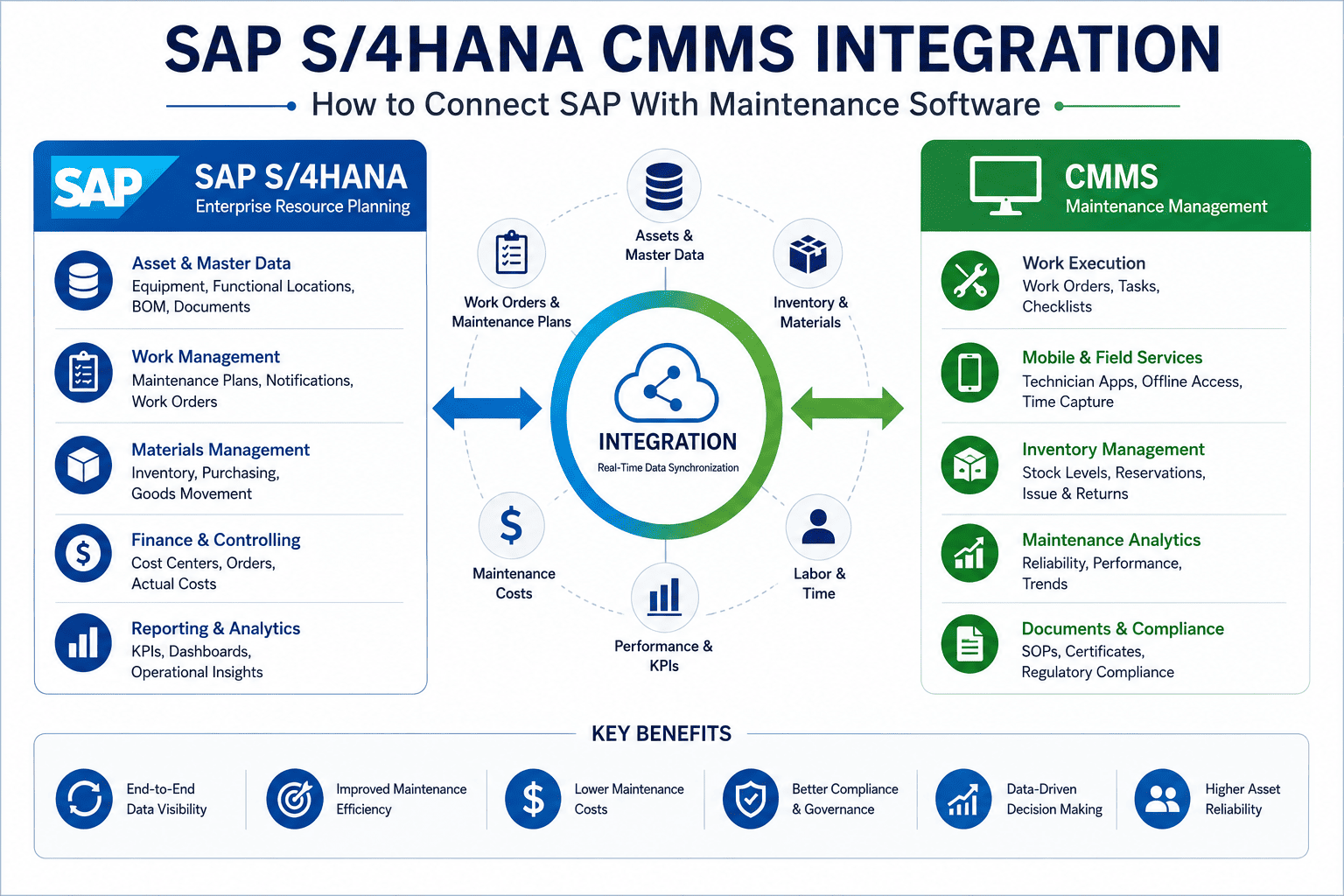
The integration is not a one-way data export. It is a continuous bidirectional intelligence layer where SAP master and transactional data fuses with CMMS operational telemetry inside a unified analytics engine. The architecture has three layers—data sources, the AI engine, and analytical outputs—each handling specific responsibilities. Visualizing the full stack makes it easier to see where standalone systems fall short and where the integrated layer creates measurable lift.
Three-Layer Intelligence Architecture
How SAP and CMMS data converge into AI-driven analytics
Four Analytics Capabilities Unlocked by Integration
Once SAP transactional records and CMMS operational telemetry merge into a unified analytics engine, four distinct capabilities become possible that neither system delivers standalone. These outcomes are not theoretical—they show up in measurable downtime reduction, parts spend optimization, and budget accuracy within months of go-live. McKinsey's 2024 research on AI in manufacturing reports that integrated predictive maintenance programs typically deliver 30 to 50 percent reductions in machine downtime and 15 to 30 percent increases in labor productivity.
Failure Prediction
ML models correlate SAP work order history with CMMS sensor patterns to estimate remaining useful life on rotating equipment, motors, pumps, and compressors. Failures get scheduled, not reacted to.
14–60 day advance warning typical
Anomaly Detection
Live CMMS sensor streams compared against SAP-defined operating envelopes flag deviations before they escalate. Catches the subtle drifts no rule-based system would detect.
Sub-minute detection latency
Maintenance Forecasting
Combines historical SAP work order volumes with current CMMS asset health to project 12-month maintenance workload, labor requirements, and budget needs by cost center.
±8% budget accuracy at 12 months
Cost Optimization
Links SAP MM parts costs and FI/CO actuals with CMMS consumption data to recommend stocking levels, vendor consolidation, and labor allocation that minimize total maintenance spend.
15–25% parts spend reduction
How the SAP-CMMS-AI Data Flow Actually Works
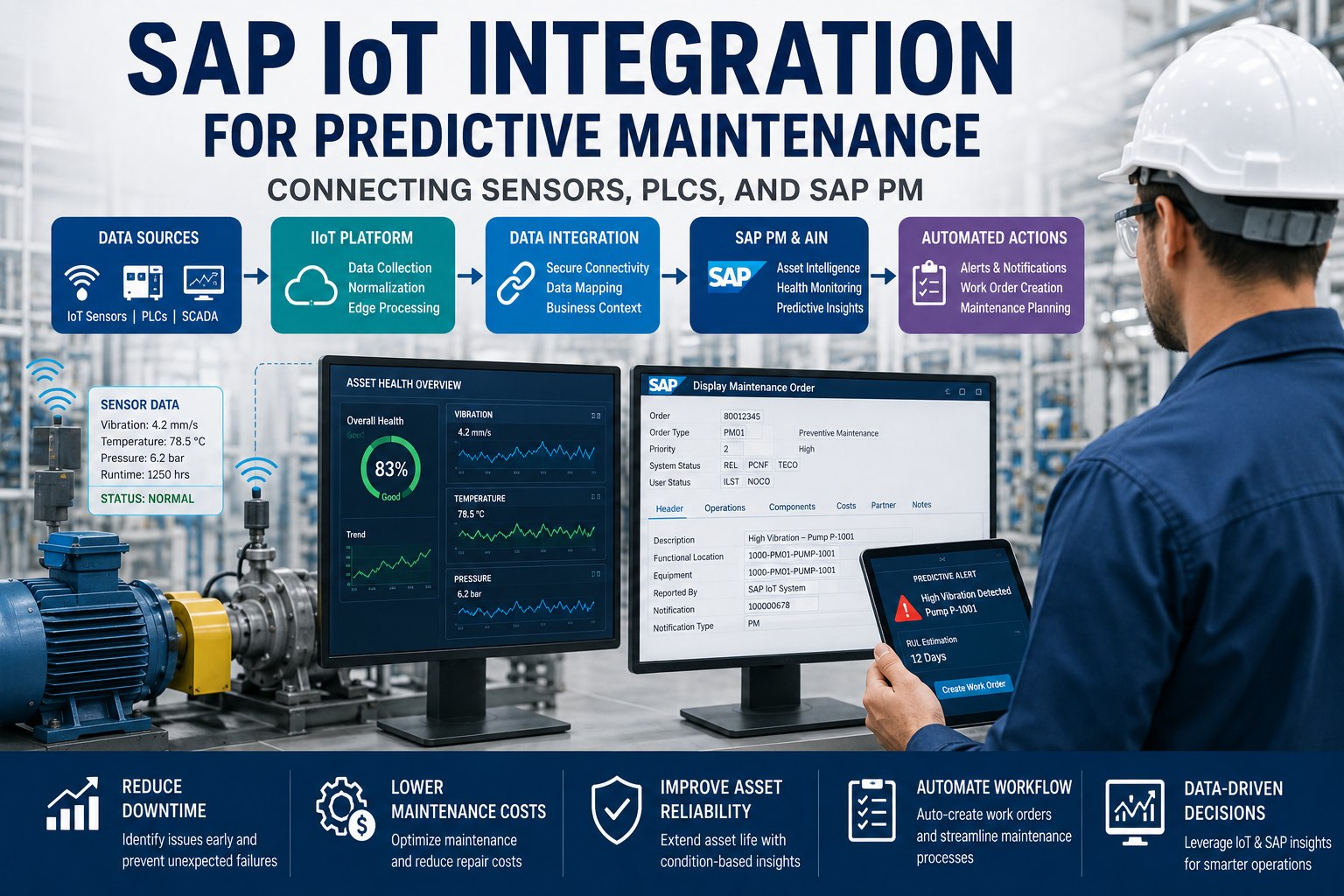
The technical pipeline moves data continuously, not in nightly batches. SAP exposes master and transactional data through standard OData APIs or SAP Business Technology Platform connectors. CMMS systems push live sensor and work order events via REST endpoints. Both streams land in a unified data layer where AI models train, score, and emit predictions back into both systems. The compute backbone matters: AI inference for industrial analytics runs on dedicated on-premises hardware—an RTX PRO 6000 Blackwell central server paired with Jetson AGX edge boxes—so sensitive operational data never leaves the plant network while still benefiting from modern accelerated machine learning.
The Integration Data Pipeline
From source systems to AI predictions and back
1
Extract & Stream
SAP OData and CMMS REST APIs push asset, work order, sensor, and cost data into the unified analytics layer in near real time.
2
Normalize & Match
Equipment IDs, functional locations, and cost centers reconcile across systems so AI models see one asset—not two records.
3
Score with ML Models
Models running on the on-prem RTX PRO 6000 Blackwell server analyze combined SAP-CMMS data to generate failure predictions, anomaly scores, and forecasts.
4
Act & Loop Back
Predictions trigger SAP work orders automatically and update CMMS asset health dashboards, closing the analytics loop without manual handoffs.
A 30-minute working session walks through the integration layer, the AI scoring pipeline, and what predictions look like once your SAP and CMMS data converge in one analytics engine.
Measurable ROI from Integrated Maintenance Analytics
The business case for SAP and CMMS integration is not abstract. PwC's 2024 Predictive Maintenance 4.0 study found that mature programs—those with integrated data, AI models, and closed-loop work order automation—generate average payback inside 18 months and deliver compounding returns from year two forward. The gains come from three places: avoided downtime, optimized parts spend, and labor productivity. Below is how the metrics shift across maturity stages.
Analytics Maturity vs Outcomes
Swipe to compare maturity stages
Metric
Disconnected
Basic Integration
Full AI Analytics
Unplanned Downtime
High
Reduced
30–50% lower
Parts Spend
Inflated
Stable
15–25% lower
Budget Forecast Accuracy
±30%
±18%
±8%
Labor Productivity
Baseline
+10%
+15–30%
Failure Detection Lead Time
Reactive
Hours
Weeks ahead
Asset Life Extension
None
5–10%
20–40%
18moTypical payback period for integrated AI analytics programs
3–5xMulti-year return after year-two cost compounding
The companies winning at maintenance analytics are not the ones with the most sophisticated models—they are the ones whose models train on the most complete data. A failure prediction algorithm running on CMMS sensor data alone misses the procurement signals SAP carries. A forecasting model running on SAP work order history alone misses the real-time condition signals from the floor. Integration is the unglamorous prerequisite that makes the AI work.
A
Models Train on Complete Context
A failure pattern looks different when you can see both the maintenance history (SAP) and the sensor signature (CMMS) leading up to it. Models trained on both data types catch failure modes neither system can predict alone.
B
Closed-Loop Action Without Handoffs
AI predictions become SAP work orders automatically. CMMS technicians close the work order on mobile. Costs post to the right FI/CO center. No copy-paste, no missed notifications, no reconciliation work.
C
Trust Built on Auditability
When a prediction triggers a $50,000 repair, leadership wants to see the underlying data. Integrated systems provide the full lineage—sensor readings, SAP master data, model logic—in one auditable view.
Stop forcing your team to bridge SAP and CMMS manually. See how integrated AI analytics delivers failure predictions, anomaly alerts, and budget forecasts from data that already exists in your environment.
What is the difference between SAP PM and a CMMS, and why integrate them?
SAP Plant Maintenance is the enterprise system of record for assets, work order financials, procurement, and master data governance. A CMMS handles the operational layer: mobile work execution, IoT sensor integration, technician inspections, and real-time equipment health. SAP excels at transactional control; CMMS excels at floor-level intelligence. Integrating them gives AI models complete visibility into both the financial and operational reality of each asset, which is the prerequisite for accurate failure prediction, anomaly detection, and budget forecasting.
What kinds of failures can AI predict from integrated SAP and CMMS data?
Integrated analytics is most accurate on rotating equipment (motors, pumps, compressors, fans), bearings, gearboxes, and any asset class where degradation produces sensor signatures (vibration, temperature, current draw) and has historical work order patterns in SAP. Typical advance warning is two to eight weeks. Models also catch lubrication breakdown, misalignment, imbalance, and electrical insulation degradation. Static equipment like vessels and piping requires inspection data plus thickness measurements rather than continuous sensor streams.
How long does SAP-CMMS-AI integration typically take to implement?
A focused pilot on one asset class typically runs eight to twelve weeks: two weeks for connector setup and data mapping, four weeks for model training on historical data, and two to four weeks for validation and tuning. Plant-wide rollouts take four to nine months depending on the number of assets, the cleanliness of SAP master data, and how many CMMS sensor points need to be onboarded. Most facilities see their first actionable prediction inside 90 days.
Do I need SAP BTP to enable AI analytics on integrated data?
SAP Business Technology Platform makes integration easier through pre-built connectors and managed APIs, but it is not strictly required. Standard SAP OData APIs work directly with most modern AI analytics platforms. BTP becomes more valuable for organizations standardizing across many SAP modules or requiring SAP-native AI services. For plants prioritizing rapid time-to-value and on-premises data residency, a direct API approach to a unified analytics layer is often faster and more flexible.
What ROI can I realistically expect from AI-powered maintenance analytics?
Mature programs typically see 30 to 50 percent reductions in unplanned downtime, 15 to 25 percent reductions in spare parts spend, and 15 to 30 percent gains in maintenance labor productivity, with budget forecast accuracy improving from roughly ±30 percent to ±8 percent at the twelve-month horizon. Typical payback runs about 18 months for a focused deployment, with three to five times multi-year returns as the program compounds across more asset classes and plants.