sap-iot-integration-predictive-maintenance

SAP IoT Integration for Predictive Maintenance: Connecting Sensors, PLCs, and SAP PM


Your machines are already talking—vibration accelerometers, temperature probes, the PLCs on your lines, the SCADA system in the control room all stream signals about asset health. The problem is that this data lives in the operational-technology world while SAP PM lives in IT, and the two rarely meet. So a bearing trends toward failure for weeks in the historian while SAP keeps scheduling calendar PMs that miss it. Connecting IoT sensors and PLCs to SAP PM bridges that OT-to-IT gap—turning live machine signals into automatic, condition-based work orders. Book a free demo to see signals become work orders.

From Sensor Signal to SAP Action
What connecting OT data to SAP PM makes possible
OT ↔ IT
Bridge the gap between plant-floor signals and enterprise maintenance
RUL
Predict remaining useful life instead of guessing from the calendar
Auto
Anomalies create maintenance orders with little to no human touch
No rip-out
Connect existing PLCs, SCADA, and historians—no sensor replacement

Why Sensor Data Alone Doesn't Fix Anything

Plenty of plants have invested in sensors and condition monitoring, then wondered why downtime didn't drop. The reason is that monitoring without integration just produces dashboards nobody acts on fast enough. A vibration alarm in the SCADA system means nothing if it doesn't reach the maintenance planner as a work order with the right asset, the right priority, and the right parts. SAP PM, in its standard form, runs on historical data and static schedules—powerful for planning, blind to real-time condition. The value isn't in collecting more sensor data; it's in connecting the signal directly to the maintenance action inside SAP, so a detected anomaly becomes a dispatched repair automatically.

Matching the Sensor to the Failure Mode

Predictive maintenance starts with sensing the right thing. Different failure modes announce themselves through different physical signals, so sensor selection is a deliberate decision made during asset criticality assessment—not a blanket install. The good news: most of these signals can be captured from instruments you likely already have, and fed to SAP through standard industrial protocols without replacing a thing.

Sensor Type to Failure Mode
Vibration
Bearing wear, imbalance, misalignment, looseness in rotating equipment.
Temperature
Overheating, friction, lubrication breakdown, electrical hot spots.
Acoustic Emission
Early crack growth, leaks, and friction before they're audible.
Pressure & Current
Blockages, load shifts, motor strain, and process deviations.
Sensor choice follows the failure mode—captured via existing PLC, SCADA, and historian feeds

The Data Journey: From Plant Floor to Work Order

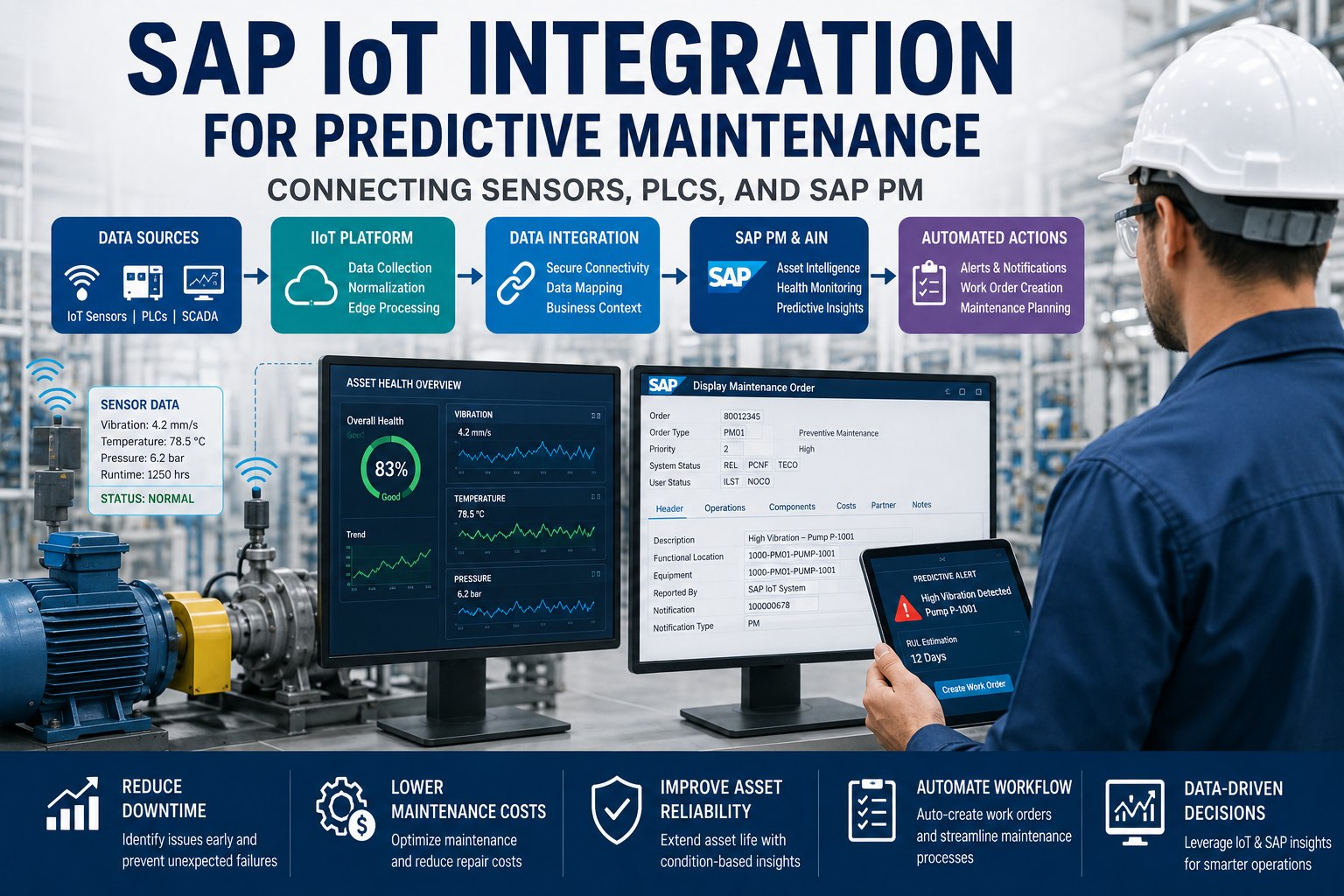
The heart of SAP IoT integration is a layered pipeline that carries a raw signal from the machine all the way to a dispatched technician. Raw sensor data is noisy and high-volume, so it's processed at the edge before it ever reaches SAP—filtered, enriched, and translated from industrial protocols into something the enterprise can use. Then the analytics layer turns clean data into a prediction, and SAP turns the prediction into action. Here's the full path.

The OT-to-IT Predictive Pipeline
Four layers from machine signal to maintenance order
Layer 1
Sense (OT)
Sensors, PLCs, SCADA, and historians generate live signals on vibration, temperature, pressure, and current.
Layer 2
Edge Process
An edge gateway filters noise and translates OPC-UA, MQTT, Modbus, and REST into clean, low-latency data streams.
Layer 3
Predict (AI)
Models trained on signal-plus-failure history detect anomalies and estimate remaining useful life for each asset.
Layer 4
Act (SAP PM)
A predicted failure auto-creates a maintenance order on the asset—with priority, parts, and schedule—in SAP PM.

That last hop—from prediction to a real SAP work order—is where most monitoring projects stall and where the value lives. Teams ready to trace it against their own OT stack can sign up free to map their data pipeline before scoping a project.

Where You Are on the Maintenance Maturity Ladder

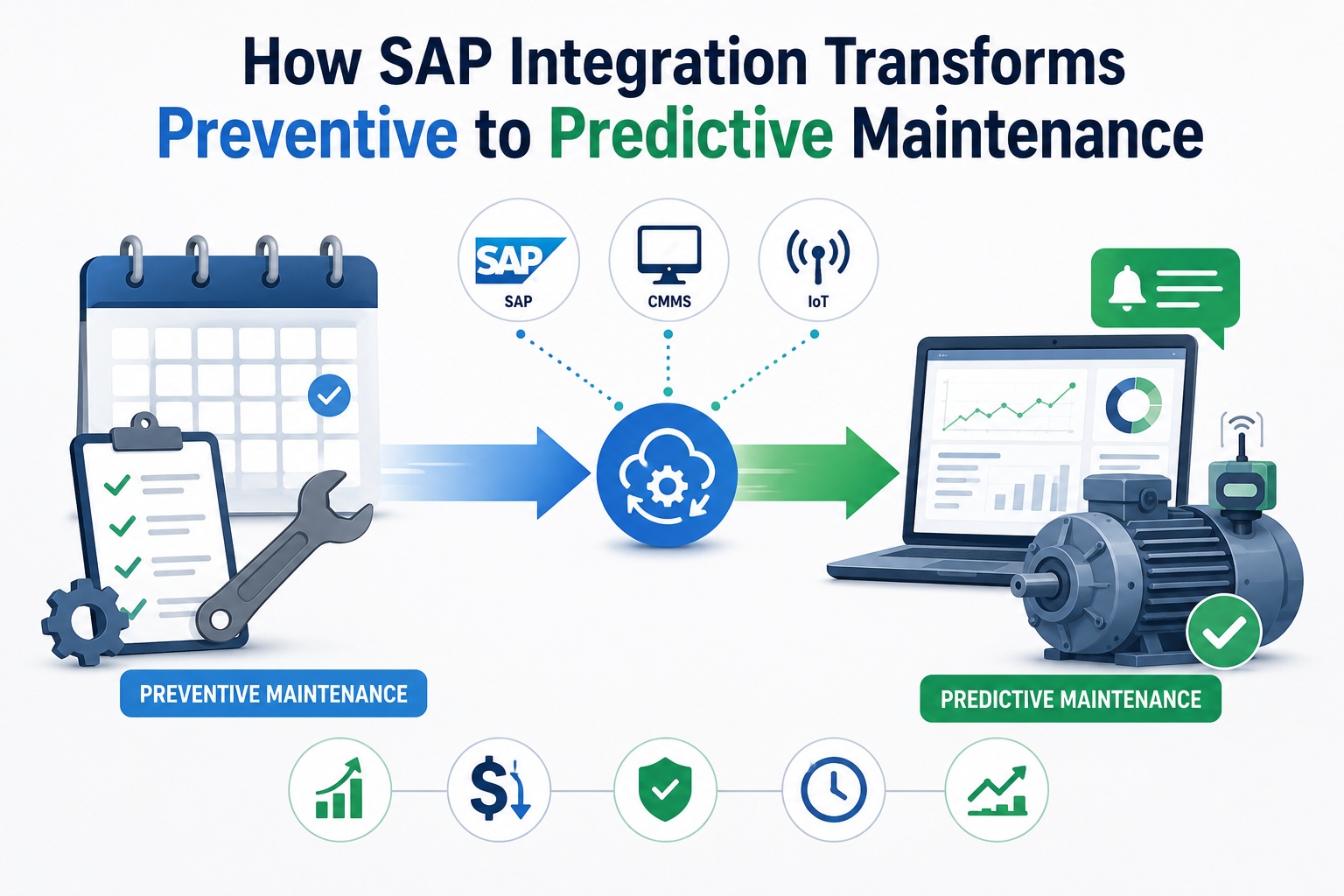
IoT-to-SAP integration isn't a single leap—it's a climb up a maturity ladder, and knowing your rung clarifies the next step. Most SAP EAM programs still sit on the lower rungs, reacting to failures or running fixed schedules. Integration moves you up to condition-based and predictive maintenance, and the frontier is prescriptive—where the system doesn't just predict a failure but recommends the optimal response based on risk, cost, and asset condition, then queues it in SAP.

The Maintenance Maturity Climb
1
Reactive
Fix it when it breaks—maximum downtime and cost
2
Preventive
Calendar-based PMs—misses real condition, wastes parts
3
Condition-Based
Act on live sensor thresholds—maintenance when data says so
4
Predictive
Forecast failures and RUL—intervene before the break
5
Prescriptive
System recommends the optimal action and queues it in SAP
See Predictive Work Orders on Your Assets
Watch live sensor and PLC data flow through an edge layer into SAP PM—anomalies predicting failures and auto-creating maintenance orders—mapped to your OT stack and asset model in a 30-minute walkthrough.

The Brownfield Reality: Connect, Don't Wait

Here's where teams get stuck. The fully native SAP path—migrating all OT data into SAP's cloud environment so SAP APM and Joule can analyze it—is powerful but slow: brownfield implementations consistently run nine to eighteen months from contract to first production failure prediction, driven by BTP provisioning, sensor integration, and aligning historian and SCADA feeds to SAP's data model. For most plants, the pragmatic path is to connect the OT data you already have to SAP PM through standard protocols now, start generating predictive work orders on critical assets, and expand coverage as you go—rather than waiting a year and a half for a full data migration to finish.

The brownfield approach gets value flowing in weeks, not quarters. Teams weighing the options can sign up free to assess their OT readiness and see which assets are already instrumented enough to start.

Expert Perspective: The Last Hop Is the Whole Point

I've seen seven-figure sensor programs deliver almost nothing, because the data ended in a dashboard nobody watched in time. The signal was there—a motor current creeping up for three weeks—but it never became a work order until the motor failed. Predictive maintenance isn't a sensor problem or even an AI problem anymore; both are solved. It's an integration problem. The entire return on your IoT investment lives in that last hop, from a prediction to a dispatched SAP work order with the right part already on its way. Get that hop automated and everything upstream finally pays off.

Signals Must Become Orders
A prediction that doesn't auto-create a work order is just a dashboard nobody acts on in time.
Use the Sensors You Have
Standard protocols connect existing PLCs, SCADA, and historians—no costly rip-and-replace.
Start at the Edge
Processing data at the edge cuts noise and latency before it ever reaches SAP.

Getting Started Without a Year-Long Project

You don't need to migrate every historian into the cloud to begin. Start with an asset criticality assessment to pick the equipment where failure hurts most, confirm those assets are instrumented with the right sensors for their failure modes, and connect their existing PLC, SCADA, or historian feeds through standard protocols. Process at the edge, run anomaly detection, and wire the output to auto-create SAP PM work orders on a single critical line. Teams can sign up free to start with one critical line and validate the full loop before expanding. Each asset you connect moves you up the maturity ladder and proves the value before the next investment.

Your equipment is already broadcasting its health in real time. The opportunity isn't more sensors—it's closing the gap between those signals and the maintenance action inside SAP. Connect IoT, PLCs, and SCADA to SAP PM through an edge-processed, AI-driven pipeline, and a creeping vibration becomes a scheduled repair before it becomes a breakdown. That's the shift from reacting to failures to preventing them, built on the data you already collect. Teams ready to see it on their own assets can book a free demo to review their integration strategy.
Turn Live Machine Signals Into SAP Action
Connect sensors, PLCs, and SCADA to SAP PM through an edge-processed predictive pipeline. Anomalies forecast failures and auto-create work orders—using the instruments you already have. See it on your setup.

Frequently Asked Questions

How do IoT sensors and PLCs connect to SAP PM?
Through a layered pipeline. Sensors, PLCs, SCADA, and historians generate live signals that an edge gateway filters and translates from industrial protocols—OPC-UA, MQTT, Modbus, and REST—into clean data streams. An analytics layer detects anomalies and estimates remaining useful life, and the prediction flows into SAP PM where it automatically creates a maintenance order on the affected asset. Crucially, this connects your existing PLC, SCADA, and historian systems without requiring sensor replacement, so you leverage instrumentation you already have rather than starting from scratch.
What's the difference between condition-based and predictive maintenance?
Condition-based maintenance acts on live sensor thresholds—when vibration or temperature crosses a set limit, maintenance is triggered. Predictive maintenance goes further: it uses models trained on sensor data correlated with historical failures to forecast when a failure will occur and estimate each asset's remaining useful life, so you intervene before the threshold-crossing becomes a breakdown. Both are rungs on a maturity ladder above reactive and calendar-based preventive maintenance. The frontier is prescriptive maintenance, where the system also recommends the optimal response based on risk, cost, and condition.
Do I need SAP APM, or can I connect IoT data another way?
SAP Asset Performance Management is the native, BTP-based path and integrates deeply with S/4HANA, but brownfield implementations consistently run nine to eighteen months from contract to first production failure prediction, driven by BTP provisioning, sensor integration, and aligning historian and SCADA feeds to SAP's data model. The pragmatic alternative is to connect your existing OT data to SAP PM through standard protocols now and start generating predictive work orders on critical assets in weeks, expanding coverage over time rather than waiting for a full data migration to complete.
Why doesn't sensor monitoring alone reduce downtime?
Because monitoring without integration produces dashboards, not actions. A vibration alarm in SCADA accomplishes nothing if it doesn't reach the maintenance planner as a work order with the right asset, priority, and parts—fast enough to act before failure. Many plants invest in sensors and condition monitoring, then see little downtime improvement for exactly this reason. The value isn't in collecting more data; it's in automating the last hop from a detected anomaly to a dispatched SAP work order, so a signal becomes a repair with little to no human intervention.
Which assets should we start with?
Begin with an asset criticality assessment to identify the equipment where failure carries the highest cost or safety impact, then confirm those assets carry the right sensors for their likely failure modes—vibration for rotating equipment, temperature for friction and electrical issues, acoustic for early cracks and leaks, pressure and current for blockages and load shifts. Connect those existing feeds first, wire anomaly detection to auto-create SAP PM orders on a single critical line, validate the full loop, then expand. This phased start proves the value on your highest-impact assets before broader investment.


Share This Story, Choose Your Platform!