SAP-CMMS Integration for HACCP Compliance in Food Manufacturing
Food manufacturers face a documentation challenge that has no equivalent in most industries. Every PM activity on a critical control point asset must link to a HACCP plan, traceable to regulatory inspections, and defensible during FDA audits. Every equipment failure touching food contact surfaces becomes a potential corrective action under FSMA preventive controls. Every calibration drift on a CCP measurement device becomes a verification finding waiting to happen. Integrated SAP PM and CMMS architecture turns that documentation burden into operational discipline. Book a free demo to walk through HACCP-integrated maintenance.
FOOD SAFETY COMPLIANCE REALITY
The Documentation Burden HACCP Places on Maintenance
7
HACCP Principles
Each with maintenance touchpoints
21 CFR 117
FDA FSMA Rule
Preventive Controls for Human Food
600+
FDA Inspections / yr
Find maintenance-related failures
5
Compliance Frameworks
Anchored via integrated CMMS
Why Maintenance Integration Matters for HACCP Compliance
HACCP doesn't treat maintenance as adjacent to food safety—it treats maintenance as a primary control. A metal detector that hasn't been calibrated is not a maintenance gap; it's a failed CCP and a regulatory event. A thermal processing oven whose temperature sensor drifted out of tolerance produces verification findings that can extend to product hold, recall, or FDA enforcement action. A cooling tunnel with a failed bearing isn't an availability problem; it's a critical limit violation waiting for an inspector to discover. Every maintenance decision on CCP-related equipment is, by HACCP's logic, a food safety decision.
PM tracks change-over sanitation and validates absence with ATP testing and allergen swabs
The documentation challenge compounds the operational stakes. FSMA's Preventive Controls Qualified Individual (PCQI) requirements demand documented evidence that preventive controls are operating as designed. FDA inspections increasingly focus on the evidence chain linking equipment performance to product safety. Food manufacturers running maintenance on paper logs struggle to produce that evidence chain under inspection pressure. Food safety and maintenance leaders ready to begin a structured assessment can Sign up free to begin a HACCP-maintenance integration assessment.
How SAP PM + CMMS Solves Food Safety's Documentation Challenge
Three integration capabilities differentiate food manufacturing CMMS from general industrial CMMS. First, the equipment master must support CCP tagging—every asset linked to a HACCP plan is identified, and its work orders flow into food safety verification rather than just maintenance reporting. Second, calibration management has to support traceability to NIST-traceable standards with automated re-calibration scheduling based on instrument criticality. Third, the audit trail has to support FDA Part 11 electronic records requirements with tamper-evident logging and validated electronic signatures.
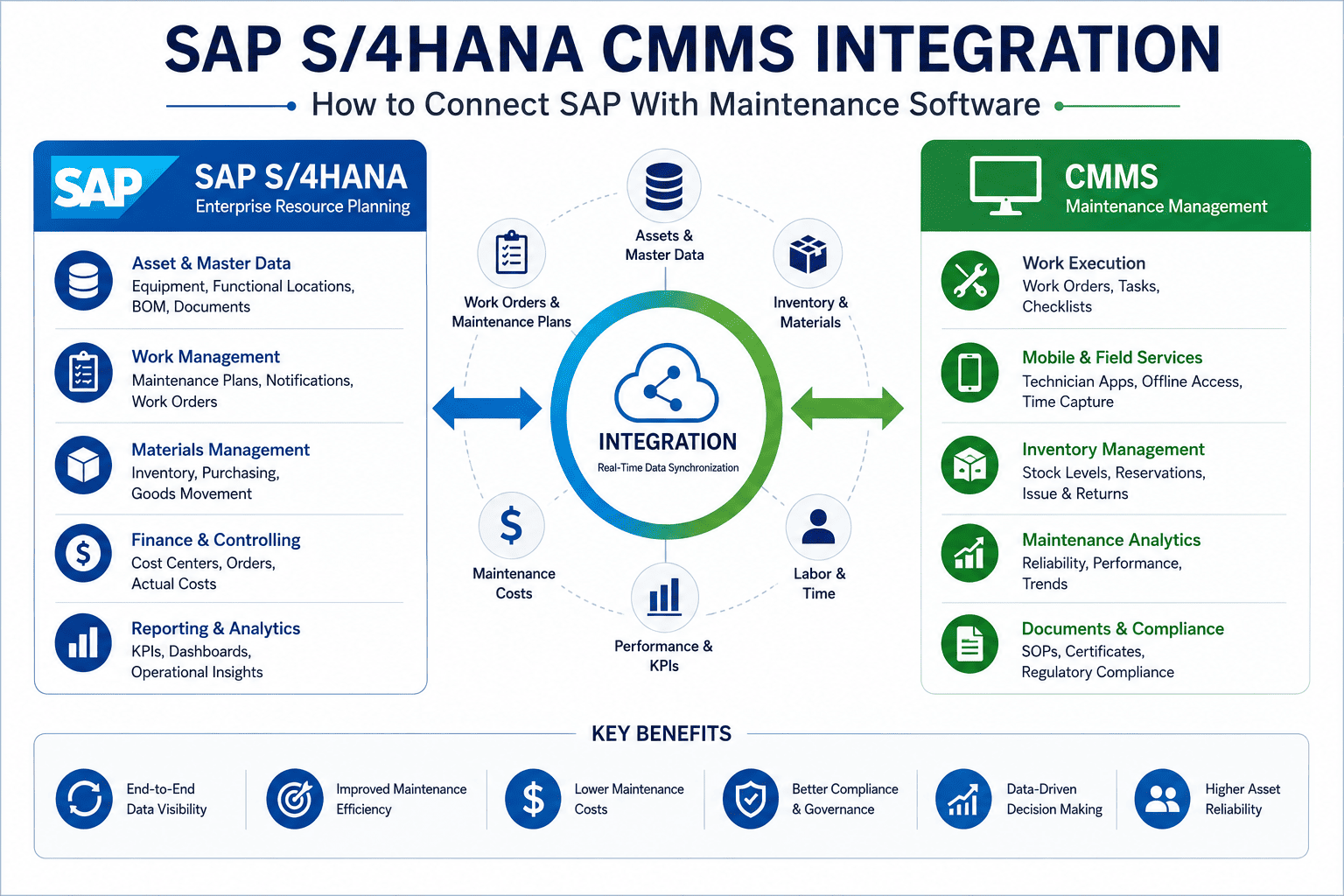
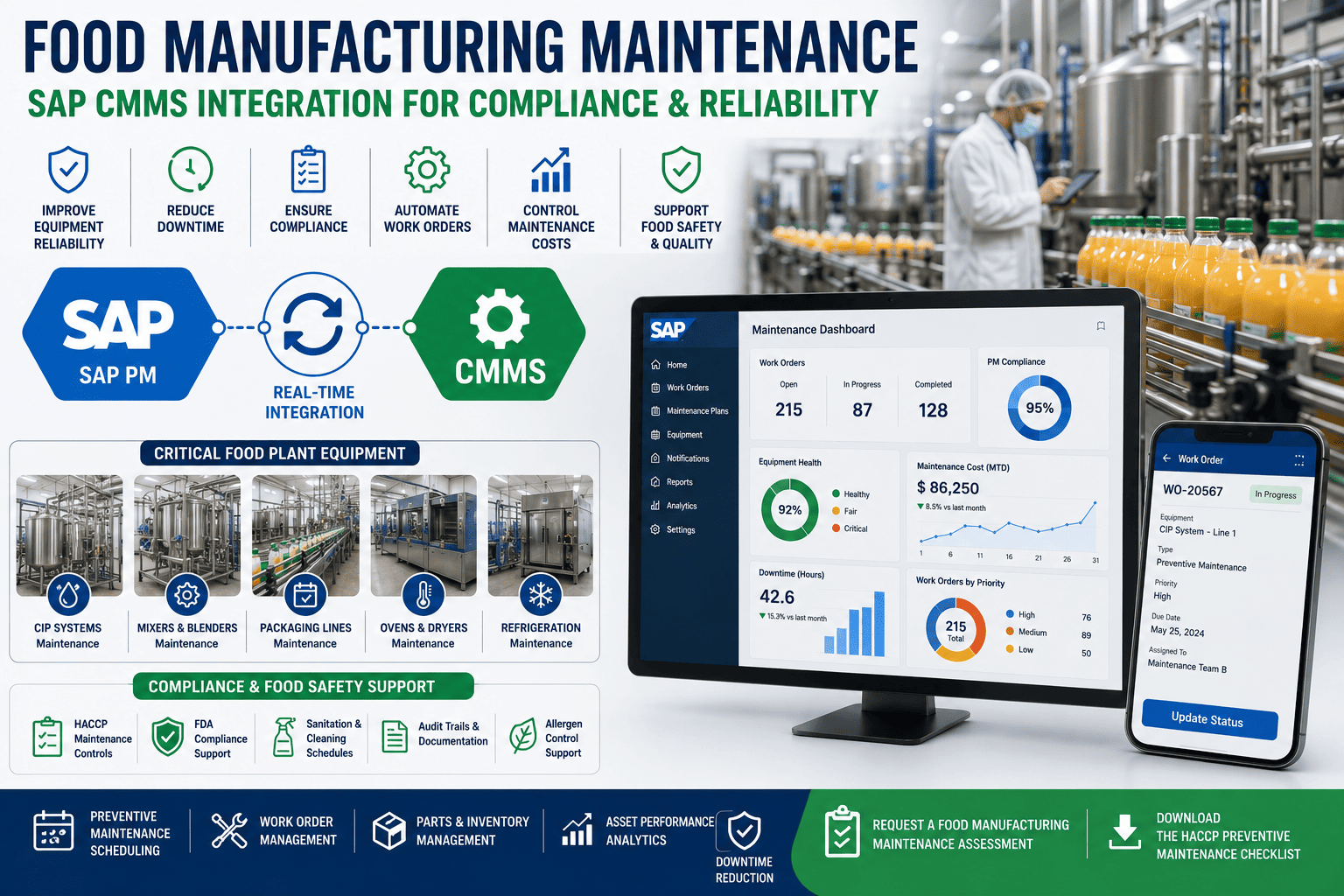
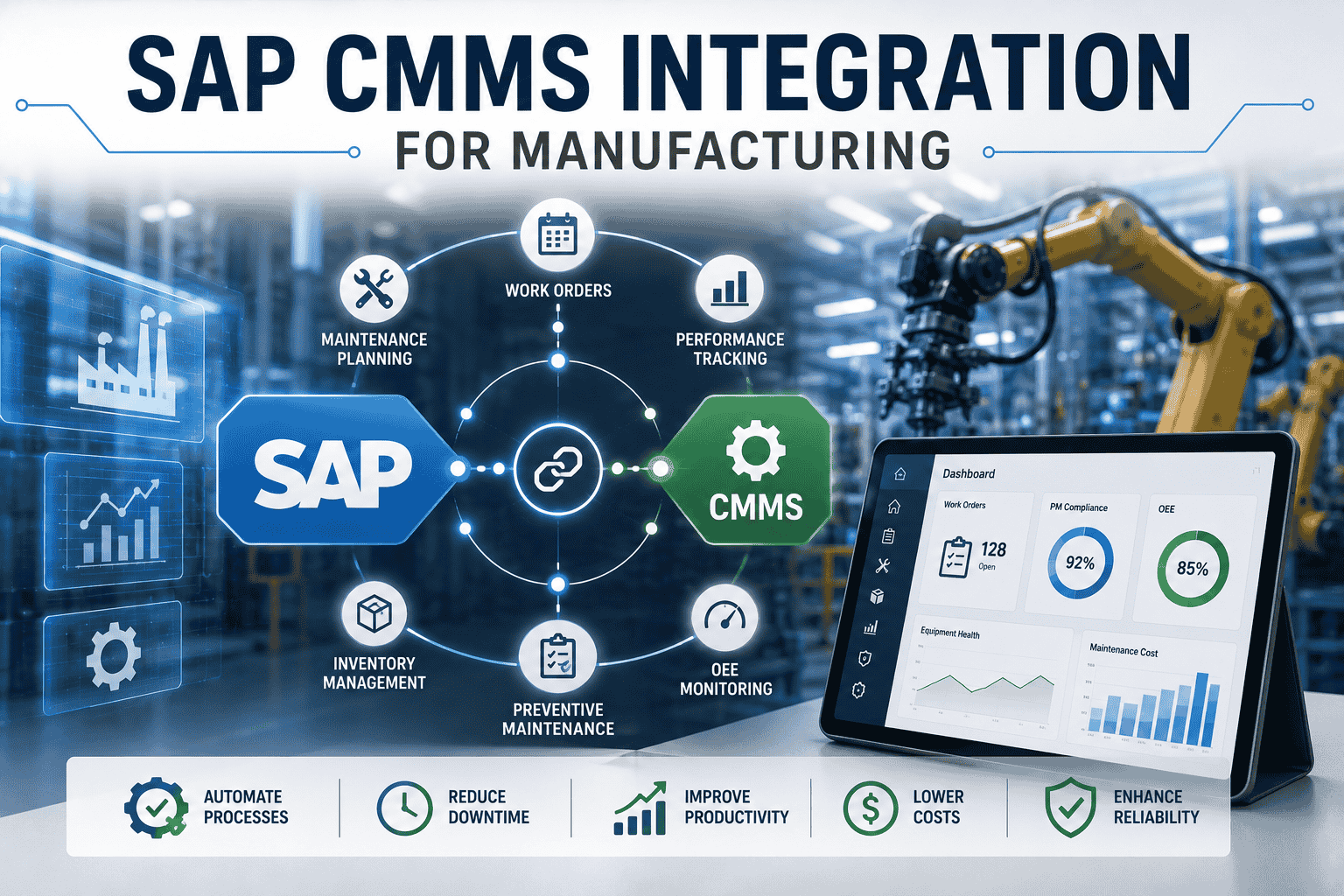
SAP PM provides the equipment master, cost center, and financial governance backbone. The CMMS layer provides mobile work execution, calibration management, and the food-safety-specific workflows (sanitation, allergen change-over, pre-operational inspections) that food manufacturing requires. Together, the integration produces the evidence chains that turn HACCP plans from documents into operational reality—and audit responses from multi-week assembly into same-day query.
The HACCP 7-Principle Maintenance Integration Map
The map below shows each of the seven Codex HACCP principles, the maintenance touchpoint that supports it, and the compliance evidence the integrated SAP-CMMS architecture produces. Each principle has a specific operational anchor in the maintenance program—not maintenance generally, but a specific PM workflow that produces specific evidence that satisfies the principle's requirements.
Maintain documentation accessible to regulators for inspection
Maintenance Does
All maintenance records linked to HACCP plan · 21 CFR Part 11 compliant e-records
Evidence Produced
Audit-ready records produced as byproduct · same-day inspection response
Compliance Frameworks Anchored Through Integration
FDA 21 CFR 117FSMA Preventive ControlsGFSI BenchmarkedISO 22000BRCGS Issue 9
The pivotal principle is Principle 02—Determine CCPs—because every other principle depends on its accuracy. A CCP that wasn't identified during hazard analysis won't have critical limits established, won't be monitored, won't have corrective action workflows, and won't appear in verification reports. The discipline of Principle 02 is what determines whether the rest of the HACCP plan produces meaningful food safety control or just paperwork. Food safety leaders ready to map current CCP coverage can Sign up free to score CCP coverage against the 7-principle map.
From Equipment PM to HACCP Audit Evidence
The single highest-stakes workflow in food manufacturing maintenance is the response to a CCP-related equipment event—a metal detector reject, a thermal processing temperature excursion, a sanitation cycle failure. The pipeline below shows how an integrated SAP-CMMS architecture turns each event into structured evidence.
CCP EVENT → AUDIT-READY EVIDENCE
From Detection to Documented Closure in 24 Hours
T+0Detection
01
CCP Critical Limit Excursion Detected
Sensor reading outside critical limit, metal detector reject, thermal hold-time violation, or sanitation cycle failure. Event auto-logged with timestamp, equipment ID, CCP identifier, and severity.
T+5 minAlert
02
Notification & HACCP Team Alert
Notification auto-created in SAP PM linked to CCP equipment, HACCP plan reference, and product lot in production. PCQI alerted per HACCP escalation matrix.
T+15 minHold
03
Product Hold & Work Order Dispatch
Affected product placed on hold with lot traceability captured. Corrective work order generated. Maintenance crew dispatched with permit-to-work and food-grade parts reservation.
T+HoursRepair
04
Repair, Sanitation & Re-verification
Repair executed by qualified technician. Sanitation cycle completed and verified. CCP re-verified through challenge testing. All steps captured via mobile.
T+24 hrsClosed
05
HACCP Documentation & Verification
Event documented in HACCP plan records with deviation report, corrective action, and verification. Product disposition documented with lot traceability. Available for FDA inspection.
The differentiator from paper-based workflows isn't speed—it's evidence chain integrity. When an FDA inspector asks six months later about a specific event, the integrated record produces the full chain from a single query rather than from multi-day reconciliation across paper logs and disconnected systems.
SEE IT IN ACTION
Walk Through HACCP-Integrated Maintenance on a Live Site
CCP-tagged equipment master, calibration management, deviation workflow, and audit-ready documentation. 30-minute live session.
The financial case for HACCP-integrated maintenance sits on three compounding factors: avoided regulatory enforcement (FDA warning letters and 483 observations carry six-to-seven-figure remediation cost), reduced product hold-and-release exposure, and inspection efficiency.
PAPER-BASED vs INTEGRATED SAP-CMMS
Annual Operating Performance Delta
CCP Equipment PM Compliance
75%
94%
+19 pts
FDA Inspection Prep Time
2-4 wks
1-3 d
−85%
Calibration Overdue Rate
12%
<1%
−90%+
Product Hold Duration
24-72 hrs
4-12 hrs
−70%
Audit Remediation Cost
$100-500K
$10-50K
−80%
Paper-Based Baseline
Integrated SAP-CMMS
6-12 mo
Typical payback period at mid-size food manufacturer
$1-5M / yr
Avoided regulatory & product disposition cost at typical scale
Expert Perspective: What Distinguishes Audit-Ready Food Manufacturers
"
The food manufacturers I've seen pass FDA inspections cleanly share a property that often surprises outside engineers: they treat maintenance documentation as food safety documentation, not as a separate workflow. Every PM completion on a CCP-related asset captures the data the inspector would want to see. Every calibration record is tied directly to the critical limit it supports. When the inspector asks for verification evidence, the answer is a screen share in minutes rather than a multi-week records-assembly project.
01
Maintenance Records Are Food Safety Records
Every PM, every calibration, every work order on a CCP-related asset is HACCP-relevant evidence. Treating it as separate documentation creates the gaps inspectors find.
02
CCP Tagging Is the Foundation
Every CCP-related asset tagged in the equipment master at implementation, not retrofitted later. CCP tagging drives PM elevation and the audit trail FDA expects.
03
Evidence on Demand
When the inspector asks, the answer comes from integrated data in minutes. Multi-week evidence assembly indicates the architecture isn't operational—it's nominal.
90-Day Path to Integrated Food Safety Maintenance
Food manufacturers that successfully deploy HACCP-integrated maintenance follow a consistent cadence. The roadmap below is what disciplined teams execute.
90-DAY DEPLOYMENT ROADMAP
From Equipment Master to FDA-Inspection-Ready Operations
DAYS 1–20
01
CCP-Tagged Equipment Master
Inventory CCP-related equipment across operation. Tag each asset with HACCP plan linkage. Establish criticality ranking aligned with hazard analysis.
DAYS 21–45
02
Calibration & PM Plan Activation
Integrate calibration management with NIST traceability. Build CCP-elevated PM plans. Validate measurement device tolerance against critical limits.
DAYS 46–70
03
Mobile Crews & Deviation Workflow
Deploy mobile work orders. Activate CCP excursion workflow with auto-notification and hold integration. Test deviation response.
DAYS 71–90
04
Audit Reporting & FDA Readiness
Activate automated HACCP verification reporting. Run mock inspection drills. Establish KPI dashboard for food safety leadership.
By day 90, the integration is operational across CCP-related equipment, HACCP documentation flows as a byproduct of daily operations, and food safety leadership has dashboard visibility. Operations and quality leaders ready to start can Sign up free to begin the CCP equipment master baseline this week.
START THE TRANSFORMATION
Turn HACCP Documentation From Burden Into Operational Output
How does SAP PM handle CCP tagging in the equipment master?
CCP tagging happens through SAP PM's equipment classification system, with custom characteristics added to indicate HACCP plan linkage, hazard category, critical limit reference, and verification cadence. The classification is queryable across the equipment population, so reports filter to all CCP equipment overdue on calibration in seconds. Integration with the CMMS layer extends the classification to mobile work order workflows, ensuring field technicians see the CCP designation before they begin work.
What's the difference between HACCP and FSMA Preventive Controls?
HACCP is a food safety management framework codified by Codex Alimentarius and adopted globally. FSMA Preventive Controls is the U.S. regulatory implementation under 21 CFR 117, requiring registered food facilities to implement preventive controls based on hazard analysis. FSMA Preventive Controls is HACCP-compatible but broader—covering allergen controls, sanitation controls, and supply chain controls. A HACCP plan is a strong foundation for FSMA compliance; FSMA requires additional documentation around PCQI training and supply chain verification.
How does calibration management integrate with CCP critical limits?
The calibration discipline for CCP-related measurement devices is tighter than general practice. Each device's accuracy specification must support the critical limit it measures. Calibration intervals are set against measurement criticality rather than vendor defaults. Each calibration record is linked to the critical limit it supports, with NIST-traceable standards documented. When calibration drift exceeds tolerance, the system triggers automatic re-verification of all product produced since the last successful calibration.
How does the system handle allergen change-over between products?
Allergen change-over is a specialized maintenance workflow where the equipment is treated as a hazard source between production runs. The CMMS layer handles this through scheduled change-over work orders with specific sanitation procedures, validation testing requirements, and documented sign-off. Validation testing (ATP testing, allergen-specific swabs, visual inspection) is captured with photos and lab results. Records become HACCP documentation supporting FSMA allergen control and BRCGS Issue 9 audit expectations.
What's the relationship between this system and GFSI-benchmarked standards?
GFSI benchmarks food safety management standards—including BRCGS, SQF, FSSC 22000—against a common baseline. Integrated CMMS supports these standards through the same evidence-chain discipline regardless of which specific GFSI standard the facility certifies against. BRCGS Issue 9 emphasizes engineering maintenance and facility infrastructure with documentation requirements that align directly with integrated CMMS capabilities. The CMMS integration produces evidence supporting any GFSI-benchmarked certification audit.