A technician gets a work order, walks to the storeroom, and the bin is empty. The part that was "in stock" on a three-week-old spreadsheet is gone—and a scheduled repair becomes an emergency airfreight order at ten to twenty times the cost. This is the quiet failure of disconnected parts management: SAP MM knows what you bought, the storeroom knows what's there, the work order knows what's needed, and none of them talk. Connecting SAP MM to your CMMS makes availability part of the workflow. Book a free demo to see connected inventory.
What Disconnected Parts Management Costs
The price of a storeroom that doesn't talk to maintenance
10–20x
Emergency airfreight cost vs normal planned procurement
6–20 wks
Lead time on critical single-source spares—a stockout means weeks of outage
98%
Inventory accuracy with CMMS integration vs 74% for manual counts
15–25%
Lower inventory carrying cost with demand-driven replenishment
Sources: MRO inventory optimization benchmarks (2026), industry stockout studies
Why SAP MM Alone Leaves a Gap on the Floor
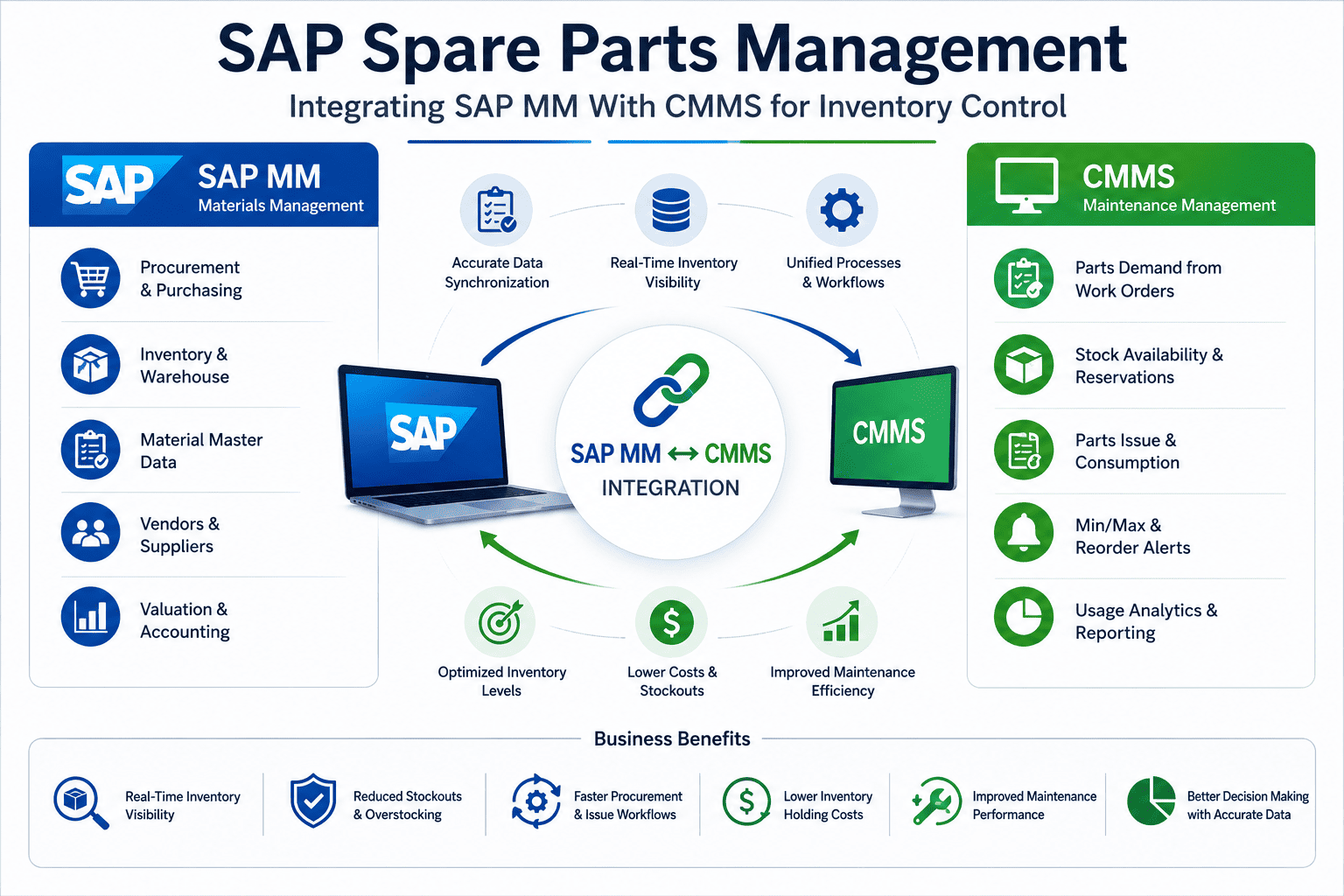
SAP Materials Management is a powerhouse—it connects procurement, inventory control, warehouse management, and financial accounting into one framework, and it excels at purchasing workflows, vendor management, and inventory valuation. But it was never designed to sit on a maintenance technician's hip. The gap isn't in SAP's capability; it's in the last mile. When the storeroom catalog lives separately from the work order system, a technician can't see from their job which parts are compatible, available, and in stock for that specific asset—so they make a manual storeroom trip before any wrench turns, and SAP's inventory balance drifts from physical reality between counts.
The Four Things SAP MM Already Does Well
Procurement
Purchase requisitions, orders, and approval workflows from request to fulfillment.
Inventory Control
Stock quantities, valuation, and movement documents with full financial linkage.
Warehouse Mgmt
Storage locations, bins, and goods movements across one or many sites.
Financial Accounting
Inventory valuation and consumption posting tied straight to the ledger.
Not All Spares Are Equal: Segment Before You Stock
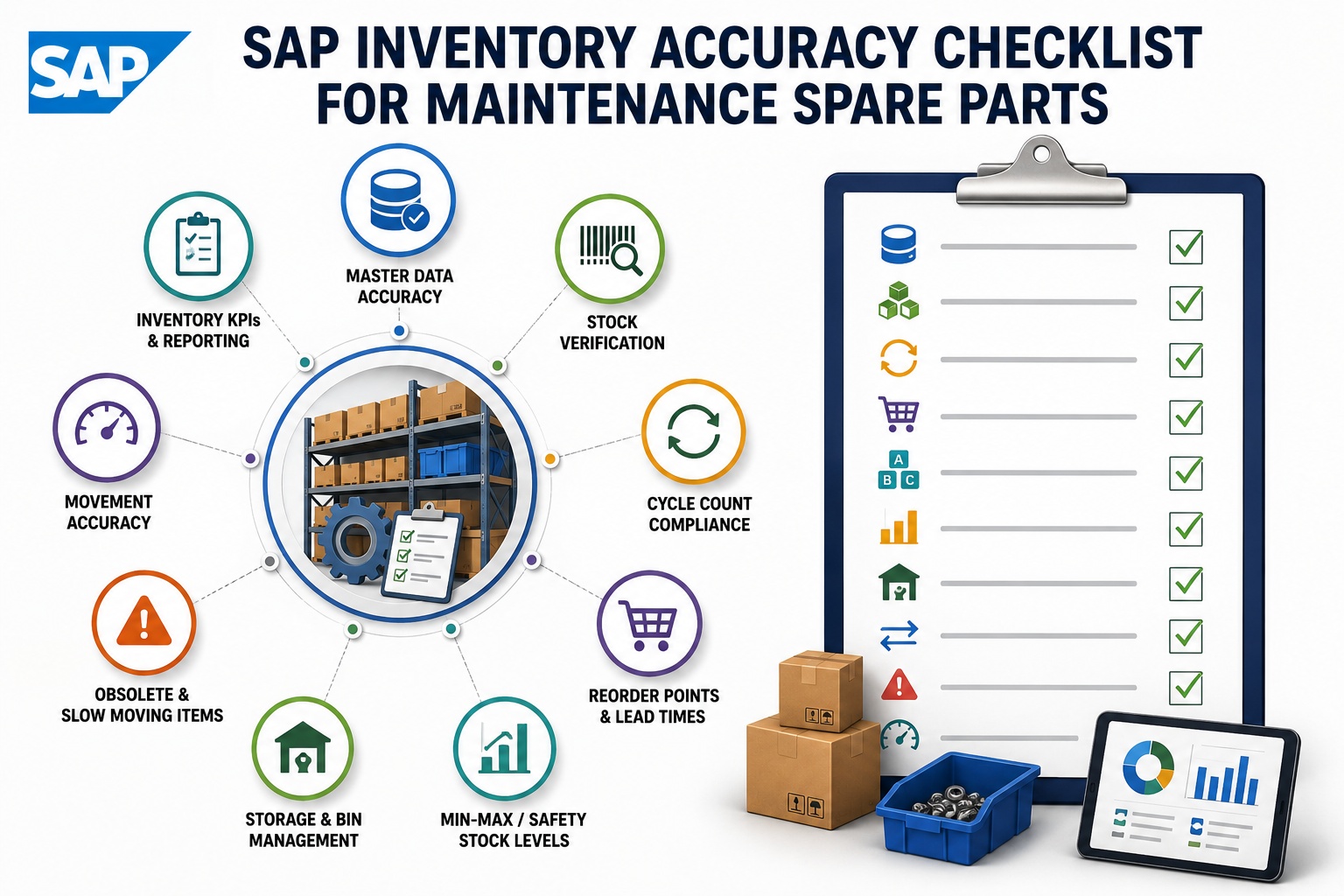
The traditional "just in case" approach—large safety stocks on everything—ties up capital in slow-moving parts while critical spares still stock out during turnarounds. The fix starts with segmentation. ABC analysis ranks parts by value and consumption so your stocking budget goes where it matters, and criticality classification flags the single-source, long-lead-time parts whose absence converts a scheduled job into a multi-week outage. Get this right and you carry less while protecting more.
Segmenting the Parts Catalog
Where stocking budget and safety stock should concentrate
Class A
High value, high turnover
Target 6–15 turns/year · tight reorder control · turnover above 15 signals stockout risk
Class B
Moderate value and movement
Around 3–6 turns/year · periodic review · balanced safety stock policy
Class C
Low value, slow movement
1–3 turns/year · lean stocking · bulk-order to minimize handling
Critical
Single-source, long lead time
6–20 wk lead · minimum one unit always · linked to the asset it protects
That criticality link is the difference between a part you can replace in a day and one that idles a line for a month. Teams ready to classify their own catalog can sign up free to run ABC analysis on their consumption history.
The Reserve-to-Reorder Workflow That Prevents Stockouts
A work order that lists required parts but doesn't reserve them from stock doesn't solve the availability problem—it only documents it. Integration changes that. When SAP MM and the CMMS are connected, parts get reserved before the technician is dispatched, consumption posts to SAP within seconds, and when stock crosses a reorder point, a purchase requisition fires automatically—routed to the approved supplier with the right quantity and price. Here's the full loop.
From Work Order to Replenished Shelf
1
Reserve
Work order links required parts and reduces available stock before dispatch—no surprise empty bin.
2
Consume
Technician issues the part; consumption posts to SAP MM within seconds, keeping balances accurate.
3
Trigger
Stock crossing the reorder point auto-generates a purchase requisition—before zero, not at repair time.
4
Replenish
Goods receipt updates planners in real time and restocks the shelf ahead of the next need.
See Automated Reorder on Live Inventory
Watch parts reserve against work orders, consumption post to SAP MM in seconds, and reorder points fire purchase requisitions automatically—configured for your parts room in a 30-minute walkthrough.
Manual Tracking vs Integrated Inventory
The gap between a spreadsheet storeroom and CMMS-integrated inventory isn't about having better tools—it's about whether parts data connects to maintenance execution at all. When it does, the difference shows up in wrench time, first-time fix rates, and working capital. When it doesn't, technicians hunt for parts, planners reconcile counts by hand, and capital sits idle in obsolete stock nobody flagged.
Spreadsheet Storeroom vs SAP MM + CMMS
Swipe to compare →
Those gains compound—less emergency spend, more wrench time, and reclaimed capital from stock you no longer need to hoard. Teams ready to quantify it for their own storeroom can sign up free to assess their inventory against these benchmarks.
Expert Perspective: Connect Parts to Assets, Not Just Shelves
For years we treated SAP MM and our maintenance system as two separate worlds, and we paid for it in stockouts and emergency freight. The breakthrough wasn't a better inventory tool—it was connecting parts to the assets they serve and to the work orders that consume them. The moment a depleted critical spare triggered procurement automatically, before the failure that needed it, everything changed. Stockout rate dropped, the procurement cycle shortened, and finance stopped calling about misposted cost centers. It was the highest-impact technology decision our group made.
Parts Linked to Assets
When each spare ties to the equipment it serves, depletion triggers action before the failure event.
Reserve, Don't Just List
A work order must reduce available stock before dispatch—listing parts only documents the problem.
Kill the Squirrel Stash
Visibility surfaces hidden, obsolete stock—reclaiming capital tied up "just in case."
Getting Started Without a Full Reimplementation
You don't need to rebuild SAP to close the gap. Connect the CMMS to SAP MM so every consumption posts in real time and every reorder point fires a requisition automatically—no re-keying between systems. Start by registering your critical spares with minimum stock and asset links, since those carry the highest stockout cost, then bring in Class A parts and expand outward. Teams can sign up free to load their critical spares first and widen coverage from there. Each part you connect tightens inventory accuracy and removes another manual reconciliation from your planners' week.
Spare parts management fails not because SAP MM is weak, but because its procurement engine and the maintenance floor live in separate worlds. Bridge them and parts availability becomes part of the workflow: reserved before dispatch, consumed accurately, reordered before zero, and replenished ahead of need. That's how you stop losing repair time to empty bins and idle capital to overstocking at the same time. Teams ready to see it on their own SAP MM data can book a free demo to review their integration strategy.
Stop Losing Repair Time to Empty Bins
Connect SAP MM's procurement engine to the maintenance floor. Parts reserved before dispatch, consumption posted in seconds, reorder fired before zero—higher accuracy, fewer stockouts, less idle capital. See it on your setup.
Frequently Asked Questions
How does SAP MM integrate with a CMMS for spare parts?
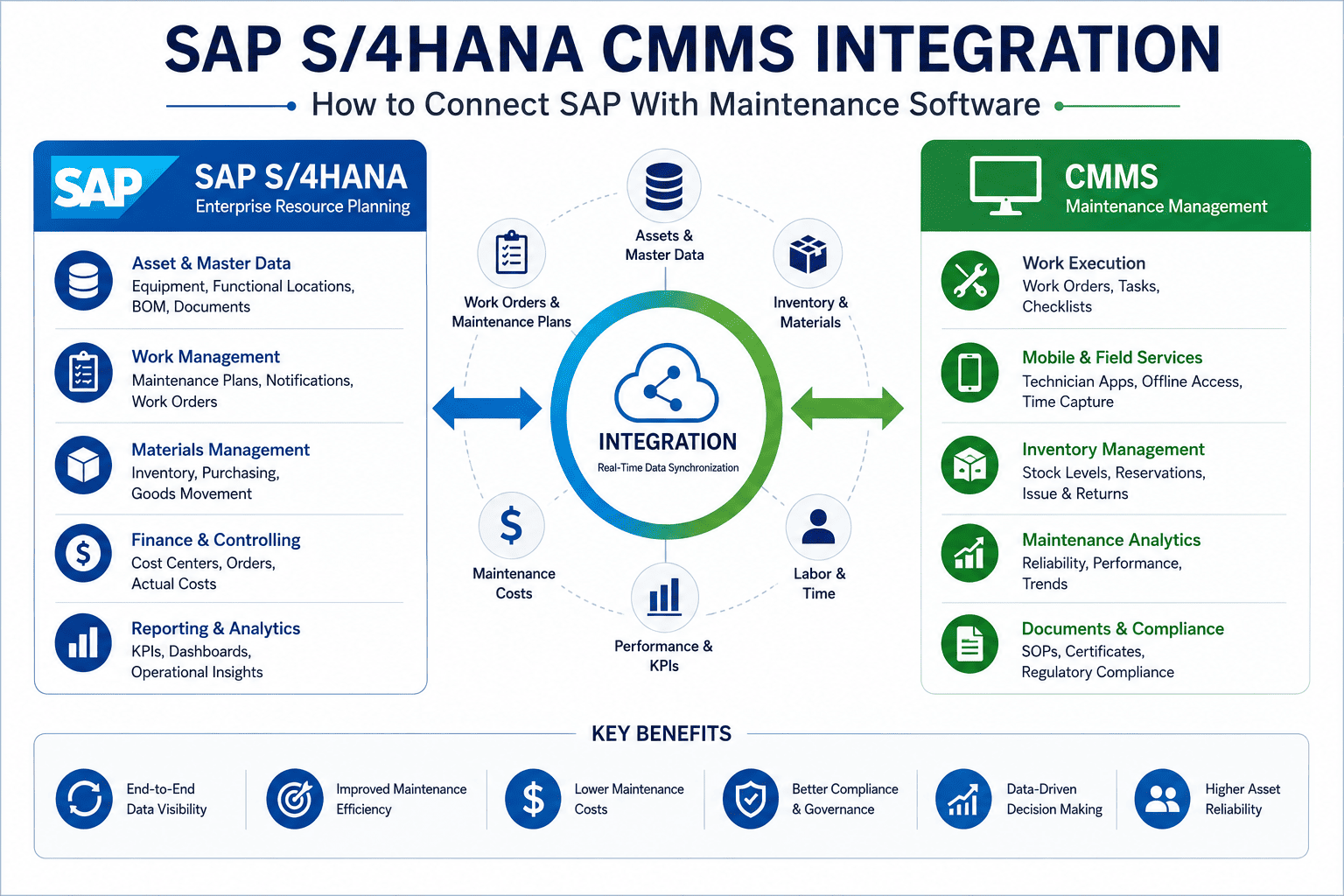
SAP MM and the CMMS connect through shared master data and real-time synchronization. Material masters and stock levels flow so technicians see accurate availability, while parts consumption, reservations, and goods receipts flow back to keep SAP balances current. When a planner schedules work, the CMMS reserves the required parts in SAP, reducing available stock before the technician is dispatched. When stock crosses a reorder point, SAP MM generates a purchase requisition automatically. The result is one connected loop from work order to replenished shelf, with no manual re-keying between systems.
What is the difference between reserving and just listing parts on a work order?
Listing parts on a work order documents what's needed but does nothing to guarantee availability—the technician can still arrive at an empty bin. Reserving links the required parts to the work order and actually reduces the available stock count before dispatch, and flags any shortfall in advance so it can be procured before the job. This single distinction is what turns reactive parts hunting into proactive availability. A system that only lists parts records the stockout problem; a system that reserves them prevents it.
How do reorder points and automatic procurement work?
A reorder point is a minimum stock threshold configured per part, ideally calculated from actual work-order consumption history and vendor lead times rather than the calendar. When inventory for that part drops below the threshold, the integrated system automatically generates a purchase requisition or alert—routed to the approved supplier with the correct quantity and pricing—so replenishment begins before a stockout can disrupt scheduled maintenance. You set the safety stock policy per part class and the system handles the math and the trigger, eliminating manual monitoring and spreadsheets.
What are critical spares and how should they be managed?
Critical spares are parts for single-source assets with long lead times—often 6 to 20 weeks—whose failure stops production or violates compliance, such as a main gearbox seal, a compressor shaft seal, or a switchgear breaker. A stockout on a critical spare converts a scheduled maintenance event into a multi-week unplanned outage. They should be identified explicitly, held at a minimum stock of at least one unit, and linked to the specific asset record they protect, so that depletion triggers immediate procurement well before the failure event that will require the part.
How much can integration actually reduce inventory cost and stockouts?
The gains are well documented. CMMS-integrated tracking achieves roughly 98% inventory count accuracy versus about 74% for manual quarterly counts, and demand-driven replenishment commonly lowers inventory carrying costs by 15 to 25% by eliminating the obsolete and overstocked "squirrel stash." Plants using real-time, condition-directed replenishment report 20 to 40% fewer parts emergencies. The savings compound: fewer 10-to-20x emergency airfreight orders, more wrench time instead of parts hunting, and reclaimed capital that can be reinvested in higher-impact reliability work.