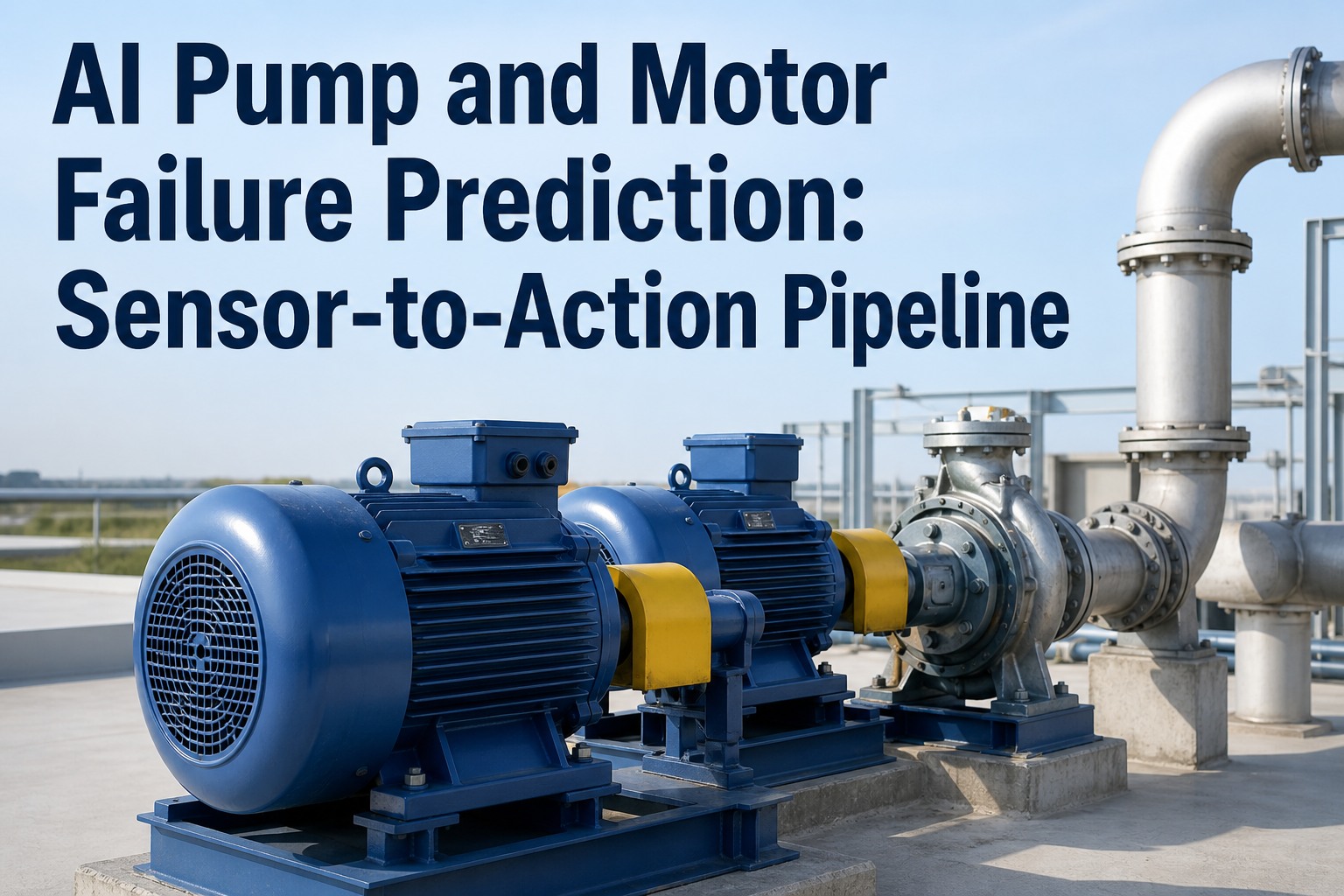
AI Pump and Motor Failure Prediction: Sensor-to-Action Pipeline
By Riley Quinn on May 1, 2026
Every pump failure costs an average $260,000 in unplanned downtime. Every motor that trips unexpectedly takes a production line with it. In 2026, neither scenario is inevitable — because the sensor data that predicts both failures is already streaming off your equipment, right now. The question is not whether AI can predict pump and motor failures. It can, with 80–96% accuracy, 2–6 weeks ahead of physical breakdown. The question is whether your plant has built the sensor-to-action pipeline that turns that prediction into a closed work order before the failure happens. Start monitoring your pumps and motors free on OxMaint — no hardware required to begin. This guide maps the full technical stack: sensor selection, AI model types, deployment architecture and the CMMS loop that makes predictions actionable.
MAY 12, 2026 5:30pm est , orlando
See OxMaint's AI Pump & Motor Pipeline Live at Oxmaint AI Live Webinar
Join us in Orlando for a live walkthrough of the full sensor-to-action pipeline — from vibration spectrum analysis to auto-generated work orders. Bring your asset list and walk out with a deployment plan.
Live demo: current signature analysis detecting motor faults
Vibration spectrum to RUL prediction walkthrough
Edge vs. cloud AI deployment architecture for rotating equipment
Sensor-to-CMMS integration: zero manual work orders
The 2026 Reality Check: Pumps and motors account for 60–70% of all industrial electrical energy consumption — and an estimated 45% of all unplanned plant downtime. AI-driven predictive models now predict bearing failure 10–30 days out with 80–96% accuracy. The cost of not deploying: $260,000 per major pump failure event on average.
The 6 Failure Modes AI Actually Detects — and How Early
Efficiency curve drift vs. baseline pump performance map
Impeller Wear
3–7
weeks lead time
Detection Accuracy
83%
Sensor: Flow rate + power consumption + vibration
Rising power-to-flow ratio + vane pass frequency deviation
The Sensor-to-Action Pipeline: Every Step Mapped
Prediction without action is just an expensive alert. The plants that generate real ROI from AI are those that have closed the full loop — from sensor data acquisition through work order completion. See OxMaint's full sensor-to-work-order pipeline in a live 30-minute demo. Here is each stage of the pipeline and where most deployments break down.
01
Sensor Data Acquisition
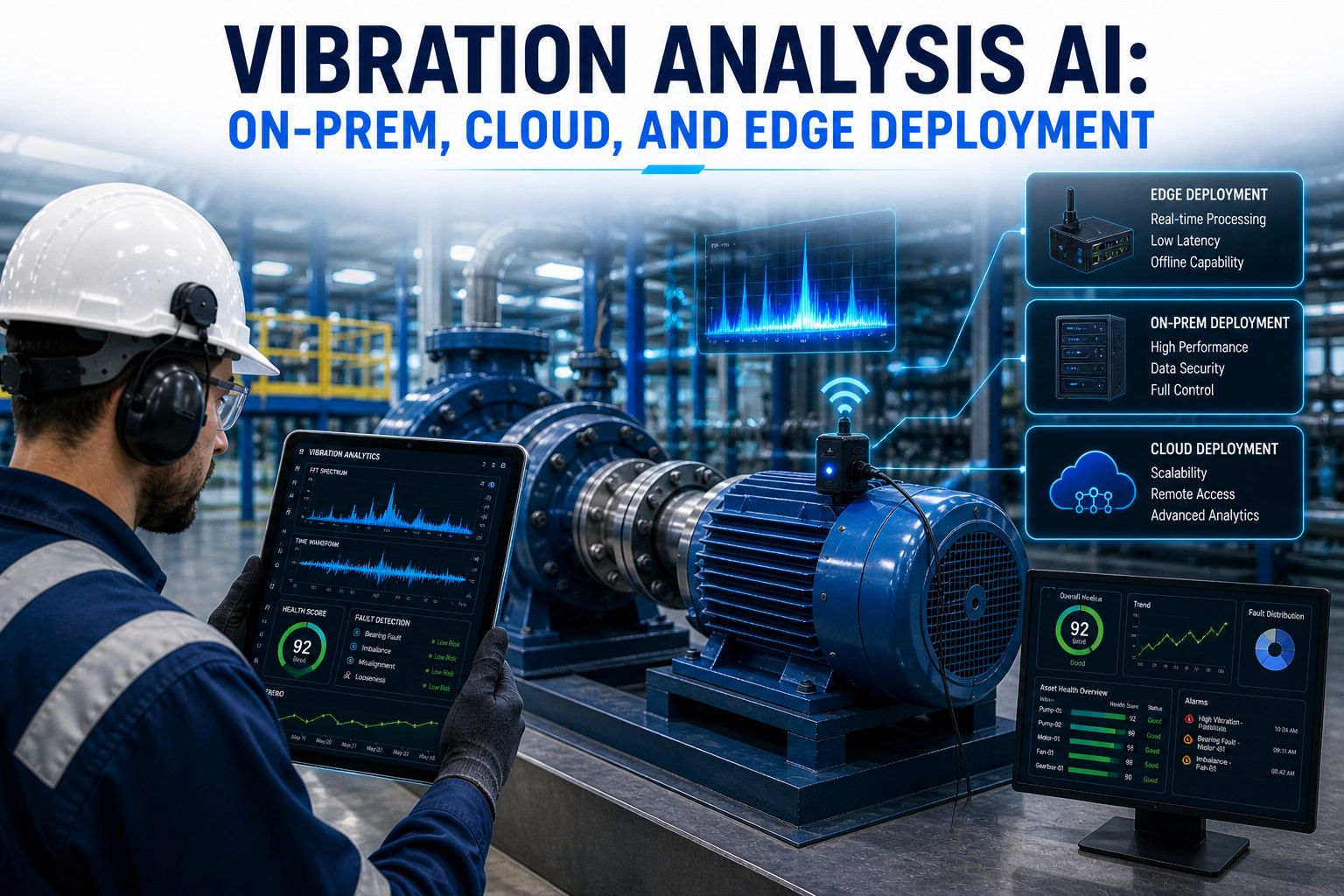
Vibration, current, temperature, pressure, and acoustic sensors stream data at 10kHz–40kHz sampling rates. Wireless IoT sensors retrofit to existing pumps and motors in minutes — no rewiring, no production stop.
Raw sensor streams hit an edge gateway for first-pass FFT and feature extraction — converting raw waveforms into frequency-domain signatures. Edge processing keeps latency under 50ms and reduces data volume by 90% before cloud transmission.
ML models compare live frequency signatures against known failure progression curves. Remaining Useful Life (RUL) is calculated as a time-to-threshold prediction with confidence intervals, not just a binary alert.
AI classifies detected signals by failure mode, severity level, and asset criticality. A bearing fault on a redundant pump gets a different priority than insulation breakdown on a single-string motor driving a continuous process.
This is where 60% of deployments fail. An alert that requires manual work order creation loses most of its value to shift-change gaps and human delay. When AI connects directly to your CMMS, it auto-generates the work order with failure mode, RUL, recommended parts, and due date — before the predicted failure window.
Native CMMS integrationParts pre-ordering triggerTechnician assignmentClosure & asset record update
Your Pumps and Motors Are Already Sending Failure Signals
OxMaint connects your existing sensors to AI-driven failure prediction — bearing faults, cavitation, current anomalies — and closes the loop automatically with CMMS work orders. Deployment in days, not quarters.
Motor Current Signature Analysis vs. Vibration Analysis: Which to Deploy First
The two dominant AI techniques for rotating equipment monitoring are Motor Current Signature Analysis (MCSA) and vibration spectrum analysis. They are complementary — but most plants start with only budget and sensor access for one. Here is the honest comparison.
MCSA vs. Vibration Analysis — Deployment Decision Guide
For pump and motor predictive maintenance in manufacturing environments
Drag the scrollbar below to explore the full comparison
Criteria
Motor Current Signature Analysis (MCSA)
Vibration Spectrum Analysis
Installation
Current clamp on MCC — non-invasive, no machine access needed
Accelerometer bonded or bolted to bearing housing
Cost per Asset
$100–$300
$300–$800
Best For
Motors in hazardous, enclosed, or hard-to-reach locations
Any rotating equipment with accessible bearing housings
Failure Modes Detected
Rotor bar faults, insulation breakdown, stator winding issues, imbalance
Deployment recommendation: Start with vibration on your 10 most critical pumps (highest consequence of failure). Add MCSA for motors in enclosed panels or hazardous areas. By Year 2, most plants run both in parallel — the combination detects failure modes that neither catches alone.
2026 Market Reality: What the Numbers Say
96%
Detection accuracy for bearing failures using AI vibration spectrum analysis — the most reliably solved problem in rotating equipment AI
TeepTrak / Industry Data 2026
30 days
Average lead time AI provides before bearing failure — vs. 0 days for reactive maintenance and wasted PM from fixed schedules
OxMaint Field Data 2026
85%
Reduction in unplanned pump failures reported by plants running continuous AI vibration + MCSA monitoring with CMMS integration
OxMaint Customer Outcomes
$91B
AI predictive maintenance software market size projected by 2033, growing at 24%+ annually as rotating equipment monitoring becomes standard
Industry Analysts 2026
Expert Perspective: Where Pump and Motor AI Programs Actually Fail
The most common failure mode I see in pump and motor AI programs has nothing to do with the AI model. It's this: the plant installs vibration sensors on 50 assets, gets alerts, and has no defined workflow for what happens next. Alert goes to an email inbox. Reliability engineer reviews it on Monday. By Tuesday someone notices the pump is running rough. By Thursday there's an emergency repair at overtime rates. The AI predicted it. Nobody acted on it in time. The second failure mode is going straight to build — buying a GPU cluster and training custom models before the plant has even 6 months of labeled failure data. You cannot train a motor rotor bar fault model on data from motors that haven't failed yet.
Alert-to-Action Is the Real Metric
Detection accuracy matters — but Mean Time to Act (MTTA) determines actual downtime reduction. An AI that detects correctly but alerts without workflow integration saves nothing.
6 Months of Data Before Custom Models
Pre-trained managed models outperform custom-built models until you have 6–12 months of actual failure events from your own assets. Start managed, collect data, then evaluate custom training at Year 2.
CMMS Integration Is Not Optional
Plants that auto-generate work orders from AI alerts see payback within 12 months. Plants requiring manual work order creation report 24–36 month ROI timelines — if they confirm it at all.
Deployment Readiness: Is Your Plant Ready for Pump and Motor AI?
Run through each dimension. Plants that score green across 3 or more are ready to pilot now. Plants scoring mostly amber should address data and workflow gaps before sensor investment.
Sensor Infrastructure
Ready
Any vibration or temperature sensors already mounted on critical pumps/motors. Wireless retrofit takes hours per asset if none exist.
Failure History Data
Assess First
6+ months of maintenance logs with failure descriptions. Without labeled failure history, pre-trained managed models are your only viable starting point.
Network Connectivity
Ready
OT network with at least one edge gateway path to cloud or on-prem AI processing. Air-gapped plants need edge-only AI stack — feasible but adds complexity.
CMMS Integration Path
Critical Gap
Without a defined path from AI alert to CMMS work order, the entire ROI case collapses. Resolve this before deploying any AI monitoring — it must be in scope for Phase 1.
Alert Response Workflow
Define Before Go-Live
Who receives a severity-3 bearing fault alert at 2am? What is the decision tree? Map the workflow before sensor installation, not after.
Close the Loop: From Pump Anomaly to Fixed Asset — Automatically
OxMaint connects vibration sensors, MCSA data, and your CMMS into a single automated pipeline. AI detects the failure signature, generates the work order, assigns the technician, and closes the loop — before the breakdown. Start free or see it live in 30 minutes.
Conclusion: The Signal Is Already There — You Just Need the Pipeline
Pumps and motors have been telling you they're about to fail for years. The vibration frequency shifts, the current sideband anomalies, the acoustic bursts of early cavitation — all of it was in the sensor data, unread. AI doesn't create new information. It reads what your equipment is already broadcasting and converts it into a work order before the failure date. The sensor-to-action pipeline has five stages, and most manufacturing plants stall at stage four — the alert arrives but no defined workflow converts it into a closed maintenance event. That's the gap that separates plants seeing 3–6x ROI from those that spent budget on sensors and saw no downtime reduction. Start your OxMaint free account and connect your first pump to AI monitoring today. Start with your 10 most critical rotating assets. Prove the alert-to-work-order loop on those assets. Then scale. The math is consistent: every dollar invested in condition monitoring for pumps and motors returns between $3 and $10 in prevented failure costs — but only if the pipeline closes. Book your 30-minute session with an OxMaint rotating equipment specialist to map your deployment plan.
Frequently Asked Questions
How accurate is AI at predicting pump and motor failures in 2026?
Accuracy depends on failure mode and sensor configuration. Bearing failure prediction using AI-trained vibration spectrum analysis currently achieves 90–96% accuracy with 10–30 days of lead time — the most reliably solved problem in rotating equipment AI. Motor current signature analysis for rotor bar faults and insulation degradation achieves 70–85% accuracy. Pump cavitation detection using acoustic and vibration combined reaches 85–90%. Overall system accuracy improves over 2–4 weeks as AI models adapt to your specific equipment's baseline signatures.
What sensors are needed for AI pump failure prediction?
A minimum viable sensor set for a centrifugal pump includes a triaxial accelerometer on the drive-end bearing housing and a temperature sensor on the motor winding. Adding a pressure differential sensor and flow rate measurement enables cavitation detection and impeller wear prediction. For the motor, a current clamp on the motor power feed (non-invasive MCSA) adds electrical fault detection without any machine access. Modern wireless IoT sensors in the $300–$800 range install in minutes without wiring or production interruption. OxMaint integrates with over 200 sensor types and all major protocols including OPC-UA, Modbus, and MQTT.
What is Motor Current Signature Analysis (MCSA) and when should I use it?
Motor Current Signature Analysis is a non-invasive AI technique that monitors electrical current drawn by a motor to detect developing faults. Current clamps install on the motor control center panel without any machine access, making MCSA ideal for motors in hazardous locations, enclosed environments, or any situation where mounting vibration sensors is impractical. MCSA excels at detecting electrical faults with 82–90% accuracy but has lower accuracy than vibration analysis for purely mechanical bearing faults. The two techniques are complementary — the combination covers failure modes that neither addresses alone.
How long does it take to deploy AI pump and motor monitoring on a plant floor?
With a managed AI platform like OxMaint, wireless sensor installation on 10–20 critical pumps and motors takes 1–3 days. Initial AI predictions from pre-trained models begin within 24 hours. The models adapt specifically to your equipment's baseline signatures over 2–4 weeks, improving accuracy progressively. Full plant-wide deployment covering 50–150 assets typically takes 4–12 weeks depending on sensor infrastructure complexity. CMMS integration with native connectors is a configuration task of days. Building a custom AI stack from scratch takes 6–18 months and requires in-house ML engineering capacity.
What ROI should a manufacturer expect from AI pump and motor failure prediction?
Plants with full CMMS integration typically confirm payback within 8–18 months. Documented outcomes include 30–50% reduction in unplanned downtime on monitored assets, 18–25% lower maintenance costs, and 20–40% extension in equipment lifespan. The primary value driver is avoiding emergency repair events: the average unplanned pump failure costs approximately $260,000 when downtime, emergency labor, expedited parts, and production loss are combined. A single prevented failure on a critical pump typically covers the annual cost of an AI monitoring subscription for that asset class. Plants without CMMS integration report significantly longer ROI timelines of 24–36 months.