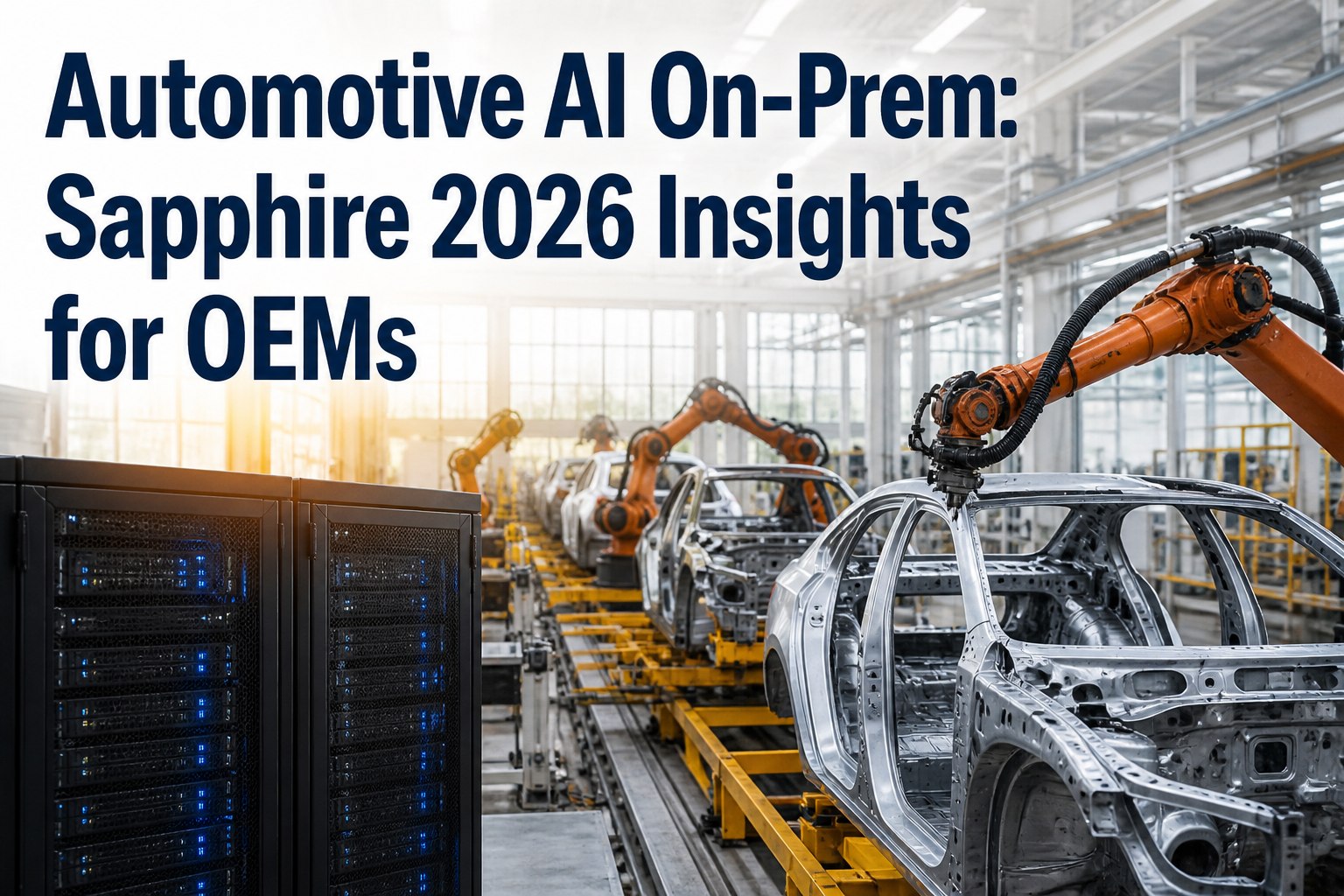
Automotive AI On-Prem: Sapphire 2026 Insights for OEMs
By Riley Quinn on May 4, 2026
The OEM playbook in 2026 has flipped. For five years, every automotive AI deck assumed cloud-first — train ADAS perception on hyperscaler GPUs, run plant analytics in a managed AI platform, push everything through someone else's data center. Then the bills arrived. Healthcare analytics workloads have run 62% over cloud budget in 18 months. Per-token API costs add up faster than capital BOM forecasting can absorb. And the data — ADAS scenarios, plant yield curves, supplier exception patterns — is the IP that makes the OEM competitive against the next OEM. The math now lands at 35% lower TCO and 70% lower OpEx on-prem at scale, with 2-5× better latency for real-time inference. That's the conversation happening on the Sapphire show floor in Orlando this May. Sign up free to see the on-prem automotive AI reference architecture.
MAY 12, 2026 5:30 PM EST , Orlando
Upcoming OxMaint AI Live Webinar — Automotive On-Prem Reference Architecture for OEMs
Live session for automotive CIOs, plant CTOs, ADAS engineering leads, and AI infrastructure architects. We'll walk through the on-prem reference architecture for OEM workloads — ADAS perception data pipelines, plant predictive maintenance + defect inspection, supply chain scenario AI, and the SAP S/4HANA + Datasphere integration patterns that turn enterprise data into AI training fuel without leaving the firewall.
The Three Automotive AI Data Domains — And Where Each Belongs
"Automotive AI" isn't one workload — it's three distinct domains with different data shapes, latency requirements, and cloud-vs-on-prem economics. The OEMs winning at AI deployment in 2026 don't ask "cloud or on-prem"; they ask "which domain, and where does the data live." Here's the map that decides it.
Why hybridBursty workloads, external partner data — cloud for scale, on-prem for sensitive views
StandardsSAP Datasphere, Joule integration, supplier API gateways
The TCO Math — Why On-Prem at OEM Scale Now Wins
The 2026 cost picture is the strongest argument for on-prem AI at OEM scale. Cloud API pricing has dropped 20-30% annually under competitive pressure, but on-prem hardware costs have dropped faster — H100 GPUs settling at $25,000-30,000 (down from $35,000-40,000), A100s at $8,000-12,000. Combined with persistent OEM workload volume, the break-even has crossed. Deloitte research identifies the threshold: on-prem AI is economically viable when total costs reach 60-70% of equivalent cloud. For sustained automotive workloads, the math is now well past that crossover. Book a demo to see the TCO model run on your specific workload mix.
The Reference Architecture — Sensor Data to SAP Work Order
The OEMs landing on-prem AI at scale aren't building one big model — they're connecting four layers that move data from physical sensors through training and inference into ERP-driven action. The OxMaint reference architecture for automotive plants follows the same four-layer pattern that's working at GM, Hyundai, and Stellantis: edge ingestion → on-prem training cluster → inference layer → SAP S/4HANA work-order generation. Sign up free to see the four-layer reference architecture mapped to your plant footprint.
L1
Edge Ingestion
Plant floor sensors, vision cameras at line speed, robot telemetry, weld monitors. NVIDIA Jetson edge nodes pre-process and forward via OPC-UA, MQTT, BACnet to the on-prem cluster.
NVIDIA Jetson AGXOPC-UAKafkaModbus
L2
On-Prem Training Cluster
GPU cluster (H100/H200/L40S) running perception model training, vision defect classifiers, anomaly autoencoders, predictive maintenance LSTM. ADAS scenario data and plant data both train here — never leaves the firewall.
NVIDIA H100PyTorchTritonMLflow
L3
Real-Time Inference Layer
Line-speed scoring at <100 ms total latency. Vision defect detection per part, anomaly scoring per asset, energy optimization per AHU. Multivariate fusion across plant signals. The hot loop where on-prem matters most.
Triton InferenceTensorRTONNX<100 ms latency
L4
SAP S/4HANA + CMMS Action
Inference outputs flow into SAP Plant Maintenance work orders, Datasphere analytics, and OxMaint CMMS dispatch. The "what now?" layer — proposed interventions, tasks, supplier escalations, line-slowdown decisions.
SAP S/4HANADatasphereJouleOxMaint CMMS
The OEM Partnership Map — Where the Industry Is Already Going
The automotive AI landscape in 2026 isn't speculative — every major OEM has now publicly committed to a multi-vendor on-prem + cloud + edge stack. Looking at the announced partnerships clarifies where the convergence is happening: GM and Hyundai with NVIDIA on Omniverse + Cosmos, Mercedes with Google Gemini for cockpit, Stellantis with STLA Brain as the digital foundation, BMW with Alibaba's Yan AI for Neue Klasse. The pattern: OEMs are mixing platforms by workload, with on-prem owning the operations and IP-sensitive layers. Book a demo to see how OxMaint integrates with the NVIDIA, SAP, and Microsoft platforms your OEM is already running.
GM
NVIDIA partnership — manufacturing, vehicle technology, robotics. Omniverse for digital twin simulation, Cosmos for synthetic data generation.
Hyundai
NVIDIA across SDV, ADAS, manufacturing. Boston Dynamics Atlas humanoid in plant strategy. Robotics-driven manufacturing ecosystem.
Mercedes
MB.OS with Google Gemini + Microsoft Bing for cockpit conversational AI. Multiple agents with contextual memory and personality traits.
Stellantis
STLA Brain digital foundation — separates software from hardware, enables continuous OTA innovation. SmartCockpit on top.
BMW
Neue Klasse + Alibaba Yan AI for cockpit (China market). 2026 production debut. Multi-agent coordination, digital ecosystem integration.
Visteon
NVIDIA-powered AI-ADAS Compute Module (Jan 2026) — single scalable platform spanning intelligent cockpit and ADAS for Tier-1 OEM customers.
The Numbers Driving 2026 Automotive AI Decisions
Industry benchmarks from CES 2026, SAP Sapphire pre-conference research, and OEM partnership announcements through Q1 2026 anchor the financial and operational case for on-prem automotive AI. These are the numbers automotive CIOs are putting in their board decks this quarter.
35%
Lower TCO with on-prem vs cloud-only AI at sustained OEM workload scale
70%
Lower ongoing OpEx after Year 1 — capital amortization vs continuous cloud spend
62%
Cloud AI budget overrun in 18 months — typical pattern for sustained workloads
24–36 mo
New vehicle development cycle — down from 48-60 months, AI is the compression engine
2026 H100 settled price — down from $35-40K, capital math now favors on-prem at scale
Pre-Configured · SAP-Ready · Ships in 6–12 Weeks
Order an Automotive AI Stack That's Trained Before It Ships
OxMaint's automotive AI server arrives pre-configured with the four-layer reference architecture — edge ingestion, on-prem training cluster, real-time inference, and SAP S/4HANA + CMMS integration. Pre-loaded with vision defect models, anomaly detection autoencoders, predictive maintenance LSTM, and the SAP S/4HANA + Datasphere connectors that turn enterprise data into AI training fuel. Pre-configured, pre-tested, ready to plug into your plant within days.
What an On-Prem Automotive AI Deployment Actually Costs
The OxMaint automotive AI stack is a one-time capital purchase: hardware, perpetual software license, AI models, SAP integration, and CMMS workflow. Robot platforms, plant cameras, and sensor hardware are sourced from your existing OT vendors of choice. No recurring license fees. Future costs are entirely optional and at your discretion. Sign up free to see automotive AI pricing tailored to your plant footprint and workload mix.
Swipe to see breakdown
Component
Unit Cost
Per Plant (4 mo)
Notes
AI server (GPU + compute)
$19,000
$19,000
Inference cluster, model fine-tuning, plant analytics
Edge ingestion unit
$4,000
$4,000
OPC-UA + MQTT + Modbus protocol bridge for plant floor
Network + install
$10,500–$14,500
~$12,500
Plant VLAN, sensor cabling, electrical, GPU power
OxMaint AI software + SAP integration
$35,000–$55,000
$45,000 avg
Perpetual license, AI models, SAP S/4HANA + Datasphere, CMMS integration
Per-Plant Total
$72,500–$94,500
~$84,500 avg
4-month delivery — single plant or assembly facility
4-Plant OEM Rollout
~$420,000–$520,000
Total programme
Parallel deployment across multiple plants
$84.5K
Avg per plant
4 mo
Delivery
$0
Recurring fees
∞
Perpetual
Perpetual · Owned · SAP-Native · Reference at Sapphire 2026
Stop Renting AI Compute for Workloads That Run Every Day
A complete on-prem AI platform on enterprise-grade hardware in your plant. ADAS data pipeline, plant predictive maintenance, vision defect inspection, supply chain scenario AI, SAP S/4HANA + Datasphere integration — all pre-installed, all owned. No SaaS lock-in. No per-token recurring fees. Source code and modification rights included. Find us at SAP Sapphire 2026 in Orlando, May 11-13.
How does this integrate with our existing SAP S/4HANA, Datasphere, and Plant Maintenance modules?
The OxMaint automotive AI platform is built around SAP integration as a first-class connector, not an afterthought. SAP S/4HANA Plant Maintenance: AI-generated work orders flow into PM module via standard BAPIs, with full asset hierarchy mapping and notification linkage. SAP Datasphere: bidirectional data flow — enterprise data feeds AI model training, AI inference outputs feed back as Datasphere objects for analytics and reporting. SAP Joule integration: natural-language queries against plant data answered by AI inference outputs, surfaced in the Joule conversational interface. SAP Master Data Governance: asset records and bills of materials reference the same canonical IDs used by AI models, eliminating reconciliation drift. Implementation typically completes in 3-5 weeks for an existing S/4HANA deployment, depending on the depth of PM module customization and Datasphere model maturity. The OxMaint integration team includes SAP-certified engineers and the platform ships with reference connectors for Honeywell Niagara, Rockwell FactoryTalk, Siemens MindSphere, and GE Proficy — the OT systems most commonly bridged into SAP at OEM plants.
Is OxMaint's automotive AI deployable across multiple plants with different existing OT stacks?
Yes — and this is a primary deployment pattern for OEM customers. The OxMaint automotive AI platform supports federated deployment across plants with different OT vendors (Rockwell, Siemens, Honeywell, GE, Schneider, ABB) through standard industrial protocols (OPC-UA, Modbus TCP, MQTT) and direct integrations to the major MES, historian, and SCADA platforms. Each plant runs its own on-prem instance with local model fine-tuning to plant-specific patterns (line speeds, equipment models, ambient conditions, supplier mix). A central federated layer aggregates model improvements, asset benchmark data, and cross-plant defect-pattern correlations — without raw data leaving each plant. Federated learning patterns let plants benefit from each other's model improvements without sharing the underlying production data. This is the architecture pattern that GM, Hyundai, and Stellantis are converging on for their multi-plant AI rollouts in 2026, and the OxMaint platform is designed for that pattern from day one.
What automotive-specific AI workloads ship pre-configured with the OxMaint platform?
The platform ships with five pre-configured automotive workload models. (1) Vision defect inspection: pre-trained on weld, paint, panel-fit, and assembly defect patterns; fine-tunes against your specific line cameras in 2-4 weeks. (2) Predictive maintenance: anomaly detection autoencoders pre-trained on rotating equipment patterns (motors, compressors, robots) — fine-tunes against your asset signatures in 30-90 days. (3) Energy optimization: HVAC + compressed air + chiller load forecasting with demand-controlled response. (4) Quality-defect-rate forecasting: predicts defect-rate spikes 24-72 hours ahead from upstream process drift. (5) Supplier risk classification: structured prediction over Tier-1/Tier-2 supplier signals (cost, on-time, quality, financial health). Custom workloads layer on top using the same training cluster and inference layer — perception model fine-tuning for ADAS data, scenario generation for simulation, R&D code-gen for control logic prototyping. The full source code and model weights are included with the perpetual license; your team can extend, retrain, and modify freely.
How does this compare to NVIDIA Omniverse, Microsoft Foundry, or hyperscaler AI platforms automotive OEMs are already using?
These platforms solve different problems. NVIDIA Omniverse: digital twin and physical AI simulation — excellent for factory simulation, ADAS scenario generation, and robotics learning. Microsoft Foundry / AMD VAS stack on Azure: virtualization of development environments, systems-level simulation for SDV development, cloud-based engineering compute. Hyperscaler AI platforms (Google Vertex, Azure ML, AWS SageMaker): general-purpose AI training and serving with managed services. The OxMaint platform is the operations and CMMS integration layer that sits below these platforms — it's where plant predictive maintenance, line-speed defect detection, and SAP work-order automation actually run. Most OEMs in 2026 use a mix: Omniverse for simulation, Foundry/Azure for engineering compute, hyperscaler for some R&D bursts, and on-prem (OxMaint or equivalent) for plant operations and CMMS. The OxMaint platform integrates with all of the above through standard protocols and APIs — Omniverse digital twin data feeds the OxMaint training cluster; Datasphere data flows in; AI outputs flow back to SAP S/4HANA. The platforms are complementary, not competitive.
How long from sign-up to live automotive AI operation, and where do we start?
Six to twelve weeks from sign-up to live operation is typical. The compressed timeline works because the server is configured, integrated, and pre-tested in the OxMaint factory before shipping — GPU, AI software, automotive workload models (vision defect, anomaly autoencoder, predictive maintenance LSTM), SAP S/4HANA + Datasphere connectors, and CMMS integration are all installed and validated against synthetic automotive data before the unit ships. On-site work then collapses to: rack the server in your plant IT room (1 day), connect to your SAP S/4HANA and PM module (3-5 days), connect to your plant SCADA/historian (3-5 days), configure asset list and line cameras (1 week), pre-train models against your existing healthy-operation and known-good-part data (2-4 weeks running in parallel), validate alerts in shadow mode (2-4 weeks), then production cutover. Most OEMs start with one workload at one plant — typically vision defect inspection at a single assembly line or predictive maintenance against the highest-cost rotating equipment — see ROI in months 3-6, then scale to additional workloads and plants. The 6-12 week timeline is for a single-plant single-workload start; full multi-plant multi-workload rollouts run 12-18 months at OEM scale.