Phase Shift Anomalies in Foundation Crack Detection
By Riley Quinn on May 7, 2026
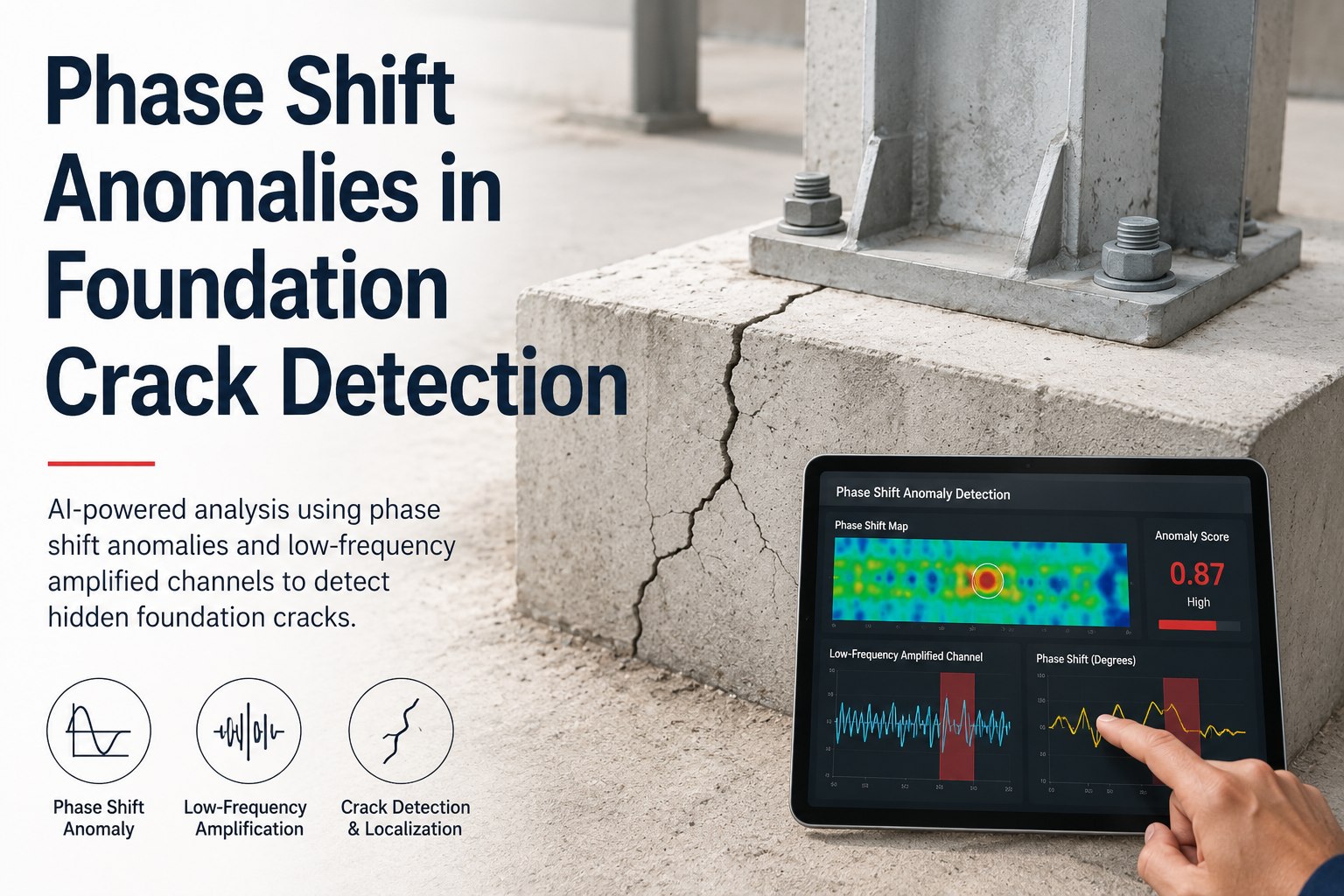
Concrete foundations don't fail dramatically. They fail invisibly — a hairline crack at the rebar interface today, a propagating fracture in six months, a load-bearing failure in two years that everyone retroactively decides was "obvious in hindsight." The catch is that visual inspection misses 80% of foundation cracks because the dangerous ones are subsurface — they hide under coatings, behind machine bases, inside columns, under floor slabs. Phase-shift anomaly detection is the structural-health monitoring technique that finds these hidden cracks. The principle is elegant: a healthy concrete foundation has a specific natural-frequency signature and a specific phase relationship between excitation and response. When a crack develops, both shift in measurable ways — natural frequency drops by 25-55% during initial cracking, mode-shape phase angles deviate from baseline, and the resulting anomaly map points directly to the crack location. The technique is non-destructive, runs continuously, and detects cracks weeks to months before they become visible. Sign up free to see phase-shift anomaly detection on your foundation data.
MAY 12, 2026 5:30 PM EST , Orlando
Upcoming OxMaint AI Live Webinar — Phase Shift Anomalies in Foundation Crack Detection
Live session for facility managers, structural engineers, plant maintenance leaders, and reliability teams responsible for concrete foundations supporting industrial machinery. We'll walk through how AI captures phase-shift anomalies in low-frequency vibration channels, demonstrate the modal-frequency drop signature that precedes visible cracking, show concrete foundation health scoring in action, and walk through the OxMaint AI inspection deployment that ships pre-trained and ready to run in 6–12 weeks.
The Phase Relationship — What a Healthy Foundation Looks Like
When a machine runs on a concrete foundation, every vibration cycle produces an excitation wave that travels through the concrete and produces a response wave the foundation's mass and stiffness send back. In a healthy foundation, those two waves have a specific phase relationship — the response is delayed from the excitation by a precise amount determined by the concrete's stiffness, mass, and boundary conditions. When a crack develops, stiffness drops locally. The response wave arrives at the wrong moment relative to the excitation. That timing offset — the phase shift — is the diagnostic signature that no visual inspection can replicate.
HEALTHY FOUNDATION
Stable phase, baseline frequency
CRACKED FOUNDATION
+44° phase shift, −38% first-mode frequency drop
−25 to −67%
First-mode natural frequency drop with crack damage
5×
Loss-factor (damping) increase as cracks propagate
<0.6%
ML-based crack location error in published trials
Why Low-Frequency Channels Catch What Ultrasound Can't
Concrete inspection has historically been split between two NDT techniques: visual testing (good for surface cracks, blind to anything subsurface) and ultrasonic pulse-echo (good for delamination, but coarse aggregates scatter the signal at high frequencies, killing crack sensitivity). Phase-shift anomaly detection runs in the low-frequency window — typically 0–500 Hz — that's been mostly ignored, even though it's where the foundation's structural-mode information actually lives. AI processing of these low-frequency channels extracts modal information that would be impossibly noisy for a human analyst to interpret manually. Sign up free to load your foundation accelerometer data into the modal analyzer.
0–500 Hz
Structural Modes
0.5–10 kHz
Bearing & mech
10–50 kHz
Ultrasonic NDT
100+ kHz
Phased-array
FOUNDATION CRACKS
Best detected at 0–500 Hz (modal analysis)
DELAMINATION
Mid-frequency ultrasonic pulse-echo
SURFACE CRACKS
High-frequency phased-array (350+ kHz)
The Four Stages of Foundation Crack Progression
Concrete foundations don't fail in a single event — they progress through four well-documented stages, and each stage produces a distinct phase-shift signature in low-frequency vibration data. The horizontal timeline below shows what the modal response actually looks like at each stage, the typical timeline, and what action the maintenance program should take. Book a demo to walk through the four-stage classifier on your foundation data.
STAGE 1
6–12 months ahead
Microcracking
Subsurface microcracks at rebar interface. Phase shift ≤2°, frequency drop ≤5%. Invisible to inspection but detectable in low-frequency modal data.
Action: trend only · log to baseline
STAGE 2
3–6 months ahead
Hairline Cracking
Visible hairline cracks (<0.3mm). Phase shift 5–15°, frequency drop 10–25%. Mode shapes begin to deform from baseline. MAC value drops below 0.95.
Action: schedule inspection · monitor monthly
STAGE 3
2–8 weeks ahead
Propagating Cracks
Cracks extending toward rebar (0.3–1.0mm). Phase shift 15–35°, frequency drop 25–55%. Loss factor increases 2–5×. Foundation rigidity measurably compromised.
Action: structural review · plan repair within 60 days
STAGE 4
Days to weeks
Through-Cracks & Settlement
Through-cracks (>1mm), spalling, differential settlement. Phase shift >35°, frequency drop >55%. Boundary conditions changing — mode shapes radically altered.
Action: emergency engineering review · halt operations
Owned, Not Rented — The OxMaint Foundation Monitoring Stack
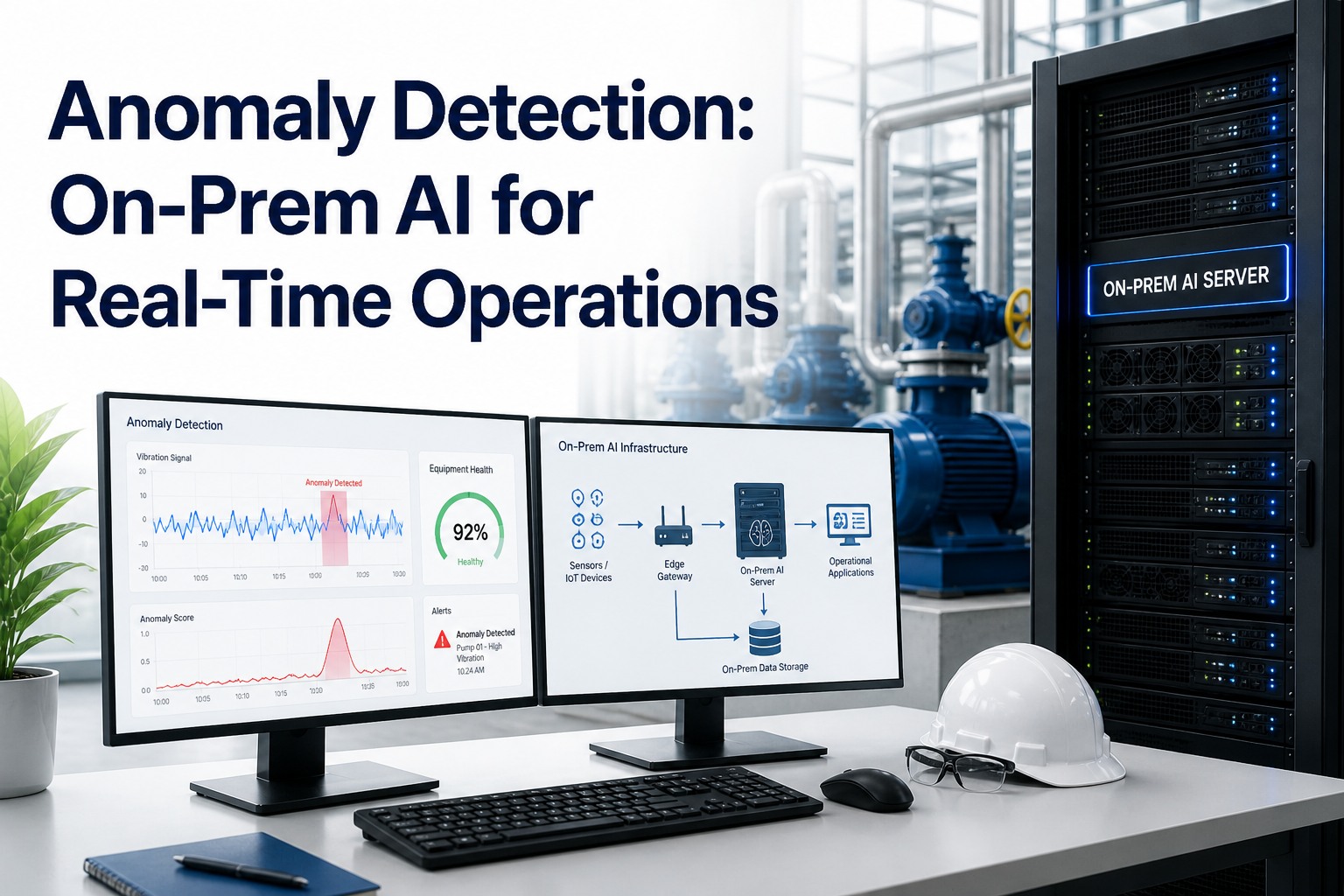
The OxMaint Foundation Monitoring deployment isn't a SaaS subscription you pay every month forever. It's a pre-configured AI server bundled with low-frequency triaxial accelerometers, AGX Orin edge appliances running modal-analysis pipelines, and an RTX PRO 6000 Blackwell server running the phase-shift anomaly detector and four-stage classifier. Get a quote and order it like the hardware it is — pre-configured, pre-tested, ready to begin healthy-baseline capture within days, and owned outright the day delivery completes.
Perpetual License
No monthly fees, no per-foundation metering, no per-asset billing. Future costs are entirely optional and at your discretion.
Data Sovereignty
Modal baselines, phase histories, foundation health data all live on your server, behind your firewall. Never uploaded.
Source Access
Source code and modification rights included. Adjust modal models, add custom foundation geometries, retrain freely within your org.
AI-Native Core
Phase-shift anomaly detection, modal frequency tracking, four-stage classification, NLP work orders — built in, not bolted on.
Pre-Configured · Modal-Ready · Ships in 6–12 Weeks
Order an OxMaint Foundation Monitoring Stack — Pre-Loaded
A complete on-prem AI monitoring deployment for concrete foundation health. Low-frequency triaxial accelerometers at strategic foundation points, AGX Orin edge appliances running modal analysis, RTX PRO 6000 Blackwell central server running phase-shift anomaly detection and the four-stage classifier, automatic CMMS work-order generation when phase deltas cross threshold. Pre-trained on industrial foundation datasets, ready to fine-tune on your specific concrete grade and geometry within days.
From Phase Anomaly to Engineering Action — The Closed-Loop Pipeline
Detecting a phase-shift anomaly isn't the deliverable. The deliverable is an engineering review, a documented severity assessment, and a scheduled corrective action with the right structural engineer assigned. The OxMaint Foundation Monitoring Stack connects every phase-shift event directly to the CMMS work-order engine with rule logic that maps each stage to its standard response. Sign up free to walk through the phase-anomaly-to-work-order pipeline on your foundations.
01
Sense
Triaxial accelerometers stream low-frequency data continuously from instrumented foundation points. 5+ year battery life on standard mounting.
→
02
Decode
AGX Orin runs modal extraction. Cross-spectral density computes phase angles between sensor pairs. Mode shapes reconstructed from sensor arrays.
→
03
Classify
Synapse AI matches phase deltas + frequency shifts to four-stage library. MAC value computed against baseline mode shapes. Severity assigned.
The OxMaint Foundation Monitoring Stack uses the standard per-plant architecture: central RTX PRO 6000 Blackwell server plus two AGX Orin edge appliances, with low-frequency accelerometers added per critical foundation. Modal analysis, phase-shift detection, four-stage classification, and CMMS connectors all included in the OxMaint AI Software + Integration line. Book a demo to walk through per-plant pricing for your foundation footprint.
Swipe to see breakdown
Component
Unit Cost
Per Plant
Notes
RTX PRO 6000 Blackwell 96GB Server
$19,000
$19,000
Phase-shift detector + Synapse AI
NVIDIA AGX Orin #1 (Modal Edge)
$4,000
$4,000
Low-freq modal extraction + phase computation
NVIDIA AGX Orin #2 (PLC + CCTV Edge)
$4,000
$4,000
PLC tag sync + visual crack confirmation
Industrial Ethernet Switch + Cabling
~$2,500
~$2,500
Plant-floor switch, Cat6A, SFP modules
Local Electrical / Instrumentation
$8,000–$12,000
~$10,000 est
Sensor mounting, anchor bolts, wireless gateway
OxMaint AI Software + Integration
$35,000–$55,000
$45,000 avg
Modal models, foundation library, CMMS connectors
Per-Plant Total
$72,500–$94,500
~$84,500 avg
4-month delivery per plant
4-Plant Full Rollout (with Enterprise AI)
~$420,000–$520,000
Total programme
Parallel delivery + DGX Station GB300 Ultra
$84.5K
Avg per plant
4 mo
Delivery
$0
Recurring fees
∞
Perpetual
Perpetual · Owned · Source Access · Data Sovereignty
Stop Catching Foundation Cracks at Stage 4 — Detect at Stage 1, Owned
Phase-shift anomaly detection, low-frequency modal analysis, four-stage foundation classification, automatic CMMS work-order generation, and the full OxMaint software stack. Your team owns the platform, the AI models, the foundation library, and the source code outright. The architecture every modern facility-management program is converging on as concrete monitoring moves from periodic inspection to continuous AI surveillance.
How does phase-shift detection differ from standard vibration analysis?
Standard vibration analysis looks at amplitude — how much a machine or structure is moving at each frequency. Phase-shift analysis looks at timing — the precise moment in each oscillation cycle when the response wave reaches its peak relative to the excitation. Two measurements can have identical amplitudes but different phase relationships, and only the phase tells you about stiffness changes inside the foundation. For concrete cracks specifically, phase shift is more sensitive than amplitude because cracks reduce local stiffness without necessarily reducing overall vibration energy. The technique requires at least two synchronized sensors (one at the excitation source, one at the response point) and high-precision timing — modern AGX Orin edge processing makes the math practical at industrial scale.
What kinds of foundations does this work on?
The technique applies to any reinforced concrete foundation supporting industrial machinery — pump pads, compressor blocks, turbine foundations, press foundations, motor pedestals, structural columns, equipment skids, and large-format slab foundations. It works on both new construction (where a true healthy baseline can be captured immediately) and existing foundations where baseline must be established from current state with appropriate annotations about pre-existing damage. Steel-plate-on-grout interfaces are a common edge case worth flagging — the grout layer adds its own modal complexity and typically requires a 4-week tuning period before stable phase baselines settle. Foundations under heavy dynamic loading (forging hammers, compressors with strong reciprocating components) benefit most because the excitation source is continuous and predictable.
How long does it take to establish a baseline?
For most industrial foundations, 30 days of continuous data collection during normal operation gives a workable baseline; 60–90 days produces a robust one. The system needs to capture the full operating envelope — startup transients, normal running, partial-load conditions, idle, and any seasonal effects (concrete elastic modulus varies measurably with temperature, especially in unconditioned spaces). The OxMaint engine starts in learning mode during the baseline period, displays phase deltas without triggering work orders, and lets structural engineers verify operating-regime classifications before the system goes live. After 90 days, the model continues self-refining — every confirmed-healthy hour adds to the training set, gradually tightening thresholds and reducing false positives. Most plants see false-positive rates drop from ~12% in month one to under 4% by month six.
Can this replace structural engineering inspections?
No, and that's not the goal. Phase-shift anomaly monitoring is a continuous early-warning system that flags developing problems and quantifies their severity — but the decision about repair scope, methodology, and structural acceptability still requires a licensed structural engineer (PE) reviewing the data, the foundation drawings, and physical inspection results. The two technologies are complementary: AI monitoring runs 24/7 and catches deterioration months earlier than periodic inspection schedules; structural engineers translate detection into engineering judgment. A typical workflow: AI flags a Stage 2 phase shift on a compressor foundation, work order auto-generates with all relevant data, structural engineer reviews remotely, schedules an in-person assessment within 30 days, recommends specific corrective action (epoxy injection, jacket repair, partial replacement). The AI changes when the engineer is involved; it doesn't replace the engineer.
How long until our team is productive with foundation monitoring?
Most facility teams reach basic productivity within 3–4 weeks of deployment and full operational fluency within 3–4 months. The OxMaint Foundation Monitoring deployment includes structured training: weeks 1–2 cover sensor mounting strategy, baseline capture, and dashboard navigation; weeks 3–4 cover the four-stage classifier and phase-shift interpretation; weeks 5–12 cover advanced topics including custom foundation geometries, integration with structural engineering review workflows, and CMMS integration depth. Teams already running vibration programs ramp faster — they recognize the modal-analysis vocabulary immediately. Teams new to vibration benefit from the AI pre-classification which reduces the cognitive load of phase interpretation. By month 4, the facility team is independently operating the stack with thresholds tuned to plant conditions and CMMS work orders auto-generating from every above-threshold detection.