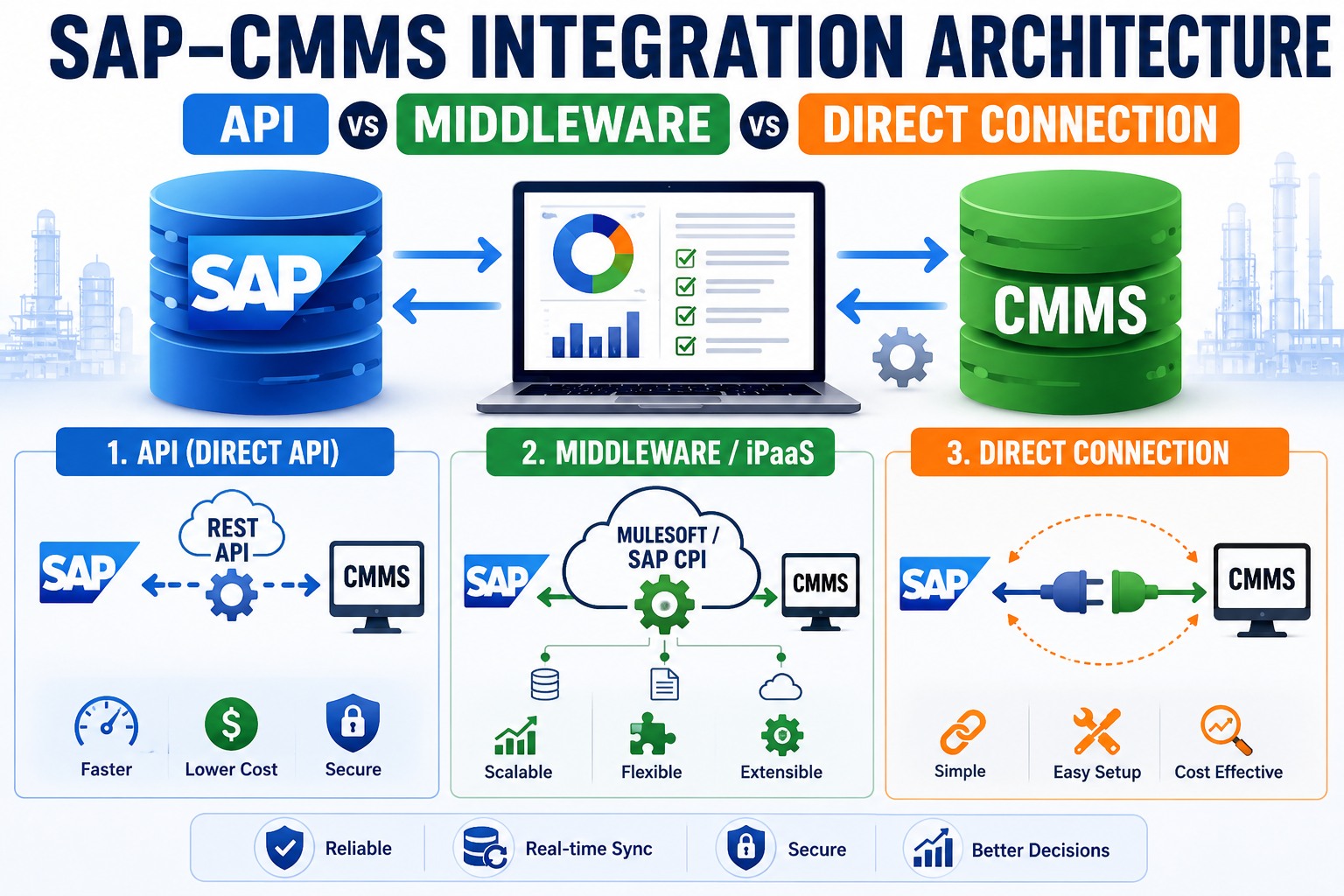
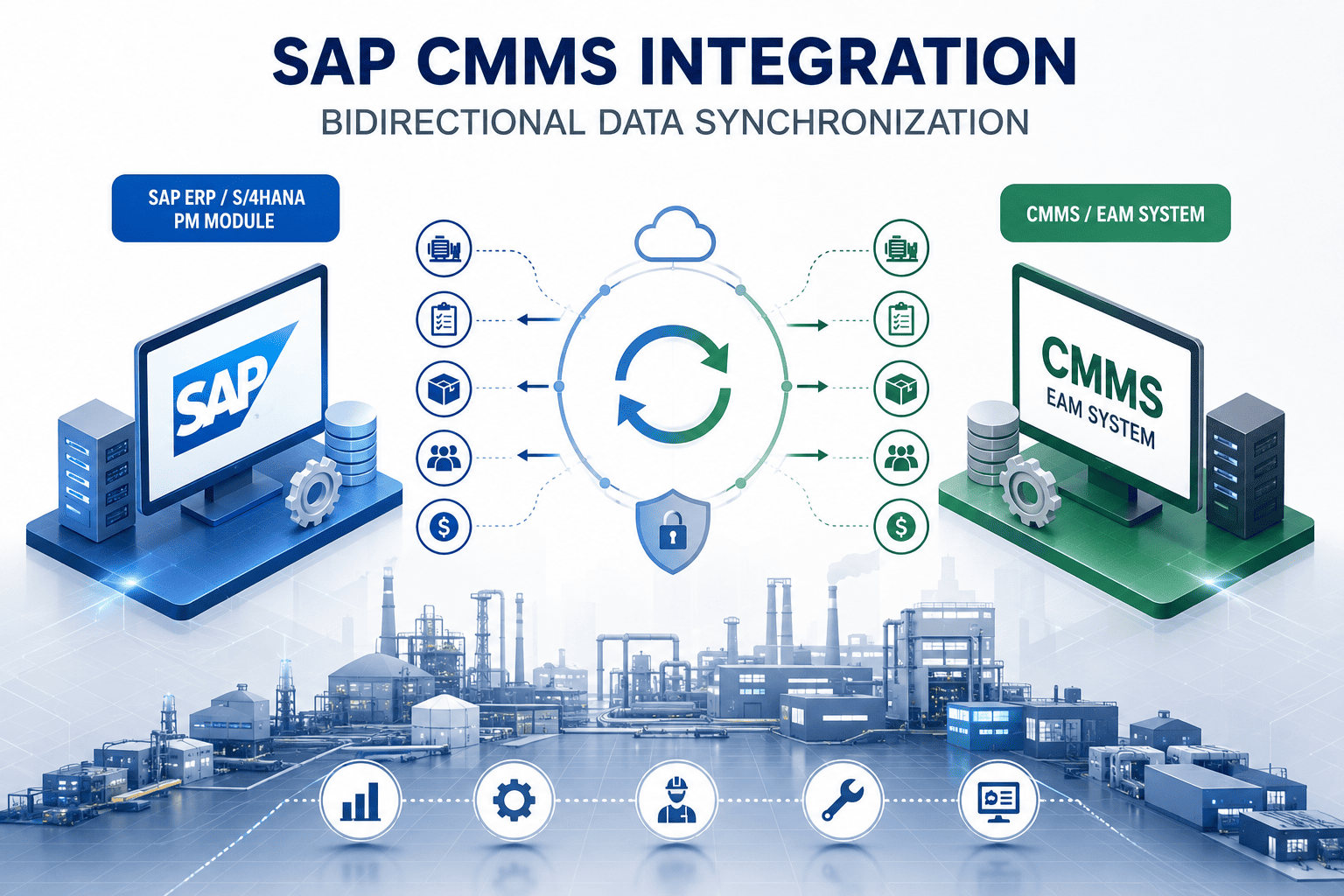
Every SAP-CMMS integration project starts with the same fork in the road: should you connect directly via APIs, route everything through middleware, or use direct database connections for maximum performance? The choice you make today will shape your maintenance operations for the next five to seven years—affecting everything from monthly licensing costs to how quickly you can adapt when business requirements change. Most organizations regret rushing this decision. The teams that get it right take time to evaluate trade-offs carefully. Book a free demo to walk through architecture options for your specific landscape.
Direct API
REST / OData / SOAP
Point-to-point connection
Lightweight, fast to build
Limited transformation
Best for: small operations, single plant
Middleware
SAP CPI / MuleSoft / BTP
Decoupled architecture
Heavy transformation, routing
Enterprise scalability
Best for: multi-system, multi-plant
Direct Connection
RFC / BAPI / Database
Native protocol binding
Maximum performance
High maintenance burden
Best for: legacy, performance-critical
The Integration Architecture Decision That Shapes Your Next Five Years
SAP-CMMS integration isn't a one-time technical choice—it's an architectural commitment that influences every future maintenance modernization initiative. The architecture you select determines how quickly you can add new plants, integrate IoT sensors, support mobile workflows, and adapt to S/4HANA migrations. Gartner's 2025 application integration research found that organizations choosing the wrong integration pattern spend 3.2x more on integration maintenance over a five-year horizon compared to teams that match architecture to actual business requirements.
62%
of enterprises report architecture choice as their #1 integration regret
3.2x
higher five-year cost when integration pattern mismatches business scale
5-7yrs
typical lifespan of an SAP integration architecture before redesign
Direct API Integration: When Simplicity Wins
Direct API integration connects SAP and your CMMS through native REST, OData, or SOAP endpoints—no middleware in between. The CMMS application calls SAP APIs directly to read work orders, post confirmations, and update master data. This is the leanest architecture available, and for the right use case, it's also the fastest to deploy and cheapest to operate.
Strengths
Setup in 2-6 weeks for typical scope
No middleware licensing fees
Simple debugging and traceability
Native SAP standard endpoints
Limitations
No central error handling layer
Limited data transformation capability
Hard to scale beyond 2-3 connected systems
Each endpoint requires custom logic
For maintenance teams running a single facility with predictable transaction volumes, direct API integration often delivers the highest ROI. Sign up free to explore native SAP API connectors built specifically for maintenance data flows.
Middleware Integration: The Enterprise Standard
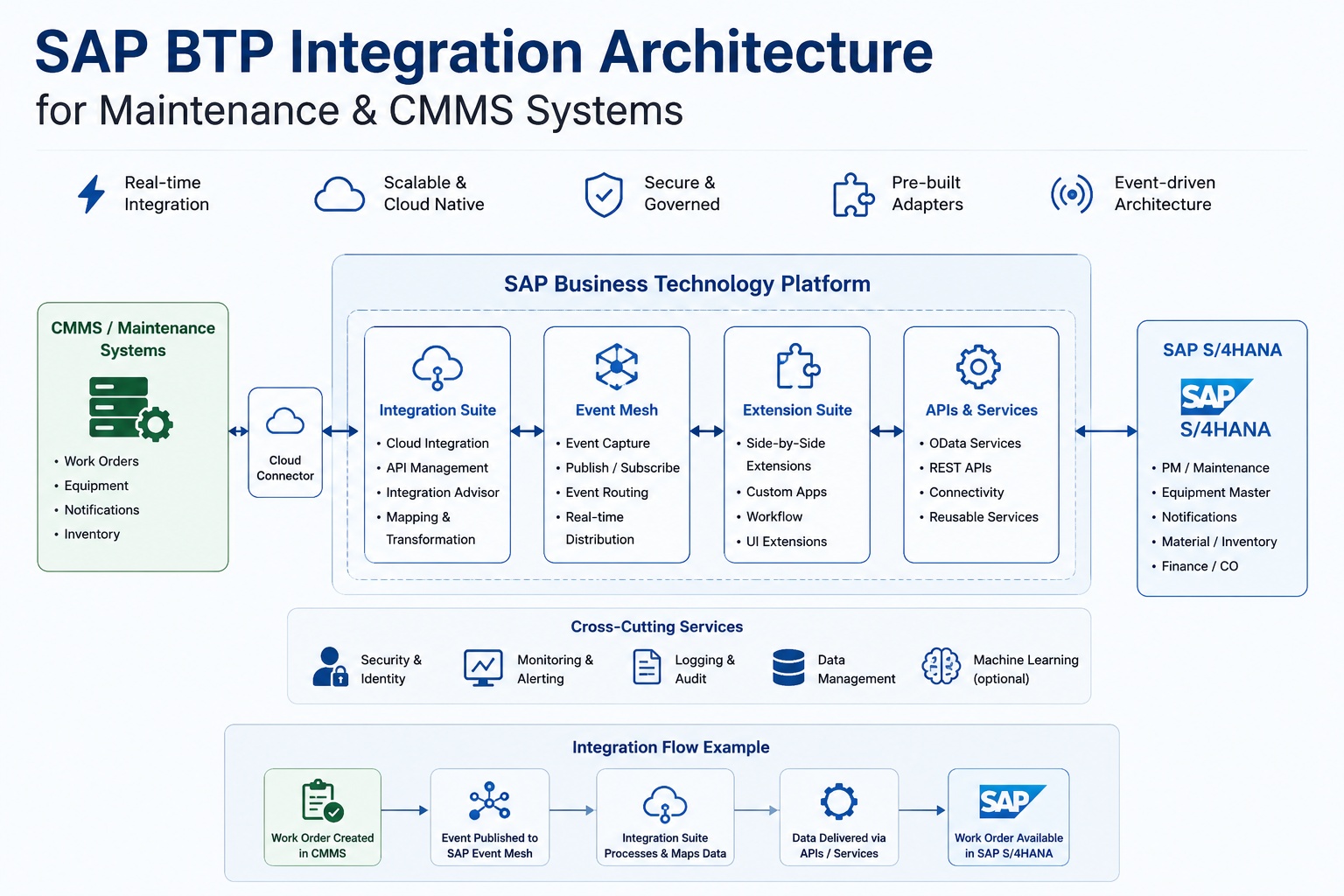
Middleware platforms—SAP Cloud Integration (CPI), SAP BTP Integration Suite, MuleSoft, Boomi, and Informatica—sit between SAP and your CMMS as an orchestration hub. They handle protocol translation, message transformation, routing logic, error queues, and monitoring in a centralized layer. For enterprises with multiple SAP systems, multiple plants, or integrations spanning beyond just CMMS, middleware is the architecture of record.
Strengths
Decouples systems—each evolves independently
Centralized monitoring and error handling
Heavy data transformation capability
Scales to 50+ connected systems gracefully
Limitations
Annual licensing $30K-$120K typical
Requires specialized integration team
3-9 month implementation timeline
Additional latency vs direct calls
See How Each Architecture Performs in Production
Watch how Oxmaint connects to SAP via native APIs, CPI middleware, and direct RFC—each demonstrated against real maintenance workflows. Decide what fits your operation in 30 minutes.
Direct Connection (RFC & Database): Power and Peril
The third architecture bypasses HTTP entirely. RFC (Remote Function Call), BAPI invocations, and direct database connections create native protocol bindings between SAP and your CMMS. Performance is unmatched—we're talking millisecond response times and zero serialization overhead. But the trade-offs are significant: tight coupling means SAP upgrades become CMMS upgrade events, and the surface area for security vulnerabilities expands considerably.
Strengths
Sub-second response for live queries
Zero protocol translation overhead
Access to native SAP data structures
Works well with legacy on-premise SAP
Limitations
Tight coupling to SAP version
Requires SAP-certified RFC user setup
Complex to maintain across S/4HANA migration
Higher security audit burden
Operations evaluating direct connection architectures should weigh long-term S/4HANA migration plans carefully. Sign up free to model how each pattern would handle your transaction volumes and migration timeline.
Total Cost of Ownership: What Each Architecture Actually Costs
Headline licensing fees tell only part of the story. The true cost of an integration architecture includes implementation, ongoing maintenance, scaling costs as you add systems, and the hidden cost of technical debt when an architecture outgrows its design assumptions. The comparison below reflects typical five-year TCO for a mid-size manufacturing operation running SAP ECC or S/4HANA with one primary CMMS deployment.
The TCO math frequently surprises teams: middleware looks expensive upfront but often wins over five years when scaled across multiple plants, while direct connection looks cheap until S/4HANA migration arrives. Sign up free to build a TCO model tuned to your facility count and transaction volumes.
Security and Compliance Considerations by Architecture
Each architecture creates a different security posture. Direct API integration limits attack surface to documented endpoints with OAuth or SAML authentication—straightforward to audit. Middleware introduces a new platform requiring its own security model but centralizes monitoring and access control beautifully. Direct connection via RFC creates the broadest attack surface and typically triggers the most rigorous security review from IT governance teams. For organizations under SOX, GxP, or ISO 27001 audit, the middleware pattern's centralized logging often becomes the deciding factor regardless of cost.
Expert Perspective: Choosing the Right Architecture for Your Operation
The architecture mistake I see most often isn't picking the wrong pattern—it's picking a pattern based on today's scope without thinking through where the operation will be in three years. Teams that pick direct API for a single plant find themselves rebuilding when they add facilities. Teams that pick middleware for a single plant burn budget on platform licensing they don't yet need. The right answer is almost always whichever architecture matches your scope 24 months from now, not what you have today.
Match Scope to Pattern
Single plant + stable scope = Direct API. Multiple plants + complex transformations = Middleware. Legacy ECC + performance critical = Direct Connection.
Plan for S/4HANA
If S/4HANA migration is within 24 months, avoid direct RFC patterns. APIs and middleware migrate cleanly; direct connections rarely do.
Budget for Maintenance
Allocate 20-30% of initial cost annually for integration maintenance regardless of pattern. The cheap-up-front architectures often have the highest ongoing costs.
Teams ready to evaluate architectures against their specific operational scope can request a working session with our integration specialists. Book a free demo to compare patterns using your actual transaction volumes and plant footprint.
Make the Architecture Decision With Confidence
Don't pick an integration pattern based on assumptions. See live demos of API, middleware, and direct connection architectures—then choose the one that fits your operation today and three years from now.
Frequently Asked Questions
Can I start with direct API integration and migrate to middleware later?
Yes, and this is increasingly common for growing operations. The migration path works cleanly if you design your CMMS to abstract SAP calls behind an internal integration layer from day one. When you add middleware later, you redirect that layer to call the middleware platform instead of SAP directly—your application code stays unchanged. Plan for 6-10 weeks of integration work during the transition, including parallel running and cutover validation.
Is SAP CPI better than MuleSoft for SAP-CMMS integration?
It depends on your broader landscape. SAP CPI ships with pre-built content packages for SAP modules, making CMMS integration faster if you stay within the SAP ecosystem. MuleSoft offers stronger non-SAP connectivity, better API management capabilities, and more flexible deployment options. For organizations with diverse non-SAP systems, MuleSoft often wins. For SAP-centric landscapes, CPI's pre-built accelerators typically reduce time-to-value significantly.
How do direct RFC connections impact S/4HANA migration?
S/4HANA deprecates many traditional RFCs and BAPIs in favor of OData APIs and CDS views. Operations relying on direct RFC connections typically face significant integration rework during S/4HANA migration—often 30-60% of the original integration effort. The newer SAP S/4HANA Embedded Analytics and OData services replace many legacy RFC patterns, so direct-connection architectures should plan for substantial redesign as part of any S/4HANA program.
What's the realistic minimum team size for each architecture?
Direct API integration can be maintained by a single SAP-aware developer with strong API skills—often a member of the CMMS implementation team. Middleware requires a dedicated integration specialist familiar with the chosen platform (CPI, MuleSoft, Boomi) plus an SAP functional consultant. Direct connection patterns need an SAP Basis administrator for RFC user management plus a developer comfortable with native SAP protocols. Skill availability often constrains architecture choice more than budget.
Can a modern CMMS work with all three architectures simultaneously?
Yes, and this hybrid approach is becoming the new standard. A well-designed CMMS uses direct APIs for low-frequency master data sync, routes high-volume transactional flows through middleware for resilience, and may use direct RFC only for performance-critical real-time queries. The key is choosing a CMMS with native support for all three patterns rather than forcing a single architecture across every integration touchpoint.