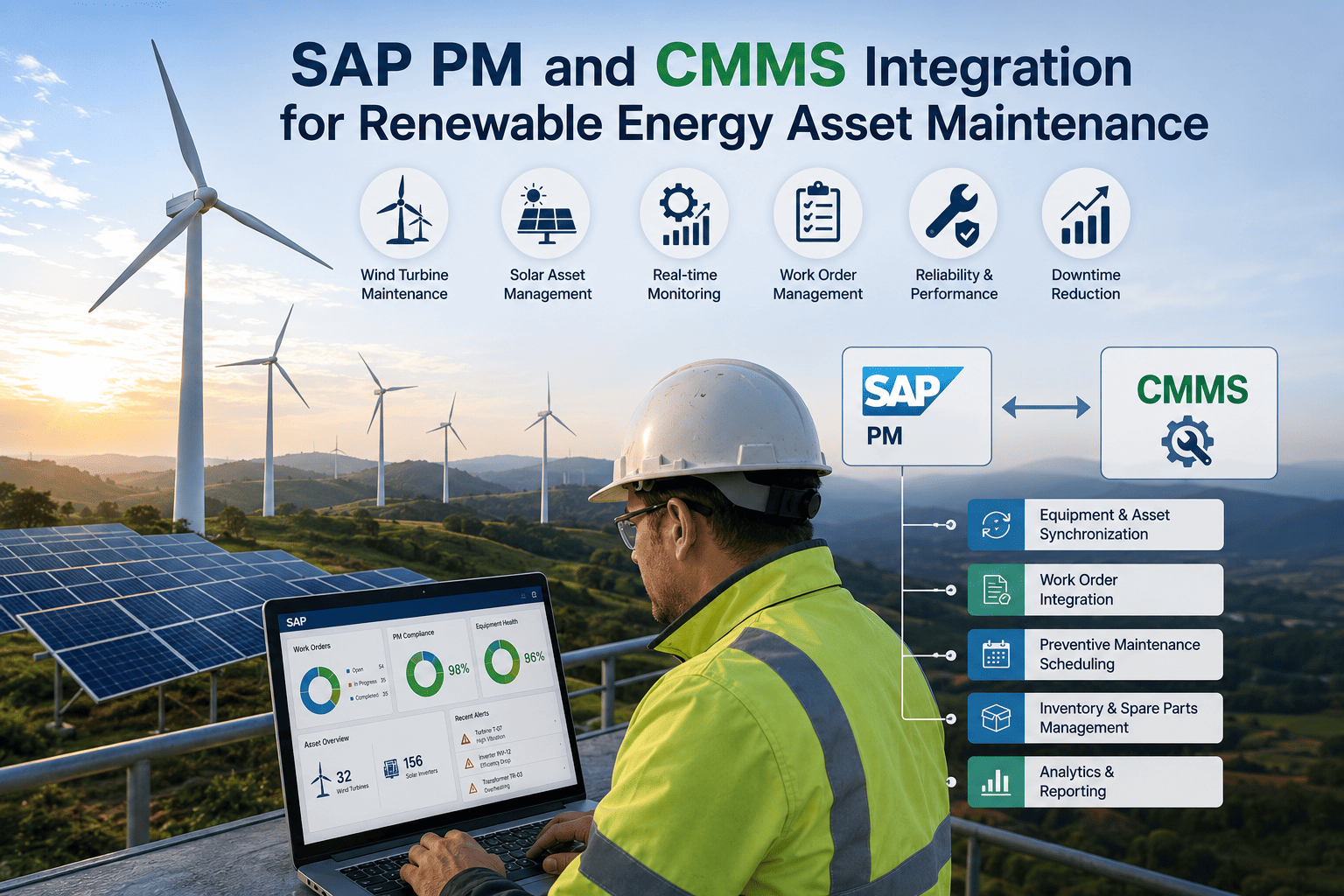
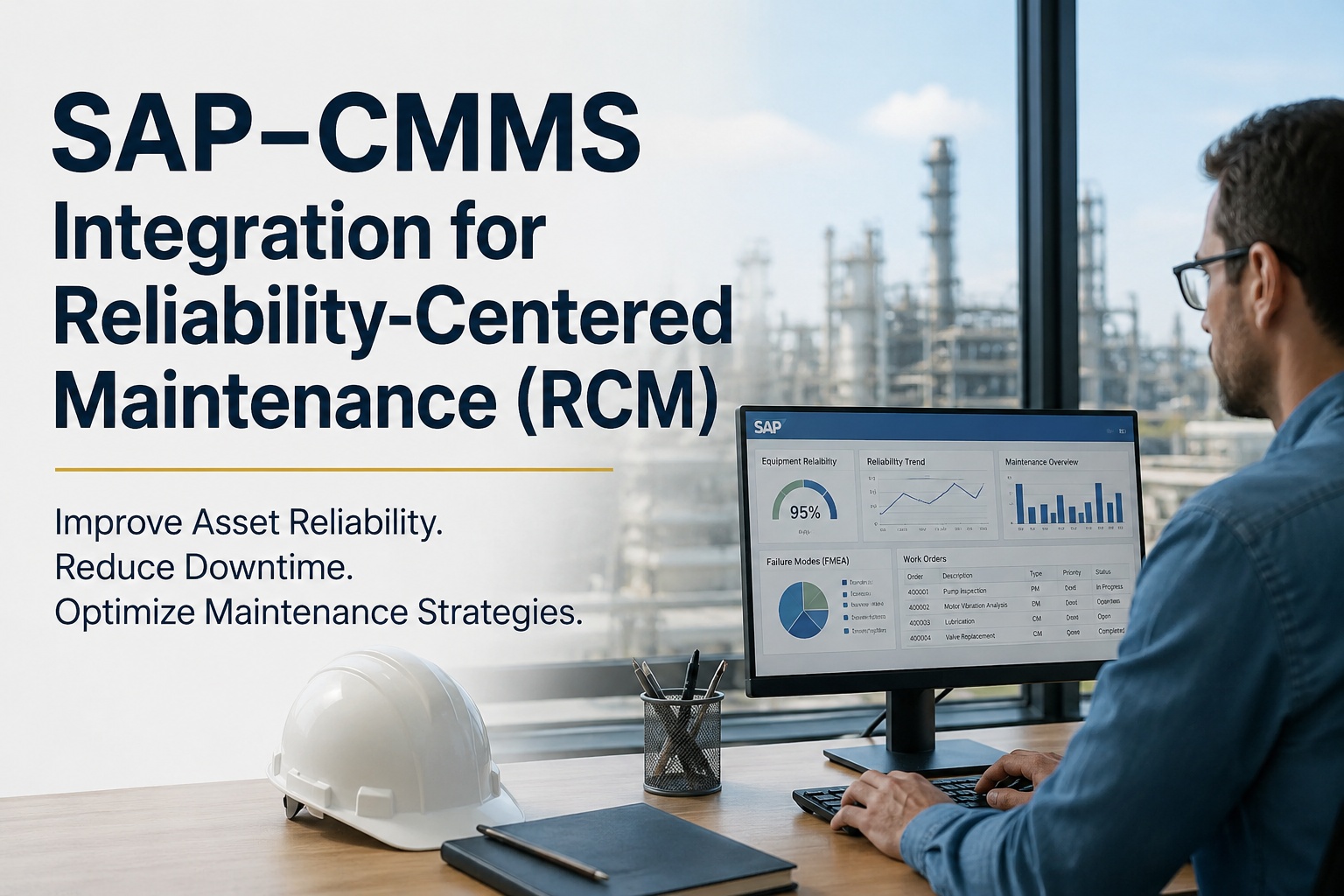
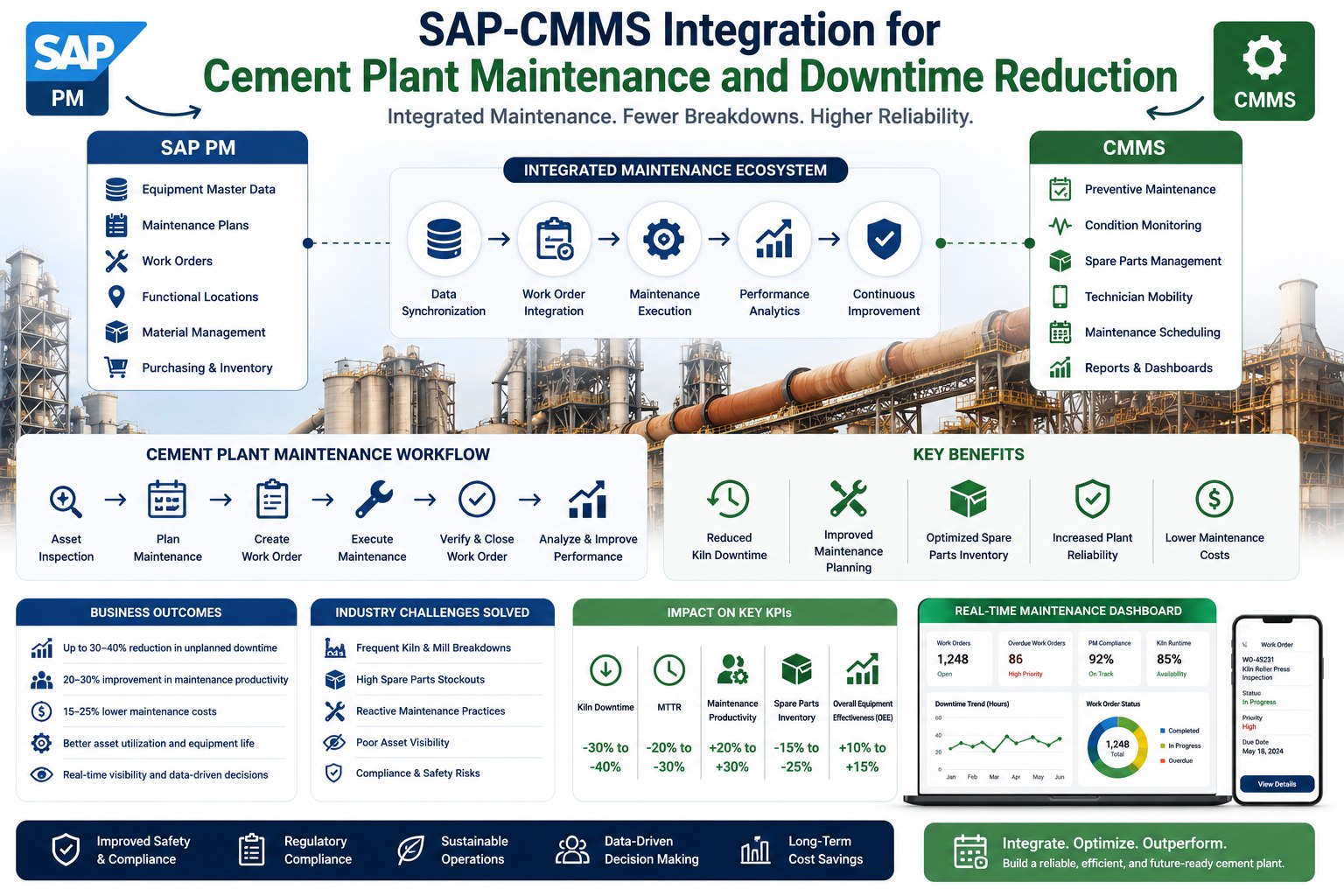
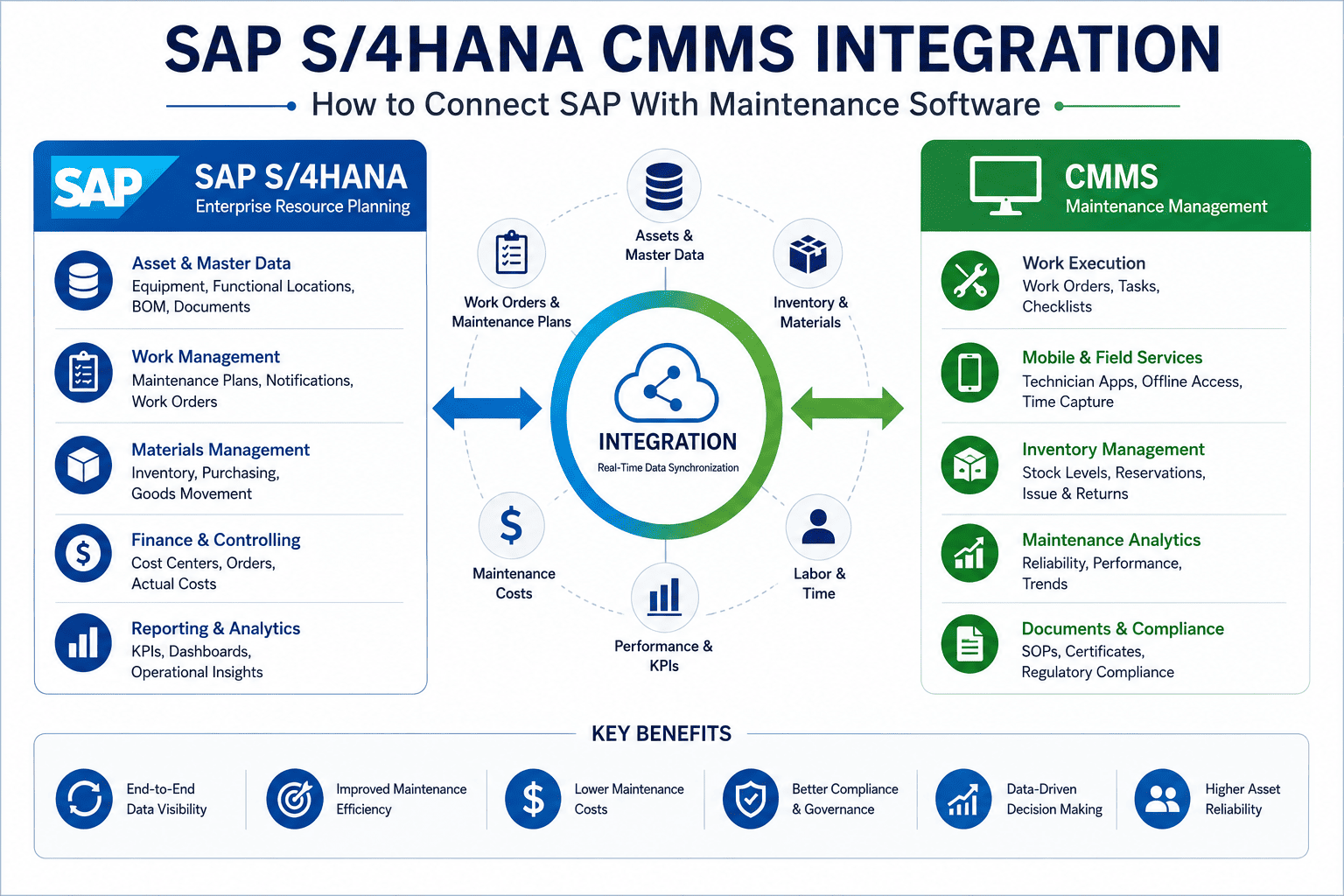
SAP PM and CMMS Integration for Renewable Energy Asset Maintenance
Wind farms and solar fields don't behave like factories. Assets are distributed across square miles. Failure modes are component-specific—gearbox bearings on turbines, inverter capacitors on solar strings. Warranty windows stretch 20 years. Performance is measured against PPA guarantees that fluctuate with weather. Traditional SAP Plant Maintenance was built for fixed industrial plants, not fleets of remote assets. When SAP PM connects to a modern CMMS with AI analytics running at the site, renewable operators get fleet-wide visibility, predictive insight on critical components, and the warranty discipline these long-lived assets demand. Here is how the integration actually works.
RENEWABLE ENERGY OPERATIONS
Fleet Visibility Across Every Turbine and Inverter
SAP PM holds the asset register. The CMMS captures the field reality. AI analytics turns sensor streams into warranty-aware predictive maintenance—at every site, at fleet scale.
20yrAsset lifecycle
$400KGearbox swap
40%Solar O&M issues
Why Renewable Energy Maintenance Breaks Traditional Approaches
Renewable assets have a fundamentally different operating profile than industrial plants. A coal-fired power station concentrates thousands of components inside one facility. A 200 MW wind farm scatters those components across 5,000 acres on top of 250-foot towers. A 100 MW solar field spreads them across rows of inverters and tens of thousands of panels. SAP PM works fine for the asset register, work orders, and financial costing—but the operational reality of remote, distributed, weather-dependent assets requires capabilities SAP was never built to deliver alone. The four challenges below shape how renewable operators approach the integration.
Geographic Distribution
A typical wind farm covers thousands of acres. Solar fields span hundreds. Sending a technician for every alert isn't viable. Predictive insight at the asset level decides whether a truck rolls or not.
Solar panels carry 20–25 year warranties. Wind components have layered coverage spanning 5–15 years. Tracking what's still covered against what just failed is a discipline most CMMS deployments handle poorly.
PPA Performance Pressure
Power purchase agreements set availability and energy-yield targets with financial consequences. Operators need real-time visibility into how each asset contributes to fleet-level guarantees.
None of these problems are solvable with SAP PM alone, and none are solvable with field tools alone. They require integration—a system that holds asset master data, warranty terms, and financial coverage centrally while pulling continuous health signals from every asset in the field. Renewable operators ready to scope this integration can sign up free to map their renewable asset visibility gaps against the same diagnostic framework used by larger fleets.
The Connected Asset Field: Visibility at Fleet Scale
The architecture that makes renewable maintenance work treats every turbine and every inverter as a connected endpoint reporting back to a central operations hub. SAP PM provides the asset master and financial layer. The CMMS provides field-level work order execution and sensor management. AI analytics—running on local hardware at the wind farm or solar site—converts sensor streams into predictions before bandwidth becomes a constraint. The result is fleet visibility that scales with the asset count, not against it.
Distributed Asset Fleet · Connected Operations
How wind and solar assets feed a unified maintenance intelligence layer
WIND FARM
24 turbines · 200 MW
22Healthy
2Watch
SOLAR FIELD
480 panels · 14 strings · 100 MW
13Strings nominal
1Underperforming
Operations Intelligence Hub
SAP PMCMMSAI Analytics
504Assets monitored
99.2%Fleet availability
The AI analytics layer runs on local on-prem hardware—an RTX PRO 6000 Blackwell central server with Jetson AGX edge nodes—so sensor data and predictions stay inside the site network even when satellite or cellular backhaul to corporate is limited. That matters for remote wind farms and desert solar installations where bandwidth is the constraint. Renewable operators can book a free demo of the renewable asset operations dashboard and see how the fleet view scales from a single site to a portfolio.
Wind and Solar Have Different Integration Needs
Treating wind and solar as a single maintenance category is a common mistake. The asset categories share an architecture pattern but diverge on what gets monitored, how often failures happen, and what failure costs look like. The integration has to respect those differences—SAP master data needs to reflect them, and the CMMS workflows need to handle them accordingly.
Wind Turbines
Critical Components Monitored
Main BearingGearboxGeneratorPitch SystemYaw DriveBlade Health
Highest-Cost Failures
Gearbox replacement: $250K–$500K
Main bearing repair: $100K–$300K
Generator rewind: $80K–$200K
Integration Priority
Vibration analytics on drivetrain components, SCADA data feeding CMMS work orders, warranty status by component, technician dispatch with crane scheduling.
String-level performance tracking, inverter telemetry into CMMS, panel soiling detection, warranty claim workflow tied to manufacturer terms in SAP master data.
The integration layer normalizes these differences—technicians on either asset type see a consistent work order experience, while SAP PM holds the financial and contractual specifics that vary by asset class. Operators running mixed portfolios can sign up free to onboard their wind or solar fleet and pilot the same integration approach across both asset types.
Warranty, Performance, and PPA Compliance
The financial layer is where SAP PM earns its place in renewable operations. Component-level warranties with overlapping coverage periods, performance guarantees tied to PPA contracts, and capacity factor reporting to investors all live in or near the SAP environment. The integration brings field reality into that financial layer—so when a gearbox fails, the system knows immediately whether the failure is under OEM warranty, which clauses apply, and what documentation the claim needs.
Component Warranty & Performance Tracker
Representative view: layered coverage windows on a single 3.6 MW turbine
Tower & Foundation
20 yr · Active
Blades
15 yr · Active
Gearbox
10 yr · Active
Generator
10 yr · Active
Pitch & Yaw Systems
5 yr · Expired
Electronics & Controls
3 yr · Expired
$0Avoidable claims missed in year one
100%Coverage visibility before truck-roll
AutoClaim documentation from CMMS
Beyond warranty, the same integration powers PPA compliance reporting. Availability percentages, capacity factor by site, energy yield versus guarantee, and unplanned downtime causation all consolidate into one operating view—giving asset managers the documentation needed for monthly settlement and the early signals needed to avoid penalty exposure. Renewable portfolios looking to harden their PPA reporting can book a free demo to see the SAP warranty tracking integration against representative wind and solar configurations.
See Fleet Visibility on Your Wind and Solar Assets
A 30-minute working session walks through the SAP PM connector, the field-level CMMS workflow, and the on-prem AI analytics layer—mapped to your specific asset mix, warranty terms, and PPA structure.
Three Realities That Shape Renewable Maintenance Strategy
Reliability Is Bought, Not Hoped For
The cost difference between predictive and reactive maintenance on a 200 MW wind farm is in the millions. The fleets that hit 98%+ availability targets are the ones that invested in sensor coverage and AI analytics early. The ones still chasing availability are running the same maintenance approach they ran ten years ago.
Warranty Discipline Pays For Itself
A single missed gearbox warranty claim can cost $400,000. Most renewable operators leak warranty value not because they don't have coverage, but because they don't have documentation aligned to the claim window. SAP-CMMS integration with auto-generated maintenance records closes that gap.
Local AI Beats Remote AI for Renewables
Many wind and solar sites have limited backhaul bandwidth—satellite or thin cellular. Running AI inference on local hardware at the site keeps predictions flowing regardless of connectivity, and keeps proprietary performance data inside the operator's network rather than shipped to a vendor cloud.
The renewable operators that get this right treat maintenance not as a cost center but as a portfolio-protection function—because that's what it is when each percentage point of availability translates directly to PPA revenue. Teams ready to model that impact against their own fleet can sign up free to start their renewable maintenance assessment and run the diagnostic in under an hour.
Every Turbine, Every Inverter, One Operating View
Oxmaint integrates with SAP PM for asset and warranty data, runs CMMS workflows for the field, and deploys AI analytics on local hardware at every site. Wind, solar, or mixed portfolios—the same integration model works.
Why integrate SAP PM with a CMMS for renewable assets instead of using SAP alone?
SAP PM excels at the financial, contractual, and asset-master layer—warranty terms, work order costing, parts procurement, and depreciation. It was not designed for the operational realities of distributed renewable assets: mobile work order execution at remote sites, continuous IoT sensor management, component-aware AI analytics, or string-level solar performance tracking. The CMMS layer adds these capabilities while keeping SAP as the system of record. Integration means renewable operators get both without forcing either system to do what it was not built for.
Does this integration approach work for both wind and solar in the same portfolio?
Yes. The architecture is asset-class agnostic. Wind turbines and solar assets feed into the same operations hub through the same SAP-CMMS-AI integration pattern, even though the specific sensor types, failure modes, and warranty structures differ. Operators running mixed portfolios get a unified work order experience across both technologies, with asset-class-specific intelligence applied automatically. The integration scales the same way whether you operate 50 turbines, 5 solar fields, or both.
How is warranty data tracked through the integrated system?
SAP PM holds the warranty master data—coverage windows, OEM terms, claim procedures—as part of each asset's equipment record. When the CMMS records a maintenance event or AI analytics predicts a failure, the integration automatically checks warranty status before any work order action triggers. If a component is under coverage, the workflow generates the claim documentation, attaches maintenance history, and routes to the OEM claim process. This eliminates the most common warranty leakage pattern: failures repaired before anyone checks coverage.
Can AI analytics run locally at remote wind farm or solar sites?
Yes—and for most renewable operations, it should. Remote wind farms and large solar installations often have limited backhaul bandwidth (satellite, microwave, or constrained cellular). Running AI inference on local on-premises hardware at each site means predictions continue regardless of corporate connectivity, sensor data stays inside the site network, and latency stays low enough for real-time alerts. The local AI layer syncs aggregated insights and work orders to the central SAP environment when bandwidth permits.
What KPIs improve most after integrating SAP PM with a CMMS for renewables?
The biggest gains typically show up in fleet availability (commonly 2–4 percentage points), warranty recovery (often double-digit increases in successful claims), unplanned downtime cost reduction, and PPA compliance margin. Specific numbers vary by fleet age, asset mix, and starting maturity—older wind fleets with extensive gearbox issues often see the largest absolute savings. Solar operations typically see the fastest ROI from inverter and string-level monitoring catching underperformance that would otherwise go unnoticed for weeks.