sap-cmms-osha-compliance

OSHA Compliance Management with SAP and CMMS Integration


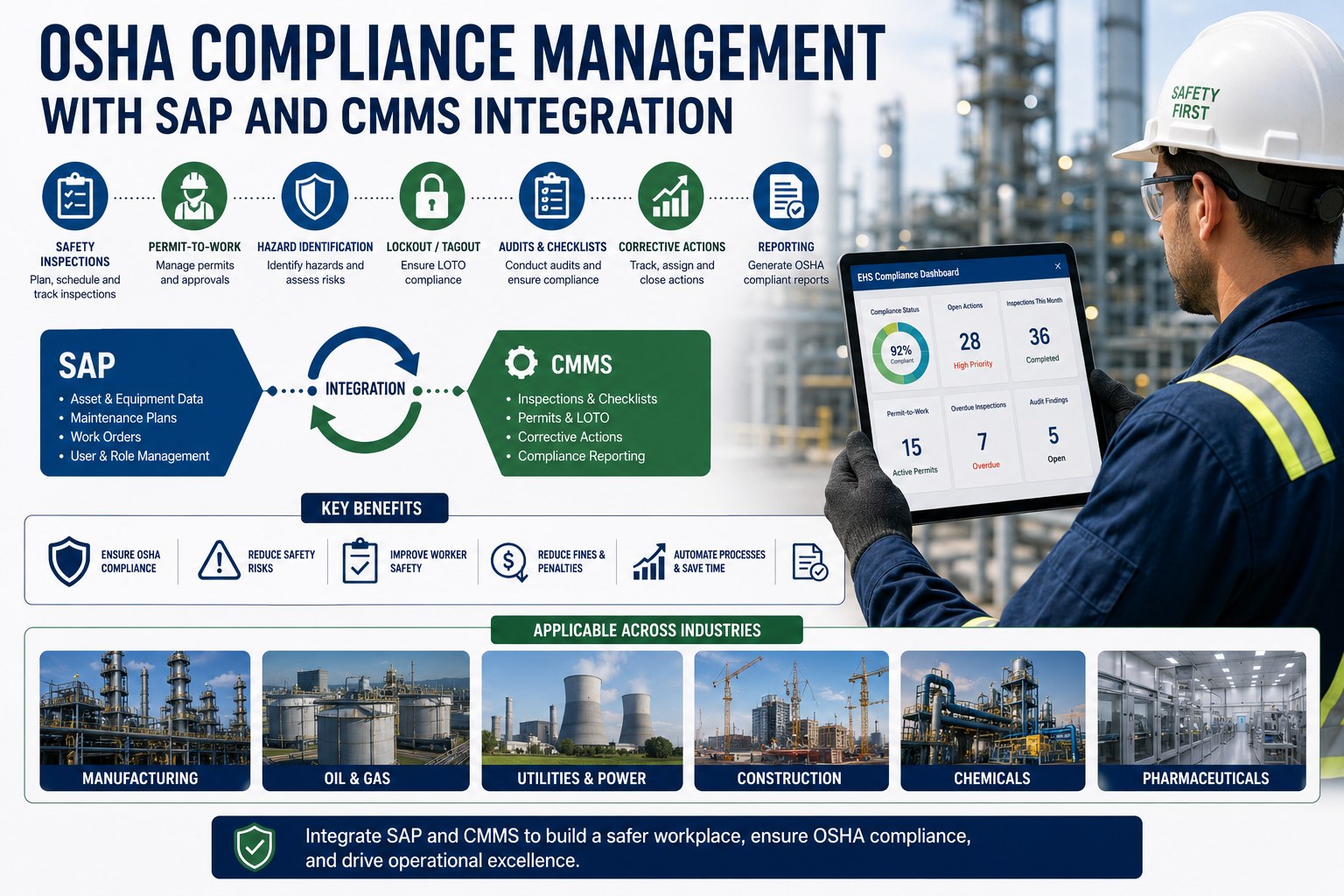
In January 2025, OSHA raised serious-violation penalties to $16,550 per citation and willful-violation penalties to $165,514. Manufacturing alone absorbed $2.7 million in forklift-related citations last year. The math has changed: OSHA compliance is no longer a safety officer's clipboard task—it's a balance sheet item. Plants relying on paper inspection logs, spreadsheet LOTO registers, and email-chain permit approvals are operating on borrowed time. The plants getting this right link SAP PM's financial backbone to a CMMS layer that turns every safety task into audit-ready documentation. Book a free demo to walk through OSHA compliance integration.

OSHA Penalty Landscape, 2025
The Real Cost of Manual Compliance
$16,550
2025 OSHA penalty per serious violation (per occurrence)
Source: OSHA 2025 Final Rule
$165,514
2025 maximum penalty for willful or repeated violations
Source: OSHA
$2.5M
Largest single-employer OSHA fine issued in 2024
Source: OSHA enforcement data
6,307
Fall Protection citations in FY 2024—#1 violation for the 14th consecutive year
Source: OSHA Top 10

Why OSHA Compliance Has Become a Maintenance-First Problem

The OSHA standards that produce the most citations every year are not safety abstractions—they're maintenance failures. Machine guarding violations happen because a guard was removed for service and not replaced. Lockout-tagout citations happen because energy isolation steps weren't documented. Powered industrial truck violations happen because daily inspections were skipped. Respirator program failures happen because fit testing schedules slipped. Every single one of these traces back to a maintenance workflow that either ran without documentation or didn't run at all.

This is why OSHA compliance is no longer a function that lives separately from maintenance management. The same SAP PM equipment master, the same work orders, the same mobile execution that handles preventive maintenance must also produce the safety documentation OSHA inspectors demand. When compliance evidence is generated as a byproduct of normal work execution, the audit becomes a non-event. When it's a separate spreadsheet exercise, the citations accumulate. Plants ready to link maintenance and compliance into one workflow can Sign up free to start auto-archiving OSHA evidence from the first work order.

The Top 10 OSHA Violations a CMMS Should Be Preventing

The list below is OSHA's Top 10 most-cited violations from FY 2024, ranked by citation count. Each one maps directly to a CMMS workflow that, when integrated with SAP PM, prevents the violation at the source rather than catching it in audit.

OSHA Top 10 — FY 2024 Citations & CMMS Prevention
01
Fall Protection — General Requirements 1926.501
6,307
Height-work permits, anchor inspection schedules
02
Hazard Communication 1910.1200
2,888
SDS library, chemical inventory sync with SAP MM
03
Ladders 1926.1053
2,573
Ladder inspection PMs, defective-equipment tagging
04
Respiratory Protection 1910.134
2,470
Fit-test scheduling, medical clearance tracking
05
Lockout / Tagout 1910.147
2,288
Digital LOTO log linked to every work order
06
Powered Industrial Trucks 1910.178
2,248
Daily forklift pre-op checklists, operator certs
07
Fall Protection — Training 1926.503
2,050
Training matrix, expiration alerts, refresher PMs
08
Scaffolding 1926.451
1,873
Pre-shift inspection forms, competent-person sign-off
09
PPE — Eye & Face Protection 1926.102
1,716
Task-linked PPE requirements in work orders
10
Machine Guarding 1910.212
1,540
Guard replacement verification step in PM closure
Every one of these top 10 violations maps to a maintenance workflow that, executed correctly with documented evidence, prevents the citation entirely.

Manufacturing absorbs the largest share of these citations—937 forklift-related violations alone, totaling $2.7 million in penalties for one industry in one year. Most of those would have been prevented by a daily mobile pre-op checklist tied to operator certification status. The technology to do this has existed for a decade; what's been missing is the integration with SAP PM that makes the financial governance defensible. Plants ready to map their top OSHA exposures to CMMS prevention workflows can Sign up free to audit current compliance coverage against the Top 10.

The Permit-to-Work 5-Gate Approval Cascade

OSHA-compliant hazardous work doesn't get a single approval—it gets five. Hot work, confined-space entry, energized electrical work, and elevated work all require a multi-gate permit-to-work chain where each gate has a specific authorized role, verification scope, and timestamped sign-off. The visualization below shows how that cascade flows when SAP PM and CMMS handle it in one digital workflow instead of paper clipboards.

5-Gate Permit-to-Work Cascade
Multi-role approval chain for hazardous work · Each gate timestamps and locks
Gate 1
Permit Issuer
Scope, hazards, controls identified · Risk assessment attached
~10 min
Gate 2
Area Authority
Production impact reviewed · Adjacent work conflicts checked
~15 min
Gate 3
Safety Officer
PPE specified · Atmospheric tests · Rescue plan confirmed
~20 min
Gate 4
Isolation Lead
LOTO applied · Energy verified zero · Padlocks tagged
~30 min
Work
Execution
Authorized work begins · Mobile checklist active · Live monitoring
As scoped
Gate 5
Closure Verifier
Work area cleared · Guards reinstalled · LOTO removed · Permit closed
~10 min

The five-gate cascade isn't bureaucracy—it's how OSHA's general duty clause expects high-hazard work to be authorized. The traditional version of this process lives on paper clipboards, with photocopied permits walked from office to office, signatures collected over hours, and the original document misfiled by week's end. Digital permit-to-work tied to SAP PM work orders compresses the same five gates into 45–60 minutes with a complete digital audit trail that survives every OSHA inspection.

From Lockout-Tagout to Audit-Ready Evidence

Lockout-tagout violations sit at #5 on OSHA's Top 10 and trigger some of the highest per-incident penalties because they're the violations OSHA most often correlates with fatalities. What inspectors look for isn't whether locks were applied—it's whether the energy isolation procedure was documented, whether the right padlock count was used, and whether each authorized employee verified zero energy before work began. Every one of those checkpoints is a CMMS data field, not a paper signature.

Digital LOTO — Each Step Generates Evidence
1
Energy Source Identification
Asset record auto-lists all energy sources (electrical, hydraulic, pneumatic, thermal, mechanical, chemical). No source missed.
2
Isolation Procedure Pulled
Equipment-specific LOTO procedure attached to work order. No improvisation, no wrong-equipment errors.
3
Padlock Application Logged
Each authorized employee scans their personal padlock barcode. System enforces correct lock count.
4
Zero-Energy Verification
Test instrument readings captured. Each isolation point verified with timestamped photo evidence.
5
Removal & Restore
Lock removal logged by same employee who applied it. Guard reinstallation verified. Asset returned to service.

The evidence pack OSHA wants—energy sources identified, procedure followed, padlocks applied by authorized employees, zero-energy verified, restoration completed—is generated automatically as the work happens. No safety officer compiling reports at the end of the week. No missing signatures discovered at audit time.

See OSHA Compliance Built Into Every Work Order
Walk through digital permit-to-work, mobile LOTO, automated inspection cycles, and SAP-integrated cost posting—all in one demo built around your plant's actual hazards. 30 minutes.

ROI: What OSHA Compliance Automation Actually Returns

The financial case for OSHA automation isn't speculative—it's the difference between absorbing $16,550 per serious violation and not absorbing it. Cumulative data from manufacturers and process plants that moved from paper-based compliance to SAP-integrated digital workflows shows the magnitude of the shift.

Paper Compliance vs Integrated Digital: 12-Month Operating Results
Swipe to compare
Compliance Metric Paper / Spreadsheet Integrated Digital Shift
Permit-to-Work approval time 3–6 hours 45–60 min −80%
LOTO evidence completeness 62% 98% +36 pts
Daily forklift pre-op completion 71% 96% +25 pts
OSHA audit prep time 3–6 weeks 2–4 days −90%
Citations per audit (avg) 4.2 0.6 −86%
Recordable incident rate (TRIR) Baseline Down 30–45% Material
$16,550 Per avoided serious-violation citation in 2025
$165,514 Per avoided willful or repeated citation

The math gets aggressive fast. A mid-size manufacturer carrying historical citation exposure of 4-6 serious violations per OSHA audit—a typical pattern for plants on paper-based compliance—is absorbing $66,000 to $99,000 in penalty risk every inspection cycle. Avoid 86 percent of that exposure through digital workflows and the system pays for itself many times over before counting the avoided willful citations. Safety directors ready to model their plant's specific exposure can Book a free demo to walk through OSHA risk reduction on their hazard inventory.

Expert Perspective: Why Most OSHA Programs Stall

Compliance teams fail not because they don't know what OSHA requires—they know exactly what's required. They fail because the systems they rely on can't produce the evidence at audit speed. The safety officer with seven years of experience knows every LOTO step cold; what they can't do is reconstruct twelve months of energy-isolation events from paper logs in two days. The plants that consistently pass OSHA audits have stopped trying to recreate evidence after the fact and started capturing it as the work happens. Once the evidence flows automatically, the audit changes from a survival exercise to a routine review.

Capture Evidence at the Asset
The technician with the wrench produces the evidence. Mobile capture of timestamps, photos, readings, and signatures at the asset eliminates the reconstruction problem.
Tie Every Permit to a Work Order
Floating permits get lost. Permits attached to specific work orders, with specific assets, in specific cost centers, survive every audit and every personnel turnover.
Make Top-10 Coverage the Floor
Don't build a generic compliance system. Build coverage for OSHA's Top 10 specifically—that's where the citations live and where prevention dollars produce the highest return.

90-Day Path to OSHA-Ready Maintenance Operations

The roadmap below is what safety and maintenance leaders execute together when they move from paper-based compliance to digital workflows tied to SAP PM. The pace matters: visible wins by week six keep the program funded; full coverage by day 90 makes the next OSHA audit a non-event.

90-Day OSHA Integration Roadmap
From paper compliance to audit-ready by next quarter
Days 1–20
Hazard Inventory & SAP Mapping
Catalog hazardous tasks against OSHA Top 10. Map LOTO points to SAP equipment master. Identify pilot zone—typically the line with most permits or recent citations.
Days 21–45
Digital Permit & LOTO Pilot
Activate mobile permit-to-work and digital LOTO on pilot zone. Validate 5-gate approval cascade. Train issuers, area authorities, safety officers, and isolation leads.
Days 46–70
Top 10 Coverage Rollout
Deploy daily forklift pre-op checklists. Activate ladder, scaffold, and PPE inspection PMs. Configure fit-test and training expiration alerts. Wire to SAP cost centers.
Days 71–90
Audit Pack & Reporting
Activate OSHA-ready evidence exports. Launch compliance dashboard for plant leadership. Schedule mock OSHA audit. Establish monthly safety review cadence.

By day 90, the plant's OSHA documentation is no longer a quarterly scramble—it's a continuous output of normal maintenance work. The same mobile work orders that close PMs also capture compliance evidence. The same SAP cost postings that track maintenance spend also tag safety-related work for regulatory reporting. Safety and maintenance leaders ready to start the hazard inventory can Sign up free to map OSHA Top 10 coverage on their pilot line this week.

Make the Next OSHA Audit a Non-Event
Every permit timestamped. Every LOTO step logged. Every inspection captured at the asset. See SAP-integrated OSHA compliance running on your plant's hazards in a live walkthrough.

Frequently Asked Questions

How does an integrated CMMS reduce OSHA citation risk specifically?
By capturing compliance evidence as a byproduct of normal maintenance work rather than as a separate reporting exercise. Every work order closure produces timestamped documentation: photos, readings, signatures, parts consumed, and procedure adherence. When OSHA arrives, the evidence pack for any covered period assembles in days rather than weeks. Plants moving from paper to digital workflows typically see citations per audit drop from 4-6 per inspection to under 1.
Does this work with our existing SAP EHS module, or does it replace it?
It complements rather than replaces SAP EHS. SAP EHS holds the regulatory configuration, incident records, and corporate-level safety data. The CMMS layer handles the field-facing execution—mobile permits, mobile LOTO, daily inspections, work order-linked compliance evidence. The two systems integrate via standard OData APIs, so safety incident data captured at the asset flows into SAP EHS automatically, and SAP EHS configuration drives the rules enforced in the CMMS.
What's the difference between paper-based LOTO and digital LOTO from OSHA's perspective?
From OSHA's perspective, the substantive requirement is identical: energy sources identified, procedure followed, isolation verified, restoration completed, all by authorized employees. The difference is evidentiary completeness. Paper LOTO logs are typically 60-70 percent complete at audit time—missing signatures, illegible entries, lost forms. Digital LOTO achieves 98 percent completeness because each step is mandatory in the workflow, and missing steps prevent work from proceeding. Inspectors see the same procedure executed reliably every time.
How much can a plant realistically reduce OSHA penalty exposure?
Operating data from manufacturers transitioning to digital compliance workflows shows average citation counts dropping 80-90 percent within the first 18 months. For a plant carrying historical exposure of 4-6 serious violations per audit at $16,550 each, that translates to $50,000 to $80,000 in avoided penalties per inspection cycle. The math improves dramatically when willful or repeated violations are in play, where each avoided citation represents $165,514 in penalty reduction.
How long until a plant sees measurable compliance improvement?
Pilot zones typically show measurable evidence-completeness gains within four to six weeks of activating digital permit-to-work and LOTO. Full Top-10 coverage and OSHA-ready audit exports are operational by day 90. The largest compliance KPI improvements—LOTO evidence completeness, daily inspection completion, audit prep time—are visible within the first quarter. Reductions in actual OSHA citation counts follow on the next audit cycle, typically 6 to 18 months after digital workflows are fully deployed.


Share This Story, Choose Your Platform!