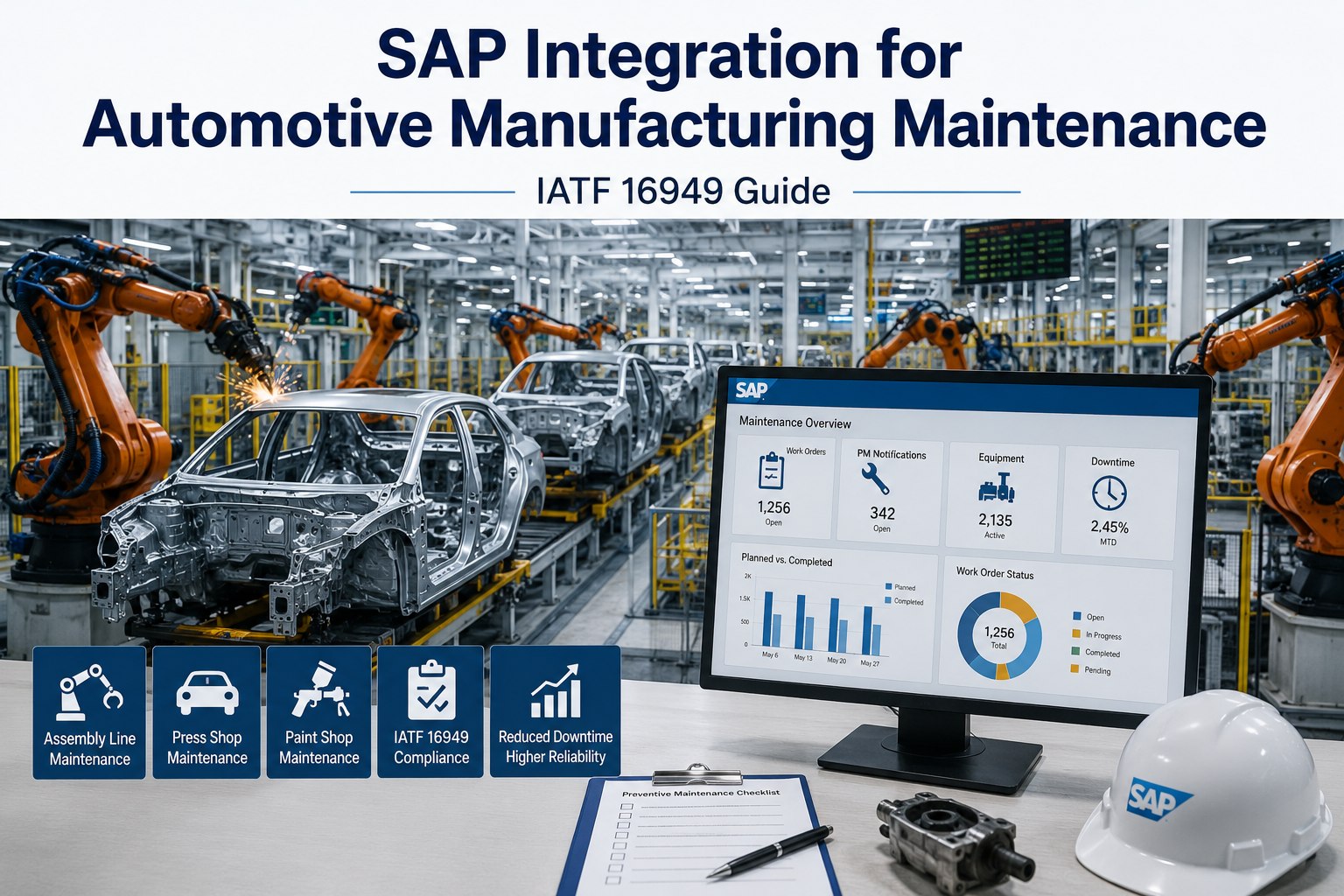
SAP Integration for Automotive Manufacturing Maintenance | IATF 16949 Guide
Automotive plants operate on a clock no other industry matches. Stamping presses cycle every 6 seconds. Welding robots fire 300 times per minute. Assembly lines pace a vehicle through final inspection every 60-90 seconds. When equipment fails, the takt-time clock stops—and so does the entire $400-per-minute revenue stream behind it. SAP-CMMS integration in automotive must serve IATF 16949 compliance, TPM execution discipline, and high-tempo recovery simultaneously. The plants that get integration right keep takt; the ones that don't accumulate downtime that compounds across shifts. Book a free demo to see automotive-grade integration.
AUTOMOTIVE PRODUCTION REALITY
Every Minute of Downtime Costs Roughly $400—Across Six Distinct Plant Areas
60-90s
Typical Final Assembly Takt
85%+
World-Class OEE Target
IATF
16949 Quality Standard
6
Distinct Plant Areas
Why Automotive Maintenance Operates on Different Rules
Most manufacturing operations measure success in shifts or days. Automotive plants measure success in seconds. A vehicle exits final assembly every 60-90 seconds in volume passenger-car production—roughly 50-60 vehicles per hour, 1,200+ per shift, 4,000+ per day in three-shift operations. The economic consequence of equipment failure compounds at this tempo: a 30-minute downtime event isn't an inconvenience, it's 25-30 vehicles that didn't get built, plus the cascade effects on supplier just-in-sequence deliveries and downstream rework if the failure produces quality issues.
IATF 16949 codifies this reality in maintenance terms. Clause 8.5.1.3 requires documented preventive maintenance of production equipment with measurable effectiveness. Clause 7.1.5 mandates calibrated measuring equipment with traceable records. The maintenance program isn't just a reliability function; it's evidence that your plant operates within the quality discipline OEMs require of every Tier 1 supplier. Maintenance leaders ready to align with IATF 16949 can Sign up free to align maintenance with IATF 16949.
The 6 Automotive Plant Areas + Their Maintenance Profiles
The framework below maps the six functional plant areas every automotive operation runs, with each area's takt time, critical equipment, maintenance challenges, and integration requirements. Paint shop anchors as the gold accent because it's typically the most maintenance-intensive area—the bottleneck that determines plant capacity.
6 PLANT AREAS · TAKT TIMES · IATF CLAUSES · MAINTENANCE PROFILES
Automotive Plant Maintenance Map
PHASE A · Body Construction
PHASE B · Paint & Assembly
PHASE C · Powertrain & Quality
01
Stamping / Press Shop
IATF 8.5.1.3
TAKT
6-15 sec/cycle
CRITICAL EQUIPMENT
Hydraulic/mechanical presses (200-2,000 ton), dies, blanking lines, transfer systems
MAINTENANCE CHALLENGE
Extreme cycle counts; die wear tracking; lubrication system reliability; bolster alignment
INTEGRATION DELIVERS
Die hit counters; lubrication scheduling; press tonnage monitoring tied to SAP equipment master
02
Body Shop / Weld Shop
IATF 8.5.1.3
TAKT
60-90 sec/unit
CRITICAL EQUIPMENT
200-800 welding robots, fixtures, tip dressers, weld controllers, geometry stations
Gauge R&R; CMM verification; vision system calibration; measurement traceability
INTEGRATION DELIVERS
Calibration records with NIST traceability; gauge R&R scheduling; measurement uncertainty tracking
2Body Construction
2Paint & Assembly
2Powertrain & Quality
03Paint Shop Anchor
The takt indicator on each row tells the story automotive maintenance leaders know intuitively: when stamping cycles every 6 seconds, you have 6 seconds between problems becoming production losses. Integration architecture must serve this rhythm. Maintenance leaders ready to apply the framework can Sign up free to apply the 6-area framework.
SEE IT IN PRACTICE
Walk Through Automotive Plant Integration Live
30-minute walkthrough showing stamping press monitoring, robot fleet management, paint shop scheduling, and quality gate calibration—all running in an integrated SAP-CMMS architecture sized for automotive takt.
A 30-minute unplanned downtime event in stamping doesn't end at minute 30. The press recovers, but the body shop runs short of blanks. The paint shop runs short of bodies. Final assembly runs short of paintable units. Each upstream area's recovery ripples downstream over the next 90-120 minutes. Three-shift operations then carry the residual into the next shift's planning, where catch-up overtime competes with scheduled maintenance windows. A single 30-minute event easily produces 3-4 hours of downstream effect by the end of the day. Integration architecture's value isn't preventing every event—it's reducing both frequency and recovery time so the cascade never starts.
TPM in Automotive: Beyond Theory to Operational Practice
TPM (Total Productive Maintenance) originated in Toyota's supply chain and remains the dominant maintenance philosophy in automotive worldwide. The four foundational pillars below describe what TPM looks like operationally—not as an academic framework but as the daily discipline that produces 85%+ OEE.
Autonomous Maintenance
Operators perform basic care (clean, inspect, lubricate, tighten). Integration captures their findings as the first line of defense.
Planned Maintenance
Time-based and condition-based PM driven from SAP plans, executed in CMMS, with measurable effectiveness per equipment.
Focused Improvement
Loss elimination targeting the 6 Big Losses. Integration provides the data; Kaizen teams use it to attack root causes.
Quality Maintenance
Maintain equipment conditions that produce zero defects. Maintenance metric becomes FTQ (first-time quality), not just uptime.
The pattern that works across all four pillars: integration makes the discipline visible and measurable. Without that, TPM becomes a wall poster in the breakroom. With it, TPM becomes the way the plant runs. Maintenance leaders ready to operationalize TPM can Sign up free to operationalize TPM pillars.
ROI of Automotive Plant Integration
Automotive integration ROI shows up in metrics that matter to plant managers and OEM customer relationships: OEE, unplanned downtime, MTTR, audit posture, and inventory efficiency. The deltas below reflect typical gains from ad-hoc to integrated maintenance.
AD-HOC vs INTEGRATED AUTOMOTIVE MAINTENANCE
Plant Performance Delta
Overall Equipment Effectiveness
~65%
85%+
+20 pts
Unplanned Downtime Share
8%
2%
−75%
Mean Time to Repair (MTTR)
90 min
20 min
−78%
IATF 16949 Audit Observations
Common
Near-zero
−85%
Spare Parts Inventory Turnover
4x
8x
+100%
85%+
OEE achievable with integrated maintenance discipline
20 min
MTTR with mobile work orders and parts visibility
The compounding effect: faster MTTR raises availability; better PM raises performance; tighter quality maintenance raises FTQ. Each component of OEE reinforces the others. Plant leaders ready to model integration payback can Book a free demo to model OEE improvement scenarios.
Expert Perspective on Automotive Plant Maintenance
"
The automotive plants I've watched genuinely transform their maintenance share an unusual realization: they stopped measuring maintenance by maintenance metrics and started measuring it by production metrics. The maintenance team's KPI isn't "PM compliance percentage"—it's "did the line run at takt this shift." The shift changes everything. Suddenly the maintenance team is asking different questions during PM design: not "what does the manual say?" but "what failure modes actually cost us minutes at takt?" Suddenly investments in condition monitoring and rapid-response capability look obvious rather than expensive. The plants that stay stuck treat maintenance and production as separate organizations measuring separate things; the plants that excel treat them as one organization measuring the line. Automotive maintenance is production maintenance.
01
Measure Maintenance by Production
PM compliance is an input metric. Did the line run at takt is the outcome metric. Optimize for the outcome, not the input.
02
Build for Rapid Response
In automotive, 20-minute MTTR vs 90-minute MTTR is the difference between hitting and missing shift targets.
03
Treat the Plant as One Organization
Maintenance and production aren't separate departments—they're functions of the same plant serving the same takt.
90-Day Automotive Integration Roadmap
The 90-day program below establishes automotive-grade SAP-CMMS integration: plant area mapping, TPM pillar setup, IATF 16949 evidence workflows, and production-rhythm operations.
90-DAY AUTOMOTIVE ROADMAP
From Plant Area Mapping to Production-Rhythm Integration
DAYS 1–25
01
Plant Area Mapping
Inventory equipment by plant area (stamping, body, paint, assembly, powertrain, QA). Map to SAP master. Identify critical-path bottlenecks.
DAYS 26–50
02
TPM Pillar Integration
Configure autonomous maintenance workflows; integrate planned maintenance; set up loss tracking for 6 Big Losses.
Mobile work orders deployed; rapid-response protocols active; takt-aligned PM scheduling; OEE tracking against shift targets.
KEEP TAKT
Make Your Automotive Plant Maintenance Production-Rhythm Ready
Six plant areas mapped. TPM pillars operational. IATF 16949 evidence flowing. The integration architecture that makes 85%+ OEE achievable and audit posture defensible.
How does IATF 16949 differ from ISO 9001 for maintenance specifically?
ISO 9001 requires a quality management system with general process control. IATF 16949 adds automotive-specific requirements that materially change maintenance expectations. Clause 8.5.1.3 explicitly requires documented preventive maintenance of production equipment with measurable effectiveness—not just "we do PM" but "we measure whether our PM is actually preventing failures." Clause 7.1.5 requires calibrated measuring equipment with traceability to national or international standards. Clause 10.2 requires nonconformity and corrective action with documented root cause analysis. Clause 8.5.5.1 requires consideration of TPM. The cumulative effect: maintenance programs that pass ISO 9001 may fail IATF 16949 simply because the automotive standard demands evidence of effectiveness, not just procedure existence.
What's the practical difference between TPM and standard preventive maintenance?
Standard PM is a maintenance team activity: technicians follow schedules, perform tasks, document completion. TPM is a plant activity involving operators, maintenance, engineering, and management together. Operators perform autonomous maintenance (cleaning, inspection, basic lubrication) on equipment they run. Maintenance focuses on tasks operators can't do. Engineering eliminates failure modes through equipment design changes. Management protects time and budget for TPM execution. The metrics differ too: standard PM measures schedule compliance; TPM measures the 6 Big Losses—equipment failure, setup/adjustment, idling/minor stops, reduced speed, defects, and startup losses. The systemic view is what produces the OEE improvements TPM is known for.
How do we handle maintenance during planned production windows?
Automotive plants typically have planned maintenance windows: end-of-shift (15-30 min), weekly preventive (varies by shift pattern), and monthly/quarterly major maintenance. The integration pattern that works: the CMMS knows the production schedule and surfaces maintenance candidates that fit available windows. Major maintenance is planned weeks ahead with model-mix considerations; minor maintenance gets fit into shorter windows; emergency maintenance interrupts production only when truly necessary. Without integration, maintenance windows get wasted on whatever the shift supervisor remembers; with integration, every window is optimized against the prioritized backlog.
What KPIs matter most for automotive maintenance leaders?
Five KPIs dominate automotive maintenance dashboards. OEE (Overall Equipment Effectiveness) measures the combined effect of availability, performance, and quality—world-class is 85%+. MTBF (Mean Time Between Failures) measures reliability; trends matter more than absolute values. MTTR (Mean Time to Repair) measures response capability; 20 minutes is excellent, 90 minutes is poor. PM Compliance measures schedule adherence; should be near 100% but doesn't predict reliability alone. FTQ (First-Time Quality) measures defect-free output; maintenance affects this through equipment condition. The strongest plants track these against takt-time pressure and treat decreases as urgent problems.
How does integration support PPAP and APQP processes?
PPAP (Production Part Approval Process) and APQP (Advanced Product Quality Planning) require evidence that production equipment is qualified, calibrated, and capable of producing parts to specification. The integration architecture captures this evidence as routine output: equipment qualification records, calibration history with traceability, capability studies (Cpk), and maintenance history for the specific equipment producing the part. When a new program launches, the PPAP submission can reference live evidence from integrated systems rather than reconstructing documentation. When customer audits scrutinize particular parts, the equipment history is queryable in minutes rather than reconstructed in days. The integration becomes part of the quality system, not adjacent to it.