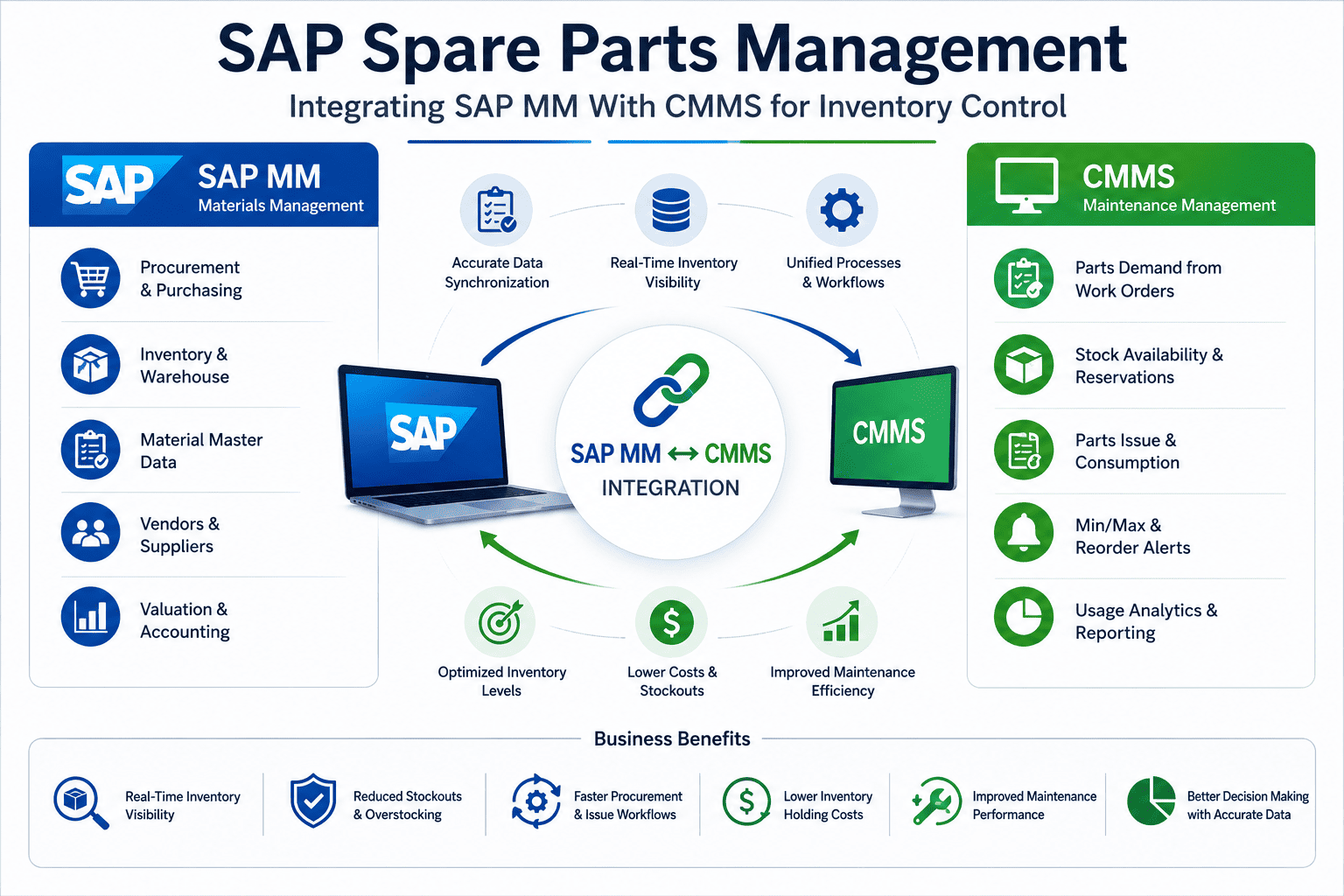
Every time a technician replaces a bearing, swaps a filter, or installs a gasket, that part needs to leave SAP MM inventory. In theory, a goods issue (movement type 261) posts instantly against the maintenance order. In practice, technicians finish the repair, move to the next job, and log the parts at the end of the shift — if they log them at all. The result: SAP inventory shows parts on the shelf that were consumed hours ago, reorder points trigger too late, and finance allocates costs to the wrong period. Oxmaint eliminates this gap entirely. When a technician closes a work order on the Oxmaint mobile app, every part consumed posts to SAP MM as an automatic goods issue in real time — no manual MIGO transaction, no end-of-shift batch entry, no missing records. Start your free trial and automate goods issue from your very first work order closure. Or schedule a demo to see how Oxmaint turns maintenance completion into instant SAP inventory updates.
SAP MM Integration
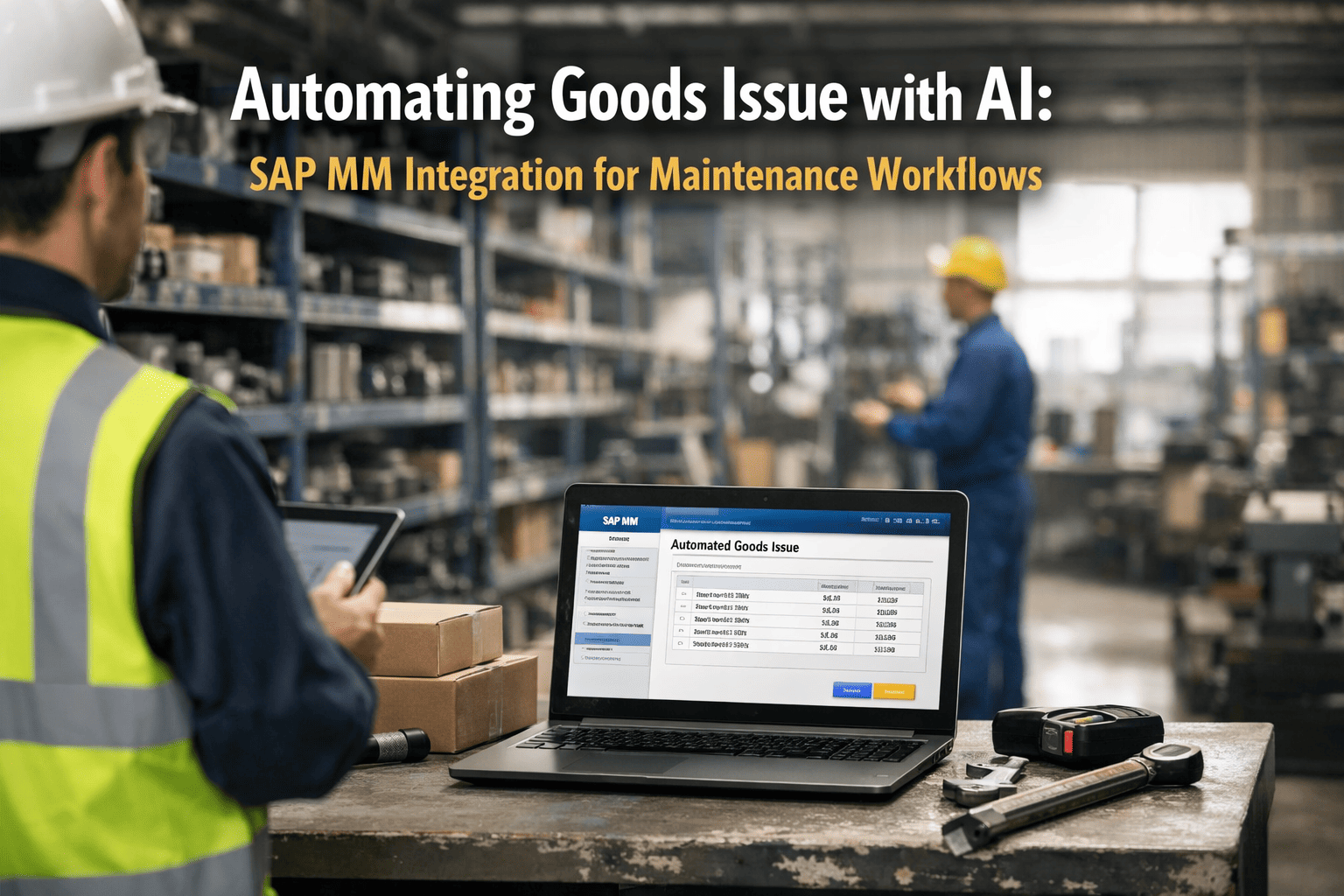
Automating Goods Issue with AI: SAP MM Integration for Maintenance Workflows
Operations Guide · 8 min read
40%
Maintenance data goes unrecorded when technicians must navigate SAP's desktop interface for parts logging
<60s
Time from Oxmaint work order closure to automatic goods issue posting in SAP MM
4-8 hr
Typical delay in manual parts logging — SAP inventory blind spot where stock shows available but is consumed
85%
Reduction in manual data re-entry when Oxmaint automates the field-to-SAP goods issue workflow
Oxmaint: Work Order Closes → SAP Goods Issue Posts Automatically
Oxmaint connects every maintenance completion directly to SAP MM — parts consumption, cost allocation, and inventory deduction happen the instant a technician taps "Complete" on their mobile device. No MIGO. No batch entry. No missing records.
The Goods Issue Gap: What Breaks in Manual Workflows
Goods issue is one of the simplest SAP MM transactions — movement type 261 posts a material withdrawal against a maintenance order. But simplicity in concept does not mean simplicity in practice. Technicians work in turbine halls, on rooftops, and inside equipment enclosures. They are focused on the repair, not on navigating MIGO in SAP GUI. The gap between physical parts consumption and SAP inventory update is where maintenance inventory accuracy falls apart.
Technician completes repair
4-8 hours pass
Handwritten parts list submitted
Planner re-keys into SAP
MIGO posted — often with errors
Inventory inaccurate for hours
Finance costs posted late or wrong
Result: Ghost inventory, missed reorders, wrong cost allocation
Technician scans part on mobile
↓ Instant
Part linked to work order automatically
↓ Instant
Work order closed on Oxmaint app
↓ < 60 seconds
Goods issue posts to SAP MM (Mvt 261)
Result: SAP inventory accurate in real time, costs settled, reorders triggered
Five Ways Manual Goods Issue Costs You Money
01
Ghost Inventory
SAP shows 12 bearings on the shelf. In reality, 4 were consumed this morning and never logged. The next technician plans a repair based on false availability — then discovers the part is not there, causing a second trip to the storeroom or a production delay.
02
Missed Reorder Points
Reorder triggers in SAP MM depend on accurate stock levels. When goods issues are posted 4–8 hours late — or not at all — safety stock thresholds are never breached, purchase requisitions are never generated, and emergency procurement fills the gap at premium cost.
03
Wrong Cost Allocation
When parts consumption is posted late, costs settle to the wrong period or the wrong cost centre. Finance reports lag reality. Maintenance cost per asset becomes unreliable. Capital planning decisions are made on incomplete data.
04
Audit & Compliance Gaps
Handwritten parts lists have no timestamp, no traceability, and no link to the specific work order. When auditors ask "which parts were used for this repair?", the answer lives on a scrap of paper — if it exists at all.
05
Technician Time Wasted
Navigating SAP MIGO or filling out paper forms is not maintenance work — it is administrative overhead. Every minute a technician spends on data entry is a minute they are not repairing, inspecting, or preventing the next failure.
How Oxmaint Automates Goods Issue in SAP MM
Oxmaint turns every work order closure into an automated SAP MM goods issue — no manual transaction, no planner re-entry, no delay. Here is the exact workflow from field to SAP.
Technician Scans or Selects Parts on Mobile
Using Oxmaint's mobile app, the technician scans a barcode or QR code on the spare part — or selects from the work order's pre-populated BOM. Part number, quantity, and storage location are captured automatically. Works fully offline.
Work Order Completed with Parts Attached
When the technician taps "Complete", every consumed part is linked to the work order with timestamp, quantity, storage location, and technician ID. Photos and notes can be attached for audit trail. No paper forms involved.
Automatic Goods Issue Posts to SAP MM
Oxmaint's certified SAP connector triggers a movement type 261 goods issue in SAP MM within seconds. Stock levels update instantly. Reorder points evaluate against current (not stale) inventory. The goods issue references the SAP maintenance order automatically.
Cost Settled to SAP FI/CO in Real Time
Material costs flow from SAP MM to FI/CO against the correct cost centre and maintenance order. Finance sees actual maintenance costs as they happen — not in weekly batch postings. Asset-level cost tracking becomes accurate by default.
The AI Layer: Smarter Inventory, Not Just Faster Posting
Automating the goods issue transaction is step one. Oxmaint's AI layer goes further — analysing consumption patterns across your entire asset portfolio to predict what parts you will need before you need them, flag unusual consumption that might indicate a deeper equipment problem, and optimise reorder quantities based on actual usage rather than OEM estimates.
Consumption Pattern Analysis
Oxmaint's AI tracks which parts are consumed against which asset classes, at what frequency, and under what conditions. Seasonal spikes, batch-related patterns, and accelerating failure curves are surfaced automatically — giving planners data-driven reorder intelligence.
Anomaly Detection on Consumption
If a pump that normally uses one seal kit per quarter suddenly consumes three in a month, Oxmaint flags this as an anomaly and links it to the asset's condition history — suggesting investigation before the next failure rather than just re-ordering more seals.
Predictive Parts Forecasting
By combining AI condition monitoring with historical parts consumption data, Oxmaint predicts which parts will be needed in the coming weeks — enabling pre-staging that reduces emergency procurement and keeps planned maintenance on schedule.
Optimised Reorder Quantities
Static SAP reorder points are based on estimates. Oxmaint's AI adjusts safety stock and reorder quantities dynamically based on actual consumption velocity, lead time variability, and asset condition forecasts — reducing both stockouts and excess inventory.
Automate Goods Issue. Predict Parts Demand. Eliminate Stockouts.
Oxmaint turns every work order closure into an instant SAP MM goods issue — and layers AI-driven consumption intelligence on top. Your inventory becomes self-correcting, not manually managed.
What Posts to SAP When a Work Order Closes
Every Oxmaint work order completion triggers a precise set of SAP transactions — not just the goods issue. Here is exactly what flows to each SAP module automatically.
SAP MM
Goods Issue (Mvt 261)
Material number & quantity consumed
Storage location & plant code
Reference to maintenance order
Stock level deduction (real-time)
Reorder point evaluation triggered
SAP PM
Work Order Confirmation
Labour hours & technician time entries
Technical completion status
Failure codes & observations
Equipment history updated
Next PM schedule recalculated
SAP FI/CO
Cost Settlement
Material cost to maintenance order
Labour cost to cost centre
General Ledger posting (real-time)
Asset-level cost accumulation
Period-accurate financial reporting
Before & After: Inventory Accuracy with Oxmaint
| Metric |
Manual Goods Issue |
Oxmaint Automated Goods Issue |
| Time to SAP MM posting |
4–8 hours (end-of-shift batch entry) |
Under 60 seconds from work order closure |
| Parts logging accuracy |
60% — handwritten, unverified, often incomplete |
99%+ — barcode scanned, system-validated, timestamped |
| Reorder trigger reliability |
Delayed — evaluates against stale stock levels |
Instant — evaluates against real-time post-consumption stock |
| Cost allocation accuracy |
Weekly batch — often wrong period or cost centre |
Real-time settlement to correct order and period |
| Audit trail |
Paper-based, untraceable, incomplete |
Digital: technician ID, timestamp, photo, GPS, work order link |
Oxmaint SAP Compatibility
✓
SAP ECC & S/4HANA
Certified connector for both — continuity during migration
✓
Full Offline Mode
Parts scan and work order complete offline — syncs on reconnect
✓
Barcode & QR Scanning
Camera-based part identification — no extra hardware needed
✓
4–8 Week Deployment
Full SAP integration live in weeks — no middleware required
Frequently Asked Questions
How does Oxmaint automate goods issue in SAP MM?
Does Oxmaint work offline for parts tracking?
What SAP movement types does Oxmaint support?
How does AI improve inventory management beyond automation?
Oxmaint's AI layer analyses parts consumption patterns across your asset portfolio to detect anomalies (unusual consumption that signals equipment problems), predict future parts demand based on condition monitoring, and optimise reorder quantities dynamically — moving your inventory from static SAP estimates to data-driven, self-adjusting intelligence.
Sign up free and see AI-powered consumption insights from your first month of data.
Does Oxmaint replace SAP MM?
No. SAP MM remains the system of record for inventory, procurement, and materials management. Oxmaint serves as the mobile execution layer that captures parts consumption in the field and posts it to SAP MM automatically. SAP stays your inventory backbone. Oxmaint ensures the data feeding it is accurate, timely, and complete.
Schedule a demo to see the architecture in action with your SAP environment.
Every Part Tracked. Every Cost Settled. Every Goods Issue Automatic.
Oxmaint turns work order closure into instant SAP MM goods issue, real-time cost settlement, and AI-powered inventory intelligence. Deploy in 4–8 weeks. No middleware. No manual MIGO. No missing parts data.