A single failed runway edge light can trigger a NOTAM, an immediate runway closure, and cascading delays totaling hundreds of thousands of dollars. The bulb costs forty dollars. Airport maintenance lives in this gap—catastrophically simple failures producing operationally enormous consequences. SAP PM provides the financial backbone, but managing 24/7/365 facility operations from a desktop transaction screen doesn't work. Airports getting this right pair SAP PM with purpose-built CMMS execution covering FAA Part 139, ground support equipment, and terminal infrastructure from one mobile platform. Book a free demo to walk through airport SAP PM integration.
Why Airport Maintenance Breaks Generic SAP PM Setups
SAP PM was designed for industrial plants where you can negotiate downtime windows. Airports don't have downtime windows. Runways are active. Terminals are occupied. Baggage systems are running. The maintenance team works around live operations 24 hours a day, with regulatory documentation requirements that no other industry imposes. A single jet bridge has electrical, hydraulic, structural, and fire safety inspection cycles—each with its own regulator, evidence trail, and audit calendar. Multiply that by 60 to 200 jet bridges, plus runway lighting circuits, baggage conveyors, HVAC plants, ARFF vehicles, and several hundred pieces of ground support equipment.
The result is asset complexity that overwhelms any maintenance management approach built on desktop SAP transactions. Technicians can't navigate IW31 from the apron at 2 AM. Compliance evidence can't live in spreadsheets when an FAA inspector arrives unannounced. The plants—and the airports—getting this right keep SAP PM as the financial backbone and layer purpose-built CMMS execution on top, with mobile inspections, automated compliance archiving, and condition monitoring across every airport asset class. Airport operations teams ready to see the layered architecture in action can Sign up free to model SAP PM integration for their airport assets.
The Airport Asset Universe in One View
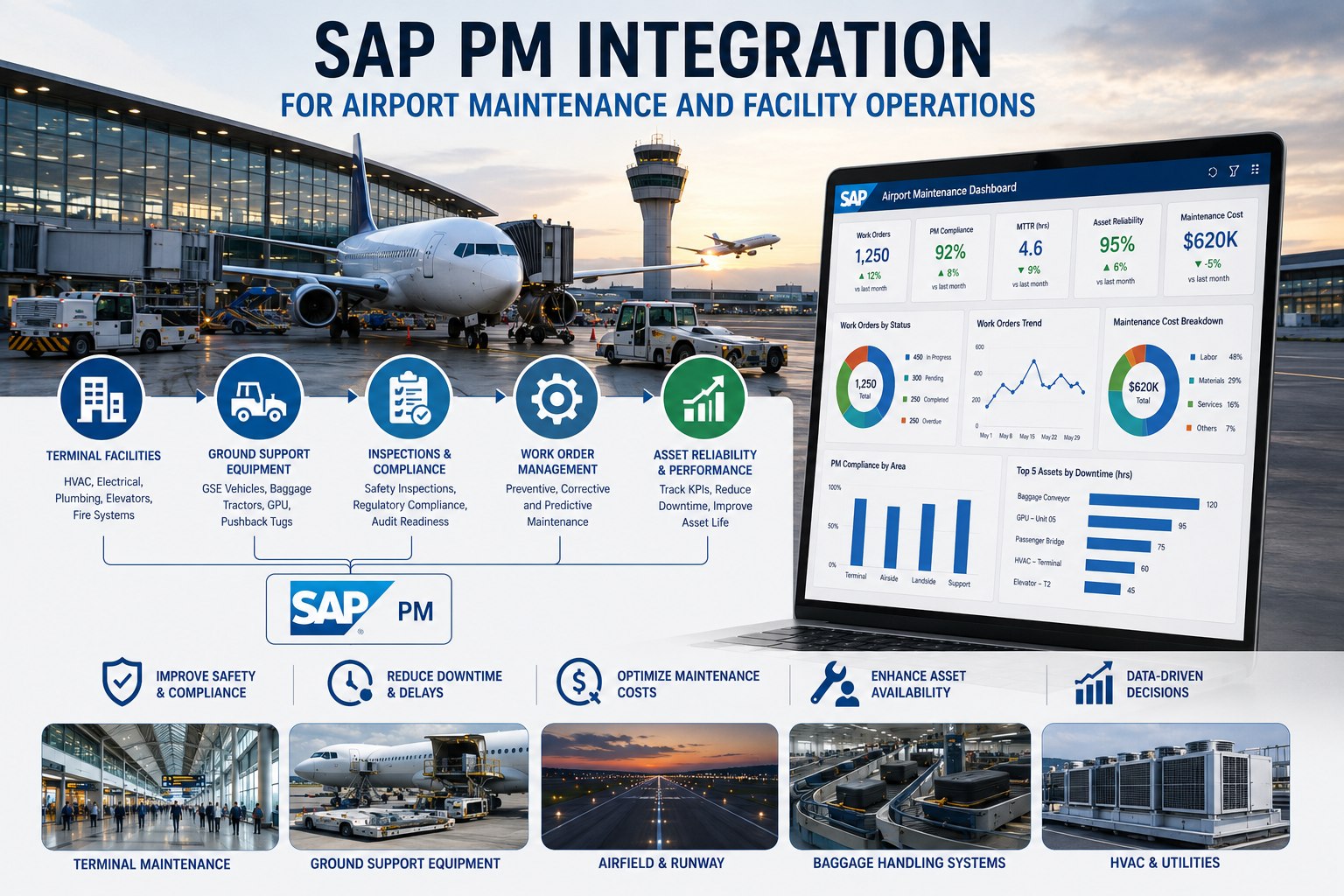
The visual below maps the assets a single mid-size international airport manages every day. Each zone represents a distinct regulatory regime, maintenance cadence, and operational risk profile—yet all of them must share one SAP equipment master, one cost structure, and one compliance audit trail.
The asset universe is genuinely vast, and that's the central challenge: a maintenance approach that works for a 200-asset food plant breaks at airport scale. Successful integrations don't simplify the asset hierarchy—they make it navigable. Mobile-first execution means a technician walking the apron at 3 AM can pull up the full service history of any GSE unit by scanning a tag. Compliance dashboards mean an FAA inspector arriving Monday morning can be handed a 90-day evidence packet in twenty minutes instead of two weeks.
Three Compliance Regimes Running in Parallel
What separates airport maintenance from every other facility category is the simultaneous, non-overlapping regulatory load. A single asset—a jet bridge—falls under electrical, hydraulic, structural, and fire safety inspection codes at the same time. The CMMS layered on SAP PM has to satisfy all of them without the maintenance team building three different reporting systems.
The cost of failing any one of these isn't just the fine—it's the operational restriction that follows. A FAA Part 139 violation can result in an operating restriction. An NFPA-tagged life safety deficiency can shut a terminal wing. An ICAO finding can affect aerodrome certification. Plants and airports ready to put compliance evidence on autopilot can Sign up free to begin auto-archiving regulatory evidence from the first work order.
The 24-Hour Operations Window Problem
Airports don't close. Maintenance has to happen around live operations, often in narrow overnight windows when traffic drops below operational thresholds. The integration of SAP PM with airport-purpose CMMS makes this scheduling possible by treating flight schedules as a hard constraint and routing maintenance windows around them automatically.
The system that makes this work doesn't just generate maintenance orders—it sequences them. A runway lighting inspection auto-schedules into the 02:00–05:00 window. An escalator deep clean lands in 23:00–02:00. A GSE rotation flows into 14:00–16:00. Emergency overrides exist, but the planning system defaults to non-disruptive windows so peak operations stay protected.
ROI: What Integration Returns for Airport Operations
The financial math at airport scale moves faster than at industrial facilities because the cost of any single failure is so much higher. A single avoided gate closure pays for years of CMMS investment. The numbers below come from operating data at mid-size hub airports that moved from siloed maintenance tracking to SAP PM integrated with airport-purpose CMMS execution.
| Operating Metric | Siloed Tracking | Integrated CMMS | Shift |
|---|---|---|---|
| FAA Part 139 audit prep time | 10–14 days | < 1 day | −93% |
| Jet bridge availability | 91% | 98% | +7 pts |
| Baggage system unplanned downtime | Baseline | Down 38% | −38% |
| GSE fleet availability | 86% | 96% | +10 pts |
| PM compliance rate | 74% | 93% | +19 pts |
| Maintenance efficiency | Baseline | Up 25–40% | Material |
The biggest single ROI lever is the prevented gate closure. At $10,000 to $50,000 per hour of cascading delays, catching one jet bridge bearing failure during a scheduled inspection instead of as a peak-hour breakdown pays for the entire CMMS program for several years. Airport operations teams ready to model the financial case for their specific fleet can Book a free demo to walk through projected savings on their asset base.
Expert Perspective: What Sets Airport Maintenance Apart
The mistake most airports make is treating maintenance like an industrial problem with regulatory paperwork bolted on. The plants that get this right invert that: they treat compliance evidence as the primary output of maintenance work, with cost tracking and asset history as secondary. When every work order completion automatically produces FAA-ready documentation, GPS-stamped inspection records, and signed evidence packets, the audit becomes a non-event. When it doesn't, the audit becomes a six-week scramble that pulls maintenance teams away from the actual work of keeping the airport operational.
90-Day Path to Integrated Airport Maintenance
Most airport CMMS implementations underestimate the integration work and overestimate the configuration work. The phased path below is what successful airport operators execute—starting with a single zone, validating the SAP PM connection, then scaling to full facility coverage.
By day 90, airports executing this roadmap typically see PM compliance climb from the low 70s to the low 90s, jet bridge availability move from 91 to 98 percent, and FAA audit prep time drop from two weeks to less than a day. Airport operations teams ready to begin the discovery phase can Sign up free to start mapping airport assets to SAP PM this week.