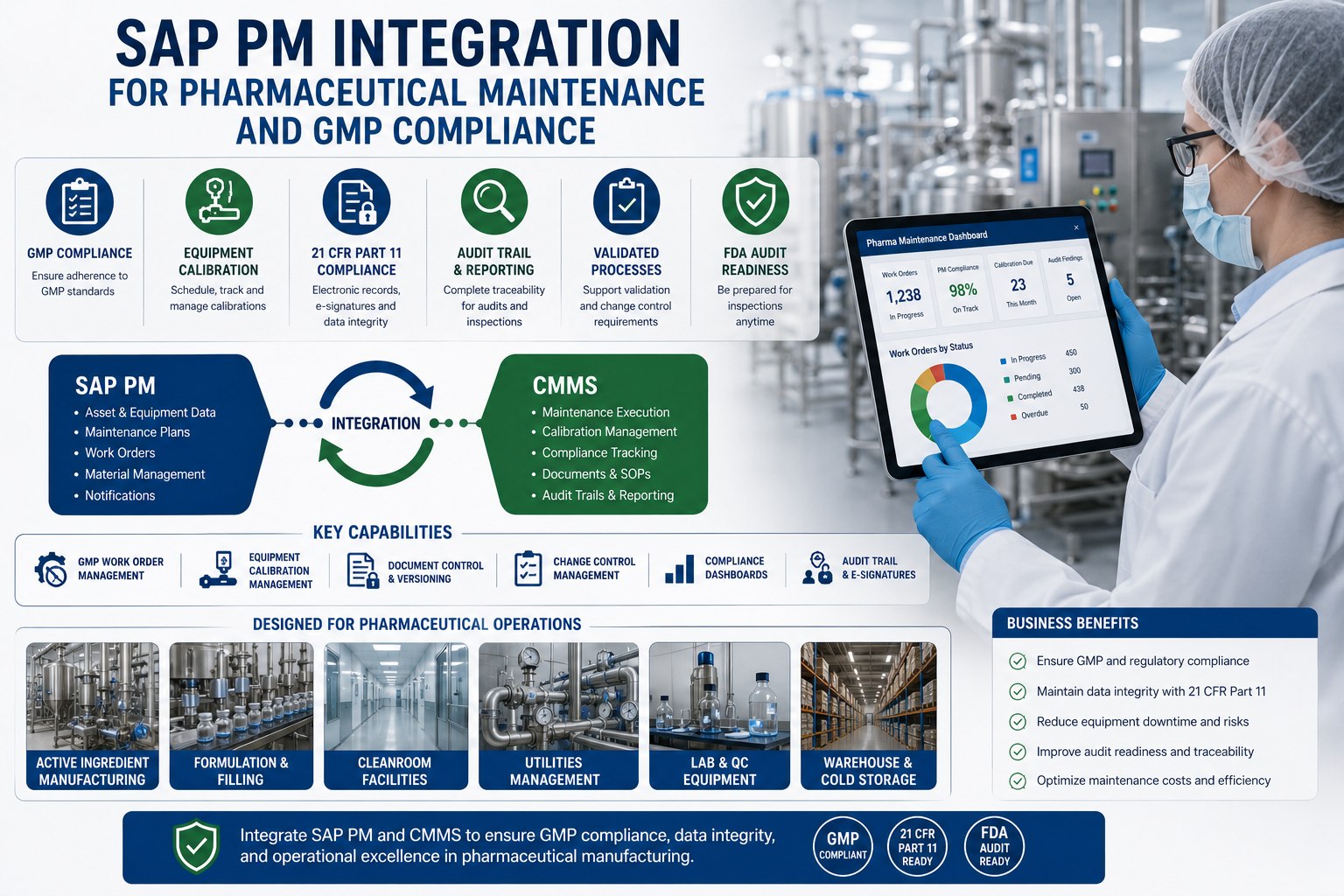
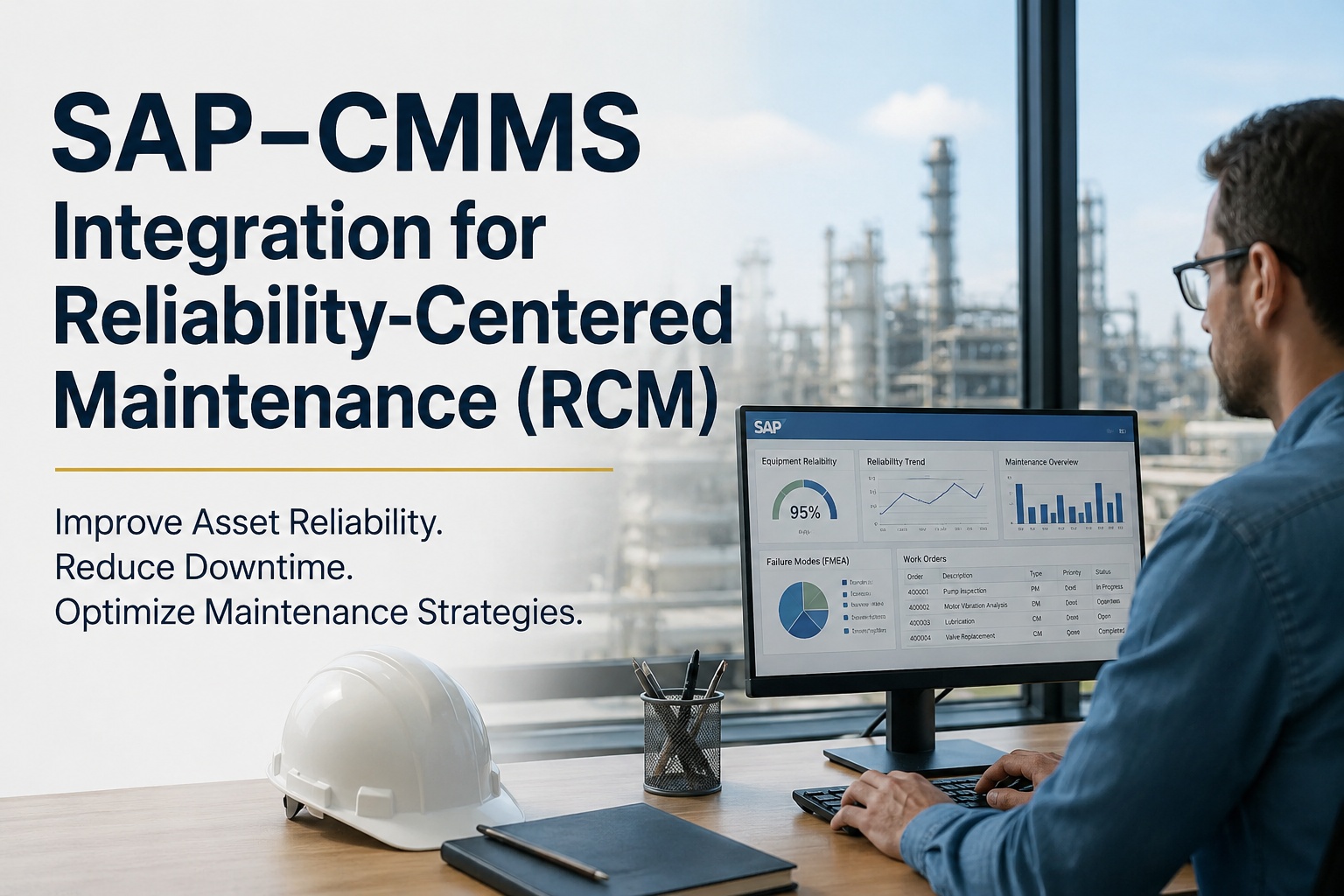
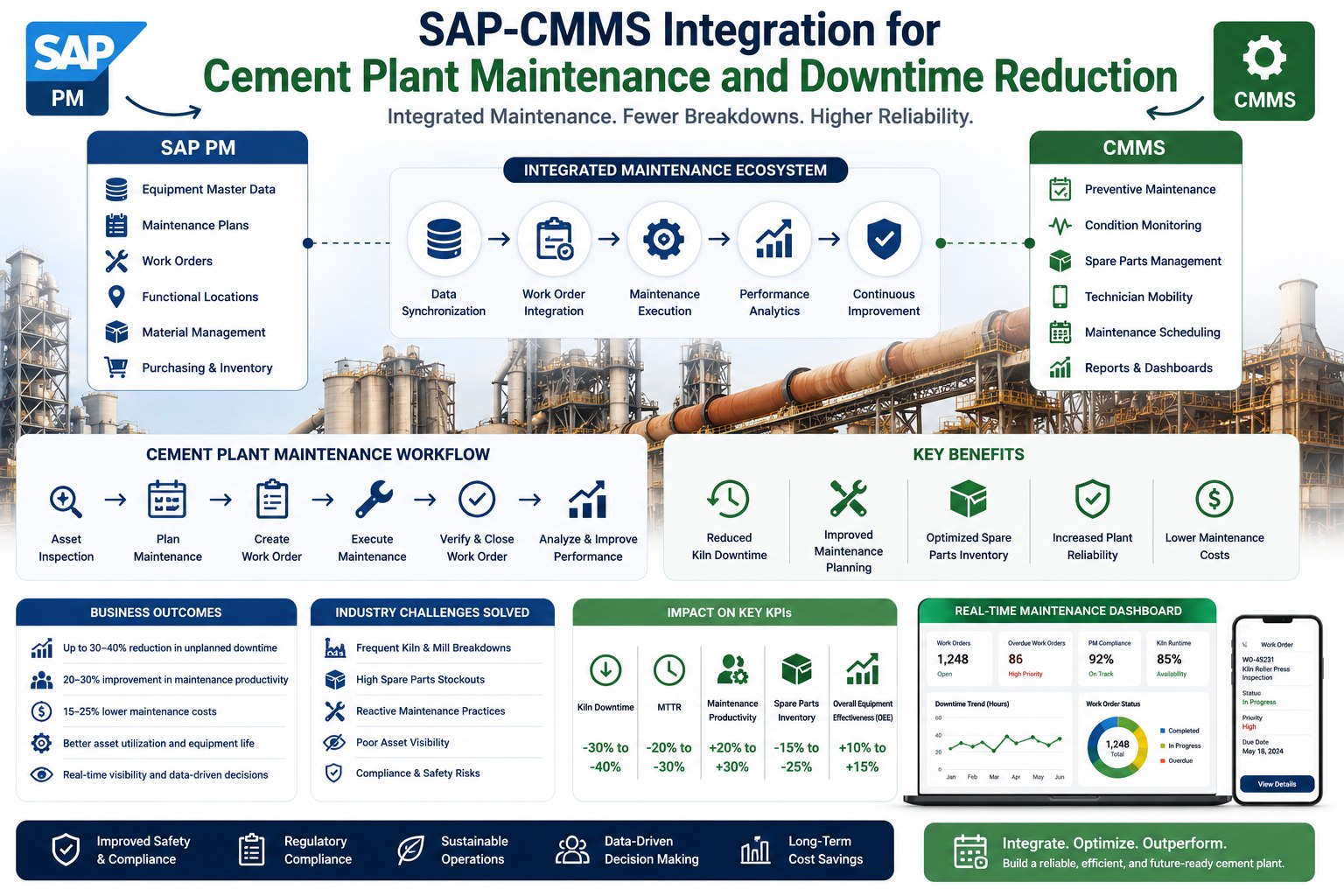
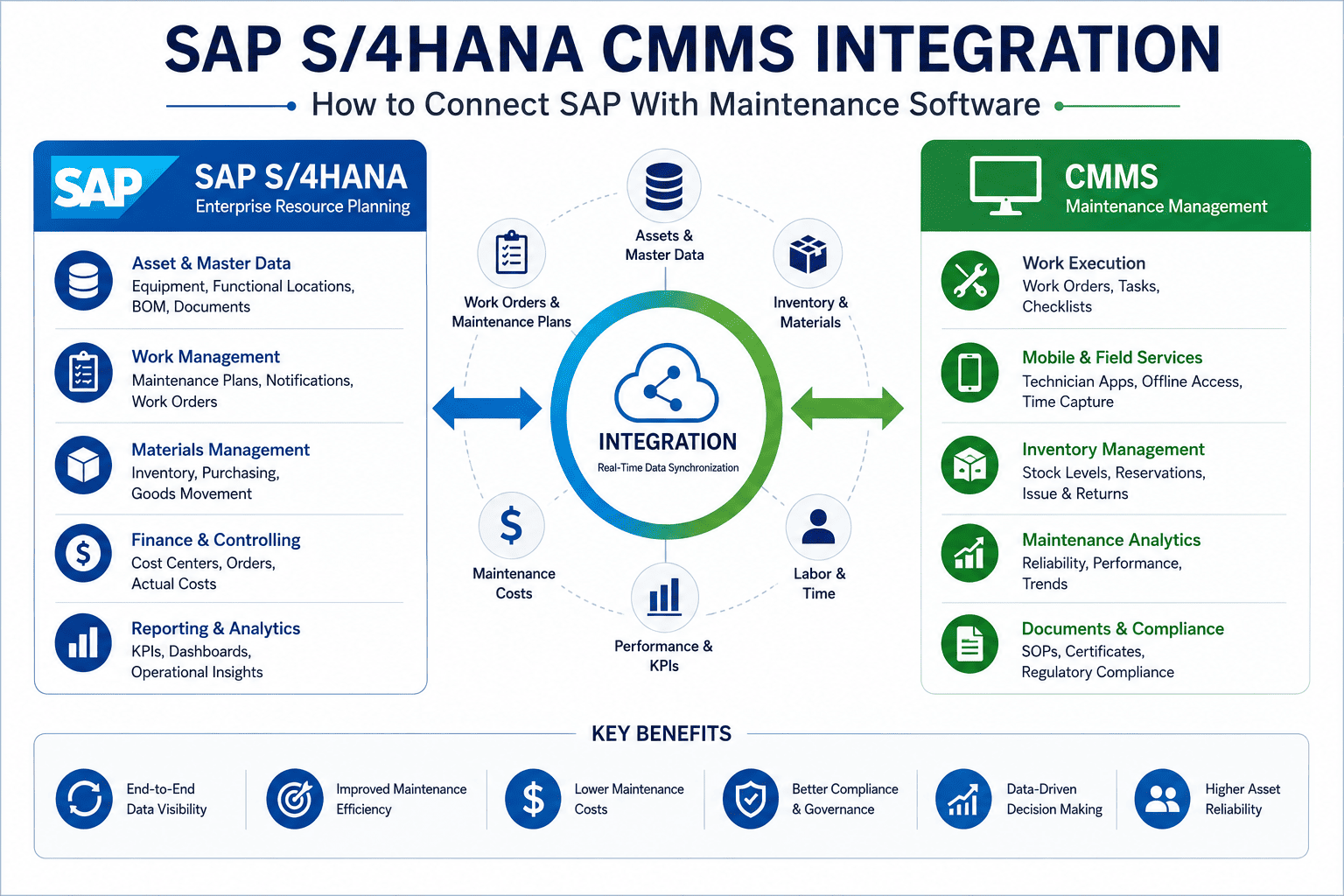
In 2025, the FDA issued 85 warning letters to pharmaceutical manufacturers. Data integrity deficiencies appeared in 60 to 80 percent of them. The top-cited GMP violation—failure to follow written quality procedures—has held that position for four consecutive years. Pharmaceutical maintenance isn't just OSHA compliance with a pharma label. It's a separate regulatory universe where every PM, every calibration, every equipment touch must be electronically signed, timestamped, and ALCOA+ compliant. SAP PM provides the financial backbone; the CMMS layer makes the records validated. Book a free demo to walk through GMP maintenance integration.
85
FDA warning letters issued to drug product manufacturers in 2025
Source: FDA enforcement records
60–80%
Of FDA drug GMP warning letters cite data integrity deficiencies
Source: Certivo / FDA analysis
184
FY 2024 citations for 21 CFR 211.22(d) — top violation for 4 consecutive years
Source: RAPS
18,539
FDA inspections in FY 2023; 31% ended in Voluntary or Official Action
Source: FDA
Why Pharma Maintenance Is the Most Regulated Maintenance on Earth
Manufacturing maintenance in any other industry is judged by whether the equipment ran reliably. In pharma, that's the baseline—what FDA actually inspects is whether the maintenance event itself was performed under written procedures, by qualified personnel, with electronic signatures, complete audit trails, and data records that satisfy ALCOA+ principles. A bearing replaced without the correct change control documentation can retroactively invalidate every batch that ran on that equipment. A calibration certificate signed by an unauthorized technician can trigger a product recall. The cost of a single warning letter routinely runs into seven figures in remediation, lost market access, and reputational damage.
This is why pharma SAP PM integrations don't just need to work—they need to be validated. Every workflow, every signature point, every data field has to survive computer system validation (CSV) and demonstrate Part 11 compliance for electronic records and signatures. The CMMS layer sitting on top of SAP PM has to enforce procedures, not just track them. Plants ready to layer validated CMMS execution on top of SAP PM can Sign up free to model GMP maintenance workflows on a sandbox.
The ALCOA+ Framework — Pharma's Data Integrity Foundation
ALCOA+ is the nine-principle framework the FDA uses to evaluate every electronic record produced during GMP operations. Every maintenance workflow in a pharma plant—every PM completion, every calibration result, every change control approval—must satisfy all nine principles simultaneously. The grid below shows how each principle translates into a specific CMMS data control.
A
Attributable
Every record identifies who performed the action, when, and under what authority.
CMMS captures: User ID, role, timestamp, IP / device
L
Legible
Records must be readable and remain so for the entire retention period.
CMMS captures: Structured fields, no free-text-only entries, OCR for scans
C
Contemporaneous
Records created at the time the activity occurred—not later from memory.
CMMS captures: System timestamp at action, not at save
O
Original
The first capture of the data, or a verified true copy with full audit trail.
CMMS captures: Source-of-truth flag, immutable record ID
A
Accurate
Free from errors; all relevant data captured; supported by validated controls.
CMMS captures: Validated instruments, range checks, error trapping
+ C
Complete
All data, including failed tests, repeats, and metadata, is captured and retained.
CMMS captures: No deletion permitted, failed runs flagged not removed
+ C
Consistent
Records follow standard sequence; data flows match procedural expectations.
CMMS captures: Workflow gating, sequence enforcement
+ E
Enduring
Records persist for the full retention period, typically 5–25 years post-batch.
CMMS captures: WORM storage, immutable audit log, backup verified
+ A
Available
Retrievable on demand—including during an FDA inspection in real time.
CMMS captures: Indexed retrieval, inspector view, export-to-PDF
The nine principles look conceptual on paper, but they translate into hard CMMS data controls: structured fields instead of free text, system-generated timestamps instead of user-entered dates, immutable audit logs instead of editable records, mandatory electronic signatures with meaning codes instead of name fields. Plants ready to audit their current maintenance records against ALCOA+ can Sign up free to run an ALCOA+ gap assessment on a sample asset.
21 CFR Part 11 Requirements That Live in Your CMMS
21 CFR Part 11 governs electronic records and electronic signatures in FDA-regulated operations. Three sections of Part 11 land squarely on the maintenance CMMS, and each translates into specific functional requirements that determine whether your records are admissible or worthless.
§ 11.10
Controls for Closed Systems
System validation, audit trail, record retention, access limits, operational checks, authority checks, device checks, and training records for users.
CMMS must provide
Validation documentation · Role-based access · Time-stamped audit trail · Authority checks at each action
§ 11.50
Signature Manifestations
Each signed electronic record must show: printed name of signer, date and time of signature, and the meaning of the signature (authored, reviewed, approved).
CMMS must provide
Full-name display · Timestamp visible · Signature meaning code · Permanent linkage to record
§ 11.70
Signature / Record Linking
Electronic signatures and their associated records must be linked such that the signature cannot be excised, copied, or transferred to falsify a different record.
CMMS must provide
Cryptographic linkage · Record-signature pairing · Tamper detection · Immutability
The trap most pharma operations fall into is assuming SAP PM alone delivers Part 11 compliance. SAP PM holds the master data and financial structure, but the field-execution layer—where the signatures actually happen, where the timestamps get captured, where the audit trail lives—needs purpose-built CMMS functionality validated for Part 11.
The Calibration Lifecycle That Survives an FDA Audit
Calibration is the maintenance activity FDA inspectors examine first, because a missed calibration retroactively questions every measurement taken on that instrument since the previous certification. The lifecycle below shows what an FDA-defensible calibration event captures, from scheduling through expiry alerting.
Day -30
Auto-Generated Alert
CMMS triggers expiry alerts 30, 14, and 7 days before calibration due date. Work order auto-generated. Procedure SOP attached. Required standards reserved.
Day 0
Pre-Calibration Verification
Technician identity authenticated. Training and authorization status verified. Reference standards confirmed traceable to national standards (NIST). Environmental conditions logged.
+ 30 min
As-Found Readings
Pre-adjustment measurements captured—structured fields, not free text. Each reading timestamped at acquisition, not at save. In-tolerance / out-of-tolerance auto-evaluated.
+ 45 min
Adjustment & As-Left Readings
If adjustment required, change control event opens. Post-adjustment readings captured. Reason for adjustment documented. Out-of-tolerance event triggers batch-impact assessment workflow.
+ 60 min
Sign-Off & Certificate Issue
Electronic signature applied with meaning ("Performed By"). Second signature for review ("Reviewed By"). Certificate auto-generated with audit trail attached. Next calibration date set.
The traditional paper version of that same calibration takes between four hours and two days of administrative work after the event itself, with the calibration certificate frequently signed and filed days after the actual measurements. By inspection time, the asynchronous timestamps fail the Contemporaneous principle of ALCOA+ and the entire record becomes questionable. Digital workflows capture every step at the moment it happens.
See Validated SAP-CMMS Running on Pharma Workflows
Walk through a live demo covering 21 CFR Part 11 electronic signatures, calibration lifecycle, change control, and CAPA workflows—all linked to SAP PM. 30 minutes, validated for GMP environments.
ROI: Audit-Ready vs Audit-Scramble
The financial case for pharma CMMS integration doesn't live in operational savings—those are real but secondary. The case lives in avoided warning letters, prevented batch invalidations, and audit cycles that take days instead of months. The numbers below come from pharma operations transitioning from paper-based maintenance documentation to SAP-integrated validated CMMS execution.
Swipe to compare
7 figures
Typical remediation cost of a single FDA warning letter
31%
Of FDA inspections currently end in action-required findings
The single largest financial event in pharma is the avoided warning letter. Average remediation cost runs into seven figures—consent decrees, third-party consultant engagements, batch invalidations, and the operational disruption of running parallel paper and digital systems while remediation proceeds. The plants that consistently end inspections in the No Action Indicated zone are running validated digital workflows, not paper backed by good intentions. Quality and engineering leaders ready to model the financial case can Book a free demo to walk through warning letter risk reduction.
Expert Perspective: What Validated CMMS Actually Means
The mistake most pharma operations make is treating validation as a one-time event rather than a continuous state. A CMMS isn't validated because it was qualified at install three years ago—it's validated because every change is controlled, every user is trained, every workflow is documented, and every electronic record satisfies ALCOA+ continuously. The plants that survive FDA inspections without warning letters do this work as a discipline, not as a project. Their CMMS isn't a tool they bought; it's an operating system they run, with the same rigor they apply to manufacturing itself.
Validate the Workflow, Not Just the Software
Software validation gets the system into a compliant state. Workflow validation—procedures, training, change control, periodic review—keeps it there. Both are required; one without the other fails inspection.
Build to ALCOA+, Not to Convenience
Every shortcut that makes the system easier to use—free-text fields, optional signatures, edit permissions—creates an ALCOA+ failure mode. The right system enforces compliance even when users would rather not.
Calibration Is the FDA's First Question
Inspectors open with calibration because it touches every measurement in every batch. If calibration documentation is bulletproof, the inspection moves on. If it's questionable, every batch becomes vulnerable.
90-Day Path to Validated SAP-CMMS for Pharma
Pharma CMMS implementations are validated implementations—they include qualification documentation, training records, change control evidence, and periodic review schedules from day one. The roadmap below is what successful pharma operations execute when they move from hybrid paper-digital workflows to fully validated SAP-integrated CMMS.
Days 1–20
URS & Risk Assessment
User Requirements Specification document. GAMP 5 risk assessment for system categorization. SAP PM integration architecture defined. Validation plan approved by quality.
Days 21–45
IQ / OQ Execution
Installation Qualification confirms correct deployment. Operational Qualification verifies system behaves per specifications across all functional scenarios. SAP integration tested end-to-end.
Days 46–70
PQ & Pilot Use
Performance Qualification on a pilot asset class. Calibration workflows tested with actual instruments. Electronic signatures validated. User training and SOP completion.
Days 71–90
Go-Live & Periodic Review Cadence
Plant-wide go-live for in-scope workflows. Validation summary report signed. Periodic review schedule established. Mock FDA inspection conducted to verify audit-readiness.
By day 90, the system isn't just live—it's validated, documented, and inspector-ready. The next FDA visit isn't a six-week scramble; it's a routine review where evidence is exported in minutes instead of reconstructed over weeks. Quality and engineering leaders ready to begin the URS phase can Sign up free to start the URS workshop for a validated SAP-CMMS deployment.
Make the Next FDA Inspection a Non-Event
Every PM signed. Every calibration documented. Every change controlled. See a validated SAP-CMMS running ALCOA+ compliant pharma workflows on your equipment hierarchy.
Frequently Asked Questions
Does SAP PM alone satisfy 21 CFR Part 11 requirements for maintenance?
SAP PM provides excellent financial governance, master data, and audit trail capabilities, but the field-facing execution—electronic signatures with meaning codes, contemporaneous data capture, mobile signature workflows—typically requires a CMMS layer validated specifically for Part 11. SAP remains the system of record for cost and master data; the CMMS handles the field-execution signatures, timestamps, and ALCOA+ data controls that pass FDA inspection.
What's the difference between ALCOA and ALCOA+?
ALCOA—Attributable, Legible, Contemporaneous, Original, Accurate—was the original five-principle data integrity framework. ALCOA+ adds four more principles: Complete (all data including failed runs retained), Consistent (records follow procedural sequence), Enduring (records persist through retention period), and Available (retrievable on demand). FDA and EMA both reference the expanded ALCOA+ framework in current guidance, and validated CMMS systems should satisfy all nine principles, not just the original five.
How long does validation typically take for a pharma CMMS deployment?
A focused validation following GAMP 5 risk-based principles takes approximately 90 days from URS approval to PQ sign-off, with the longest single phase being IQ/OQ execution at 25–30 days. Pharma-purpose CMMS platforms come with pre-validated functional documentation that significantly accelerates the timeline compared to validating a custom-built solution. The 90-day timeline assumes parallel execution of training, SOP development, and change control configuration.
What happens to maintenance records when we migrate from paper to digital?
Existing paper records remain valid for their original retention period and are typically scanned into the validated CMMS as verified true copies with full chain-of-custody documentation. Going forward, new records are born-digital with native ALCOA+ compliance. The transition is managed through a documented data migration protocol that itself becomes part of the validation package, ensuring continuity of evidence for FDA inspections that span the transition period.
How does the system handle out-of-tolerance calibration events?
An out-of-tolerance event automatically triggers a deviation workflow: the affected instrument is flagged, a batch-impact assessment is initiated to identify all production runs that used the instrument since the previous calibration, and a CAPA workflow opens for investigation. The CMMS maintains the complete audit trail of the OOT event, the investigation, and the corrective action, satisfying 21 CFR 211.192 requirements for discrepancy investigation that was the second-most-cited GMP violation in FY 2024.