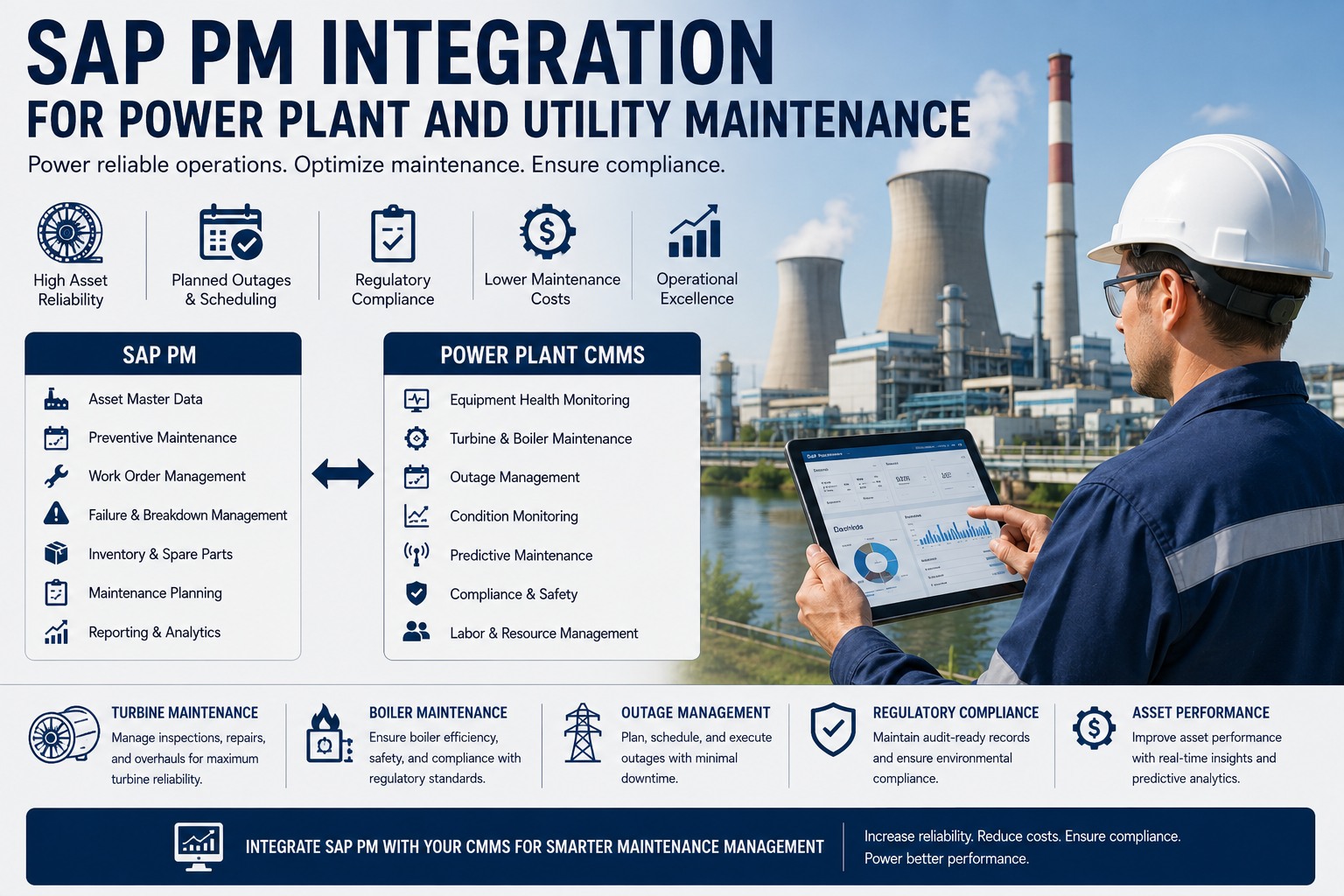
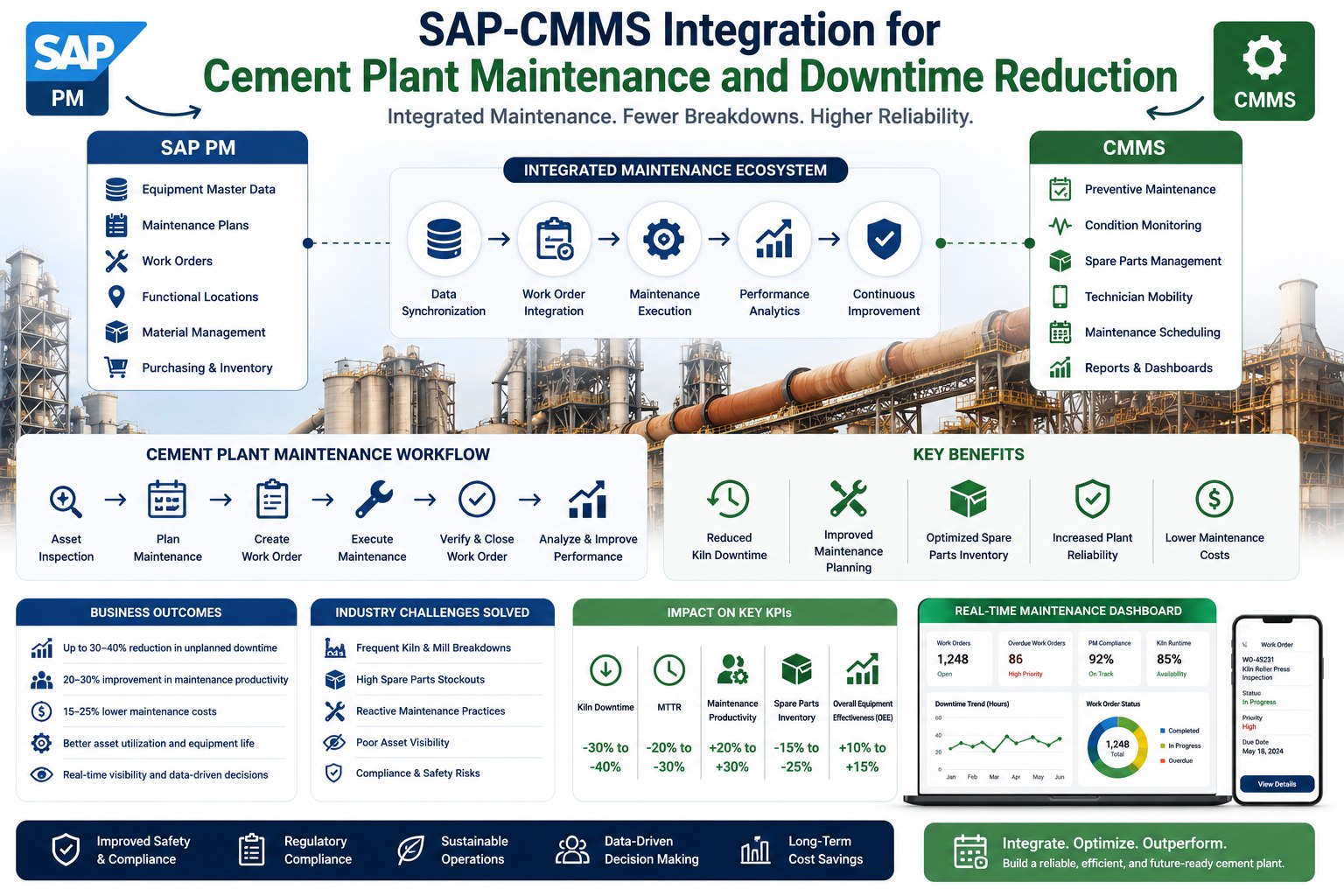
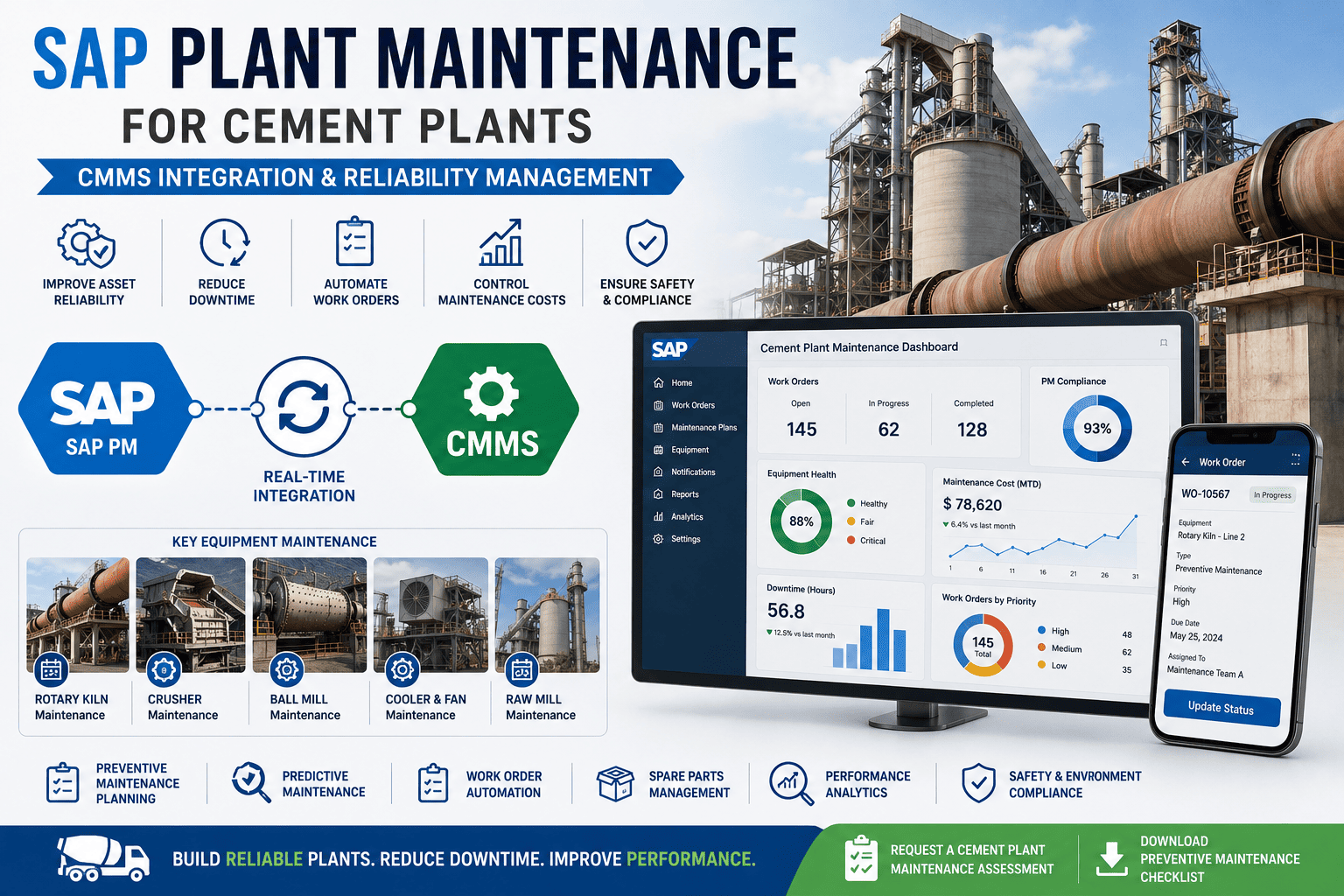
SAP PM Integration for Power Plant and Utility Maintenance
A 540 MW combined-cycle plant in Texas lost $28.4 million last year to a single HRSG tube failure that had been developing for eleven months. The early warning signs were all there: climbing stack temperatures, falling feedwater outlet readings, three consecutive missed inspection windows. The data existed. It just lived in three disconnected systems—the DCS historian, a maintenance supervisor's Excel file, and SAP PM. Nobody connected the dots. This is the integration gap that defines power generation maintenance in 2026, and it's exactly what SAP PM integration with a modern CMMS is built to solve.
Market Reality, 2026
Why SAP-Integrated Maintenance Is No Longer Optional
$10.29B
ERP market for energy & utilities in 2025
Source: Industry analyst data
395+
Energy & utility companies running SAP Utilities globally
Source: SAP customer disclosure
53%
Operational efficiency gain when CMMS connects to SAP S/4HANA
Source: IDC
$1.2M
Average daily cost of a single gas turbine trip
Source: ABB / industry benchmarks
The SAP PM Reality in Power Generation Today
SAP Plant Maintenance has been the financial backbone of power generation for two decades. Cost-center postings, purchase order flows, asset master data, capital project accounting—SAP governs all of it with the audit trail regulators expect. The problem isn't SAP itself. The problem is that SAP PM was designed by accountants for accountants, and a control room operator standing next to a 1,200-ton steam turbine at 3 AM doesn't have time to navigate six T-code screens to log a finding. So the data goes somewhere else. Excel files. Sticky notes. Text messages. Verbal hand-offs at shift change.
The result is a parallel universe of maintenance information that never makes it back into SAP. Equipment histories sit in one database, cost reports in another, and condition monitoring data in a third. According to industry research, the average utility loses 2 to 4 hours per technician per week to duplicate data entry between SAP and shadow tracking systems. Multiply that across a fleet of 80 to 200 technicians and the hidden cost runs into seven figures annually—before counting the outages that nobody saw coming because the warning signals lived in a system nobody was watching. Plants ready to close that gap can Sign up free and connect SAP PM to a unified maintenance view in a fraction of the time it took to deploy SAP itself.
The Integration Architecture That Closes the Gap
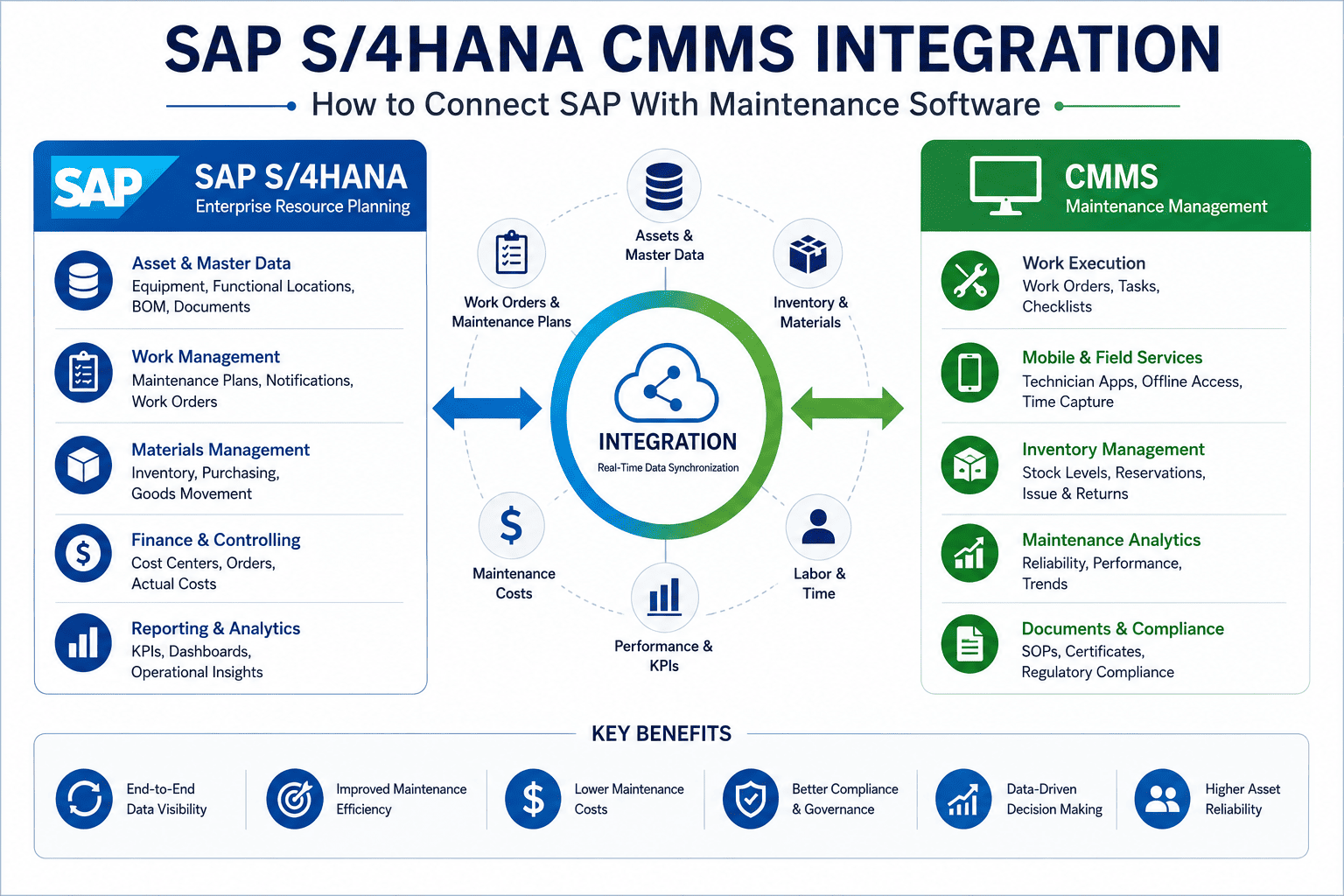
The plants achieving the highest availability rates in 2026 aren't replacing SAP. They're extending it. A purpose-built CMMS sits between SAP and the field, translating ERP-level governance into mobile-first execution and pushing real-world findings back into SAP in real time. Every layer of the stack does what it's best at. Here's what that architecture looks like in practice.
SAP PM ↔ CMMS Integration Stack
Four layers, bidirectional sync, zero duplicate data entry
Layer 1
SAP ERP Backbone
SAP PM • SAP MM • SAP PP • SAP EHS • S/4HANA
Financial governance, master data, cost centers, capital tracking, audit trail
Bidirectional sync
Layer 2
Integration Bridge
REST/OData APIs • Middleware • Event Streaming
Work order sync, BOM lookup, cost posting, time confirmation, real-time event flow
Bidirectional sync
Layer 3
CMMS Execution Layer
Mobile work orders • Digital checklists • Compliance dashboards
DCS feeds, vibration sensors, oil analysis, thermography, condition data
The bridge layer is where most legacy integrations break down. Plants that tried to build custom RFC connectors a decade ago are now living with brittle middleware that fails every time SAP patches. Modern integration bridges use standard OData APIs that survive S/4HANA upgrades. Power plants ready to see how this stack maps to their existing landscape can Book a free demo to walk through the integration architecture for your specific SAP version.
What Bidirectional Sync Looks Like in Practice
Architecture diagrams are useful, but the real test is what happens when a gas turbine starts trending toward a bearing problem at 2 AM. Here's the round-trip data flow that separates a true integration from a fancy import script.
Anatomy of a Gas Turbine Bearing Alert
From sensor anomaly to closed SAP work order, in one workflow
01
DCS / Sensor Layer
Vibration analyzer flags 7.2 kHz frequency spike on Unit 2 lube oil pump bearing. Trend rises 6% over 48 hours.
→ Pushed to CMMS via OPC UA
02
CMMS Analysis
AI correlates spike with 30-day bearing temperature trend and prior failure patterns. Generates a Priority-2 work order with predicted RUL of 18 days.
→ Work order auto-created in CMMS
03
SAP PM Sync
CMMS pushes work order to SAP PM with equipment number, functional location, cost center, and predicted parts BOM. SAP generates corresponding maintenance order.
→ Two-way ID linkage established
04
SAP MM Lookup
Bearing kit availability checked against SAP MM. Two in stock, three on order. Reservation auto-posted. If stock-out, purchase requisition triggers.
→ Inventory reserved in real time
05
Field Execution
Technician receives mobile work order with full asset history, last service date, lockout/tagout checklist, and torque specifications. Logs photos, readings, parts consumed.
→ Execution data captured at the asset
06
SAP Confirmation
Labor hours post to SAP for payroll. Parts consumption posts to SAP MM with cost-center allocation. Work order closes with full audit trail. NERC-compliant documentation auto-archived.
→ Loop closed, books updated
That six-step round trip used to take three systems, four people, and roughly two business days of post-event cleanup. Plants running integrated platforms now close it in a single workflow—and the same trip that previously triggered a $1.2 million-per-day forced outage is caught during planned downtime instead.
Compliance Built Into the Integration Layer
Power generation operates under a regulatory regime unlike anything else in industry. NERC reliability standards, FERC market rules, EPA emissions permits, OSHA 29 CFR 1910.269, and the ASME Boiler and Pressure Vessel Code all impose documentation requirements that paper-based PM programs simply cannot satisfy at audit time. The strength of an SAP-integrated CMMS is that every compliance artifact—inspection records, calibration certificates, lockout-tagout logs, environmental readings—is generated as a byproduct of normal maintenance work, not as a separate report-writing exercise.
Regulatory Coverage Across the Stack
NERC PRC Standards
Generator protection, frequency response, automatic voltage regulator testing
Auto-tracked: LOTO records, qualified-worker certs, NDE inspection cycles
The financial weight of compliance failure has grown dramatically. A NERC reliability event can trigger six-figure penalties on top of the lost generation revenue. An EPA exceedance can put a plant's operating permit at risk. Power plants ready to put compliance documentation on autopilot can Sign up free and begin auto-archiving regulatory evidence from day one.
See SAP PM and Your Field Floor in One View
Watch how a single integrated workflow eliminates duplicate data entry, surfaces hidden compliance gaps, and turns SAP PM from a back-office system into a real-time maintenance command center for power generation.
Maintenance directors care about wrench time and availability. Plant managers care about generation hours. CFOs care about cash. The numbers below reflect what operating data from integrated SAP-CMMS deployments in the 500 to 1,500 MW range typically delivers in the first 12 to 18 months. The capital math is what makes this category of investment one of the easiest signoffs in heavy industry.
SAP PM Standalone vs. SAP + Integrated CMMS
Swipe to compare
Metric
SAP PM Standalone
SAP + Integrated CMMS
Improvement
Work order completion rate
62%
91%
+47%
Unplanned downtime hours / year
340 hrs
238 hrs
−30%
Technician duplicate-entry time
3.2 hrs/wk
0.4 hrs/wk
−88%
Emergency callouts (1,200 MW plant)
Baseline
Down 31%
−31%
Audit prep time (NERC)
4–6 weeks
1–3 days
−90%
Annual savings (500 MW plant)
—
$2.5M–$8M
Net new
$28.4MAvoided cost of one HRSG tube failure caught during planned outage
60–75%Reduction in unplanned outages with integrated condition monitoring
The real ROI lever, though, isn't the line items in the table. It's the single avoided forced outage. Industry analysis shows unplanned generation outages cost between $50,000 and $500,000 per day in lost revenue and replacement power purchases. For peaking gas turbines during summer demand windows, the daily figure routinely exceeds $1.2 million. Catching one major event during planned downtime instead of as a 3 AM trip pays for the integration program for several years. CFOs evaluating the business case can Book a free demo to model ROI specific to your plant's MW capacity and dispatch profile.
Expert Perspective: What Makes Integrations Succeed
The plants that get this right share one trait: they stop trying to make SAP do field execution and they stop trying to make their CMMS do financial accounting. They let each system play its position. SAP governs the money, the master data, and the audit trail. The CMMS owns the technician experience, the asset condition data, and the work execution. The bridge between them handles the handshake. That's it. The implementations that fail are the ones that try to consolidate everything into a single platform, or that build custom RFC code nobody can maintain after the original consultants leave.
Use Standard APIs, Not Custom Code
OData and REST endpoints survive SAP patches and S/4HANA migrations. Custom RFC connectors typically don't, and the rebuild cost on every upgrade can wipe out three years of integration ROI.
Sync Equipment Numbers, Not Just Work Orders
If functional location IDs don't match across systems, cost postings drift and asset history fragments. Mapping the equipment hierarchy first prevents 80% of integration headaches downstream.
Pilot on One Unit, Not the Whole Fleet
Prove the round-trip workflow on a single gas turbine or boiler before rolling out plant-wide. Six to eight weeks of focused piloting catches the edge cases that would otherwise blow up a full deployment.
A Realistic Implementation Roadmap
Most SAP PM integration projects fail not because of technology but because of scope. The teams that succeed treat this as a 90-day phased rollout, not a 12-month transformation program. Below is the cadence that consistently delivers measurable value inside one quarter.
90-Day Phased Rollout
Designed to show measurable wins by week six
Weeks 1–2
Discovery & Mapping
Inventory SAP functional locations, equipment master data, and active PM strategies. Identify pilot unit. Confirm S/4HANA or ECC version, OData availability, and integration patterns.
Weeks 3–5
Bridge Configuration
Connect CMMS to SAP via standard APIs. Map equipment hierarchy, work order types, cost centers, and BOM structures. Test bidirectional sync on a non-production sandbox.
Weeks 6–8
Pilot Unit Go-Live
Mobile work orders deployed to technicians on one unit—typically a gas turbine or HRSG. Round-trip sync validated for at least 50 work orders. KPI baseline captured.
Weeks 9–13
Plant-Wide Rollout
Expand to remaining units. Activate condition monitoring integrations. Enable compliance reporting templates. Train shift supervisors on dashboard interpretation.
By the end of week thirteen, plants typically see their first measurable wins: a 20 to 30 percent reduction in duplicate data entry, the first auto-generated NERC compliance packet, and the first work order that flagged a developing condition before it became an outage. Operations teams ready to begin the discovery phase can Sign up free to start the 90-day integration roadmap on their own pilot unit.
Turn Your SAP Investment Into Real-Time Reliability
Your ERP backbone is already paid for. The next step is connecting it to a maintenance execution layer purpose-built for turbines, boilers, and the people who keep them running. See it in your environment before you commit to anything.
Do we need to migrate from SAP ECC to S/4HANA before integrating a modern CMMS?
No. Properly designed CMMS platforms integrate with both SAP ECC and S/4HANA through standard OData and REST APIs. Plants on ECC can integrate now and keep that integration intact through their eventual S/4HANA migration, because the API contracts remain backward compatible. Many utilities actually find that running an integrated CMMS during the S/4HANA transition reduces migration risk by giving them a continuous maintenance execution layer that's independent of the underlying SAP release.
How long does a typical SAP PM integration project take for a single power plant?
A focused, single-plant integration with a modern API-based CMMS typically takes 60 to 90 days from kickoff to plant-wide go-live, with a pilot unit operational by week six. Compare that to traditional custom integration projects that have historically taken 9 to 18 months. The difference comes from using pre-built SAP connectors and OData endpoints instead of writing custom RFC code, and from piloting on a single asset before scaling across the fleet.
Which SAP modules need to be involved—just PM, or others as well?
SAP PM is the core, but most successful power plant integrations also connect to SAP MM for spare parts and inventory, SAP PP for scheduling alignment with generation dispatch, and SAP EHS for safety incident reporting and environmental compliance. For utilities running SAP IS-U, integration with the technical objects in device management is also valuable. The CMMS should handle these connections as standard configurations rather than custom development work.
How does an integrated CMMS handle NERC and FERC compliance documentation?
Compliance documentation becomes a byproduct of normal work execution rather than a separate reporting exercise. Every work order completed on a covered asset—generator protection relays, frequency response equipment, capacity performance assets—generates timestamped evidence with technician credentials, parts consumed, readings recorded, and photos attached. When an audit notice arrives, the evidence packet for any covered period can be assembled in hours rather than weeks. The CMMS maintains the record of execution while SAP holds the financial and master data references the auditor expects.
What ROI can a 500 MW plant realistically expect in the first year?
Operating data from comparable integrations shows annual savings in the $2.5 million to $8 million range for a typical 500 MW plant, driven by three main contributors: a 15 to 30 percent reduction in unplanned downtime, a 47 percent improvement in work order completion rate, and the elimination of 2 to 4 hours per week of duplicate data entry per technician. The single largest ROI event, however, is usually a forced outage that the integrated system catches as a planned repair—often a single avoided incident in the multi-million-dollar range pays back the entire integration cost in the first year.