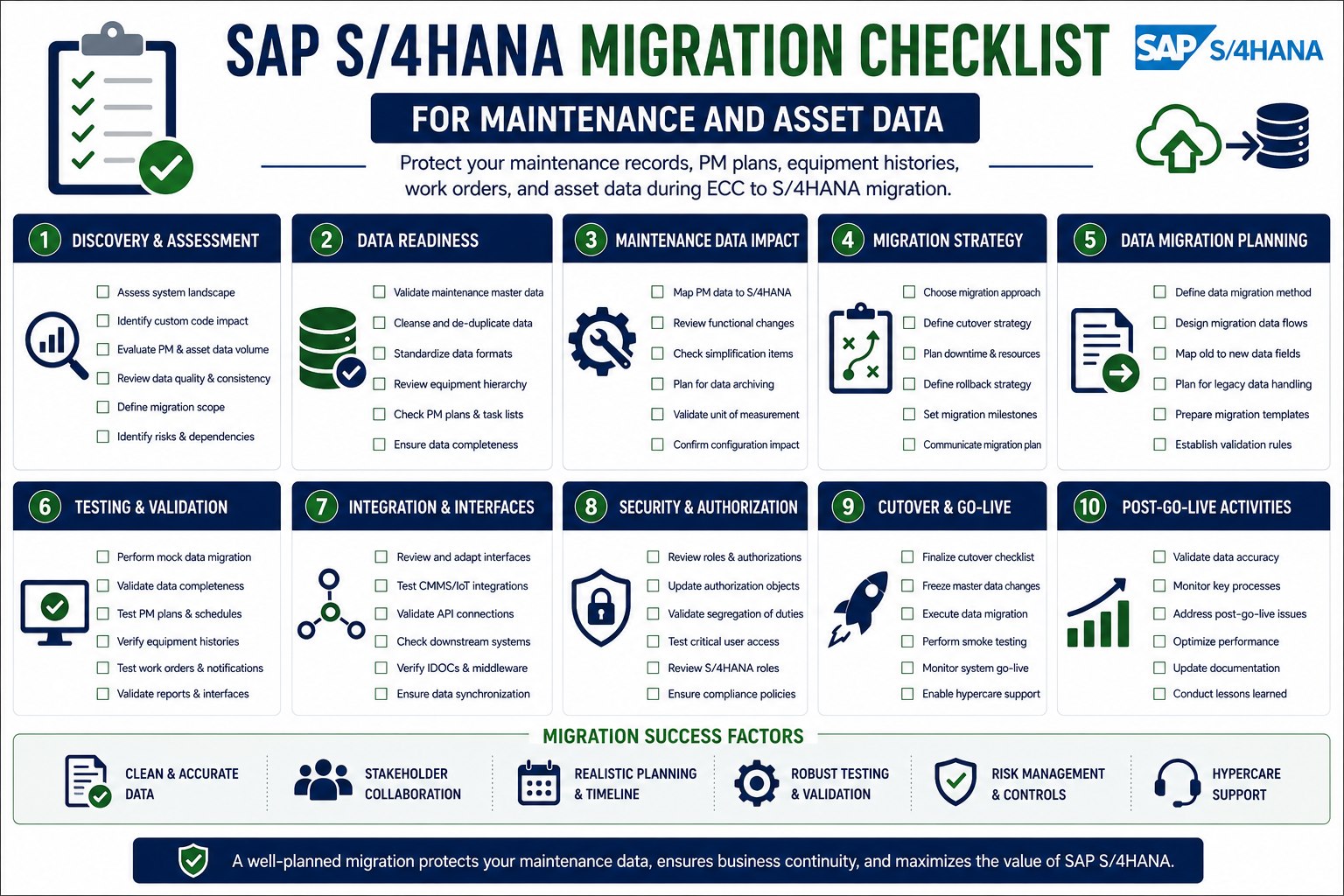
SAP ECC mainstream maintenance ends December 31, 2027—and only a third of the original 35,000 ECC customers have migrated to S/4HANA. For maintenance and asset organizations, the migration is the highest-stakes data project most plants will execute: equipment masters, functional locations, PM plans, work order histories, notifications, and the linked materials and BOMs that govern every preventive task. Get the data wrong and maintenance operations don't run on Day 1. This 30-item, 5-phase checklist covers what successful migrations validate at every stage. Book a free demo to walk through migration readiness.
The 2027 Deadline and What's at Risk for Maintenance Data
For maintenance organizations, S/4HANA migration is not an IT project—it's a data continuity project with operational consequences. Every equipment master record, every functional location, every active preventive maintenance plan, every open work order, and every notification in the archive has to land cleanly in the new system or the maintenance team can't execute work on Day 1. The plants that have migrated successfully treat maintenance data as a tier-one migration scope, equal in importance to financial and supply chain data. The plants that didn't typically experienced 30 to 60 days of post-migration disruption while emergency reconciliation projects rebuilt records that should have transferred cleanly.
The window is closing faster than it appears. SAP Compatibility Packs that allow certain legacy ECC functionality in S/4HANA expire in May 2026; mainstream maintenance for EHP 6-8 ends December 2027; extended maintenance through 2030 costs nine percent more than current support. By the time these dates arrive, available SI capacity will be saturated. Plants ready to scope a governed migration program against the real timeline can Sign up free to begin maintenance-data migration scoping.
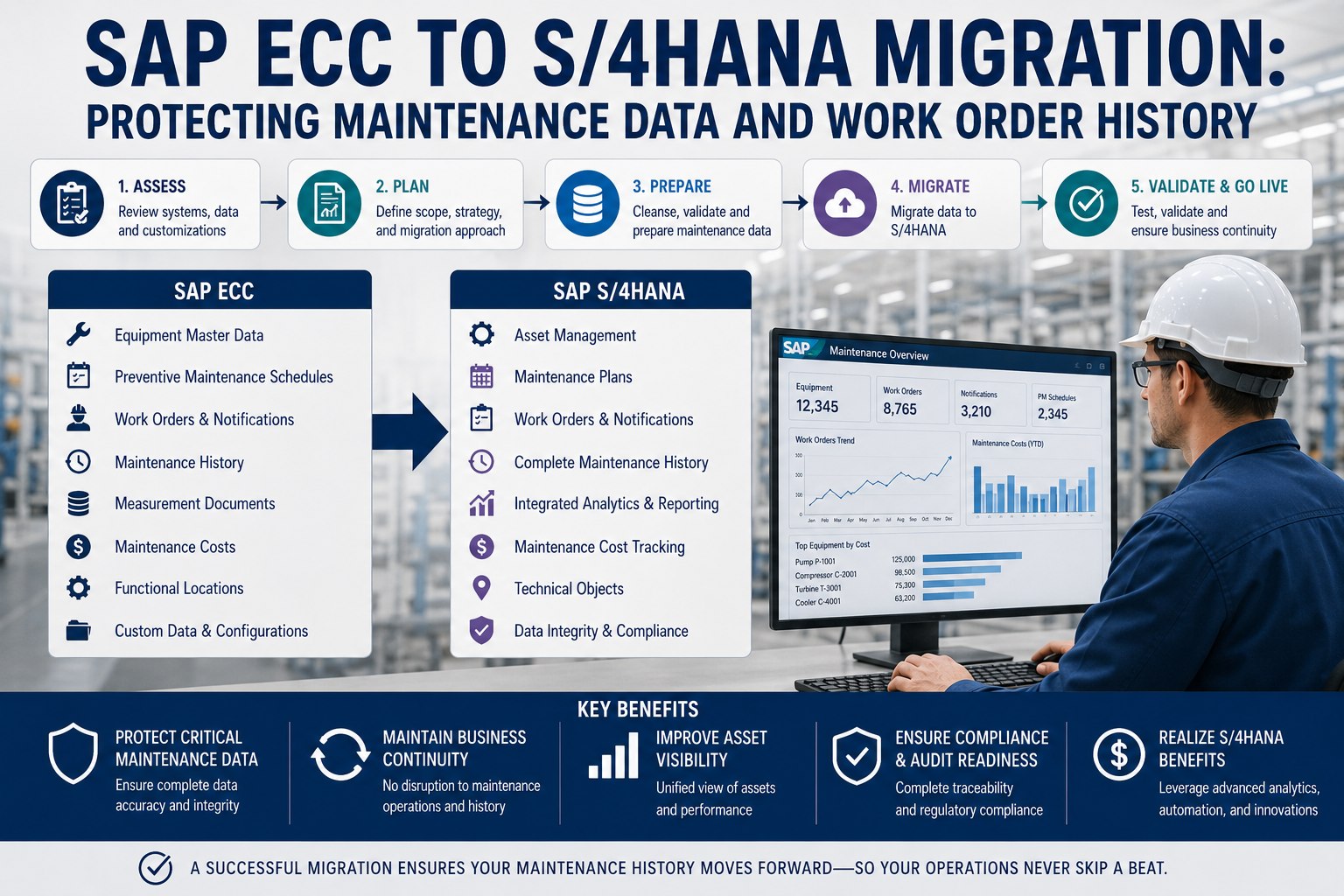
The 5-Phase S/4HANA Migration Checklist
The checklist below is organized along the actual migration timeline, from initial discovery through post-migration hypercare. Each phase has six items, each tagged with a data-domain indicator showing what the item touches: Master Data (MD), Transactional Data (TD), Custom Development (CD), or Process (PR). Phases execute sequentially; later phases depend on earlier ones being signed off.
- ECC system snapshot taken and object inventory documentedPR
- Custom Z-development assessment via Readiness Check or SI scanCD
- Migration path decided: Greenfield / Brownfield / BluefieldPR
- Compatibility Pack dependencies catalogued (May 2026 expiry)CD
- RACI matrix signed by business, IT, and SI partnerPR
- Plant Maintenance scope confirmed: PM, equipment, FLOC, BOMsMD
- Equipment master cleansed of duplicates, orphans, and inactivesMD
- Functional location hierarchy validated end-to-endMD
- Maintenance plans deduplicated, active-flag reviewedMD
- BOM completeness audit on critical equipment classesMD
- Notification & work order archive strategy decided and signedTD
- Long-text data and classification fields cleansedMD
- Migration Cockpit / DMC configured with transformation rulesPR
- Mock migration #1 executed on 50% data scopeTD
- Custom ABAP code refactored for S/4HANA data modelCD
- Universal Journal cost flow validated for maintenance postingsTD
- Mock migration #2 on 100% data with full reconciliationTD
- Defect logs from mocks closed or formally risk-acceptedPR
- Production data freeze enacted with documented sign-offPR
- Final delta of master & transactional data migratedTD
- Open work orders, PM plans, notifications transferred intactTD
- Historical maintenance records reconciled against ECC totalsTD
- User roles migrated to S/4 Fiori with SSO operationalPR
- Go / no-go decision documented by accountable executivePR
- Open work orders confirmed under correct S/4 status codesTD
- Maintenance plan executions firing on schedule verifiedTD
- Fiori UI training sustained with daily floor-walkingPR
- Historical reports reconciled against ECC baseline valuesTD
- Custom reports validated against pre-migration outputCD
- Hypercare KPIs tracked daily: errors, sync lag, user blockersPR
The non-negotiable items on this checklist are the two mock migrations in Phase 3. A migration that goes to cutover without two full mock runs—one at 50% scope, one at 100%—is operating on hope, not evidence. Mock #1 surfaces the integration defects; mock #2 confirms they're closed. Skip either, and the defects surface in production on cutover weekend instead. Project teams ready to operationalize the 30-item checklist against an active program can Sign up free to track migration items by phase and owner.
The Three Migration Paths and What They Mean for Maintenance
The choice of migration path shapes every downstream decision in the checklist. Each path has different implications for how maintenance data, custom code, and process logic transfer to S/4HANA.
The path most commonly selected for maintenance-heavy operations is Brownfield, because the operational dependency on historical work order and notification records makes archival a significant risk. Greenfield is selected by organizations using the migration as a transformation moment to redesign processes and clean technical debt. Bluefield is increasingly the choice for large multi-plant operations where different sites have different readiness levels. Engineering and IT leaders evaluating the right path for their plant can Sign up free to scope migration path implications on maintenance data.
From Mock Run to Stable Production: The Final 30 Days
The most consequential window in any S/4HANA maintenance-data migration is the final 30 days. Phases 3, 4, and 5 compress into roughly a month of intense execution, with go-live falling in the middle. The cadence below is what successful migrations consistently follow.
By the end of week +4, the migration is either declared complete or has identified specific exit-criteria gaps with documented remediation plans. The biggest single mistake in this final 30-day window is rushing cutover before mock #2 completes cleanly. The one-week delay to fix a mock-run defect is invariably cheaper than the four-week incident response that handling the same defect in production produces. Maintenance leaders ready to model their plant's final-30-day cadence can Book a free demo to map the cadence to actual cutover dates.
Expert Perspective: What Distinguishes Successful Migrations
The S/4HANA migrations I've seen succeed share a property: they treat maintenance data as a first-class migration scope, equal in stature to financial and supply chain data. The migrations that struggled put maintenance somewhere in the middle of the priority stack, behind FI and MM, and ended up discovering on cutover weekend that the equipment master had thousands of orphan records nobody had cleansed. Maintenance data is operational infrastructure. If it doesn't migrate cleanly, plants can't execute work on Day 1. Putting it on equal footing with finance, with the same data-quality discipline and the same mock-migration rigor, is the single decision that most distinguishes successful migrations from the ones that produced multi-week production incidents.