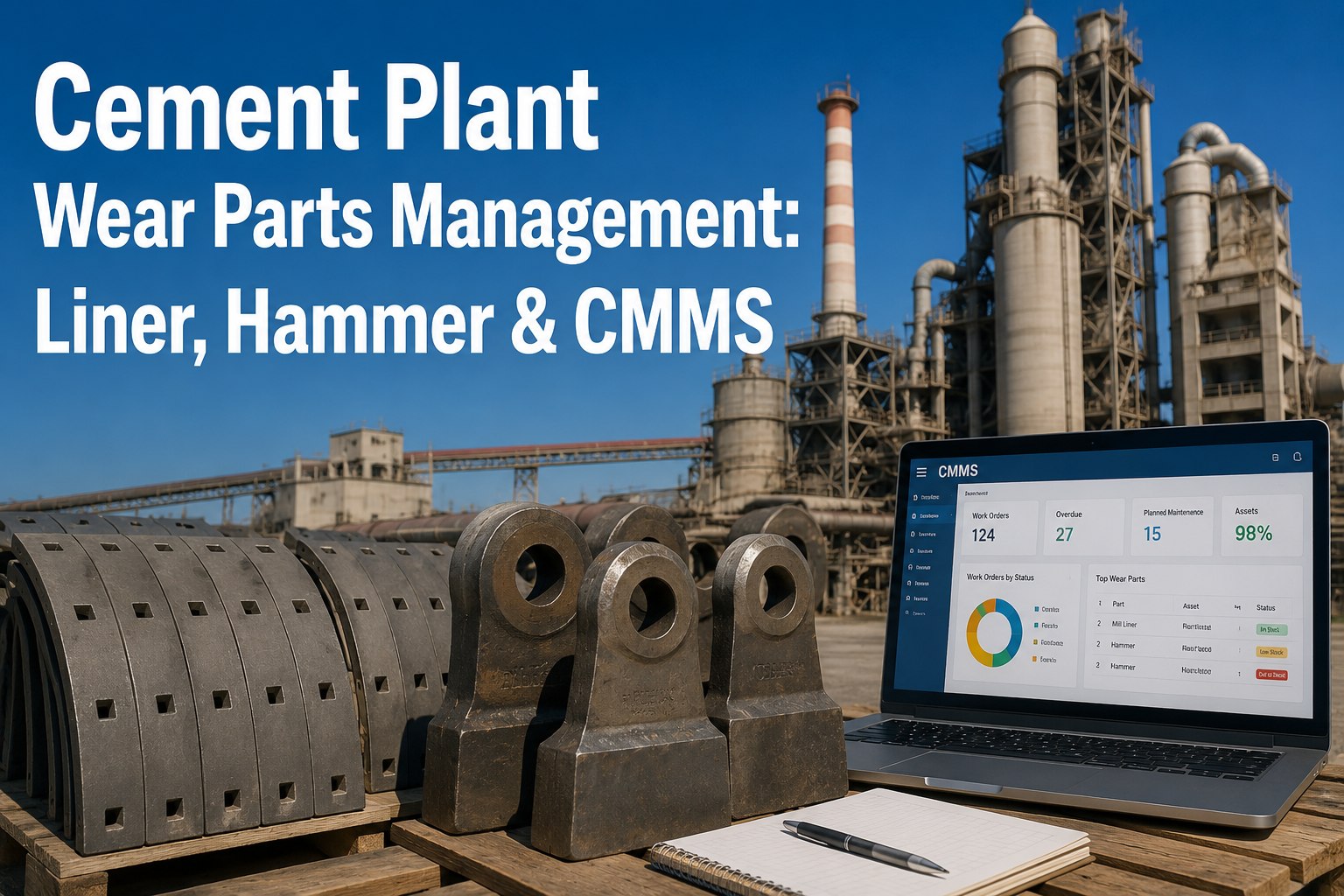
A cement plant's primary crusher is the first and most consequential bottleneck in the raw material process chain. When a jaw crusher toggle plate fractures mid-shift, or an impact crusher rotor becomes imbalanced from uneven hammer wear, the entire plant feed stops — not just the crushing circuit. At an average clinker production value of $28 per tonne and a primary crusher throughput of 800 to 1,400 tonnes per hour, every unplanned crusher outage costs $22,000 to $39,000 per hour before emergency maintenance labor and component replacement are factored in. The failure was predictable. The liner thickness was measurable. The toggle plate deflection was observable. The hammer weight differential was trackable. The problem was the absence of a system connecting those field measurements to a maintenance action before failure. Oxmaint provides exactly that system. Book a demo to see how Oxmaint structures crusher wear tracking and tonnage-based PM across your cement plant's full crushing circuit.
Crusher maintenance software for cement plants is a structured PM program that tracks liner wear profiles, toggle plate condition, rotor balance, bearing temperatures, and hammer weight differentials — triggering planned replacements based on tonnage throughput and measured wear data, not fixed calendar intervals or failure events. Oxmaint's Crusher Wear Tracking and Tonnage-Based PM modules give maintenance teams the condition visibility to schedule replacements during planned shutdowns at planned cost — before the crusher circuit fails during production.
Oxmaint's Crusher Wear Tracking connects field-measured liner profiles to planned replacement windows — so your next crusher shutdown is a scheduled event, not an emergency response.
The Crusher Types and Asset Categories Oxmaint Manages
A cement plant's crushing circuit spans multiple crusher types — each with distinct wear mechanisms, measurement intervals, and replacement triggers. Oxmaint registers and schedules every one, from primary jaw through to secondary and tertiary impact and hammer circuits.
Fixed jaw plate and swing jaw wear measured by profile gauge at defined tonnage intervals. Toggle plate deflection monitored semi-monthly. Eccentric shaft bearing vibration and temperature trended continuously. Jaw gap setting tracked against product size specification — deviation triggers immediate calibration work order.
Blow bar wear profile measured by template gauge at each planned access. Rotor balance checked after every blow bar replacement set — imbalance above 50 gram-metres triggers immediate balancing before restart. Apron liner wear tracked by thickness measurement. Rotor bearing vibration trending with velocity RMS alert thresholds per ISO 10816.
Individual hammer weight tracked per position — weight differential exceeding 50 grams triggers full hammer set replacement to prevent rotor imbalance. Liner plate thickness measured quarterly. Disc and pin wear inspected at each planned access. ATEX zone documentation maintained for coal hammer mills operating in potentially explosive atmospheres.
Mantle and bowl liner wear measured by gap setting observation and profile gauge. Eccentric assembly inspection at each major liner replacement cycle. Main shaft bearing oil temperature and pressure monitored continuously. Crusher setting monitored against product specification — drift triggers calibration alert before product quality impact.
Fixed calendar intervals waste liner life and miss actual wear patterns. Oxmaint's tonnage-based PM triggers replacements when the crusher has actually processed enough material to justify them — using your plant's real throughput data.
The Oxmaint Solution: Crusher Wear Tracking and Tonnage-Based PM
Oxmaint replaces the spreadsheet-and-memory approach to crusher maintenance with a structured condition management system — where every wear measurement trends against replacement thresholds, every tonnage counter triggers the right PM action, and every maintenance event is documented with the precision an equipment warranty claim or regulatory inspection requires.
Liner thickness measurements, jaw plate profiles, blow bar wear templates, and hammer weights logged per crusher per measurement interval — trended against manufacturer minimum thickness thresholds. Alert fires when trend projects reaching minimum thickness before the next planned access, giving maintenance the lead time to procure replacement components in advance.
Crusher throughput counters — from plant DCS, weighbridge, or manual entry — feed Oxmaint's tonnage-based PM engine. Work orders trigger automatically when a crusher reaches the defined throughput interval for liner inspection, blow bar rotation, toggle check, or bearing service — independent of calendar date. The right maintenance action at the right throughput threshold, every time.
Rotor vibration velocity RMS values logged per bearing position after every blow bar replacement or hammer set change — trended against ISO 10816 Class IV machinery limits for large cement plant crushers. A vibration reading exceeding the alert band auto-generates a balancing work order before the imbalance damages the rotor shaft or bearing housings — which carry 8–14 week procurement lead times.
Liner sets, blow bars, toggle plates, and bearing assemblies tracked with installation date, tonnage accumulated, current wear measurement, and projected replacement date. The spares forecast exports monthly — giving procurement 60 to 90 days advance notice of required components before the replacement window arrives, eliminating the emergency procurement premium on critical wear parts.
Primary crusher maintenance requiring plant feed stoppage is automatically aligned to planned kiln feed reduction or quarry blast windows in Oxmaint's scheduling engine. Supervisors receive conflict alerts when a wear-triggered replacement deadline falls outside the next planned access window — giving sufficient lead time to schedule an emergency access or advance the maintenance window before a running failure forces the issue.
Every liner measurement, blow bar rotation record, bearing service log, and crusher setting check exported as a timestamped, technician-signed, photo-evidenced record. Manufacturer warranty claims require documented PM interval compliance — Oxmaint produces the complete service history per crusher in under 20 minutes, formatted for OEM warranty submission or regulatory inspection response.
Implementation Roadmap — From Wear Spreadsheets to Full Crusher PM Automation
Oxmaint deploys crusher wear tracking and tonnage-based PM in four structured phases — configured for a cement plant's specific crusher inventory and throughput data sources without disrupting the crushing circuit or requiring IT infrastructure investment.
Every crusher registered in Oxmaint's asset hierarchy — crusher type, manufacturer, model, installation year, design throughput, and wear part specification. Existing liner thickness records, blow bar weights, and bearing vibration baselines imported from plant spreadsheets to establish trending starting points. QR tags installed on crusher access doors and bearing housings for mobile field access during inspections.
Plant DCS throughput data connected to Oxmaint via API — or manual tonnage entry configured for plants without DCS integration. PM trigger thresholds configured per crusher type and wear part: jaw plate inspection at 200,000 tonnes, blow bar rotation at 150,000 tonnes, toggle check at 100,000 tonnes, bearing vibration at 500 operating hours. Alert lead times set at 15% and 5% of remaining threshold. Book a demo to see tonnage trigger configuration for your crusher circuit.
Crusher maintenance technicians trained on Oxmaint mobile — QR scan access to crusher record, wear measurement entry with photo evidence, vibration reading input, and digital sign-off. First full crusher PM cycle executed through Oxmaint with supervisor review. Wear profile visualisations reviewed to validate alert threshold calibration against actual plant liner wear rates.
Ongoing liner wear trending, tonnage accumulation tracking, and vibration RMS monitoring feeding the crusher reliability dashboard. Monthly spares forecast report exported to procurement — 60 to 90 days advance notice of required liners, blow bars, and bearing sets before replacement windows. Capital planning for crusher overhauls integrated into the plant's 18-month maintenance budget cycle. Book a demo to see the crusher reliability dashboard and spares forecast for a plant of your scale.
Oxmaint's wear trending gives your maintenance team 4 to 8 weeks of advance notice before a liner reaches minimum thickness — enough time for planned replacement procurement and shutdown scheduling at planned cost.
Regional Compliance Coverage for Crusher Operations
Cement crusher operations face different equipment safety, dust emission, and process safety regulatory obligations across markets. Oxmaint's crusher PM templates are pre-aligned for each primary regulatory framework.
| Region | Applicable Frameworks | Key Crusher Requirements | Oxmaint Coverage |
|---|---|---|---|
| USA / Canada | OSHA 29 CFR 1910.147 LOTO, MSHA 30 CFR Part 56 Surface Mining, OSHA 1910.94 Ventilation (crusher dust), EPA NESHAP particulate emissions, ANSI B11 machine guarding | MSHA crusher inspection records, LOTO energy isolation per crusher access, OSHA dust exposure monitoring at crusher circuits, machine guarding inspection documentation, PM records for MSHA inspection response | MSHA-aligned crusher inspection scheduling, LOTO isolation checklists per crusher type, OSHA dust monitoring schedule management, machine guarding inspection records, MSHA audit-ready documentation export |
| Germany / EU | BetrSichV Machinery Safety, DGUV crusher-specific safety rules (BGI 5144), TA Luft dust emission limits, EU ATEX Directive 2014/34/EU (coal hammer mills), EU Machinery Directive 2006/42/EC | BetrSichV crusher safety inspection records, DGUV BGI 5144 periodic inspection, TA Luft particulate emission compliance documentation, ATEX zone classification records for coal crusher areas, CE machinery documentation | BetrSichV-aligned inspection scheduling, DGUV BGI 5144 checklist templates, TA Luft emission monitoring records, ATEX zone equipment inspection management, EU Machinery Directive documentation management |
| United Kingdom | PUWER 1998 (work equipment), DSEAR (explosive atmospheres), COSHH (crusher dust exposure), HSE Guidance Note PM38 (stone crushing), Electricity at Work Regulations for crusher drives | PUWER inspection and test records per crusher, DSEAR zone assessment documentation for coal circuits, COSHH respirable dust monitoring records, HSE PM38-aligned crusher inspection program | PUWER-compliant inspection scheduling, DSEAR zone documentation management, COSHH dust monitoring schedule and records, HSE PM38-aligned crusher PM templates, EaWR-compliant electrical isolation records |
| Australia | Safe Work Australia WHS Regulations, AS 4024 Safety of Machinery, State Mine Safety regulations (Mines Act by state), AS 3000 electrical for crusher drives, NEPM ambient air quality standards | Registered plant inspection for crushing equipment per state regulations, AS 4024 machine guarding records, state Mines Act crusher safety inspection compliance, NEPM dust emission monitoring at crusher circuits | Registered plant inspection scheduling per state, AS 4024-aligned guarding inspection records, state Mines Act-compliant PM documentation, NEPM dust monitoring records, WorkSafe inspection audit trail management |
| Saudi Arabia / UAE | SASO Technical Safety Standards, Saudi MOMRA mining and quarry regulations, UAE OSHAD-SF industrial machinery standards, GCC unified industrial safety regulations, Civil Defence dust explosion prevention | SASO crusher safety inspection records, MOMRA quarry equipment maintenance documentation, OSHAD-SF machinery safety compliance for UAE operations, Civil Defence dust explosion prevention for coal circuits | SASO and OSHAD-SF aligned inspection templates, MOMRA-compliant maintenance records, Civil Defence dust explosion documentation, multilingual mobile forms for Arabic-speaking maintenance crews |
Oxmaint vs Industry CMMS Platforms — Cement Crusher Maintenance
General-purpose CMMS platforms schedule time-based work orders. Cement crusher maintenance requires tonnage-based triggers, wear profile trending, rotor balance tracking, and MSHA-compliant documentation — capabilities that demand industry-specific configuration no generic platform provides out of the box.
| Capability | Oxmaint | MaintainX | UpKeep | Fiix | Limble | IBM Maximo | Hippo CMMS |
|---|---|---|---|---|---|---|---|
| Tonnage-based PM triggers from DCS or manual input | Yes | No | No | Meter-based | Limited | Add-on | No |
| Crusher liner wear profile trending with alert thresholds | Yes | No | No | No | No | Custom build | No |
| Rotor balance tracking post blow-bar replacement | Yes | No | No | No | No | With integration | No |
| Cement-specific crusher PM templates pre-built | Yes | No | No | No | No | No | No |
| MSHA / DGUV compliance documentation exports | Yes | No | No | No | No | Custom reports | No |
| Spares procurement forecast from wear trend data | Yes | No | No | Limited | No | Yes | No |
| ATEX zone equipment tracking for coal hammer mills | Yes | No | No | No | No | Custom config | No |
| LOTO isolation checklists per crusher type | Yes | Generic | Generic | Partial | Generic | Yes | Generic |
| Mobile QR scan access to crusher wear record in field | Yes | Yes | Yes | Yes | Yes | Complex UX | Limited |
| Deployment without IT project — live in weeks | 3–4 weeks | 4–6 weeks | 4–6 weeks | 6–10 weeks | 4–8 weeks | 3–6 months | 6–10 weeks |
Results Our Cement Plant Clients Achieved with Oxmaint
These outcomes are drawn from cement plant crusher maintenance programs where Oxmaint's Crusher Wear Tracking and Tonnage-Based PM replaced calendar-based scheduling and spreadsheet wear logs within the first year of deployment.
Frequently Asked Questions
Continue Reading
Connected resources in the cement plant crushing, raw materials, and equipment maintenance cluster
Replace Your Next Liner on Your Schedule — Not the Crusher's
Crusher Wear Tracking, Tonnage-Based PM, rotor balance monitoring, and audit-ready compliance documentation — all live in Oxmaint within 3 to 4 weeks, with no IT project and no disruption to your crushing circuit. Every liner, every blow bar, every toggle plate — tracked, trended, and planned.