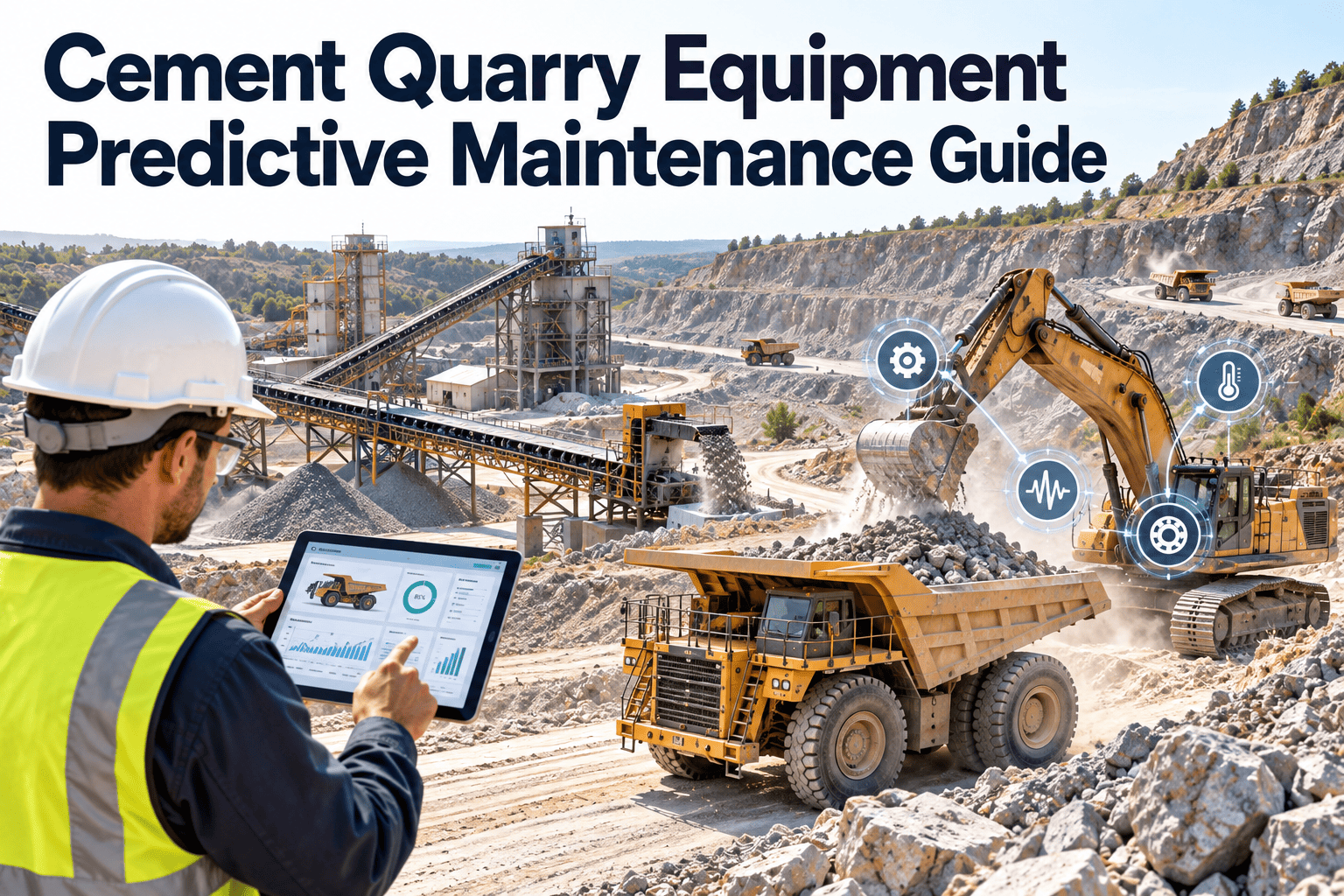
A limestone quarry fleet does not fail on calendar dates. Haul trucks degrade on tonne-kilometres hauled under abrasive dust loads. Drill rigs wear on metres drilled per shift in variable rock hardness. Jaw crushers consume liner material at rates that change with feed size and moisture content. When a single haul truck misses a 500-hour service because a paper log was misplaced, the next event is a $150,000 engine replacement, not a $2,000 oil change. When a primary crusher jaw liner runs past its replacement point, the consequence is not just unplanned downtime — it is a multi-day processing stoppage that backs up the entire raw material supply chain to the kiln. Limestone quarry operations supplying cement plants in the USA, UAE, Saudi Arabia, Germany, and Australia share a common structural problem: equipment that is maintained reactively on calendar schedules designed for lower-intensity applications, tracked on paper logs that are one misplaced binder away from an MSHA or Mine Safety inspection finding. The CMMS market for mining and quarry operations is growing at 10.1% CAGR because operators have quantified the cost of reactive maintenance at scale. This guide covers the complete fleet maintenance challenge for limestone quarry operations, the specific failure modes by equipment class, the implementation roadmap for deploying a quarry CMMS, how Oxmaint compares against leading platforms, and the compliance documentation requirements by region that your maintenance records must satisfy. Book a demo to see Oxmaint configured for your quarry fleet.
Limestone Quarry Equipment Maintenance and Fleet Tracking: The 2026 CMMS Guide for Cement Raw Material Operations
Runtime-hour PM triggers, GPS fleet tracking, drill rig to haul truck maintenance scheduling, compliance documentation for MSHA, MHSA, and Mine Safety, and multi-site quarry portfolio visibility — all from one CMMS that deploys in 14 days with no IT project.
Stop Scheduling Quarry PM on Calendars. Your Equipment Degrades on Hours and Tonnes.
Oxmaint triggers haul truck, drill rig, and crusher PM from engine hours, GPS utilisation data, and production cycles automatically. Free to start. Deployed in 14 days with no implementation fees.
Quarry Fleet Equipment: Failure Modes, PM Requirements, and What Goes Wrong Without a CMMS
Every equipment class in a limestone quarry has failure modes that are specific to the operating environment. Calendar-based PM schedules calibrated for highway-duty cycles miss the accelerated degradation rates that quarry duty, dust, impact loads, and variable rock hardness create across every asset class.
How Oxmaint Solves Quarry Fleet Maintenance: Platform Capabilities
Oxmaint is built for the asset complexity and operating conditions that calendar-based spreadsheet PM cannot handle. Here is what the platform delivers specifically for limestone quarry and mining fleet operations.
Every Hour of Haul Truck or Crusher Downtime Has a Quantifiable Cost to Your Kiln Feed Supply.
Oxmaint's runtime-triggered PM and GPS fleet tracking eliminate the scheduling gaps that cause catastrophic quarry equipment failures. Free to start. No implementation fees. Live in 14 days.
Implementation Roadmap: Quarry Fleet CMMS Deployment with Oxmaint
This is the deployment sequence for a limestone quarry fleet operation of 20 to 100 assets across drill rigs, haul trucks, loaders, crushers, and conveyors. Most quarry operations complete full PM automation within 21 days.
- Register all quarry fleet assets with make, model, year, serial number, and current hour meter readings
- Connect GPS and telematics systems via API to auto-populate engine hours per asset
- Assign asset criticality scores: Very High (crusher, conveyors), High (haul trucks, drill rigs), Medium (loaders, service fleet)
- Apply quarry-duty PM interval multipliers to OEM base intervals per asset class and site conditions
- Configure first-to-occur PM triggers: hours, tonnes, calendar — whichever threshold is reached first fires the work order
- Set crusher liner replacement triggers by tonnes processed threshold per liner grade
- Configure conveyor belt inspection work orders by runtime hours and visual condition triggers
- Assign drill rig PM by metres drilled and compressor operating hours
- Set up escalating SLA alerts: 50%, 90%, and 100% of interval elapsed triggers notifications to site supervisor
- Deploy Oxmaint mobile app to all field technicians and equipment operators with offline mode enabled
- QR-tag every asset for instant field access to service history and inspection checklists
- Configure GPS geofence alerts per quarry zone: haul roads, crusher pad, drill zone, explosive magazine area
- Map mine safety compliance frameworks per region: MSHA (USA), MHSA (Australia), Mine Safety (Saudi Arabia)
- Set up daily fleet status dashboard for site manager: PM compliance, open work orders, overdue inspections
- Monthly wear rate analysis: actual liner life versus expected tonnes — adjust replacement thresholds from real data
- Quarterly fleet cost-per-operating-hour report per asset class for equipment replacement evaluation
- Annual mine safety compliance audit package export — all inspection records, PM history, and technician attribution
- Rolling 5-year fleet CapEx forecast updated automatically as cost-per-hour trends signal replacement thresholds
Regional Compliance Requirements for Limestone Quarry Operations
Mine safety inspections are unannounced in every major mining jurisdiction. Maintenance records, inspection logs, and equipment condition documentation must be complete, current, and retrievable on demand. A CMMS that generates these records automatically as a byproduct of daily PM operations eliminates the compliance gap that manual record systems create.
- MSHA 30 CFR Part 56 — surface mine safety standards, equipment inspection records
- OSHA 29 CFR for maintenance worker safety documentation and lockout/tagout compliance
- EPA 40 CFR Part 60 — dust suppression equipment maintenance records at quarry operations
- State mine reclamation permit equipment maintenance conditions
- MSHA citations require immediate correction documentation with timestamped evidence
- Federal Law No. 8 of 1980 — industrial safety and equipment maintenance obligations
- UAE Federal Authority for Nuclear Regulation — explosive materials equipment documentation
- ADNOC and SIRA industrial safety standards for quarry operations in Abu Dhabi and Emirates
- UAE IS2030 digital maintenance record mandate for industrial equipment
- Dubai Municipality environmental compliance for quarry dust and water management
- Mines Safety and Inspection Act 1994 — WA. Mines Health and Safety Act 2004 — Queensland
- AS 4024 safety of machinery — plant and equipment maintenance requirements
- Department of Natural Resources and Mines quarry licence maintenance compliance conditions
- WorkSafe plant registration and inspection documentation for quarry equipment
- High labour costs make PM automation ROI exceptionally strong across Australian quarry operations
- BetrSichV (Industrial Safety Regulation) — mandatory inspection cycles for quarry plant and equipment
- DGUV Technical Rules for quarry mining operations — equipment inspection documentation
- Landesbergamt state mining authority — quarterly equipment condition reporting
- ISO 55001 asset management alignment required for permit maintenance conditions
- BImSchG environmental permit equipment maintenance conditions for dust and noise
- Quarries Regulations 1999 — equipment maintenance and inspection obligations for quarry operators
- PUWER (Provision and Use of Work Equipment Regulations) — maintenance records per equipment item
- Health and Safety at Work Act — plant condition records and inspection documentation
- Environment Agency environmental permit conditions for quarry water and dust management equipment
- HSE unannounced inspections require immediate production of maintenance records
- Ministry of Industry and Mineral Resources — mining equipment inspection and maintenance compliance
- SASO equipment standards for industrial machinery operating in Saudi mines and quarries
- MEWA environmental conditions for quarry operations — dust suppression and water management equipment
- Saudi Vision 2030 digital maintenance documentation mandate for industrial operations
- Civil Defence inspection requirements for quarry operations with explosive storage
All Oxmaint compliance documentation is generated from closed work orders automatically — timestamped, technician-attributed, and exportable in the format required by each jurisdiction. Book a demo to review your region's compliance export format.
Oxmaint vs Competitors: Quarry Fleet CMMS Comparison 2026
Swipe to view full comparison table
| Platform | Runtime-Hour PM | GPS Fleet Integration | Offline Mobile | Wear Part Tracking | Mine Safety Compliance | Free Tier | Deploy Time |
|---|---|---|---|---|---|---|---|
| Oxmaint Best | ✔ Full — hours, tonnes, calendar, first-to-occur | ✔ Full — telematics API, GPS position, utilisation | ✔ Full — sync on restore, works at quarry face | ✔ Liner, belt, bucket teeth by tonnes processed | ✔ MSHA, MHSA, PUWER, BetrSichV, Saudi Ministry | ✔ Permanent free tier | 7-14 days |
| MaintainX | ◑ Calendar and meter PM — no tonne-based triggers | ✗ No native GPS fleet integration | ✔ Offline mode available | ✗ Not available for quarry wear parts | ◑ General compliance tools — no mine-specific frameworks | ◑ Limited free tier | 2-3 weeks |
| UpKeep | ◑ Meter-based PM — no tonne or first-to-occur logic | ✗ No native GPS fleet integration | ✔ Offline capability, polished mobile UX | ✗ No wear part tracking by production volume | ◑ General compliance — not configured for mining | ✗ No free tier — from $45/user/month | 2-4 weeks |
| Fiix (Rockwell) | ✔ Meter and condition-based PM — strong in industrial | ◑ Limited GPS — designed for plant not mobile fleet | ◑ Mobile app available — offline capability limited | ◑ Custom configuration required for wear tracking | ◑ Manufacturing compliance strong — mine safety limited | ✔ Free plan — advanced features paid | 2-4 weeks |
| Limble CMMS | ◑ Calendar and meter PM — quarry-specific triggers limited | ✗ No native GPS fleet tracking | ✔ Offline available — praised for ease of use | ✗ No production-volume wear tracking | ◑ General compliance — mine safety not pre-configured | ✔ Starter plan available | 1-2 weeks |
| IBM Maximo | ✔ Full EAM PM depth — all trigger types with configuration | ✔ Enterprise fleet integration with custom development | ◑ Mobile features — cited as weak point for remote sites | ✔ Custom configuration for wear part tracking | ✔ Comprehensive — requires significant configuration | ✗ No free tier — $100K+ deployment cost | 6-18 months |
| Hippo CMMS (Eptura) | ◑ Calendar PM — limited runtime-hour integration | ✗ No GPS fleet tracking | ◑ Mobile available — not optimised for remote quarry | ✗ No wear part volume tracking | ✗ Not configured for mining compliance frameworks | ✔ Free trial available | 1-2 weeks |
✔ Full support ◑ Partial or requires custom configuration ✗ Not available
Results: What Quarry Operations Achieve with Oxmaint
Data Security and Platform Architecture
Quarry fleet maintenance records contain commercially sensitive operational data — production volumes, equipment condition, replacement schedules, and mine plan data. Oxmaint's security architecture protects this data to enterprise standards.
Your Quarry Fleet Records Are as Secure as Any Enterprise System — and Deployable in 14 Days at No Cost.
SOC 2 Type II certified. AES-256 encrypted. GDPR-compliant. Role-based access. Full audit logging. Enterprise security without enterprise deployment timelines or costs.
Frequently Asked Questions: Quarry Fleet CMMS and GPS Tracking
QCan Oxmaint connect to existing telematics and GPS systems already installed on our quarry fleet?
QHow does Oxmaint handle MSHA and Mine Safety compliance documentation for quarry operations?
QHow does Oxmaint work at quarry face locations without reliable mobile connectivity?
QCan Oxmaint track crusher liner and conveyor belt wear part replacement by tonnes processed rather than calendar date?
QHow quickly can Oxmaint be deployed across a quarry operation with 20 to 80 fleet assets?
Your Next Mine Safety Inspection Is Unannounced. Your Maintenance Records Should Always Be Ready.
Oxmaint gives quarry operations runtime-triggered PM automation, GPS fleet tracking, wear part replacement management, and mine safety compliance documentation — all from one platform. Free tier permanent. Paid tier unlocks unlimited assets, full GPS integration, and complete compliance reporting.
Continue Reading
The guides below cover related cement plant and raw material equipment maintenance topics that connect directly to quarry operations.