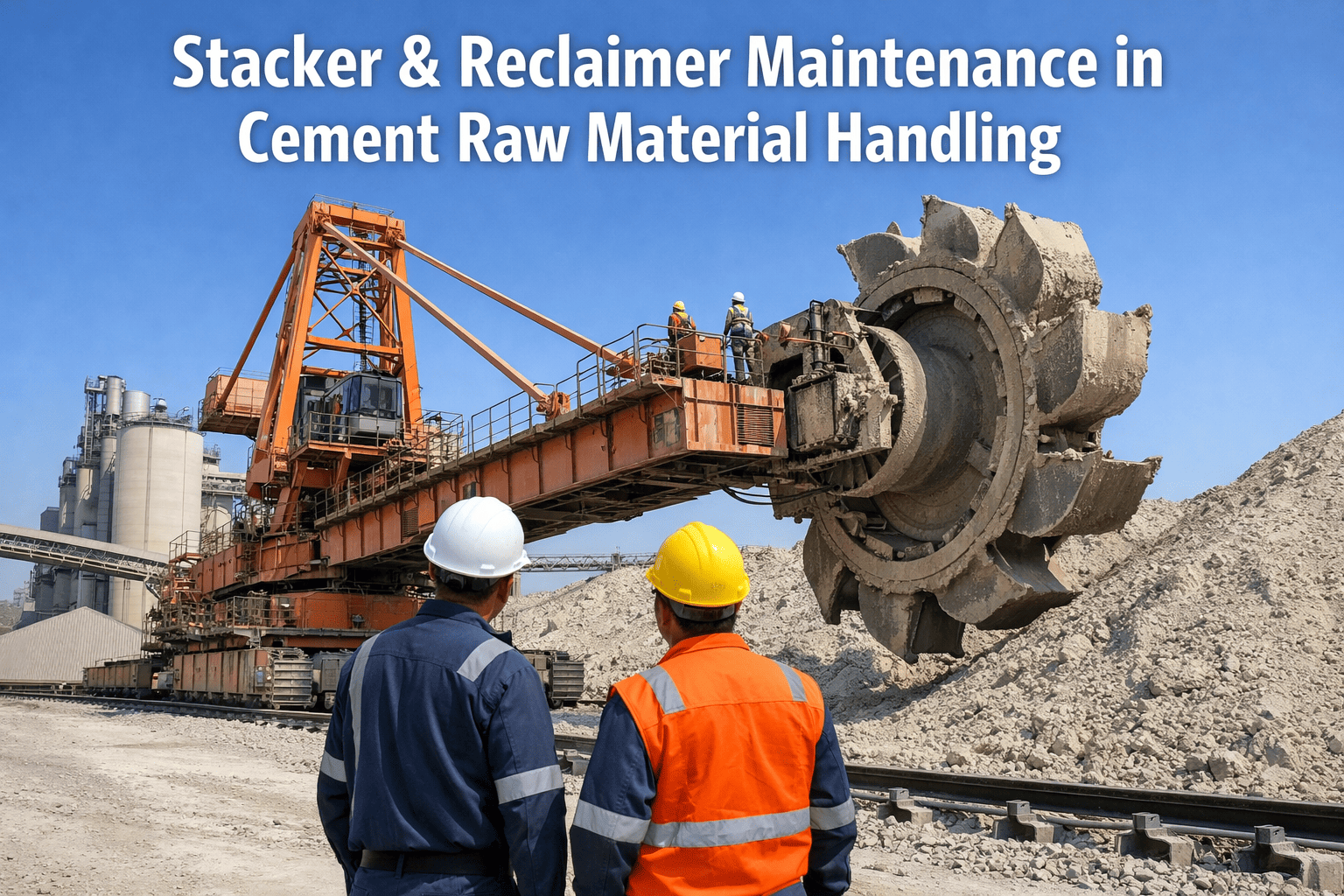
A slewing drive pinion wear failure on a circular blending bed reclaimer — undetected because the last vibration reading was taken 11 weeks past its scheduled date — forced an unplanned 72-hour shutdown at a Southeast Asian cement plant during peak production season. The repair cost was $280,000. The clinker inventory impact was $1.1 million in lost production. The root cause was not metallurgical. It was a missed PM interval that no system escalated and nobody noticed. Stacker-reclaimer equipment carries some of the highest replacement cost of any cement plant asset — typically $2M to $8M per machine — yet it is routinely the least systematically maintained equipment in the raw material handling circuit. Book a demo to see how Oxmaint structures stacker-reclaimer PM programs, alignment tracking, and condition monitoring across your raw material handling operation.
Stacker-reclaimer maintenance in cement raw material handling requires systematic PM tracking for five high-consequence mechanical systems: bucket wheel gearbox and bearings, slewing drive and ring gear, boom conveyor belt and idlers, travel drive and rail system, and lubrication circuits for all rotating components. Oxmaint manages the complete PM schedule, alignment check records, oil sample tracking, vibration trending, and wear measurement history for each machine — preventing the missed intervals that turn predictable mechanical wear into unplanned production stops.
The Five Mechanical Systems That Determine Stacker-Reclaimer Reliability
Each system fails differently and requires different PM disciplines. Managing all five from a single Oxmaint machine record ensures no interval slips between systems, across shifts, or across maintenance teams. Book a demo to see how Oxmaint builds the PM structure for your specific stacker-reclaimer configuration.
Every PM Interval. Every Oil Sample. Every Vibration Reading. Tracked in Oxmaint — Not in Your Technician's Memory.
Oxmaint generates stacker-reclaimer PM work orders at the correct interval for each mechanical system, routes them to the right technician, captures condition readings on mobile at the machine, and trends the data across every inspection cycle. Book a demo to see stacker-reclaimer PM templates configured for your machine make and model.
Oxmaint Stacker-Reclaimer Maintenance — Implementation Roadmap
A four-phase deployment structures your stacker-reclaimer from ad-hoc maintenance to a fully scheduled, condition-monitored PM program — without disrupting raw material handling operations during implementation.
Each stacker-reclaimer registered in Oxmaint with its full component tree — bucket wheel assembly, slewing mechanism, boom conveyor system, travel system, and lubrication circuits. Manufacturer-specified PM intervals loaded per component. Existing oil analysis and vibration data imported from spreadsheets to populate baseline condition history immediately.
Work order templates built per PM type — lubrication rounds, vibration readings, alignment checks, oil sampling, visual inspection checklists — each with the specific data fields required: vibration reading in mm/s, oil sample reference number, backlash measurement in mm, belt tension value. Field technicians access PM work orders via machine QR code on mobile — entering condition data at the machine, not in the control room later. Book a demo to see mobile PM data capture for stacker-reclaimer vibration and lubrication rounds.
Oxmaint's condition monitoring dashboard activated — slewing drive backlash trend, bucket wheel gearbox vibration velocity trend, oil analysis contamination index, and lubrication circuit pressure history displayed per machine. Alert thresholds configured per manufacturer specification: escalation to reliability engineer when bucket wheel bearing vibration exceeds 4.5 mm/s, or slewing ring backlash exceeds 3mm above baseline.
Condition trend data from Oxmaint feeds the planned shutdown scheduler — bucket wheel gearbox oil change, slewing ring lubrication, and travel rail inspection windows coordinated with kiln shutdown intervals to minimize raw material handling downtime. Component remaining useful life projections from wear trends feed the CapEx planning module with evidence-based replacement windows for major stacker-reclaimer components.
Regional Safety and Equipment Compliance Coverage
Stacker-reclaimer equipment operates under both equipment safety regulations and bulk materials handling industry standards — which vary significantly by jurisdiction. Oxmaint pre-configures inspection templates and documentation for each regional framework.
| Region | Primary Regulatory Frameworks | Key Stacker-Reclaimer Requirements | Oxmaint Coverage |
|---|---|---|---|
| USA / Canada | OSHA 29 CFR 1910.147 LOTO, MSHA 30 CFR Part 56 (surface mining), ASME B20.1 safety standard for conveyors, CEMA conveyor standards, CSA B167 overhead travelling cranes (Canada) | LOTO energy isolation documentation for all maintenance activities on powered stacker-reclaimer systems, MSHA inspection records for quarry-adjacent machines, ASME B20.1 conveyor safety inspection records for boom conveyors | LOTO isolation checklist per stacker-reclaimer component, MSHA surface inspection record management, ASME B20.1 conveyor inspection scheduling, OSHA-compliant confined space permits for bucket wheel interior access |
| Germany / EU | BetrSichV machinery safety, DGUV Rule 114-006 bulk materials handling, EU Machinery Directive 2006/42/EC, BGV D27 cranes and hoisting equipment, DIN 22112 belt conveyor standards | BetrSichV periodic safety inspection for slewing and hoisting mechanisms, DGUV 114-006 bulk handling equipment inspection records, CE marking maintenance log currency, DIN 22112 belt tension and splice inspection documentation | BetrSichV-aligned inspection scheduling for slewing and travel mechanisms, DGUV 114-006 inspection record management, DIN 22112 belt conveyor PM templates, CE marking inspection log maintenance per machine |
| UK | PUWER 1998 (Provision and Use of Work Equipment), LOLER 1998 (Lifting Operations), Conveyor Safety Group best practice guidelines, HSE bulk materials handling guidance, CDM 2015 | PUWER thorough examination records for boom slewing and lifting mechanisms at defined intervals, LOLER examination documentation for any hoisting function, Conveyor Safety Group belt inspection records for boom conveyor | PUWER and LOLER inspection scheduling with certificate tracking, Conveyor Safety Group checklist templates in Oxmaint, HSE-compliant maintenance record retention, CDM construction phase safety records during major overhauls |
| Australia | Safe Work Australia WHS Regulations, AS 1418 series crane and hoist standards, AS 1742 bulk materials handling, state mining safety regulations (NSW, QLD, WA), registered plant inspection requirements | Registered plant inspection for slewing mechanisms and lifting functions, AS 1418-aligned periodic thorough examination, state mining safety inspection records for quarry-adjacent stacker-reclaimers, plant design registration documentation | AS 1418-aligned inspection scheduling, registered plant examination record management, state WorkSafe inspection documentation, WHS regulation-compliant maintenance record system with location tagging |
| Saudi Arabia / UAE | SASO technical regulations for industrial machinery, UAE OSHAD-SF equipment safety requirements, Civil Defence inspection requirements for industrial equipment, Saudi Aramco SAES standards for bulk handling (Aramco-adjacent operations) | SASO machinery safety inspection records, OSHAD-SF equipment maintenance documentation, Civil Defence periodic inspection compliance, contractor safety management for large maintenance crews during major overhauls | SASO and OSHAD-SF aligned inspection templates, Civil Defence inspection record management, contractor safety induction tracking for major overhaul periods, multilingual mobile work orders for diverse maintenance workforces |
OSHA, BetrSichV, PUWER, AS 1418 — One PM System Covers Every Regional Requirement
For cement groups operating stacker-reclaimers across multiple countries, Oxmaint pre-configures the correct inspection templates, documentation formats, and audit exports for each jurisdiction — from the same machine record, without duplicate data entry. Book a demo to see multi-region stacker-reclaimer compliance configuration for your cement portfolio.
Oxmaint vs Competing CMMS Platforms — Stacker-Reclaimer and Raw Material Handling
Generic CMMS platforms manage work orders — they do not manage stacker-reclaimer slewing ring backlash trending, bucket wheel vibration velocity thresholds, or oil analysis contamination index tracking configured for cement raw material handling equipment.
| Equipment Capability | Oxmaint | MaintainX | UpKeep | Fiix | Limble | IBM Maximo | Hippo CMMS | Infor EAM |
|---|---|---|---|---|---|---|---|---|
| Stacker-reclaimer PM templates pre-built | Yes | No | No | No | No | Custom | No | Custom |
| Slewing ring backlash trend tracking | Yes | No | No | No | No | Custom | No | Custom |
| Vibration threshold alerts per component | Yes | Generic | Generic | Partial | Generic | Yes | Generic | Yes |
| Oil analysis sample tracking and trending | Yes | Generic | No | Partial | No | Yes | No | Yes |
| Multi-system PM per single machine record | Yes | Yes | Yes | Yes | Yes | Yes | Yes | Yes |
| Shutdown planning integration | Yes | Basic | Basic | Partial | Basic | Yes | Basic | Yes |
| LOTO documentation for large rotating machines | Yes | Generic | Generic | Partial | Generic | Yes | Generic | Yes |
| CapEx replacement forecasting from wear trends | Yes | No | No | Basic | No | Yes | No | Yes |
| Mobile offline field access at stockpile | Yes | Yes | Yes | Yes | Yes | Partial | Yes | Partial |
| Deployment without implementation consultant | Yes | Yes | Yes | Varies | Yes | No | Yes | No |
Stacker-Reclaimer Maintenance KPI Benchmarks — Cement Industry
Client Results — Cement Plants Using Oxmaint for Raw Material Handling
These outcomes are from cement plant deployments where Oxmaint's stacker-reclaimer PM program replaced unstructured maintenance records and spreadsheet tracking within the first year of operation.
From 51% to 91% PM Compliance — Before Your Next Slewing Ring Replacement Is an Emergency
The difference between a $42K planned bearing replacement and a $380K gearbox rebuild is eight months of vibration trending in Oxmaint. Your existing maintenance team, working from their phones at the stockpile, captures the condition data that makes that difference. Book a demo to see condition monitoring configured for your specific stacker-reclaimer make and model.
Oxmaint Platform Features for Stacker-Reclaimer and Raw Material Handling
Pre-built PM templates for circular blending bed reclaimers, linear stacker-reclaimers, and dedicated stackers — with component-specific intervals for all five mechanical systems and manufacturer-specified inspection criteria.
Slewing ring backlash measurements, boom alignment readings, and travel rail profile data plotted across every inspection cycle — deterioration trends visible before they reach failure thresholds.
Vibration velocity readings captured per bearing position per inspection — trend alerts escalate to reliability engineer when readings approach manufacturer alarm levels, before failure events occur.
Oil sample reference numbers, laboratory results, and contamination index tracked per gearbox — trending across sample cycles to identify increasing wear particle count before bearing or gear surface damage becomes irreversible.
Equipment-specific lockout isolation checklists for bucket wheel drive, slewing motor, travel drive, and boom conveyor — each lock captured digitally with technician identity before any maintenance work proceeds.
Remaining useful life projected per major component from wear trend velocity — slewing ring replacement windows, gearbox overhaul schedules, and boom conveyor belt replacement cycles feeding the 5-year CapEx plan.
Maintenance Outcomes: Before and After Oxmaint
| Maintenance Area | Before Oxmaint | After Oxmaint |
|---|---|---|
| PM interval tracking for all 5 systems | Separate spreadsheets per machine — 51% compliance | Unified Oxmaint schedule — 91% compliance in 90 days |
| Slewing ring backlash identification | Discovered at failure — emergency repair $280K to $680K | Trend alert at 2mm increase — planned intervention under $80K |
| Vibration reading currency | 43% of readings on schedule — rest overdue or missing | Automated work order generation keeps 98% on schedule |
| Oil sample tracking per gearbox | Samples submitted without baseline — no trend possible | Full contamination index trend per gearbox across all sample cycles |
| Unplanned shutdown frequency | Average 2.4 unplanned shutdowns per machine per year | Zero unplanned shutdowns in 12-month post-deployment period |
| Major component replacement planning | Emergency procurement at premium lead time price | 18-month advance procurement window from wear trend forecast |
| LOTO documentation for maintenance activities | Paper isolation registers — incomplete and not retrievable | Digital LOTO per work order — 100% compliance and audit-ready |
Frequently Asked Questions
Continue Reading
Connected resources in the cement plant crushing, conveying, and raw material handling cluster
Stop Reacting to Stacker-Reclaimer Failures — Start Predicting Them
Equipment-specific PM templates, slewing ring backlash trending, vibration threshold alerts, oil analysis tracking, and LOTO documentation — all live in Oxmaint within 5 to 8 weeks across your full raw material handling fleet. Book a demo with your raw material handling maintenance team and see the full PM program configured for your stacker-reclaimer make, model, and stockyard layout.