A cement plant producing 200 tons per hour generates over 2.3 million sensor data points every single day — kiln temperatures, mill feed rates, fan pressures, clinker chemistry, vibration signatures, and power consumption readings flowing continuously from hundreds of instruments across the production line. Without real-time monitoring, this data sits trapped in siloed DCS screens that only one operator sees at a time, while critical deviations go unnoticed for 4–8 hours until lab results confirm what sensors already knew. Plants implementing comprehensive real-time production monitoring systems report 60–80% reduction in unplanned downtime, 15–25% improvement in energy efficiency, and 10–15% throughput gains — translating to $2–4 million in annual savings for a typical 1.5 MTPA facility. Sign up for Oxmaint to unify your production data into a single monitoring platform that connects directly to maintenance workflows.
2.3M+
sensor readings per day in a typical cement plant
4–8 hrs
average detection delay without real-time integration
65–75%
OEE at most plants — world-class target is 85%+
$50K–$200K
cost of a single unplanned kiln stop event
This guide covers the complete architecture of real-time production monitoring for cement manufacturing — from the sensor layer through data integration, dashboard visualization, alert management, and the closed-loop maintenance workflows that convert monitoring signals into prevented failures and sustained performance gains.
The Cement Production Pipeline: What to Monitor at Every Stage
Cement manufacturing follows a sequential pipeline where each stage feeds the next. A deviation at any point cascades downstream — poor raw material blending affects kiln stability, which degrades clinker quality, which forces compensating adjustments in cement grinding. Effective real-time monitoring covers every pipeline stage simultaneously, correlating upstream causes with downstream effects in a way that isolated DCS screens cannot achieve.
Crusher throughput (TPH)
Feed size distribution
Crusher power draw (kW)
Stockpile levels
Mill feed rate & SEC (kWh/t)
Raw meal chemistry (LSF, SM, AM)
Separator efficiency
Silo level & blending ratio
Burning zone temperature
Kiln drive torque & speed
Preheater cyclone temps
Free lime content (predicted)
Shell temperature profile
NOx / SO₂ emissions
Cooler grate speed
Secondary air temperature
Clinker exit temperature
Heat recovery efficiency
Mill SEC (kWh/t)
Product fineness (Blaine)
Separator cut size
Gypsum dosing rate
Packer speed & bag weight
Silo inventory levels
Truck loading rate
Quality release status
Critical Monitoring Parameters: The Data That Prevents Failures
Not every sensor reading deserves equal attention. Real-time monitoring systems must prioritize the parameters that directly predict equipment failures, quality deviations, and energy waste. The monitoring zones below organize critical parameters by the type of action they trigger — from immediate operator intervention to scheduled maintenance to process optimization. Create your Oxmaint account to access pre-configured monitoring templates with these parameters already mapped to alert thresholds and maintenance workflows.
Kiln shell temperature exceeds 350°C
Refractory failure risk — hot spot indicates lining erosion requiring immediate speed/feed adjustment
Main drive motor current spikes >120% rated
Mechanical overload — bearing seizure, gear damage, or material blockage imminent
Baghouse differential pressure exceeds limit
Emission compliance violation — blocked bags require immediate cleaning cycle or bypass
Vibration amplitude exceeds alarm level
Catastrophic bearing or structural failure approaching — equipment shutdown may be required
SEC drifts 5–10% above baseline
Grinding media wear, classifier maladjustment, or ventilation blockage developing
Clinker free lime rising above 2.0%
Under-burning in kiln — fuel feed, flame shape, or raw meal chemistry shift needs investigation
Power factor dropping below 0.90
Capacitor bank degradation or VFD harmonic issues increasing reactive power penalties
Bearing temperature trending upward
Lubrication issue or early bearing degradation — schedule inspection before next planned stop
Gradual SEC increase over 30-day trend
Equipment degradation pattern — schedule media charge, liner inspection, or classifier overhaul
Cooler efficiency declining quarter-over-quarter
Grate plate wear or airflow obstruction developing — plan for next major shutdown window
Compressed air leak rate increasing
Cumulative leak development — schedule ultrasonic leak survey during next maintenance window
OEE: The Master Metric for Production Monitoring
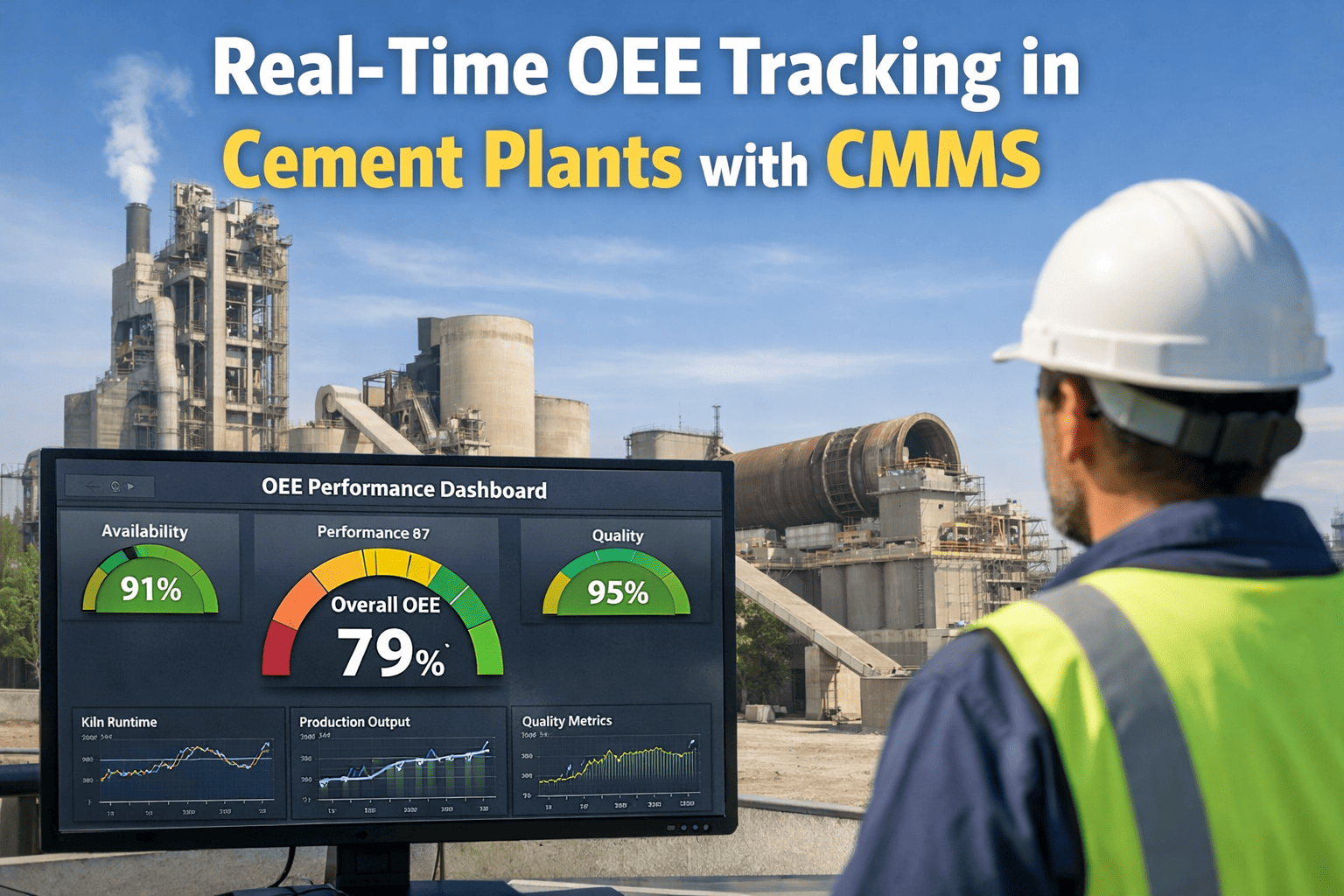
Overall Equipment Effectiveness (OEE) is the single most comprehensive production metric, combining availability, performance, and quality into one number that reveals exactly how much of your plant's theoretical capacity you are actually capturing. Most cement plants operate at 65–75% OEE, while world-class facilities achieve 85%+. Every percentage point of OEE improvement in a 1.5 MTPA plant translates to roughly 15,000 additional tons of production annually. Book a demo to see Oxmaint's automated OEE tracking configured specifically for cement plant production lines.
See Your Entire Production Line on One Screen
Oxmaint connects to your existing DCS/SCADA via OPC-UA or Modbus — no control system changes required. Pre-built cement plant templates deliver live production dashboards in days, not months, with automated OEE tracking and maintenance workflow integration.
Integration Architecture: Connecting Plant Floor to Decision-Makers
Real-time monitoring is only as reliable as the data pipeline connecting sensors to dashboards. The integration architecture must handle thousands of concurrent data streams from heterogeneous sources — PLCs, DCS controllers, smart sensors, lab instruments, and weighing systems — while maintaining sub-second latency for critical process parameters and ensuring data integrity across the entire chain.
FIELD LAYER
Temperature Sensors
Vibration Probes
Power Analyzers
Flow Meters
Pressure Transmitters
Weighbridges
Gas Analyzers
Lab LIMS
CONTROL LAYER
DCS / SCADA Systems
PLC Controllers
Motor Control Centers
Safety Instrumented Systems
ANALYTICS & CMMS
Data Historian
AI/ML Analytics
Alert Engine
Work Order System
Reporting Engine
USER LAYER
Control Room Displays
Mobile Devices
Management Dashboards
Automated Email Reports
From Alert to Action: The Closed-Loop Monitoring Workflow
The highest-value capability of any real-time monitoring system is its ability to automatically convert detected anomalies into assigned, trackable maintenance actions. Without this closed-loop connection between monitoring and execution, dashboards become passive display screens that operators eventually ignore. Plants running integrated downtime reduction strategies through their CMMS sustain monitoring benefits 3x longer than those relying on alerts alone.
1
Detect
Sensors capture anomaly. Analytics engine compares against thresholds and trend baselines. Anomaly confirmed within 1–5 seconds.
→
2
Alert
Severity-classified notification sent to operator dashboard, maintenance lead mobile device, and shift supervisor simultaneously.
→
3
Work Order
CMMS auto-generates investigation work order with equipment ID, parameter readings, suggested actions, and assigned technician.
→
4
Resolve & Verify
Technician completes corrective action. Dashboard confirms parameter returned to normal. Savings quantified and logged against work order.
Key Production KPIs for Real-Time Dashboards
Beyond OEE, cement plants should track a focused set of production KPIs on their real-time dashboards — each directly tied to an action when it drifts outside acceptable range. Linking your KPI dashboards to structured efficiency tracking frameworks ensures every metric drives a specific decision rather than just occupying screen space.
0.73–0.85
ratio target
Clinker-to-cement ratio determines both cost and carbon intensity. Every 0.01 reduction saves $3–5/ton. Real-time tracking prevents drift above target by alerting SCM dosing adjustments.
700–750
kcal/kg clinker
Specific heat consumption of kiln system. Rising trend indicates preheater inefficiency, excess false air, or deteriorating burner performance requiring maintenance inspection.
>92%
target uptime
Percentage of scheduled time that mills actually operate. Below target signals unplanned stops from mechanical failures, feed blockages, or overheating trips.
>1.33
minimum target
Process Capability Index measuring consistency within spec limits. Below 1.0 means process cannot reliably hold spec. Track for 28-day strength, fineness, and SO₃ content.
<2
events/month
Count of unplanned production stops per month. Each kiln stop costs $50K–$200K. Predictive monitoring targets zero unplanned stops by catching failures 24–72 hours in advance.
vs. rated
capacity %
Actual tons per hour compared to nameplate capacity. Running consistently below 85% indicates bottleneck in feed preparation, kiln throughput, or grinding circuit needing diagnosis.
Implementation Timeline: From Legacy Plant to Connected Operations
Implementing real-time production monitoring does not require replacing your existing control systems. Modern monitoring platforms layer on top of existing DCS/SCADA infrastructure using standard industrial protocols, reading data without writing to control systems. Start with Oxmaint's free plan to connect your first dashboard within days, then expand sensor coverage as demonstrated value builds the case for full deployment. Schedule a demo to see the phased implementation template pre-configured for cement manufacturing operations.
Phase 1
Weeks 1–4
Connect & Baseline
Audit existing metering and sensor infrastructure across all process areas
Establish DCS/SCADA data connection via OPC-UA — zero control system modifications
Deploy first operator dashboard with top 6 production KPIs
Capture 30-day baseline for alarm threshold configuration
Phase 2
Weeks 5–10
Expand & Automate
Add individual equipment monitoring for top 15 critical assets
Integrate lab quality data (LIMS connection) for real-time quality overlay
Deploy maintenance dashboard with auto-generated work orders on alert triggers
Configure role-based views for operators, maintenance leads, and management
Phase 3
Weeks 11–16
Optimize & Predict
Enable AI-powered predictive analytics for kiln, mills, and critical rotating equipment
Deploy management dashboards with OEE, cost/ton, and carbon intensity reporting
Automated daily/weekly performance reports distributed via email
Establish continuous improvement cadence with quarterly benchmark recalibration
Every Sensor. Every Parameter. One Platform.
Oxmaint unifies your DCS, SCADA, power meters, lab systems, and maintenance workflows into a single real-time monitoring platform built for cement operations. Detect deviations in seconds, auto-generate work orders, and track every improvement to your bottom line.
Frequently Asked Questions
How quickly can real-time production monitoring be deployed in an existing cement plant?
Most plants can have a functional production monitoring dashboard operational within 2–4 weeks using existing DCS/SCADA data connections via OPC-UA or Modbus protocols. No control system modifications or production shutdowns are required. Full deployment with predictive analytics, quality integration, and automated maintenance workflows typically takes 12–16 weeks depending on existing sensor coverage and data infrastructure maturity.
What data refresh rate is needed for cement plant production monitoring?
Critical process parameters (kiln temperatures, motor currents, vibration) should refresh every 1–5 seconds for real-time operator decisions. Production throughput and SEC calculations typically update every 1–5 minutes. Quality metrics from lab integration update as results become available (typically every 1–2 hours for XRF analysis). Management KPIs like OEE and cost/ton refresh hourly or daily depending on reporting needs.
Can real-time monitoring integrate with our existing DCS without modifications?
Yes. Modern monitoring platforms connect to existing DCS and SCADA systems using standard OPC-UA and Modbus TCP/RTU protocols as read-only connections. This means data is extracted without writing to control systems, requiring no modifications to existing automation infrastructure. The integration involves configuring data tags and mapping them to dashboard widgets — typically completed during the first 1–2 weeks of deployment.
What is the typical ROI from implementing real-time production monitoring?
Cement plants implementing comprehensive real-time monitoring typically see ROI within 6–12 months. Documented benefits include 60–80% reduction in unplanned downtime, 15–25% reduction in energy costs, 10–15% improvement in production throughput, and 20–30% reduction in quality variations. Combined, these improvements translate to $2–4 million in annual savings for a typical 1.5 MTPA plant, making the monitoring system investment payback achievable within the first quarter of operation.
How does real-time monitoring help prevent unplanned kiln stops?
AI-powered monitoring analyzes hundreds of kiln parameters simultaneously — bearing temperatures, shell temperatures, drive current, refractory thermal profiles, fan vibrations — and identifies subtle patterns that precede failures, often 24–72 hours before a breakdown occurs. This gives maintenance teams time to plan a controlled shutdown, prepare parts, and execute repairs during scheduled windows rather than enduring emergency stops that cost $50,000–$200,000 per incident.
What happens when monitoring detects an issue but maintenance can't respond immediately?
The CMMS work order system tracks every alert from detection through resolution. If immediate response isn't possible, the system escalates the alert based on configured severity timelines, notifies backup personnel, and maintains a prioritized queue that ensures nothing falls through the cracks. Historical data shows that even delayed responses triggered by monitoring are significantly faster than the traditional approach of discovering problems through monthly reports or equipment failure.
How many sensors does a typical cement plant need for effective real-time monitoring?
Most modern cement plants already have 500–2,000 sensors installed across their DCS and SCADA systems. Effective real-time monitoring typically starts by connecting to these existing sensors and adding 50–150 additional IoT sensors for vibration monitoring, power analysis, and temperature measurement on equipment not currently covered by the DCS. The phased approach means you can start with existing infrastructure and add sensors based on demonstrated value from early monitoring insights.