Mold Prevention and Remediation in Schools: Maintenance Best Practices
By Jamie lanister on March 28, 2026
Mold in a school building is not primarily a cleaning problem — it is a moisture problem. Every mold colony in a classroom, corridor, or storage space has a moisture source feeding it: a slow plumbing leak that nobody reported, an HVAC condensate drain that is backing up and wetting the ceiling tile above it, a roof penetration that is allowing rainwater to track into the wall cavity, or a window seal that is letting winter condensation accumulate in the frame. Districts that respond to mold with bleach and paint are addressing the symptom; districts that deploy CMMS-tracked moisture inspection programmes are addressing the cause. OxMaint enables maintenance teams to log every moisture observation, leak report, and humidity deviation as a tracked work order — building the moisture control record that EPA and state health department guidelines recommend as the foundation of an effective school mold prevention programme, and ensuring that every moisture source is identified, repaired, and documented before it becomes a mold remediation event.
OxMaint · School Mold Prevention · Moisture Control and Remediation Intelligence
Every Moisture Source Logged. Every Leak Resolved. Every Humidity Deviation Corrected.
CMMS-powered mold prevention and remediation for schools — moisture source tracking, HVAC humidity control, leak inspection scheduling, remediation protocols, and EPA-aligned documentation from first moisture observation.
Of school mold events are preceded by an unaddressed moisture report that was logged but not resolved within 48 hours
3.1×
More mold remediation events occur in schools without CMMS-tracked moisture inspection programmes vs structured programmes
<48 hrs
Target response time for all P2 moisture reports — EPA guidance identifies 24–48 hours as the critical window before mold colonisation
100%
Digital moisture observation and remediation records — timestamped, signed, photo-evidenced — EPA-aligned documentation
How CMMS Moisture Observation and Reporting Works: Four Steps to Closed Record
The single most effective mold prevention action a school can take is dramatically shortening the time between moisture observation and repair. OxMaint turns every moisture report — roof drip, window condensation, wet ceiling tile — into a timestamped, routed work order that a technician acknowledges within minutes. Start free and deploy OxMaint moisture tracking across your district within 48 hours.
MOBILE REPORTING WORKFLOW — 4 STEPS FROM DETECTION TO CLOSED RECORD
Step
Action
Data Captured
What OxMaint Does
Time
01
Select moisture source type and location
Building, zone, room, source type — roof leak, plumbing, HVAC condensate, window, ground moisture — from pre-loaded checklist
Timestamps report. Routes to facilities team. Cross-checks location for prior moisture reports.
20 sec
02
Photograph and log visible moisture
Photo of moisture source, stain, drip, or wet material — estimated area, colour of staining, proximity to HVAC
Checks if mold is visible. If mold confirmed, auto-escalates to P1 remediation protocol. Photo attached.
25 sec
03
Tag severity and mold risk
P1 Visible Mold — Remediation Required / P2 Active Moisture — Repair Within 48 hrs / P3 Observation — Monitor
Routes P1 immediately to health officer and director. P2 queues 48-hr repair. P3 to moisture monitoring.
10 sec
04
Submit and generate moisture record
Staff digital sign-off, submission timestamp, GPS location, area measurement, mold risk assessment
Seals moisture record. Repair work order raised. If P1, remediation protocol triggered automatically.
15 sec
Works offline — reports queue locally and sync when connectivity returns. Timestamp applied at submission.
Mold and Moisture Response Framework: Three Condition Tiers, Three Intervention Paths
Visible black mold in a classroom and a single water stain on a ceiling tile from a resolved leak require completely different responses. OxMaint routes every moisture observation automatically based on health risk and EPA response timeline guidance. Book a demo to see the mold prevention framework for your school buildings.
RESPONSE FRAMEWORK — THREE TIERS, AUTOMATED ESCALATION
P1
Visible Mold — Area Closed, Remediation Required
Active mold growth confirmed. Area must close immediately. No occupancy until EPA-aligned remediation is complete and clearance testing confirms safe reoccupancy. Principal and health officer alerted within 5 minutes.
Examples
Visible mold colony in classroom · Mold on HVAC components · Mold behind wall surface · Musty odour + visible growth · Water-damaged ceiling tile with growth
Alert time<5 min
Area actionClose immediately
WO priorityP1
P2
Active Moisture — Repair Within 48 Hours
Moisture source confirmed but no visible mold. EPA guidance identifies 24–48 hours as the critical window before mold colonisation in warm conditions. Repair and drying required within 48 hours.
Examples
Roof drip onto ceiling tile · Plumbing joint seeping · HVAC condensate overflow · Window seal leak · Ground moisture under floor · Wet wall from pipe
Alert time<2 hrs
Area actionRepair within 48 hrs
WO priorityP2
P3
Observation — Monitor and Inspect
Moisture indicator observed but no active source confirmed. Staining from a resolved leak, humidity slightly elevated, or prior moisture area being monitored. Logged and scheduled for follow-up inspection.
Examples
Historical water stain — dry · Humidity 60–65% RH · Minor window condensation · Slight musty odour — no visible mold · Previously repaired leak area
Alert timeNext inspection
Area actionMonitor + inspect
WO priorityP3
Most Common School Mold and Moisture Sources: Where Prevention Investment Delivers the Highest Return
MOISTURE SOURCE CATEGORY FREQUENCY — % OF ALL SCHOOL MOLD EVENTS · EPA/CDC DATA 2024–25
Category
Share of Reports
Freq.
% P1
Action
HVAC Condensate & Humidity
30%
42% P1
Quarterly condensate drain inspection
Roof Leak / Penetration
26%
55% P1
Annual + post-storm roof inspection
Plumbing Leak
20%
35% P1
Semi-annual pipe and joint inspection
Window / Door Seal Failure
12%
22% P1
Annual seal and glazing inspection
Ground / Foundation Moisture
8%
28% P1
Annual drainage and grading review
Poor Ventilation / IAQ
4%
18% P1
Quarterly IAQ + CO2 monitoring
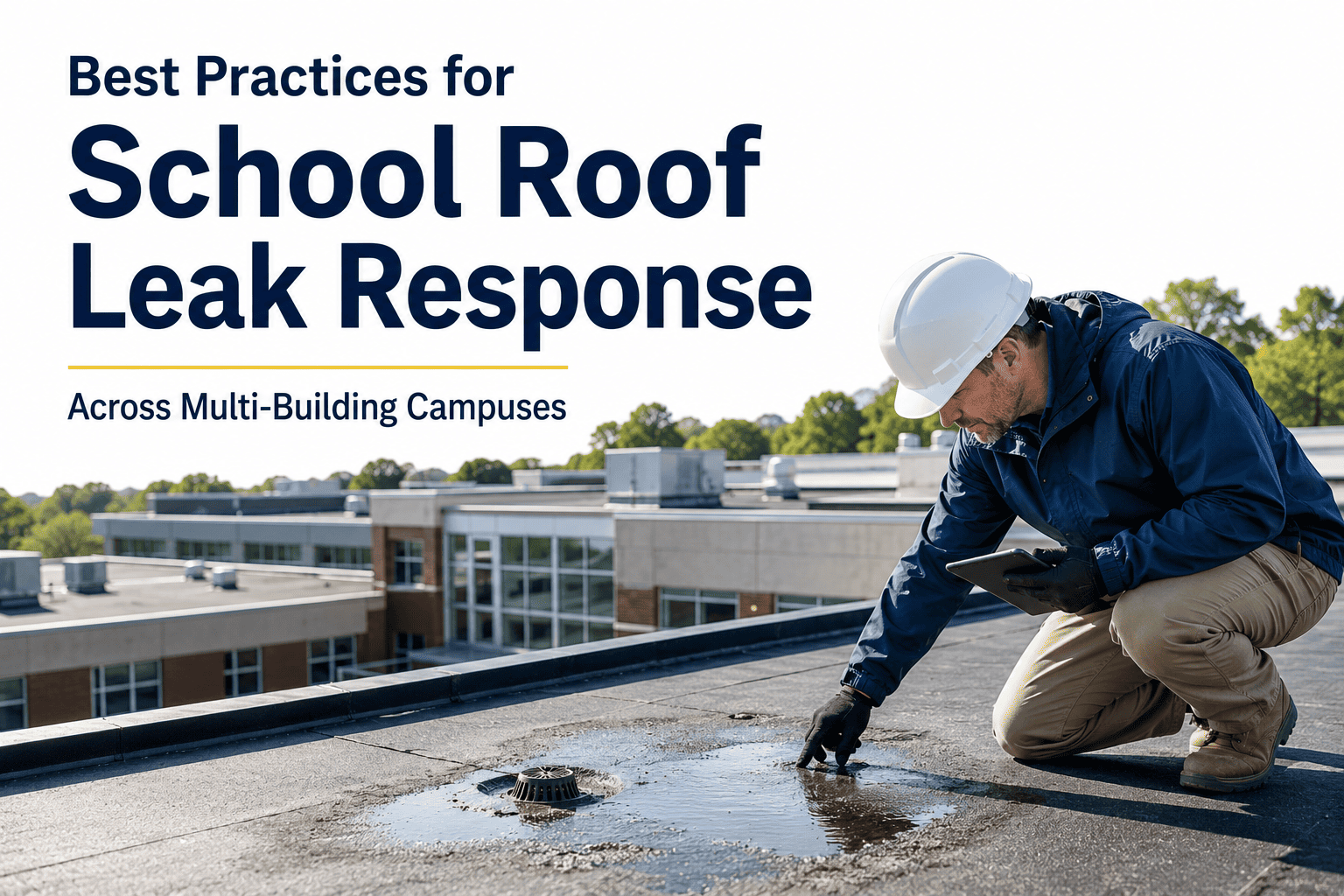
Roof leaks carry a 55% P1 escalation rate — rainwater entry through a deteriorated roof membrane or flashing is the fastest route from moisture observation to confirmed mold growth if not addressed within 24–48 hours.
From Moisture Report to Cleared Remediation Record: The Full Mold Prevention Lifecycle
A moisture report that is logged but not followed up within 48 hours has a significantly higher probability of becoming a mold event requiring remediation, area closure, and parent communication. OxMaint tracks every moisture report from first observation to repaired source, dried materials, and cleared record. Start free — closed-loop moisture tracking from day one.
INCIDENT LIFECYCLE — FROM REPORT TO CLOSED COMPLIANCE RECORD
Stage
P1 Critical
P2 Scheduled
P3 Routine
Who Receives
01
Moisture Detected
Immediate — staff observation
Patrol or routine inspection
Sensor threshold or schedule
Building record + maintenance team
02
Alert Fired
Push + SMS to health officer + director
Dashboard alert within 2 hrs
Next inspection summary
Health officer · Facility director
03
Work Order Raised
Auto-generated P1 — remediation protocol
P2 repair WO — 48-hr deadline
P3 inspection WO — next cycle
Maintenance technician mobile app
04
Source Repaired / Area Dried
Remediation contractor + drying — P1
Source repaired + drying verified
Inspection confirms dry — logged
Technician / contractor sign-off
05
Clearance Testing
Air/surface clearance — post-remediation
Moisture meter confirms dry
Follow-up inspection — clear
Health officer / inspector sign-off
06
Record Sealed
Full remediation record — exportable
Repair + drying record — sealed
Observation record — archived
Director compliance dashboard
Technology Integration: IoT Humidity Sensors, AI Camera, Digital Twin, SAP, and PM Scheduling
Moisture that is detected early costs a few hundred dollars to fix. Moisture that develops into a mold event costs tens of thousands in remediation, testing, and liability management. Technology integration shifts the balance toward early detection. Connect all moisture monitoring layers through OxMaint.
HOW EACH TECHNOLOGY ENHANCES THE MP PROGRAMME
IoT Sensors
Continuous Humidity and Moisture Monitoring
Temperature, relative humidity, and contact moisture sensors in high-risk zones — bathrooms, mechanical rooms, portable classrooms, basement corridors — push real-time readings to OxMaint, triggering P2 work orders automatically when RH exceeds 65%.
Humidity above 65% RH triggers P2 work order automatically
AI Camera
Ceiling and Wall Condition Monitoring
Cameras monitor ceiling tile colour change, wall surface staining, and window frame condition — automatically flagging developing moisture stains between inspection cycles without walkaround checks.
Moisture stain development detected automatically
Digital Twin
Building Moisture Risk Mapping
Virtual building model maps all prior moisture reports, current humidity readings, and roof/plumbing vulnerability zones — giving facility directors a moisture risk heat map that prioritises inspection effort.
Moisture risk heat map per building and zone
SAP / ERP
Remediation Cost and Insurance Tracking
Every remediation work order writes contractor cost, affected area, and clearance test result to SAP — mold remediation spend tracked at building level for capital planning, insurance claims, and deferred maintenance prioritisation.
Full remediation cost to ERP for insurance and capital planning
HVAC PM
Humidity Control Maintenance Scheduling
HVAC filter changes, condensate drain flushes, humidistat calibrations, and ERV/HRV inspections are scheduled as recurring PM tasks — ensuring the HVAC system is maintaining indoor RH below the EPA-recommended 60% threshold year-round.
HVAC PM scheduled to maintain RH below 60% year-round
Roof Inspection
Post-Storm and Annual Roof Inspection Scheduling
Annual roof inspections and post-storm condition checks are pre-loaded in OxMaint — the single highest-ROI moisture prevention activity for school buildings is catching roof penetrations and flashing failures before the next rain event.
Post-storm roof inspection auto-triggered within 24 hours
"We had six mold events in three years before OxMaint — every one started with a moisture report that sat in someone's email for a week. Since deploying OxMaint's moisture tracking, we have had zero mold events requiring area closure in 22 months. The key was the 48-hour escalation on P2 moisture reports — it made the difference between a £200 repair and a £25,000 remediation.",
Deputy Director of Estates and Facilities
Castleford Academy Trust — 12 Schools · Yorkshire, England
Frequently Asked Questions
Q1What is the EPA-recommended response time for moisture reports in schools?
EPA guidance recommends that visible mold be remediated within 24–48 hours of detection, and that active moisture sources be repaired and affected materials dried within the same window to prevent mold colonisation. OxMaint's P2 tier enforces this 48-hour response deadline automatically. Book a demo to see moisture tracking in action.
Q2How does OxMaint track HVAC-related humidity control as part of mold prevention?
HVAC condensate drain inspections, humidistat calibrations, and filter replacement cycles that affect IAQ are all managed as scheduled PM work orders in OxMaint — with humidity threshold alerts that fire automatically when indoor RH exceeds 60%.
Q3Can OxMaint generate the documentation required for mold remediation clearance reporting?
Yes. OxMaint generates a complete remediation record including moisture source identification, repair work order, drying protocol confirmation, clearance test results, and inspector sign-off — all exportable as a PDF for health department and insurance review.
Q4How does OxMaint identify which buildings have the highest unresolved moisture risk?
OxMaint's building-level moisture report dashboard shows open P2 and P3 moisture work orders per building, historical resolution times, and repeat-moisture-source locations — enabling facility directors to target inspection and repair resources at the highest-risk buildings.
Q5Can OxMaint track portable classroom moisture separately from permanent building moisture?
Yes. Portable classrooms are registered as separate assets in OxMaint with their own moisture inspection schedule — skirting, underpinning, roof seams, and HVAC condensate are all tracked per unit with dedicated moisture work order history. Start your free trial.
Q6Does OxMaint track staff awareness and communication requirements for confirmed mold events?
Yes. When a P1 mold event is confirmed, OxMaint generates a notification log entry — tracking who was notified (principal, health officer, parents), when, and through which communication channel — creating the documentation record required by EPA guidance and state health regulations.
Every Moisture Source Found. Every Leak Repaired Within 48 Hours. Every Building Mold-Free.
CMMS-powered moisture control and mold prevention — deployed across your district in one day.



.png)


