Robot Fleet Management for Facility Operations: Getting Started Guide
By John Polus on March 30, 2026
Robot deployment in commercial facilities is accelerating faster than the maintenance programs needed to keep those robots operational. A cleaning robot that stops mid-shift because a sensor error was not caught during preventive maintenance, a security robot whose mapping data went stale during a firmware update, a delivery robot whose battery health was never tracked until it failed between floors — these are not hypothetical scenarios. They are the operational reality at facilities where robots were purchased without a fleet management program. Robot fleet management is not an option for facilities that deploy autonomous machines; it is the operational foundation that determines whether the capital investment delivers its intended ROI or produces a new category of unplanned downtime. Book a demo to see how Oxmaint's Robot Fleet Health Console integrates robot operations into your existing CMMS and asset hierarchy.
AI and Automation9-11 min read
$6.2B
global facility robot market by 2028, growing at 14.8% CAGR driven by cleaning, security, and logistics automation in commercial real estate
43%
of facility robots in commercial deployments experience at least one unplanned operational stop per month from preventable maintenance gaps
3.1x
higher total cost of robot ownership for facilities without a structured fleet management program versus those with PM-integrated robot operations
91%
robot uptime rate achievable with CMMS-integrated fleet health monitoring versus 74% average for facilities managing robots without structured PM programs
Quick Answer
Robot fleet management in facility operations is the structured system for deploying, monitoring, scheduling preventive maintenance on, and optimizing the operational performance of autonomous machines across commercial buildings — cleaning robots, security patrol robots, and delivery or logistics robots. Effective robot fleet management requires integration between robot telemetry data and the facility CMMS: PM work orders triggered by robot operating hours or condition readings, anomaly alerts routed to the maintenance team, fleet health dashboards updated in real time, and robot maintenance history linked to the same asset registry as every other facility asset.
Facility Robot Types and Their Maintenance Profiles
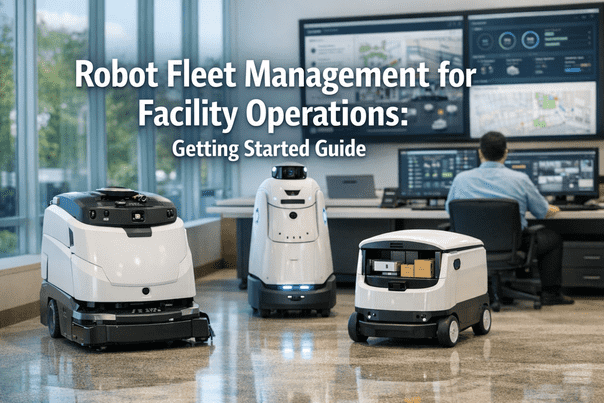
Three robot categories account for the majority of commercial facility deployments in 2026. Each category has distinct maintenance requirements, failure modes, and operational dependency profiles that determine how fleet management must be structured. Managing a cleaning robot fleet with the same inspection frequency as a security patrol robot fleet will produce incorrect PM intervals for both.
Autonomous Cleaning Robots
Floor scrubbers, vacuum robots, and window-cleaning systems operating on scheduled cleaning routes. Highest PM frequency of all facility robot categories due to brush wear, filter loading, and battery cycle accumulation in daily continuous-use operations.
Brush wear monitoringFilter replacement cyclesBattery health trendingSensor cleaning intervals
Daily
operational hours
2-4 wks
typical brush PM
74%
battery failures: top cause
Security Patrol Robots
Autonomous security patrols covering parking structures, building perimeters, and interior zones on configurable routes. Camera and sensor array maintenance, map data currency, and drive system condition determine operational reliability in 24-hour continuous deployment.
Camera lens cleaningMap data updatesDrive motor conditionFirmware currency
24/7
continuous operation
Monthly
map audit interval
38%
stops from stale map data
Delivery and Logistics Robots
Internal mail, medication, or supply delivery robots operating in healthcare, hospitality, and office environments. Elevator integration, obstacle detection system accuracy, and payload compartment integrity are the maintenance priorities governing operational safety and throughput.
Elevator integration PMObstacle sensor calibrationPayload integrity checksRoute certification
100+
trips per day typical
Quarterly
sensor calibration
61%
stops from elevator issues
Why Unmanaged Robot Fleets Fail: Four Structural Gaps
Robot fleets fail at the operational level — not the technology level — because the facility management infrastructure that supports human-operated equipment is not extended to autonomous machines. The robots are purchased, deployed, and then treated as self-managing systems until a failure event reveals the absence of the maintenance foundation that was never built.
01
No Asset Records in the CMMS
Robots are capital assets with service histories, component replacement schedules, firmware versions, and warranty timelines. When they exist outside the CMMS asset registry, maintenance history is untracked, PM intervals are never scheduled, component replacement is reactive, and warranty claims are impossible to support with documentation. A cleaning robot fleet of 12 units operating without asset records is functionally identical to a building with 12 HVAC units that have never had a work order raised — the maintenance gap accumulates invisibly until failure rates make it impossible to ignore.
02
PM Intervals Not Calibrated to Operating Hours
Robot PM intervals must be triggered by operating hours, cleaning cycles, or distance traveled — not by calendar date. A cleaning robot operating 14 hours per day needs brush replacement at 6-week calendar intervals to match the 500-hour OEM specification. The same robot operated 6 hours per day needs 14-week calendar intervals. Applying a single calendar-based PM schedule to a robot fleet with variable operating hours guarantees over-maintenance on low-utilization units and critical under-maintenance on high-utilization units simultaneously.
03
Fleet Health Data Sits in Vendor Portals
Robot manufacturers provide fleet health data through proprietary vendor portals: battery state-of-health, sensor error counts, motor current draw, and operational stop logs. This data is available but siloed from the facility CMMS. The result: maintenance teams have no visibility into battery degradation trending until runtime drops below threshold, sensor error rates spike before anyone notices, and motor current anomalies go unlogged until bearing failure occurs. Fleet health data must flow from vendor APIs into the CMMS where maintenance teams operate, not sit in a separate portal that requires vendor-specific login to access.
04
Anomaly Alerts Go to Vendor Support, Not Facility Maintenance
Most robot anomaly alerts route to the robot vendor's support system, not to the facility maintenance team that can physically respond. When a robot stops mid-route due to a sensor error, the vendor receives a telemetry alert and opens a remote support ticket while the facility maintenance supervisor has no visibility and no work order. Integrating anomaly alerts into the facility CMMS work order system closes this gap: every robot error event creates a work order in the maintenance team's existing queue with the asset ID, error code, and physical location attached.
Integrate Your Robot Fleet into Your Facility CMMS in 14 Days
Oxmaint's Robot Fleet Health Console connects to cleaning, security, and delivery robot APIs and places fleet health monitoring, PM scheduling, and anomaly alerts inside your existing CMMS workflow. Start free or book a demo to see robot fleet integration configured for your robot brands today.
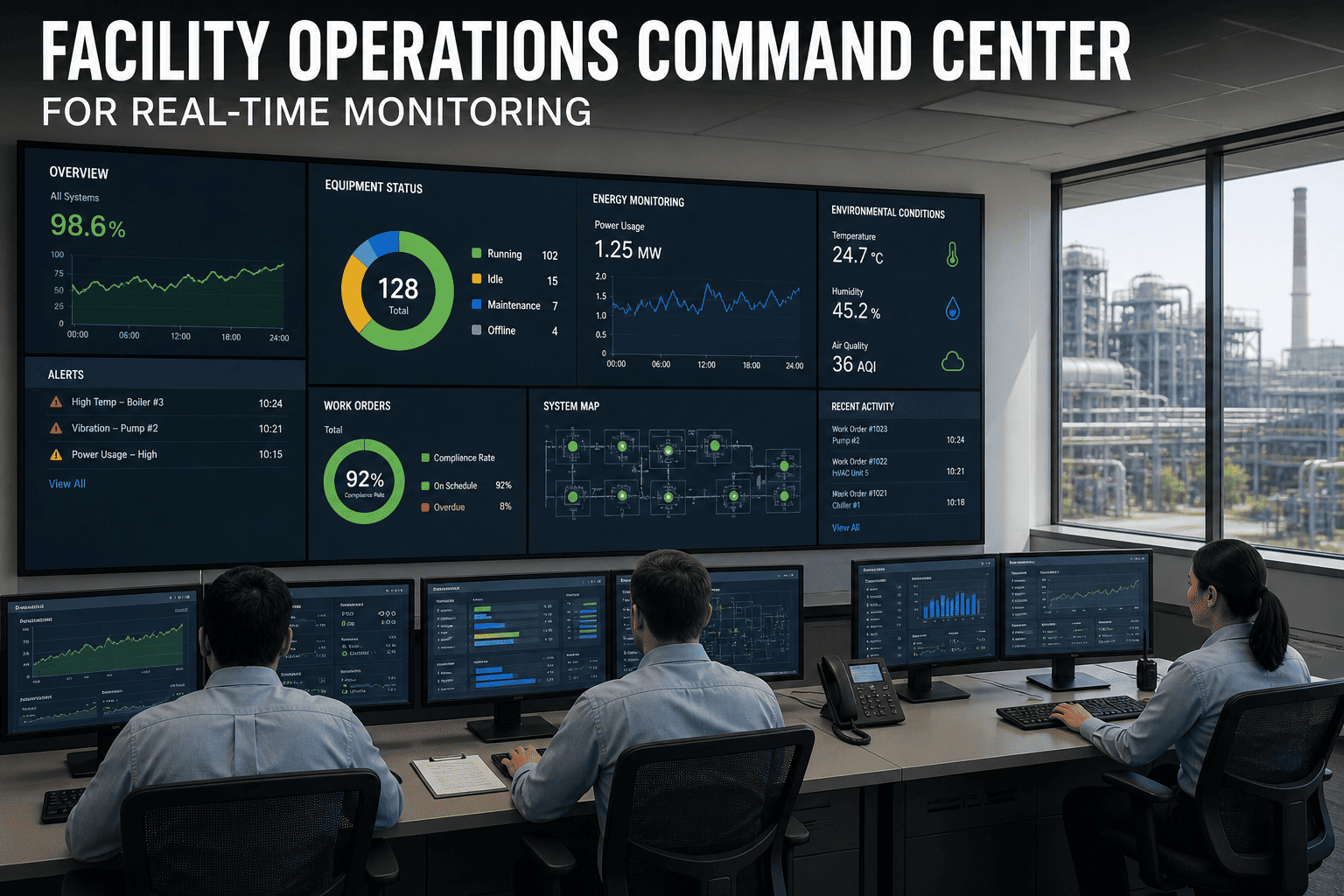
Oxmaint's Robot Fleet Health Console extends the standard CMMS asset management framework to include robot-specific data streams — operating hours, battery state-of-health, sensor error rates, route completion percentages, and firmware version tracking — integrated into the same dashboard where facility managers monitor HVAC performance, work order queues, and inspection compliance.
Fleet Health
Real-Time Fleet Health Dashboard
Fleet Health Monitoring Across Every Robot in the Portfolio
Every robot in the fleet appears as an asset on the Oxmaint dashboard with live operational status, battery state-of-health percentage, active error codes, and cumulative operating hours since last PM. Fleet managers see at a glance which robots are operating normally, which have active anomalies requiring attention, and which are approaching PM thresholds — without logging into any vendor portal or receiving a vendor support email.
Fleet health scores aggregate from individual robot metrics to a fleet-level health index by building and by robot category. Portfolio managers comparing robot fleet health across multiple buildings access the same single-screen view as every other facility asset class in the Oxmaint dashboard.
PM Scheduling
Hour-Based PM Scheduling
PM Work Orders Triggered by Robot Operating Hours, Not Calendar Date
Oxmaint receives operating hour telemetry from each robot's API and triggers PM work orders when the robot reaches configured hour thresholds — not on calendar dates that ignore actual utilization. A cleaning robot approaching 480 hours of operation receives an automatic PM work order for brush inspection and battery health check 20 hours before the 500-hour interval, giving the maintenance team time to plan around cleaning schedules rather than responding reactively.
PM templates for each robot model include the correct component checks, replacement parts, and expected service duration based on the robot manufacturer's specifications, with interval adjustments for operating environment factors such as extended-hour shifts or high-debris cleaning zones that accelerate brush wear beyond standard OEM projections.
Anomaly Detection
Anomaly Alert Routing
Robot Anomaly Alerts Routed as CMMS Work Orders to Maintenance Teams
When Oxmaint detects an anomaly in robot telemetry — battery discharge rate outside normal range, sensor error count exceeding the alert threshold, motor current draw elevated beyond specification, or route completion rate declining across multiple shifts — it creates a work order automatically in the maintenance team's queue with the robot's asset ID, error classification, physical location, and operational status attached.
Anomaly thresholds are configurable per robot model and operating environment. A security robot operating in a 24-hour continuous deployment has different alert thresholds than a delivery robot operating on a 10-hour shift. Maintenance teams never need to check vendor portals to know their robot fleet's health status — the information comes to them as standard CMMS work order alerts.
Asset Registry
Robot Asset Registry
Every Robot as a Tracked Asset with Full Maintenance History
Each robot is registered in the Oxmaint asset hierarchy under its building and floor, with manufacturer specifications, serial number, firmware version, warranty expiry, and complete work order history linked to the asset record. Replacement components — brushes, filters, batteries, sensors — appear in the inventory module with stock levels and reorder triggers configured to each robot model's consumption rate.
QR tags on each physical robot unit allow maintenance technicians to access the robot's complete asset record, open service history, and current PM checklist from a mobile device scan — without navigating to a vendor platform. All maintenance performed on the robot is logged against the asset record, building the documentation trail needed for warranty claims, insurance requirements, and capital replacement planning.
Robot PM Scheduling Framework by Robot Category
These PM intervals reflect OEM specifications adjusted for commercial facility operating conditions. High-utilization deployments require shortened intervals in the component categories most sensitive to duty cycle — particularly battery systems, wear components, and sensor arrays in environments with elevated dust or debris levels.
PM Component
Cleaning Robots
Security Robots
Delivery Robots
Oxmaint Trigger
Battery state-of-health check
Every 250 hours
Every 500 hours
Every 300 hours
Hour-meter trigger from telemetry API
Brush and wear component inspection
Every 500 hours
Not applicable
Not applicable
Cleaning cycle counter or hour trigger
Sensor and camera lens cleaning
Every 2 weeks
Weekly
Every 2 weeks
Calendar interval from last completion
Obstacle detection calibration
Quarterly
Monthly
Quarterly
Calendar trigger with deviation alert
Drive wheel and motor inspection
Every 1,000 hours
Every 750 hours
Every 1,000 hours
Hour-meter trigger with current draw alert
Map data audit and update
Monthly
Monthly
After any facility layout change
Calendar trigger or facility change work order
Firmware version review
Quarterly
Monthly
Quarterly
Vendor API version check notification
Filter replacement (cleaning robots)
Every 200 hours
Not applicable
Not applicable
Hour-meter trigger, earlier in high-debris zones
Anomaly Detection: What Oxmaint Monitors and Why
Anomaly detection for robot fleets is not the same as alarm response. Alarm response is reactive: the robot stops, an alert fires, someone responds. Anomaly detection is proactive: Oxmaint identifies degradation trends in telemetry data before they reach alarm threshold and creates preventive work orders while the robot is still operational. The difference between these two approaches is the difference between planned maintenance and emergency downtime.
Monitor 01
Battery Discharge Rate Trending
Oxmaint tracks the discharge rate per operating hour for each robot's battery pack. When the discharge rate begins accelerating beyond the established baseline for that robot unit, an anomaly alert is generated. Battery health intervention at this stage — cell balancing or scheduled replacement — extends battery service life by 40% versus waiting for runtime to fall below the operational threshold before acting.
Early intervention extends battery life by 40%
Monitor 02
Motor Current Draw Elevation
Drive motor current draw that exceeds the normal operating range for a specific robot model and surface type indicates increased rolling resistance — from debris accumulation in drive assemblies, wheel wear beyond specification, or early bearing degradation. Motors running at elevated current draw will reach thermal shutdown before the duty cycle completes, causing mid-shift operational stops that are preventable with a 20-minute drive assembly inspection.
Prevents mid-shift thermal shutdowns
Monitor 03
Route Completion Rate Decline
A cleaning robot whose route completion rate drops from 97% to 88% over two weeks is experiencing an operational problem — obstacle detection sensitivity drift, map data that no longer matches floor layouts, or debris accumulation on LIDAR sensors. Route completion trending surfaces these degradation patterns before they reach the threshold where the robot stops completing its assigned zone, producing a cleaning quality failure that triggers tenant complaints.
Prevents cleaning quality failures and tenant complaints
Monitor 04
Sensor Error Rate Escalation
All robot sensor systems generate error events. An obstacle avoidance system encountering a chair in an unexpected position generates an error that clears itself. The same system generating 40 errors per hour where it previously generated 3 indicates a sensor calibration drift, contamination, or component failure that requires intervention before the error rate reaches the threshold where the robot's safety system halts operation and requires manual reset to resume.
Prevents safety-triggered operational halts
Before and After: Robot Fleet Management Transformation
Without Robot Fleet Management
X74% average robot uptime. Unplanned stops occur at 43% monthly frequency from preventable maintenance gaps in battery health, sensor calibration, and brush wear that were never tracked
XPM intervals based on vendor calendar recommendations, not operating hours. High-utilization robots reach wear component failure before the next scheduled service; low-utilization robots are over-serviced at unnecessary cost
XFleet health data visible only in vendor portals. Maintenance teams have no operational visibility until a robot stops or a vendor support ticket arrives, by which point the maintenance window has already passed
XRobot maintenance history separate from CMMS. No capital planning data, no warranty claim documentation, no component cost trending — total cost of ownership impossible to calculate
X3.1x higher total cost of robot ownership versus structured fleet management programs — emergency battery replacements, unplanned service calls, and shortened component life from missed PM cycles
With Oxmaint Robot Fleet Health Console
V91% robot uptime with CMMS-integrated fleet health monitoring. Anomaly detection and hour-triggered PM scheduling eliminate the preventable failure categories that account for 85% of unplanned robot stops
VPM work orders triggered by robot operating hours from telemetry API. Each robot unit receives PM at the correct interval for its actual utilization — no under-maintenance on high-utilization units, no over-maintenance on low-utilization units
VRobot fleet health data integrated into the standard CMMS dashboard. Battery health, sensor error rates, and route completion metrics visible to maintenance teams in the same interface as every other facility asset — no vendor portal login required
VEvery robot maintenance event logged against the asset record in Oxmaint. Complete work order history, component replacement records, and cost data available for warranty claims, capital planning, and fleet procurement decisions
V68% reduction in unplanned robot downtime events within 6 months. Total cost of robot ownership reduced by eliminating emergency service premiums, extending component life through correctly timed PM, and preventing battery replacements through early health intervention
91% Robot Uptime. Fleet Health Monitoring Inside Your CMMS.
Oxmaint's Robot Fleet Health Console integrates cleaning, security, and delivery robot APIs into your existing CMMS with hour-triggered PM scheduling, anomaly detection work orders, and portfolio-level fleet health dashboards from day one. Start your free trial or book a 30-minute demo to see robot fleet integration configured for your robot brands today.
QWhich robot brands and manufacturers does Oxmaint's Robot Fleet Health Console integrate with?
Oxmaint integrates with the leading commercial facility robot APIs including Avidbots, Brain Corp, Cobalt Robotics, Savioke, and Ottonomy via standard REST API connections. Custom integrations for manufacturer-specific telemetry formats are available at no additional configuration fee. Book a demo to confirm integration availability for your specific robot brands.
QHow are robot PM intervals calculated if operating hour telemetry is not available from the robot API?
For robots without operating hour telemetry, Oxmaint calculates duty-cycle-adjusted PM intervals from configured shift schedules — hours per shift multiplied by shifts per week produces a reliable operating hour estimate accurate to within 8% of actual telemetry data. Hour-based triggers activate once telemetry integration is established. Start free to configure estimated-hour PM scheduling for your robot fleet from day one.
QCan Oxmaint track robot fleet costs alongside other facility maintenance costs for capital planning?
Yes. Robot work orders, component replacements, and service events are tracked with full cost data in the Oxmaint asset record — producing a complete total cost of ownership calculation per robot unit over its operational life. Fleet replacement decisions are supported by the same FCI-backed capital forecasting used for all other facility assets. Book a demo to see robot fleet capital forecasting configured for your portfolio.
QHow long does it take to deploy Oxmaint Robot Fleet Health Console across an existing robot fleet?
API integration, asset registration, and PM template configuration for a standard facility robot fleet of 4-20 units deploys in 7-14 days. The first anomaly alerts and hour-triggered PM work orders are active within 48 hours of API connection. Start free to begin robot fleet registration from your first deployment day.
68% Fewer Unplanned Robot Stops. Live in 14 Days.
Oxmaint's Robot Fleet Health Console integrates your robot fleet into the same asset hierarchy, PM scheduling engine, and maintenance dashboard as every other facility asset. No vendor portal monitoring required. No calendar-based guesswork on PM intervals. Hour-triggered PM, anomaly detection, and fleet health scoring from the first week of deployment. Start your free trial or book a 30-minute demo to see robot fleet integration for your facility type today.
Stop Monitoring Robot Fleet Health in Vendor Portals. Start Managing It in Your CMMS.
Oxmaint connects your cleaning, security, and delivery robots to your facility maintenance workflow with hour-triggered PM work orders, anomaly detection alerts, fleet health dashboards, and complete robot asset records in the same platform as every other building system. Live across your full robot fleet in 14 days. Book a 30-minute demo to see Robot Fleet Health Console configured for your robot brands today.